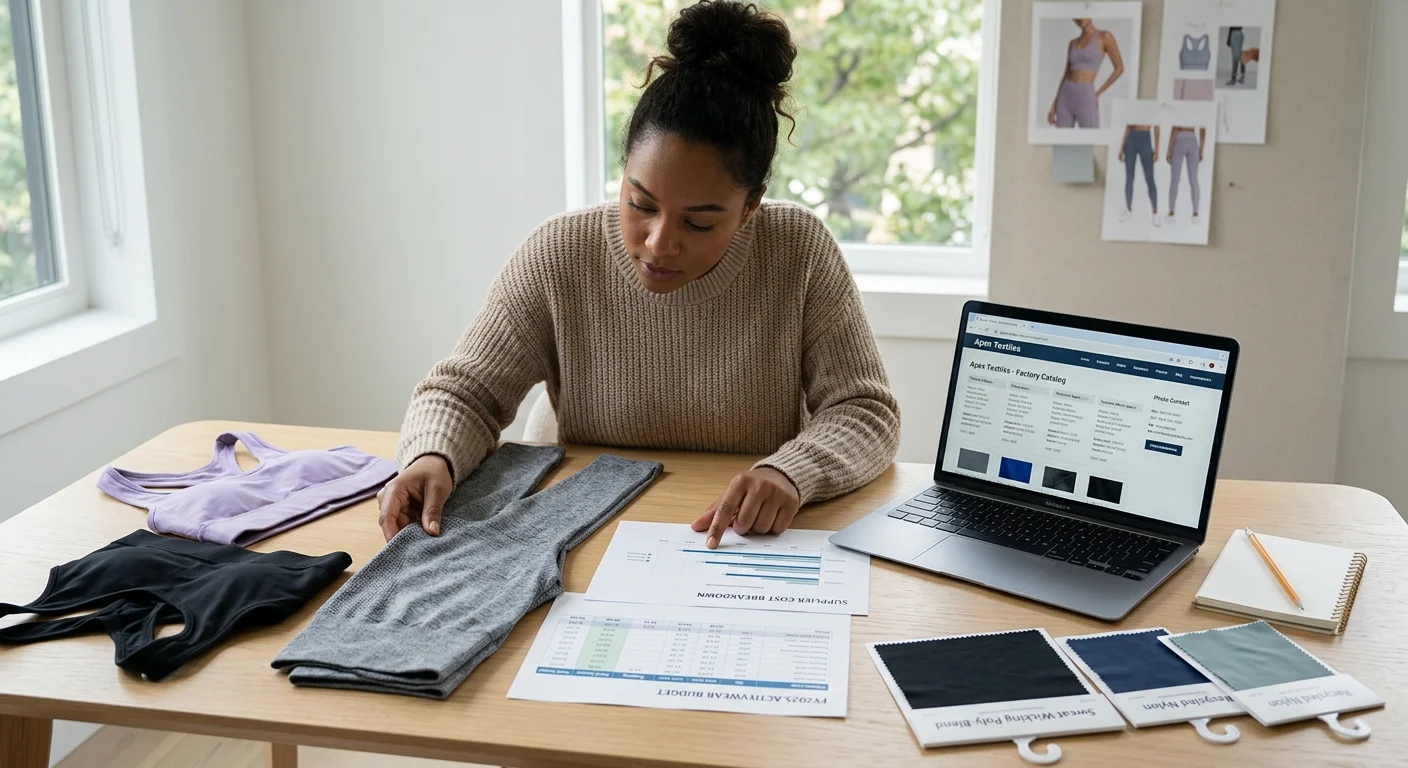
Sourcing gym wear sets without knowing the numbers means negotiating blind — and factories know it.
Before sending a single inquiry, get a clear picture of three things:
What activewear manufacturing costs per unit
What MOQ thresholds make sense for your stage of growth
How long production timelines will eat into your launch window
This guide breaks all three down with zero fluff. You get real cost structures, honest minimums, and a stage-by-stage lead time breakdown that maps onto your planning calendar.
Pricing out your first private label gym wear collection ? Benchmarking a current supplier's quote? The figures here give you a working baseline. You'll walk into every factory conversation knowing what to ask — and spotting fast when a number doesn't add up.
What Does It Cost to Manufacture a Gym Wear Set? (Per-Unit Price Breakdown)

The real answer covers a wider range than most sourcing guides admit: $8 to $35 per unit at the factory gate . That's before freight, duty, or a single label gets sewn in. Your final number depends on fabric choice, construction complexity, and how many units you order.
Here's how the math breaks down.
Per-Piece Factory Cost at a Glance
Garment | Fabric Cost | CMT + Trims | Factory Total |
|---|---|---|---|
Performance T-shirt | $3.00 | $3.00 | ~$6.00 |
Sports bra | $4.00 | $3.50 | ~$7.50 |
Compression leggings | $7.00 | $5.00 | ~$12.00 |
Zip jacket | $8.00 | $7.00 | ~$15.00 |
A standard 3-piece set (tee + bra + leggings) runs ~$25.50 factory cost before anything leaves the building.
What "Landed Cost" Looks Like in Practice
Factory price is one piece of the puzzle. Take a mid-quality compression legging made in Pakistan and shipped to the UK. It clears customs at $12.70 per unit — freight and duty included. That same legging routed to the US lands at $15–$16 .
Now add sampling ($500–$800 per style) and a tech pack ($200–$500). On a first order of 300 units, those development costs add $3.50 per piece on top.
Effective total for that legging: ~$16.20 per unit.
Where the Money Goes (Cost Ratio Breakdown)
Fabric is the biggest cost driver. It takes up 40–60% of total garment cost across most styles. The rest of the budget breaks down like this:
Labor (CMT): 25–35% — Bangladesh runs $1–$3/piece; India/Pakistan $2–$6; US/EU $8–$15
Customization/printing: 15–18% — logo prints and heat transfers add $1–$3 per garment
Packaging + branding: $0.75–$3.00 per set (labels, hang tags, poly bags, mailer box)
Logistics + duty to US: ~$10.00 per 3-piece set on a small air-freight order
Bottom line for a landed 3-piece set shipped to the US: plan on $38–$48 for a first order at modest volume. At scale, that number drops — and that's why your MOQ decision carries more weight than most new brands realize.
Fabric & Material Costs: The Biggest Variable in Your Unit Price
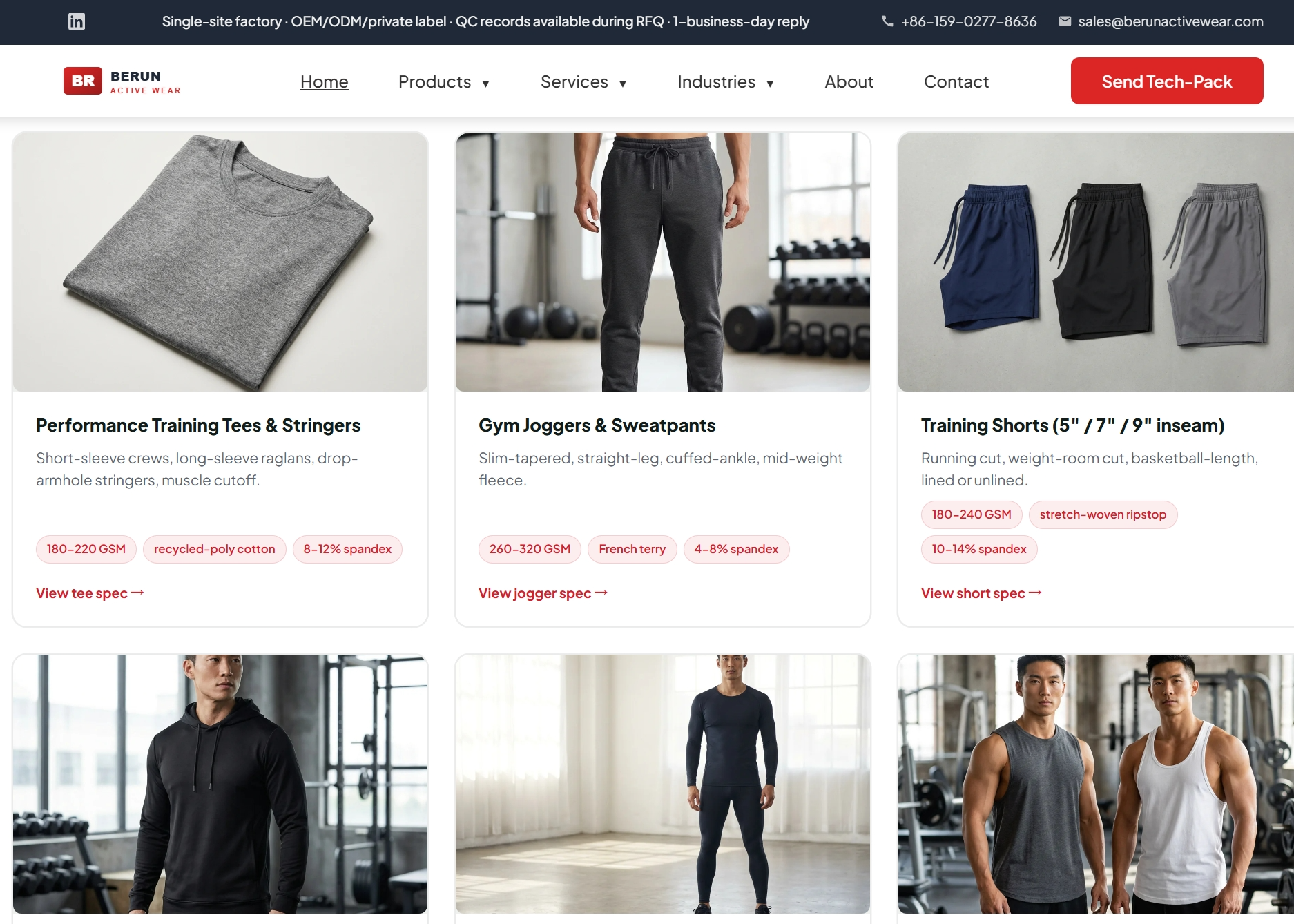
Fabric doesn't just influence your unit price — it is your unit price. Strip away labor and overhead. You'll find that 40–60% of your total garment cost sits in the roll of fabric your factory orders before cutting a single panel .
That number compounds in ways most new brands don't expect. Every extra dollar at the fabric level doesn't stay a dollar. Under a standard wholesale markup of 2× COGS, one dollar of added fabric cost becomes two dollars at wholesale. At a 3.5× retail multiplier, it becomes $3.50 on the shelf. Swap a $4/yard polyester for a $12/yard linen on a legging that uses 1.5 yards per unit. You've just added $12 to your COGS — and $36 to your retail price. No seam changes required.
What Fabrics Cost (Per Yard, by Fiber)
Here are the real price ranges for fibers most common in gym wear manufacturing:
Fiber | Per-Yard Range | Notes |
|---|---|---|
Polyester | $3–7 | Workhorse of activewear; wide availability |
Nylon | $4–8 | Stronger hand feel; preferred for compression |
Rayon blends | $4–12 | Softer drape; used in lifestyle-athletic crossover |
Cotton–poly blends | $6–12 | Ratio and thread count drive range |
Cotton (basic) | $1–5 (retail); $5–12 (bulk) | Seldom used in performance sets |
Linen | $10–25 | Uncommon in gymwear; used in resort-athletic |
Silk / silk blends | $15–60+ | Luxury-tier only |
For most performance gym wear sets , you're working in the $3–$8/yard zone — polyester, nylon, or a nylon-spandex blend. That's the zone where bulk buying gives you the clearest cost advantage.
The Width Factor Nobody Talks About
A higher per-yard price doesn't always mean a higher unit cost. Fabric width changes the math completely.
Compare two fabrics for leggings production:
Fabric A: $8/yard at 45" width → $0.00494 per square inch
Fabric B: $10/yard at 60" width → $0.00463 per square inch
Fabric B costs $2 more per yard. But it's about 6% cheaper per square inch. Add an optimized cutting marker, and that gap grows even more. Width and yield efficiency are the two numbers most buyers skip over when comparing gym wear sets supplier quotes. Don't skip them.
How to Control Fabric Cost Without Sacrificing Quality
Four moves that cut your material cost per unit:
Commit to bulk yardage once your order size supports it. Bulk cotton drops from ~$12/yard down to $5–8/yard. That's a 10–30% reduction. It adds up fast on styles with high fabric use.
Avoid pre-cut bundles. These run up to 3× the per-yard cost of the same yardage. Fine for samples. A real problem at production scale.
Tighten your marker efficiency. A 10–15% drop in fabric consumption per garment gives you a near 10–15% drop in material cost per unit. Cut panels shorter or remove fabric-heavy details by just 0.2–0.5 yards per piece. That saves $1.60–$4.00 per garment at mid-range pricing.
Back-calculate your allowable fabric cost. Say your target COGS is $10 and labor runs $4. Your fabric ceiling is $6. At 1.2 yards per unit, that's a hard cap of $5/yard . Your designer picks an $8/yard fabric? Your COGS jumps to $13.60 — and your wholesale price moves with it.
The math isn't hard. The discipline to run it before you fall for a fabric — that's what keeps your unit economics tight instead of discovering a margin problem six months after launch.
Style Complexity & Customization: How Design Choices Drive Up Production Cost
Every seam you add costs money. Every colorway you launch costs money. The relationship between design decisions and unit cost is not linear — it compounds.
Go beyond a basic two-tone compression set, and your production cost doesn't inch upward. It jumps. Here's why that happens, and how to keep it under control.
Complexity Doesn't Scale — It Multiplies
A standard gym set — solid fabric, flat seams, one color — moves through a factory without friction. Add mesh paneling, a back zipper, contrast binding, and a six-color screen print, and you haven't added 20% to your cost. You may have doubled it.
Three design variables drive most of this cost inflation:
Construction complexity. Each panel piece, seam type, or structural element (racerback, boning, drawcord casing) adds cutting time, sewing steps, and quality checkpoints. Industry benchmarks show each extra operation adds 5–20% more unit processing time per garment.
Customization and branding treatments. Embroidery, heat transfer, sublimation, woven labels — each one is a separate process step with its own setup cost. Logo placements that look minor add $1–$3 per garment in print costs alone.
Variant proliferation. Expanding from 3 colorways to 12 breaks apart your production run. Smaller per-color batches create more changeovers, more setup time, and lower line efficiency. Changeover time per style in apparel printing runs 15–60 minutes . Run multiple styles per day, and effective factory capacity drops 10–30% — your per-unit cost climbs to fill that gap.
The SKU Overhead Nobody Budgets For
Each new style variant doesn't just need more fabric. It needs a new tech pack, a new sample, a new factory BOM, and a new QC protocol.
Activity-based costing in manufacturing puts the lifecycle overhead of a single new part number at $1,000–$10,000 — covering engineering, documentation, inventory management, and gym wear supplier onboarding. That's before a single unit ships.
Take a 200-unit colorway at a $12 unit cost. That overhead adds $5–$50 per piece in hidden fixed costs. Low-volume "tail" variants fail to pay for themselves once you assign full overhead. Most brands carrying bloated style menus find this out after the fact — not before.
The 80/20 Rule Applied to Your Style Menu
The data holds across manufacturing sectors: 20% of styles generate 80% of value . The rest eat factory capacity, inflate inventory, and drain margin.
Brands that cut low-volume variants — targeting the bottom 10–30% of SKUs — recover 3–5 EBIT percentage points . For an activewear brand doing $500K in wholesale revenue, that's $15,000–$25,000 in recovered margin per year . Not from selling more. From designing less.
The practical takeaway: before you lock in your collection, run each style through three questions:
Does this variant hit minimum volume to cover its setup cost?
Does its construction complexity push unit cost past your COGS ceiling?
Does it share materials and trims with other styles — or does it need its own sourcing path?
A style that fails two of three doesn't belong in a first-run production order.
MOQ Standards by Product Type: What Minimums to Expect for Each Gym Wear Style
Factory minimums aren't arbitrary. They're built around fabric rolls, dye lots, and machine setup. Every style has its own floor.
Here's the reality: for most cut-and-sew gym wear styles, 50–100 pieces per style per color is the starting point on stock fabrics. Add custom dyeing, specialty trims, or technical construction, and that floor jumps fast — often to 300–500 units per style per color .
MOQ Ranges by Style
Style | Basic / Stock Fabric | Custom / Technical |
|---|---|---|
Leggings | 100–200 pcs | 200–500 pcs |
Sports bras | 100 pcs | 150–300 pcs |
Compression tees | 150–300 pcs | 200–400 pcs |
Gym shorts | 100–200 pcs | 200–400 pcs |
Hoodies / joggers | 100–300 pcs | 300–600 pcs |
Swimwear (bikinis, one-pieces) | 100 pcs per style | 150–300 pcs |
Jackets | 300 pcs | 300–500 pcs |
What Pushes Your MOQ Up
The gym garment MOQ is half the picture. Trim gym wear suppliers often require 1,000–5,000 pieces per trim item — even if your factory runs just 150 units. That gap gets built into your order requirement. No one mentions it in the quote.
Four variables drive most MOQ increases:
Custom fabric or dye lots — mills set yardage minimums that convert straight into piece counts
Seamless construction — needs 150–300 pcs minimum because of machine calibration and yarn minimums
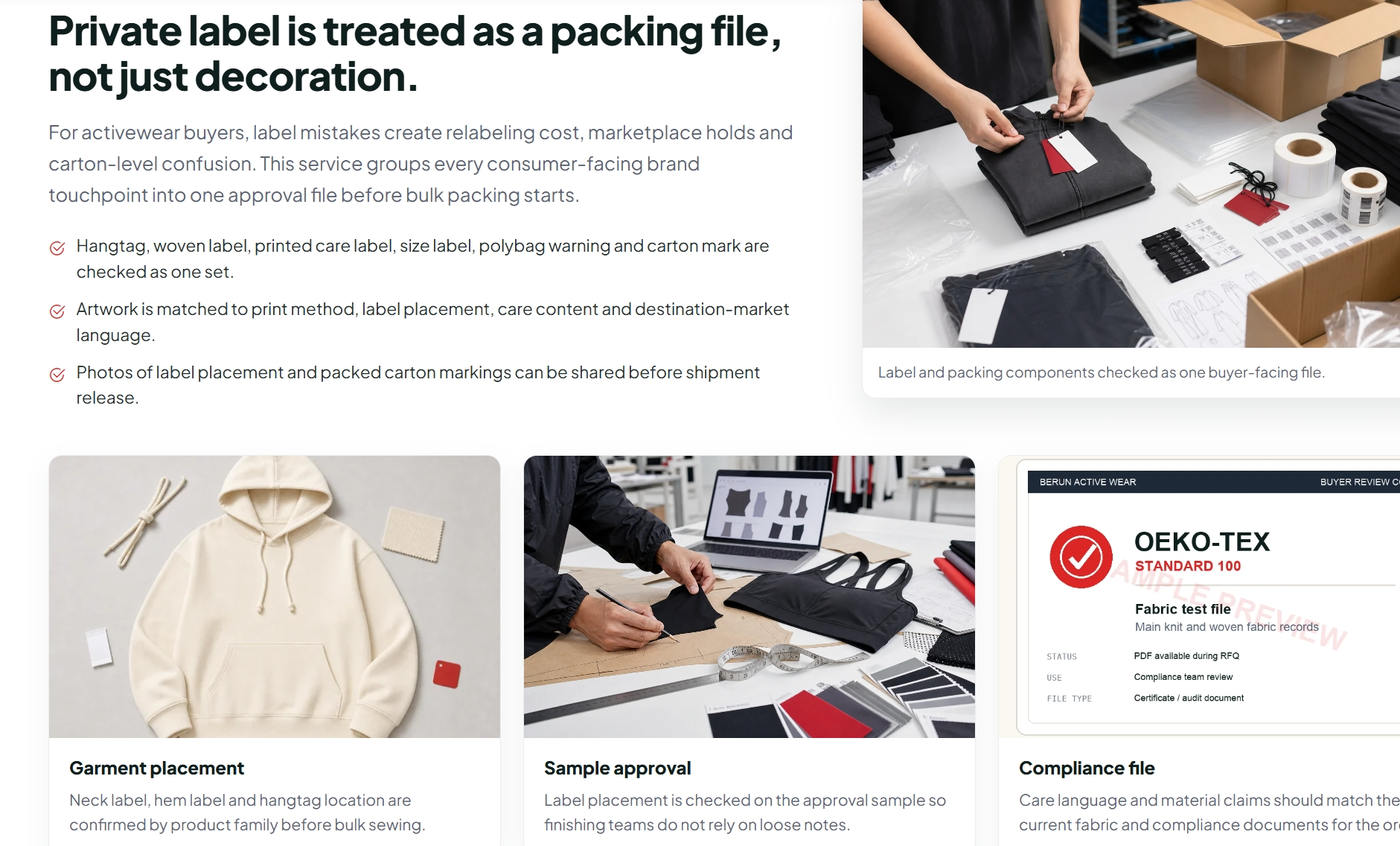
Private-label branding — custom woven labels, heat transfers, and branded zippers each carry their own gym wear sets supplier minimum
Size run depth — spreading XS through 2XL across six colorways splits your volume. Per-color counts drop below what factories can viably run
The Practical Sourcing Rule
Three tiers. Stick to them:
50–100 pcs — style testing with stock fabric
100–200 pcs — standard activewear and swimwear, minimal customization
200–500+ pcs — custom performance fabrics, seamless builds, or branded private-label pieces
At 100 pieces, expect unit costs in the $4–$20 range . Fabric grade and construction complexity move that number. The range is wide because the inputs vary that much. Nail down your fabric spec first. Your MOQ and unit cost will fall into place from there.
Production Lead Time: A Stage-by-Stage Timeline From First Contact to Delivery
Most brands miss their launch window for one reason. They never mapped the full timeline before placing the order. Production didn't run late — the planning simply started too late.
Custom gym wear takes 45–90 days from first contact to delivery door . That's the real number. The "4-week production" figure factories quote counts just the days your garments sit on a sewing line. Everything else — planning, material sourcing, quality checks, ocean freight — runs on its own clock. It moves with or without your attention.
Here's how the time breaks down, stage by stage.
The Full Timeline, Stage by Stage
Stage | What's Happening | Typical Duration |
|---|---|---|
RFQ & spec review | Factory reviews your tech pack, checks feasibility | 1–3 days |
Sampling | Proto sample made, shipped, reviewed by you | 7–14 days |
Sample approval & PO confirmation | Your revisions, factory sign-off | 3–7 days |
Material sourcing | Fabric, trims, labels ordered from suppliers | 10–30 days |
Production | Cutting, sewing, finishing | 14–21 days |
Quality inspection | Inline checks + final AQL audit | 1–3 days |
Packing & dispatch prep | Labeling, folding, boxing, shipping docs | 1–2 days |
Transit to destination | Sea freight: 20–45 days / Air: 2–7 days | Varies |
The hidden cost of this timeline: material sourcing is the longest single stage. Most buyers never plan for it. Custom fabric or specialty trims sourced overseas add 10–30 days before a single panel gets cut. That gap alone kills more launch schedules than factory delays ever do.
What "Production Lead Time" Really Means
Factories start their clock at order confirmation. You should start yours at first contact.
There's a gap between those two dates. Spec back-and-forth, sample rounds, approval cycles — all of that eats 2–4 weeks before production scheduling even opens. Stack that on top of a 45-day production-plus-freight cycle. A product you need on shelves in October needs a factory conversation in late July at the latest .
Build your calendar backward from your target in-store date. Then add a two-week buffer. That buffer isn't pessimism. It's the average cost of one round of sample revisions — and it happens more often than not.
Order Volume vs. Unit Cost: How Quantity Affects Your Final Pricing
The number on a factory quote sheet means almost nothing without context. That number assumes a volume. Change the volume, and the number changes with it.
Here's the core mechanic: unit cost drops 5–30% as order volume moves from small to bulk. Most of that drop isn't the factory getting more efficient. Fixed setup costs — machine calibration, sampling, fabric minimum orders — spread across more pieces. The more units share that fixed overhead, the less each one carries.
The brackets tend to work like this:
Order Volume | Approx. Unit Price | vs. Small Order |
|---|---|---|
50 units | $10.00 | baseline |
300 units | $9.00 | −10% |
700 units | $8.50 | −15% |
1,200+ units | $8.00 | −20% |
That 20% drop on unit cost looks modest. Run the full math and it isn't. A 50-unit order at $10 costs you $500. A 1,200-unit order at $8 costs $9,600. Your gym clothing per-unit cost is $2 lower . Your total margin position looks completely different.
One thing most buyers miss: in a volume bracket model , hitting the next tier reprices all your units — not just the extras. Order 150 pieces in a "100–200 at $9" bracket, and every one of those 150 ships at $9. That's not how tiered pricing works. In tiered pricing, units above the threshold get the lower rate. The units below stay at the original price.
Practical guidance: treat 100, 300, and 500 units as your natural checkpoint volumes. Each one opens a new price tier. Say you're sitting at 280 units. Ask your factory whether adding 20 pieces drops your per-unit cost enough to cover the extra inventory spend. More often than not, it does.
How Much Budget Do You Need to Launch a Gym Wear Set Collection?
Three numbers decide if your launch is viable — before you talk to a single factory. Total startup budget. The slice that goes to product. What's left for everything else. Get those three in the right proportion, and the rest is execution.
The range that matters: $8,000 to $60,000+ . It shifts based on how many sets you're launching, how deep you run each style, and how hard you push at launch. That's not a vague range — it reflects two different approaches with different goals.
The Two Launch Scenarios (With Real Numbers)
Scenario A — Lean starter, 2 sets, 200–300 pieces total:
Budget Line | Range |
|---|---|
Design + sampling | $1,500–$3,000 |
Manufacturing + branding | $3,000–$6,000 |
Freight + duties | $500–$1,200 |
Packaging | $600–$1,200 |
Ecommerce setup | $500–$1,500 |
Launch marketing | $1,000–$3,000 |
Contingency (10–20%) | $800–$2,000 |
Total | ~$8,000–$17,000 |
Scenario B — Standard small brand, 3–4 sets, 400–800 pieces, professional branding:
Budget Line | Range |
|---|---|
Design + sampling | $3,000–$6,000 |
Manufacturing + branding | $7,000–$16,000 |
Freight + duties | $1,000–$3,000 |
Packaging + creative | $1,500–$3,000 |
Ecommerce + dev | $2,000–$5,000 |
Marketing (launch + 3 months) | $5,000–$15,000 |
Contingency | $2,000–$6,000 |
Total | ~$21,500–$54,000 |
Scenario B lines up with what serious founders report spending in the real world. One documented ecommerce launch put $30K toward the purchase order alone , plus $5K on design, $5K on branding, and a solid marketing reserve on top of that.
Where the Budget Splits
Both scenarios follow the same basic pattern:
Product (sampling + manufacturing + freight + branding): 45–60% of total
Marketing (launch campaigns + first 3 months): 20–35%
Branding, packaging, creative : 10–20%
Ecommerce, tools, legal, contingency : 10–20%
The contingency line is not optional. One sample revision round costs $600–$3,000. It happens more often than not. Build it into your budget on purpose — skip it, and it starts eating your marketing spend instead.
The Floor You Need to Know
A very small test run — 150–250 pieces, 1–2 sets, minimal customization — costs $3,000–$6,000 in manufacturing, branding, and freight combined. That's the hard floor for physical product costs.
Below $8,000 total, you're not launching a brand. You're running a sample test. That's a fair move — just be clear about what it is. Plan for that scope, and don't expect it to support a full marketing push on top.
The solid, realistic number for a first collection that's set up to sell: $15,000–$35,000 .
FAQ: The Questions Every Gym Wear Buyer Asks Before Placing an Order

These questions come up on almost every sourcing call. Get the answers ready before you pick up the phone — the whole conversation moves faster.
What's the MOQ for a custom gym wear set?
For stock fabrics: 100–200 pieces per color per style. For custom dyeing, seamless construction, or private-label branding: expect 200–500 pieces. Some suppliers set a minimum spend instead — USD 999 is a common threshold for initial custom orders. Re-orders of the same design often carry no MOQ at all.
Can I test with a small batch before committing to a full run?
Some factories allow 2 below-MOQ re-orders per calendar year on existing designs. First-run test orders are harder to negotiate. Your best move: treat your sample order as the test. That's not your first production run — it's your proof-of-concept.
How does fabric choice change my price?
Here's a quick breakdown:
Premium nylon-spandex blends cost 20–40% more than standard polyester
Flatlock seaming adds 5–10% over basic overlock
Screen print, sublimation, and heat transfer each add USD 0.50–3.00 per piece
Custom woven labels and branded packaging stack another 3–10% on top of your garment cost
Each upgrade is a real cost decision. Know which ones matter to your customer before you spec the order.
How long will production take?
After final art, colors, sizes, and quantities are confirmed: 4–6 weeks . Five weeks is the target. Six weeks is the reality during peak season.
Two things to know:
The production clock starts at confirmed sign-off — not your first email
Build that buffer into your launch schedule, not as a last-minute fix
Do I need a resale certificate to order wholesale?
Yes — most wholesale gym wear suppliers require one. Buying direct at wholesale pricing without a registered business entity? Most suppliers will push you to a retail channel or turn the order away. Get your business registration sorted before you reach out.
What fabric specs should I be asking for?
For performance leggings and sports bras, the sweet spot is 80–90% polyester or nylon + 10–20% elastane .
For compression pieces, go tighter on the specs:
Elastane content: 15–25%
Fabric weight: 220–280 GSM
One thing to avoid: high cotton content. Cotton soaks up sweat instead of pulling it away. It has no place in gear built for real training.
How do factories handle sizing errors in bulk?
Industry standard tolerance is ±1–2 cm per major measurement. More than 2–3% of a batch falls outside that range? The factory needs a clear replacement or credit process — and you need that process documented before you sign the PO. Ask for it upfront. Don't wait until the boxes are open.
Conclusion
Most gym wear buyers spend weeks trying to piece this together. You don't have to. This guide gives you a clear picture of what manufacturing costs, what MOQ thresholds are realistic, and how long the process takes from first conversation to finished product.
Here's the bottom line: activewear manufacturing cost per unit isn't a fixed number — it's a set of levers. Fabric grade, order volume, style complexity, and the factory you choose all move that number up or down. The brands that win aren't the ones with the biggest budgets. They're the ones who walk into supplier conversations already knowing what fair looks like.
That's the edge this guide was built to give you.
Ready to turn these numbers into a real quote for your line? Contact our team at Berun Activewear . Bring your design ideas, your target price point, and your timeline. We'll handle the rest and keep it straightforward.
The best time to start was yesterday. The second best time is right now.