You've got the passion, the brand idea, maybe even a logo concept sketched out on your phone. Then you Google activewear manufacturing costs — and you hit a wall. Vague answers. Outdated numbers. Supplier websites that won't quote you without a 1,000-unit commitment.
Here's the truth: launching a custom activewear brand in 2026 is more accessible than ever. But you need to know where your money should go. Spend it in the wrong place, and you're done before your first drop. Spend it smart, and you can build a real brand for less than you expect.
This breakdown gives you real numbers, three budget tiers, and a clear roadmap — from your first sample to your first sale.
Cost Breakdown #1 — Product Development & Sampling ($300–$2,000)
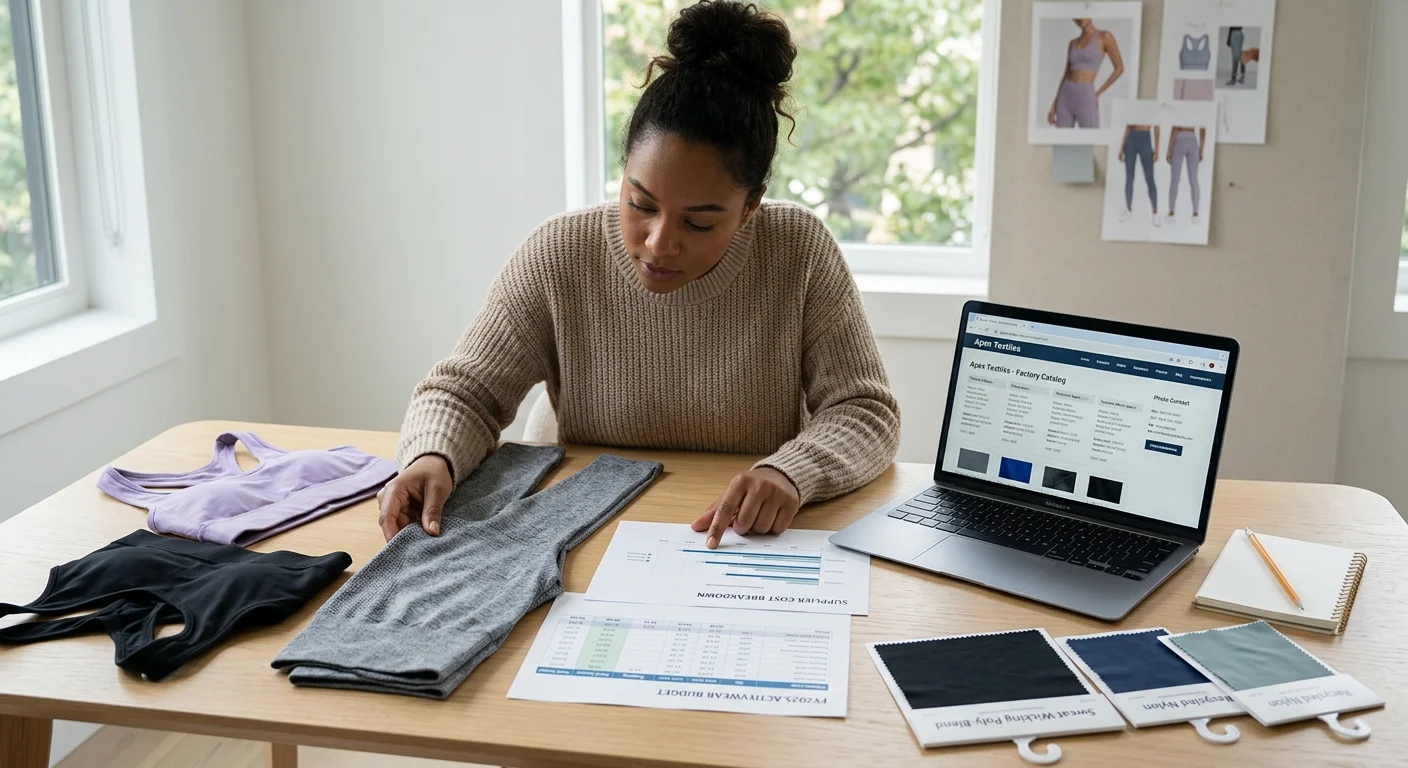
No units have shipped. No product descriptions are written. You haven't touched Instagram ads yet. But you're already paying for samples. Most first-time founders underestimate this cost. It's the one that kills early-stage brands before they ever launch.
Here's what sample costs look like by garment type:
Leggings: $80–$160 per sample
Sports bra: $80–$140 per sample
Jacket: $150–$320 per sample (complex outerwear can push to $600–$1,500)
Those per-unit numbers seem fine on their own. The real issue is volume and rounds. Most styles need 2–4 sampling rounds before production approval. So a single legging style can run you $320–$640 in samples alone — before you've confirmed a fabric or locked a fit.
Spread that across a 5-style launch collection. Your sampling budget alone hits $1,600–$3,200.
When a Tech Pack Is Worth the Investment
A tech pack runs $400–$2,000 per style . That sounds steep for a document. Look at what you actually get though: cleaner factory communication, fewer revision cycles, and faster production approval.
You need one in these situations:
Your design has multiple panels, performance construction, or complex grading
You're working with an overseas manufacturer where miscommunication adds revision risk
You're building toward scale and need repeatable, transferable documentation
Full outsourcing isn't always necessary. Your factory may already specialize in that specific garment category and handle both sampling and production in-house. Integrated activewear suppliers cut out handoff errors. That alone shrinks your development cost.
The Smart Way to Control This Budget
Three levers move the needle here:
Choose an integrated factory that handles sampling and production together — fewer rounds, lower total cost
Start with simpler constructions — complexity is a direct cost multiplier
Ask upfront what sampling fees cover — pattern work, revisions, courier shipping — and whether those fees apply toward production confirmation
Practical budget benchmarks:
Style Complexity | Estimated Total Cost |
|---|---|
Low complexity | $300–$800 |
Mid complexity | $800–$2,000 |
High complexity | $2,000+ |
Sampling isn't a sunk cost. Think of it as product insurance. Budget it with intention, and every dollar you spend after it is better protected.
Cost Breakdown #2 — Initial Production & MOQ ($1,500–$25,000)
Your sampling is approved. Your factory contact is ready. This next number decides whether your activewear brand launches — or stays a concept.
Production costs aren't just about activewear price per unit. They're about math that most first-time founders get wrong. Fixed costs (pattern grading, setup, tooling) don't disappear at lower order quantities. They spread across fewer units, so each piece carries more weight. That's what makes MOQ decisions so critical.
Here's how it plays out.
The Real Math Behind Order Quantity
Take a basic performance T-shirt. Fixed setup costs run around $1,500 per style . Variable cost per unit (fabric, sewing, trims, packaging) sits at $8.00 .
Order Quantity | Total Cost | Cost Per Unit |
|---|---|---|
50 units | $1,900 | $38.00/pc |
200 units | $3,100 | $15.50/pc |
500 units | $5,500 | $11.00/pc |
Run the same model on a higher-complexity performance legging — fixed costs climb to $3,000, variable cost to $14.00/pc:
Order Quantity | Total Cost | Cost Per Unit |
|---|---|---|
50 units | $3,700 | $74.00/pc |
200 units | $5,800 | $29.00/pc |
500 units | $10,000 | $20.00/pc |
That's not a small gap. That's a pricing and margin problem at low volume. At 50 units, setup and tooling can eat 25–50% of your per-unit cost . At 500 units, that share drops to 10–25% . Higher volume isn't just about a better price per piece. It's what makes your unit economics work well enough to sell at a real profit.
Performance Fabric Premiums Won't Break You (If You Know the Math)
Upgrading to 4-way stretch, moisture-wicking, or branded-yarn performance fabrics adds +15–30% to material costs . But materials are only 40–60% of your total unit cost. So the real hit to your cost per unit is much smaller than most founders expect.
On a 200-unit run of that basic tee:
+15% fabric premium → $15.50 → $16.10/pc (+$0.60)
+30% fabric premium → $15.50 → $16.70/pc (+$1.20)
Across a 200-unit SKU, the total fabric upgrade cost lands at $120–$240 . Stretched across a full initial production budget, performance fabric upgrades add $100–$600 per SKU . That's a manageable number — as long as you plan for it upfront.
Low-MOQ Factory vs. Traditional Factory: The Trade-Off Nobody Talks About
Low-MOQ factories (50–100 unit minimums) look attractive for a first launch. The flexibility is real. But the cost penalty is significant.
Factory Type | MOQ | Cost Per Unit |
|---|---|---|
Low-MOQ factory | 100 pcs | $25.00/pc |
Traditional factory | 300 pcs | $16.83/pc |
Traditional factory | 500 pcs | $13.50/pc |
At 100 vs. 300 units, you're paying ~49% more per unit with a low-MOQ supplier. At 100 vs. 500, that gap widens to ~85% . There's also a quality risk to factor in. With runs of 50–100 pieces, a single QC issue can hit 10–30% of your batch . Add rework and scrap, and your effective cost jumps another +10–25% on top of that.
The Smarter Launch Configuration: Focus Beats Coverage
This is where most new activewear founders waste money. They try to launch 6–8 SKUs on a limited budget. The math punishes that approach every time.
With a $15,000–$20,000 production budget:
2–3 hero SKUs (e.g., tops 300 pcs + leggings 200 pcs + sports bra 200 pcs) → total $13,000–$14,000 , leaving real budget for packaging, content, and a size test run
6–8 SKUs at 80 pcs each → $15,000–$18,000 spent, with $25–$35+/pc unit costs , tiny per-style data, and zero margin cushion
Putting your budget into 2–3 strong hero products gives you better unit economics and cleaner sell-through data. You also keep a budget buffer for what drives sales in the early stage: content and customer acquisition.
The rule is simple: fewer styles, smarter volume, stronger launch.
Cost Breakdown #3 — Branding & Design ($50–$5,000)
Branding is where founders waste the most money — or spend too little at the worst possible time.
The range is huge: $50 on one end, $5,000 on the other. Both make sense. The real question isn't which number is right. It's which number fits where your brand stands today .
Two paths exist here. Each serves a different stage.
Path 1: The Lean Brand Setup (AI + Fiverr) — $100–$500
You're in MVP mode — testing product-market fit before locking in a full visual identity. This path is the right call.
Here's what a lean but complete brand kit costs:
Asset | Cost Range |
|---|---|
Logo (AI maker / Fiverr entry-level) | $30–$150 |
Color system (palette + HEX/RGB codes) | $50–$150 |
Typography system (font pairing + hierarchy) | $50–$150 |
Basic label design (1 set) | $50–$150 |
Simple style guide (6–8 pages) | $150–$250 |
Total | $200–$500 |
Tools like Canva and Fiverr Logo Maker have made this tier a real option. A Fiverr Essential logo package runs $30 . You get a high-res PNG, transparent background, and commercial rights. Step up to the Professional tier at $60 and you add print files, a social media kit, and a basic style guide.
That's a functional brand. It's not a brand system . But for a founder testing 200 units in a niche market, it's enough to launch.
Path 2: Full Brand System (Professional Designer / Studio) — $1,500–$5,000
You know your customer. You know your positioning and your channel. You're past MVP. At that point, this investment pays back fast.
A full activewear brand system from a small studio or Fiverr Pro designer tends to include:
Logo + visual identity: $400–$2,200
Complete style guide (logo rules, color system, typography, imagery direction, social templates): $180–$600
Packaging + label design bundled in: pushes the full package to $1,500–$5,000
Here's why that spend makes sense at the right stage. Take a DTC activewear brand running $5,000/month in ads with a 3.0 ROAS — that's $15,000/month in revenue. A solid brand upgrade that lifts ad CTR by 25% and landing page conversion by 10% can push ROAS from 3.0 to ~3.9. Same ad budget. Same traffic. Revenue jumps from $15,000 to ~$19,500/month . A $2,000–$3,000 brand investment pays itself back in 4–6 weeks .
That's not a theory. Most activewear DTC brands move from a lean setup to a full system once they cross $20k–$50k/month in revenue. That's the exact reason why.
The Real Signal: Know Your Upgrade Point
65% of early-stage founders spend under $500 on a logo — and that's a smart call at launch. But visual quality carries extra weight in the activewear category . Shoppers link visual polish with product performance. Research shows 70–80% of buyers say visual presentation shapes their trust in a brand's product quality.
Think about it this way: shoppers are judging fabric performance and durability they can't touch. Your brand visuals become their stand-in for quality .
The practical decision rule:
Pre-launch / MVP: Stay lean. $200–$500 covers everything you need.
Post-validation / scaling: Put money into a proper system. $1,500–$3,000 is the sweet spot.
Raising investment or entering retail/wholesale: Budget the full $3,000–$5,000 — you'll need a professional brand deck that works as a trust asset.
Don't pour money into branding before you've validated your product. But don't hold back once you know what you're building.
Cost Breakdown #4 — Labels, Packaging & Trims ($300–$3,000)
Most founders treat packaging as an afterthought. That's a mistake that costs them real money.
Labels, hang tags, poly mailers, and trims aren't just finishing touches. They're the first thing your customer touches. Depending on how you approach them, this budget line can land anywhere from $300 to $3,000 for the same 300–500 unit run.
Here's what drives that gap.
The Per-Unit Numbers You Need to Know
Every trim component has its own pricing curve — and MOQ trap.
Woven brand labels:
- 100–300 pcs (micro run): $0.15–$0.35/pc
- 500–1,000 pcs: $0.06–$0.15/pc
- 3,000–5,000 pcs: $0.03–$0.08/pc
Hang tags (300–400 gsm, 4-color print):
- 500 pcs: $0.18–$0.35/pc
- 1,000 pcs: $0.10–$0.20/pc
- 3,000–5,000 pcs: $0.06–$0.12/pc
Printed care/size labels: $0.03–$0.12/pc for standard finishes. $0.12–$0.40/pc for premium finishes.
Custom poly mailers:
- 500–1,000 pcs: $0.20–$0.40/pc
- 3,000–5,000 pcs: $0.10–$0.20/pc
The pattern is clear — every component gets cheaper as volume goes up. At 300–500 units, your combined labels, hang tags, and inner polybags will run about $0.20–$0.60 per product for a minimalist setup. Add premium trims like foil tags and woven labels, and that climbs to $0.80–$2.50 .
Two Packaging Strategies, Two Very Different Budgets
Minimalist Setup ($300–$800 total)
For a 300–500 unit launch run, a clean, no-frills packaging kit breaks down like this:
Component | Unit Cost | Total (500 units) |
|---|---|---|
Stock poly mailer | $0.10–$0.40 | $50–$200 |
Logo label (pressure-sensitive) | $0.03–$0.08 | $15–$40 |
Woven brand label + care label | $0.08–$0.20 | $40–$100 |
Basic hang tag (no foil) | $0.08–$0.15 | $40–$75 |
Total per unit | $0.40–$0.80 | $145–$415 |
Add sampling freight and minor overage, and your total packaging cost lands in the $300–$800 range. It's clean. It's functional. For an MVP launch testing product-market fit, this is the smart move.
Branded Unboxing Experience ($1,500–$3,000 total)
Scale up the brand touchpoints on the same unit volume, and the numbers look like this:
Component | Unit Cost | Total (300 units) |
|---|---|---|
Custom rigid/premium folding box | $4.00–$6.00 | $1,200–$1,800 |
Premium woven label set | $0.25–$0.50 | $75–$150 |
Foil hang tag (custom shape, dyed cord) | $0.20–$0.60 | $60–$180 |
Inserts (card, tissue, sticker pack) | $0.12–$0.35 | $36–$105 |
Upgraded shipping mailer | $0.50–$1.50 | $150–$450 |
Total per unit | $4.00–$10.00 | $1,500–$3,000+ |
That's a 10x jump in per-unit cost — for the same quantity. The logic behind it: premium unboxing supports higher retail pricing, creates social-shareable moments, and signals product quality before the customer even touches the garment. Many premium activewear brands set aside 10–40% of retail price for packaging on purpose, especially at the higher end of the market.
Factory-Integrated vs. Self-Sourced: The Decision That Changes Your Total Cost
This is where most custom gym wear brand founders leave money on the table.
Working with a activewear factory that bundles trims and packaging runs 10–30% cheaper per unit on standard components compared to sourcing on your own. Why? The factory already has direct relationships with local label and packaging vendors. They buy at scale. They split tooling costs across multiple clients and styles.
Going it alone means you carry every fixed cost yourself. Folding carton tooling alone runs $1,200–$3,500 with MOQs of 3,000–5,000 units . For a brand ordering 500 units, that $1,200 in tooling adds $2.40/pc before a single piece of material is cut. That's what quietly pushes a $300–$800 packaging budget into $1,500–$3,000 territory.
The trade-off is control. Factory-integrated sourcing gives you a single PO and cleaner QC — but less flexibility on design details and material spec. Your packaging vision is specific? Put it all in your tech pack. Clear documentation cuts out the guesswork and keeps your brand execution on track.
The bottom line: launching your first custom activewear line at 300–500 units? Let your manufacturer handle standard trims. Save the self-sourcing approach for scaling past 1,000+ units, where the volume justifies the tooling investment.
Cost Breakdown #5 — E-Commerce Store & Tech Stack ($500–$2,500/Year)
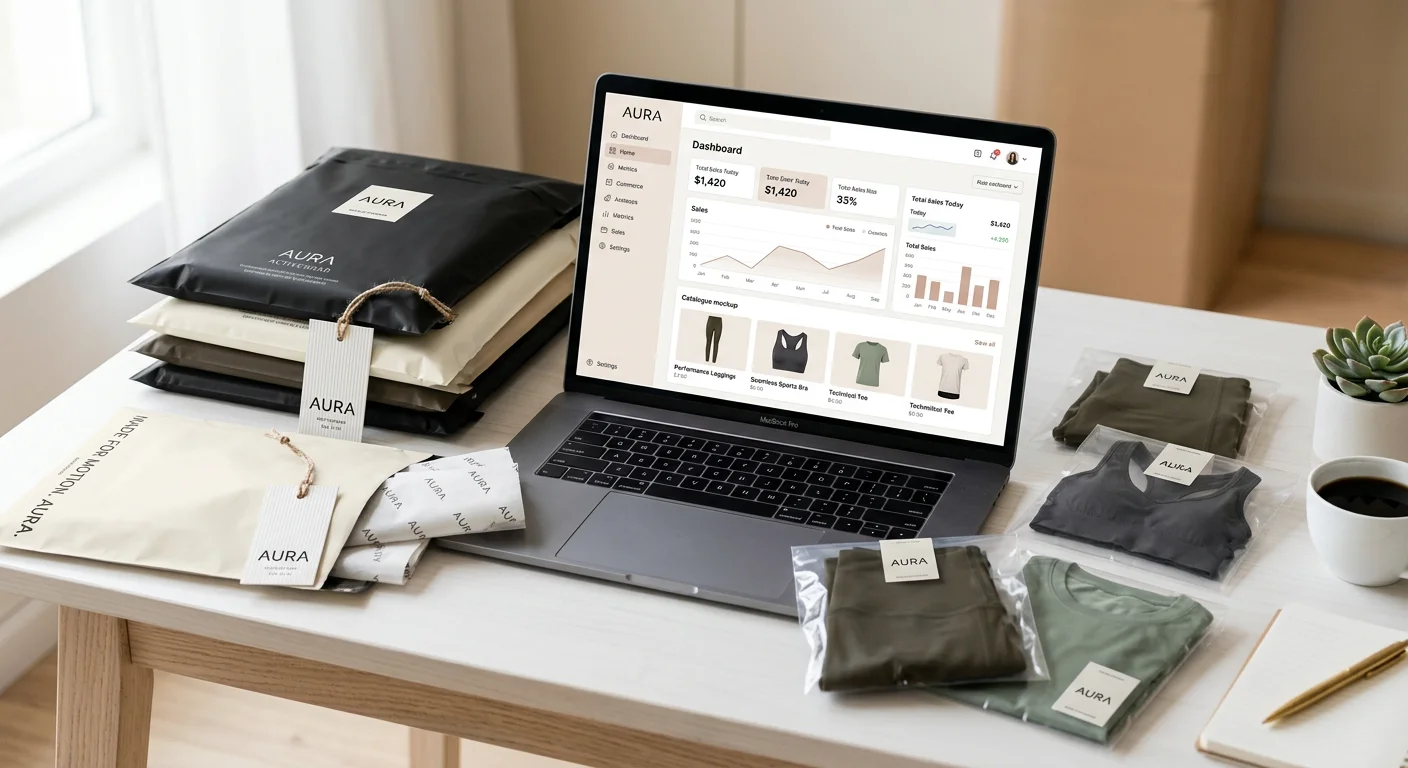
Your store is where every dollar spent on sampling, production, branding, and packaging either converts — or disappears. Get this budget wrong and you'll overspend on software you don't need yet. Or you'll underinvest in tools that drive real revenue.
The good news: Shopify lets you run a complete activewear DTC store for $500–$2,500/year . But you need to be deliberate about your stack.
What Shopify Costs in Year One
The sticker price isn't the real price. Here's what you're paying:
Platform subscription:
- Shopify Basic (annual billing): $29/month → $348/year
- Shopify Grow (annual billing): $79/month → $948/year
Add a premium theme ($140–$350, one-time), a domain ($10–$20/year), and a lean app stack ($20–$60/month). Your realistic first-year total looks like this:
Scenario | Shopify Plan | Apps/Month | Est. GMV | Payment Fees | Year 1 Total |
|---|---|---|---|---|---|
Lean Launch | Basic | $30 | ~$20k | ~$655 | ~$1,378 |
Basic + Premium Theme | Basic | $50 | ~$20k | ~$655 | ~$1,818 |
Grow Plan | Grow | $60 | ~$40k | ~$1,230 | ~$3,163 |
That third scenario breaks the $2,500 ceiling. That's a clear signal: on Grow, you need to trim your app stack or skip the premium theme in year one.
Payment processing fees are the hidden cost most founders forget to model. On Shopify Basic, you pay 2.9% + $0.30 per transaction . At $20k GMV with an average $80 order, that's $655/year in fees alone — before you pay for a single app.
The Activewear-Specific App Stack You Need
Generic Shopify guides give you generic app lists. Activewear has specific conversion problems. Shoppers can't touch the fabric. They can't test the fit. They won't buy if they don't trust the sizing.
Your minimum functional stack:
App Category | Recommended Spend | Annual Cost |
|---|---|---|
Size guide / fit tool | $10–$20/month | $120–$240 |
Reviews with photos/video | $15/month | $180 |
Email marketing + cart recovery | $20–$40/month | $240–$480 |
SEO / compliance / cookie banner | $5/month | $60 |
Product video | $0 (use native theme) | $0 |
Total | $50–$80/month | $600–$960/year |
Pair that with Shopify Basic annual billing and a free theme. Your complete tech stack lands at $1,600–$1,978/year — complete, activewear-optimized, and within budget.
The size guide and fit quiz aren't optional. Sizing anxiety is the top reason activewear shoppers abandon carts. A $20/month tool fixes that problem. It recovers more revenue than any paid ad campaign at this stage.
DIY vs. Hiring a Freelancer
Build it yourself. At least for year one.
Shopify's modern themes need zero coding knowledge. DIY setup costs nothing beyond the platform fees. A freelancer for small customization or theme tweaks runs $300–$2,000 one-time — that can push your year-one total past the $2,500 ceiling fast.
There's one exception. Your brand positioning may demand a specific visual experience from day one, and you have budget room for it. A focused $300–$700 freelancer engagement for theme refinement makes sense in that case. A full custom build at $5,000–$40,000 does not — not at launch stage.
The rule: DIY the build. Put the savings into content and customer acquisition instead.
Cost Breakdown #6 — Marketing & Brand Launch ($300–$10,000)
Marketing is where most activewear founders either find traction — or burn cash with nothing to show for it.
The range here is massive: $300 on one end, $10,000 on the other. That's not vagueness. Two founders can take the same launch in completely different directions. The budget they pick — and how they use it — changes everything.
The key isn't how much you spend. It's where you put the money first.
Your First Dollar Goes to Content
Before paid ads. Before influencer outreach. Before anything else — you need product visuals that convert.
In activewear, this isn't optional. Shoppers can't touch the fabric. They can't test the compression. Your content has to do that work for them.
The good news: a solid content kit doesn't require a $5,000 shoot. Here's a DIY setup that works:
Item | Cost |
|---|---|
Phone tripod + stabilizer | $50–$120 |
Basic lighting kit | $50–$100 |
Background / shoot space | $50–$80 |
Local model (product swap + cash) | $50–$150 |
Editing tools (CapCut, Canva) | $50–$100 |
Total | $300–$800 |
One focused shoot session — 3 to 4 hours — can produce 20–40 product photos and 5–10 short videos . That covers a full month of social posting and your first paid ad creatives.
How to Allocate Across Channels
Here's the framework that works at each budget level:
$300–$1,000 (Validation Mode)
- Content production: $200–$400
- 1 nano-influencer (product swap + $100–$200 cash)
- Paid ads: $100–$200 micro-test, nothing more
$1,000–$3,000 (Standard Cold Start)
- Content: $400–$800
- 2–3 fitness micro-influencers ($500–$1,200)
- Meta/TikTok ads: $500–$1,000, testing 3–4 creatives
$3,000–$10,000 (Scale-Ready)
- Content: $1,000–$3,000 (semi-professional shoot + UGC)
- 3–5 micro-influencers ($1,500–$3,000)
- Paid ads: $1,500–$4,000 with structured creative testing
Micro-Influencers Outperform Paid Ads at This Stage
Fitness micro-influencers (10K–100K followers) put out $5–$6.50 revenue per $1 spent on a regular basis. That's 500–650% ROI versus Meta's typical 4–5x. Their CPM sits around $4–$5 — about one-tenth the cost of standard paid placements.
Entry point: $500–$1,500 gets you 1–3 fitness creators in the 10K–30K range. Each delivers one video and one story set. Cost per creator runs $200–$500 plus product.
Two rules that make this work:
- Give every influencer a unique UTM link and discount code — track conversions, not just views
- Your benchmark for continuing: ROAS ≥ 3x . Below that, adjust the brief or swap the creator.
Paid Ads: Data First, Scale Second
Don't open with a $5,000 ad budget. Start with $1,000–$1,500 and treat the first month as a data-collection exercise.
Run 3–5 creatives across 2–3 audience sets. Spend $20–$50/day per ad group . The goal at this stage isn't revenue. It's finding which creative and audience combination hits ≥3x ROAS with a pattern you can trust. Find that signal first. Then scale into it.
Target CPA: keep it within 30–40% of your gross margin . A $30 margin per unit means your CPA ceiling is $9–$12.
The split that works: 70% conversion-focused ads, 30% brand awareness. Pull your influencer UGC and run it as Spark Ads or Partnership Ads. You get lower CPM, higher trust, and better CTR than studio-shot creative at this stage.
Cost Breakdown #7 — Shipping, Duties & Logistics ($200–$2,000)
Logistics will eat your margins if you don't plan for it. Most activewear founders budget well for production — then get blindsided at the freight stage. Not because shipping is expensive, but because the 2026 duty environment has changed the math completely .
Here's the hard reality: your factory's location now controls a massive chunk of your total landed cost.
The Tariff Landscape in 2026 (This Changes Everything)
Your sourcing country isn't just a quality or MOQ decision anymore. It's a cost structure decision .
Sourcing Country | US Import Tariff Rate | Key Risk |
|---|---|---|
China / Hong Kong / Macau | ~34% (Section 301 + reciprocal) | High baseline cost |
Vietnam (verified local origin) | ~20% | Compliance burden |
Vietnam (flagged as transshipment) | ~40% + penalties | Total cost can exceed 70% |
Portugal → US (rerouted from China) | 34% + potential 40% penalty | Not a viable workaround |
Run the numbers on a real first order. Assume FOB price of $50/unit, 100 units ($5,000 total) :
China direct to US: $5,000 × 34% = $1,700 in duties + ~$500 air freight = ~$2,200 total
Vietnam (genuine local sourcing): $5,000 × 20% = $1,000 in duties + ~$700 combined freight = ~$1,600–$1,900
Vietnam flagged as transshipment: $5,000 × 40% = $2,000 in duties alone — before freight
One critical warning: Vietnam's origin compliance threshold requires ≥30% locally sourced materials . Can't prove that? US Customs can reclassify your shipment as Chinese-origin goods. The penalty goes beyond the higher tariff rate. It includes extra fines that push your total tax burden past 70%.
Air vs. Sea: The Key Decision for Your First Shipment
For a first batch of 100–200 units, the answer is almost always air freight . Here's why.
Shipping Method | Cost (100 kg / 1 CBM) | Transit Time | Best For |
|---|---|---|---|
Air freight | ~$600 ($6/kg) | 3–7 days | First orders, high-value goods |
Sea freight LCL | ~$120–$300 | 25–40 days | 500+ unit reorders |
Sea freight FCL | $1,200–$2,000/container | 25–40 days | Large-scale bulk orders |
Most founders miss this: air freight bills by volumetric weight , not actual weight. Your billing weight is whichever is larger — actual kg or (L×W×H cm³ ÷ 6,000). A light but bulky shipment ends up costing far more than the raw weight would suggest.
At a per-unit margin of $30+, air freight adds $5–$15 per unit to your landed cost. That's 15–30% of gross margin . Painful, but workable for a first market test.
Sea freight cuts that cost by 30–50%. The trade-off? You add 3–5 weeks of lead time. Port handling fees are also unpredictable. On small shipments, those fees often cancel out the savings.
Do You Need a 3PL? The Break-Even Is Simpler Than You Think
For your first 100–300 units, self-fulfillment wins on cash cost . Your home office or spare room becomes your warehouse. At this stage, your labor is a sunk cost anyway.
Cross ~200 orders per month and the math starts to shift. A typical 3PL charges:
Inbound receiving: $0.20–$0.50/unit
Storage: $0.20–$0.50/unit/month
Pick, pack & ship: $1–$3/order
Monthly platform/management fee: $50–$200
At 200 orders per month with an average 1.2 items per order, your 3PL bill runs $400–$800/month . Self-fulfillment at that same volume costs you mostly in time. The cash outlay stays close to zero beyond shipping supplies.
The break-even point: 150–200 orders/month. Below that, fulfill yourself. Above it, the time savings and growth capacity of a 3PL start to justify the cost.
What This Means for Your Budget
Your logistics cost lands in very different places depending on your setup:
Scenario | Estimated Shipping + Duties |
|---|---|
Domestic production, selling locally | $200–$500 |
Vietnam factory, air freight to US, 100 units | $1,600–$1,900 |
China factory, air freight to US, 100 units | $2,000–$2,200 |
China factory, sea freight reorder (500 units) | $800–$1,200 |
Build your logistics cost into your unit economics before you set your retail price — not after. A $50 FOB item can land at $75–$90 once tariffs, freight, and 3PL handling are all counted in. That's the number your margin model needs to start from.
Budget Tier Summary: Which Launch Level Is Right for You?
Seven cost breakdowns. Dozens of numbers. Now it's time to pull everything together into one clear decision framework.
The three tiers below aren't arbitrary ranges. Each one reflects real-world launch configurations — different risk profiles, different cash positions, and different definitions of what "success in year one" looks like.
Tier 1: Lean Launch — $3,000–$8,000
Who this is for: First-time founders. Side-project launchers. Fitness coaches or personal trainers testing a product idea with an existing audience. Cash is limited. Time is not.
This tier is pure validation mode. You're not building a brand empire. You're answering one question: will people pay for this?
Budget Line | Lean Range |
|---|---|
Sampling (1–2 styles) | $300–$600 |
Production (50–100 units) | $1,500–$3,000 |
Branding (AI + Fiverr) | $200–$500 |
Labels & packaging (minimalist) | $300–$500 |
Shopify Basic + lean app stack | $500–$800/year |
Marketing (content + 1–2 micro-influencers) | $500–$1,200 |
Shipping & duties | $500–$1,000 |
Total | $3,800–$7,600 |
The honest trade-off: Your per-unit cost will be high — $30–$75 per piece depending on complexity. Margins are tight. But you're buying information, not inventory. A clean sell-through on 100 units tells you more than any market research report ever will.
Payback window: 2–4 months. Target $2,000–$4,000/month in revenue.
Tier 2: Standard Launch — $10,000–$25,000
Who this is for: Founders with a validated concept, a real audience, and the budget to build something that scales. You've done the research. Now you're building a brand — not just testing a product.
This is the sweet spot for most custom activewear brand launches in 2026.
Budget Line | Standard Range |
|---|---|
Sampling (2–4 styles, 2 rounds) | $800–$2,000 |
Production (200–300 units per hero SKU) | $5,000–$12,000 |
Branding (professional designer) | $1,500–$3,000 |
Labels & packaging (branded) | $800–$1,500 |
Shopify + full app stack | $1,000–$1,800/year |
Marketing (content + 3–5 micro-influencers + paid ads) | $1,500–$4,000 |
Shipping & duties | $1,000–$2,000 |
Total | $11,600–$26,300 |
At 200+ units per SKU, your unit economics start working. Cost per piece drops into the $15–$30 range. That gives you room to price sharply, absorb shipping costs, and still land a real margin.
Payback window: 3–6 months. Target $5,000–$15,000/month in revenue.
Tier 3: Full Launch — $30,000–$60,000+
Who this is for: Founders who've already confirmed product-market fit — or investors who want to enter the market with full infrastructure from day one. You're running a multi-SKU launch. Professional content. Scaled paid acquisition right out of the gate.
Budget Line | Full Range |
|---|---|
Sampling + tech packs (5+ styles) | $2,000–$6,000 |
Production (500 units × 3–5 SKUs) | $15,000–$35,000 |
Full brand system | $3,000–$5,000 |
Premium packaging + unboxing experience | $1,500–$4,000 |
Shopify Grow + premium stack | $2,000–$3,500/year |
Marketing (semi-pro content + influencers + paid ads) | $5,000–$12,000 |
Logistics + 3PL setup | $2,000–$5,000 |
Total | $30,500–$70,500 |
This tier is where brand equity builds fast. Lower per-unit cost ($11–$20) means stronger margins. A solid visual identity attracts better customers. A paid acquisition engine keeps traffic flowing. All three push sell-through rates up across more SKUs.
Payback window: 4–8 months. Target $15,000–$40,000/month in revenue.
The One Rule That Applies to Every Tier
Match your budget tier to your current evidence level — not your ambition level.
A $60,000 launch doesn't guarantee success. A $5,000 launch doesn't guarantee failure. The thing that kills activewear startups at every budget level is the same: spending money before the product and audience are validated.
Start lean if you're still testing. Scale the budget once the data tells you to. That's not caution — that's the discipline that separates brands that survive year one from those that don't.
FAQ: Quick Answers to the Most Common Startup Cost Questions
Seven breakdowns. Three budget tiers. Still have questions? Good. Here are the ones founders ask most.
What's the minimum MOQ for private-label activewear?
Most overseas factories require 100–500 units per style/color . Some push 1,000+. A 5-style launch can mean 500–2,500 units before you've sold a single piece. That's the case for starting with 2–3 hero SKUs instead of launching wide — you keep cash tight and risk low.
Is China still the cheapest option in 2026?
On per-unit price alone — often yes. Add ~34% import tariffs , freight, and compliance risk, though, and the math shifts. Vietnam or other Southeast Asian sources can land cheaper for orders under 300 units per style. Total landed cost is what matters. FOB price tells you less than you think.
How much contingency should I add?
Build in 10–20% on top of every estimate . A $15,000 production plan becomes a $16,500–$18,000 real target. Hidden costs show up every time — permits, rework, packaging overruns. Plan for them now, not after they hit.
How do I split budget between product and marketing?
At the start: 40–50% product, 30–40% marketing , with the rest covering tech and logistics. Don't cut your launch creatives short just to fund a bigger inventory run. A great product with no visibility still doesn't sell.
One rule that ties everything together: your manufacturer choice is the single biggest cost lever in your budget.
MOQ sets how much cash you tie up upfront
Defect rate decides how much you lose to rework
Payment terms control your cash flow window
Lead time determines how fast you can restock
Lock those numbers down on at least 3–5 suppliers before you commit to any one of them.
Conclusion
The numbers don't lie — starting a custom activewear brand in 2026 is more accessible than most people think.
You don't need $50,000 and a warehouse. A focused founder with $3,000–$5,000 can launch a real private label activewear brand. You can test the market and start making actual revenue. Scale after proof, not before.
So what separates the brands that make it from those that don't? A few key things:
They focus on product quality and margin from day one
They pick manufacturing partners who work with their budget, not against it
They hold off on heavy branding spend until after the first sale
Your next move is simple — stop researching, start sampling. Reach out to 2–3 activewear manufacturers and request quotes. Get your first sample in hand. Let the product show you whether the business is worth building.
The best activewear brands didn't start with big budgets. Founders built them by starting lean and staying sharp.
Now it's your turn.