Most gym owners are leaving serious money on the floor — and they don't even realize it.
You're busy negotiating membership deals and managing class schedules. Meanwhile, the fitness centres outpacing you aren't just selling workouts. They're selling identity — through custom branded protein powder stacked at the front desk, logo-emblazoned apparel hanging by the entrance, and branded water bottles members carry into every session like a badge of honour. That's private labelling activewear at work. It's becoming one of the most powerful fitness brand identity and revenue tools in the industry today.
There's a clear difference between a gym members attend and one they belong to . That gap often comes down to one thing — whether your brand lives beyond the four walls of your facility. This guide breaks down how to build that advantage. You'll get real numbers, a step-by-step launch framework, and retention data that will change how you think about your product strategy.
The Direct Impact of Private Labelling on Brand Premium and Member Retention
The data is clear: premium private labels are the fastest-growing tier in consumer goods. Not the budget tier. Not the mid-range. Premium. Retailers figured this out years ago. Fitness centre operators are just now catching up.
Launch a private label fitness apparel line under your gym's brand, and you stop being a venue. You become a wellness ecosystem — and that shift is worth real money.
The Brand Premium Mechanism
National supplement brands price their products an average of 21.6% higher than comparable private label products. That gap is your leverage.
Here's how it works in practice:
Price your house-brand protein or pre-workout 10–15% below the top national brands your members already recognise
You control sourcing. No brand owner markup in the middle. So your margins are far higher than reselling that same national brand
Members feel they're getting premium quality at a smarter price . That reinforces loyalty to your club's "system" — not to any outside brand
Give your product line a clear identity — "ClubX Recovery Blend," "ClubX Strength Series." Your packaging, formulation names, and colour palette all start reflecting your coaching philosophy in a real, visible way. Every scoop your member takes at home is a brand touchpoint. It has nothing to do with whether they showed up today.
The Retention Lock-In Most Gyms Overlook
Private label builds something most membership perks can't: switching friction .
A member's supplement stack — a specific formulation, a specific bundle tied to their 8-week programme — is only available through your gym. So leaving becomes a real hassle. They're not just cancelling a membership. They're walking away from a system that works for them. They face the effort of testing new products and dosages all over again.
Premium grocery retailers use the same logic with exclusive house-brand products you can't find at competing chains. Members compare your products against their own results inside your coaching system — not against the cheapest Amazon listing. Price comparison stops mattering once the product doesn't exist anywhere else.
The result: more brand touchpoints each week, stronger perceived ties to your club, and members who stay longer. Not because you locked them in with a contract — but because you built something they don't want to walk away from.
Gross Margin Comparison: Private Label vs. Third-Party Reselling
The numbers don't lie. See them side by side, and you'll never look at your retail shelf the same way again.
Third-party reselling feels safe. You stock a recognised national supplement brand, mark it up a little, and pocket the difference. Simple enough. But that "difference" is razor-thin. Resellers of established brands land in the 15–30% gross margin range — and that's at full MSRP. Start discounting to compete with Amazon, and that margin collapses even further.
Private label activewear services plays in a different league entirely.
For well-sourced fitness products, private label gross margins land in the 40–70% range across consumer categories. That's not a rounding error. That's a structural advantage — and it compounds every single month.
Why the Gap Is This Large
Reselling a national brand means paying for more than just the product. You're funding their marketing campaigns, their celebrity endorsements, their distribution infrastructure — all baked into the wholesale price. On top of that, MAP (minimum advertised pricing) policies cap how you can position the product. Your pricing power? Basically zero.
Private label cuts out that entire layer. You source straight from a contract activewear manufacturer. No brand owner markup. No licensing fees. No MAP restrictions. You control the formula, the packaging, and the price — full stop.
Category-Level Margin Breakdown
Here's what the actual numbers look like across the three core private label categories for fitness centres:
Supplements
- Private label whey protein: factory cost ~$18–$25 per tub → retail $45–$70 → gross margin: 40–65%
- Private label BCAA / pre-workout: cost ~$7–$9 per tub → retail $25–$40 → gross margin: 50–75%
- Third-party reselling (same category): ~20–30% realised margin, often less after discounting
Branded Workout Apparel
- Private label performance tee: cost ~$5–$8 → retail $30–$50 → gross margin: 75–85%
- Private label leggings: cost ~$8–$15 → retail $50–$90 → gross margin: 75–85%
- Third-party branded apparel reselling: ~20–35% realised margin after MAP compression
Gym Accessories (Custom Labeled Water Bottles, Resistance Bands, Shakers)
- Custom labeled water bottles / shaker cups: cost ~$1–$3 → retail $10–$20 → gross margin: 70–90%
- Resistance band sets: cost ~$4–$10 → retail $20–$40 → gross margin: ~75–80%
- Third-party accessory reselling: ~15–30% in competitive markets
What This Means for Your Bottom Line
Run the math on a modest-selling product — say, 50 units of protein powder per month.
Model | Retail Price | Your Cost | Monthly Gross Profit |
|---|---|---|---|
Third-party reselling | $60 | $42 (70% of MSRP) | ~$900 |
Private label | $55 | $22 (contract mfg.) | ~$1,650 |
That's 83% more gross profit on the same unit volume — no change to your pricing strategy, no extra selling effort required.
Scale that across supplements, apparel, and accessories, and you're looking at a completely different revenue model. Not a little better. Not marginally improved. A step-change better. Gym revenue streams built on in-house private label routinely outperform those that rely on third-party brand reselling. The margin gap alone makes the investment in your own in-house gym product line worth it.
Best Product Categories to Stock First in Your Gym
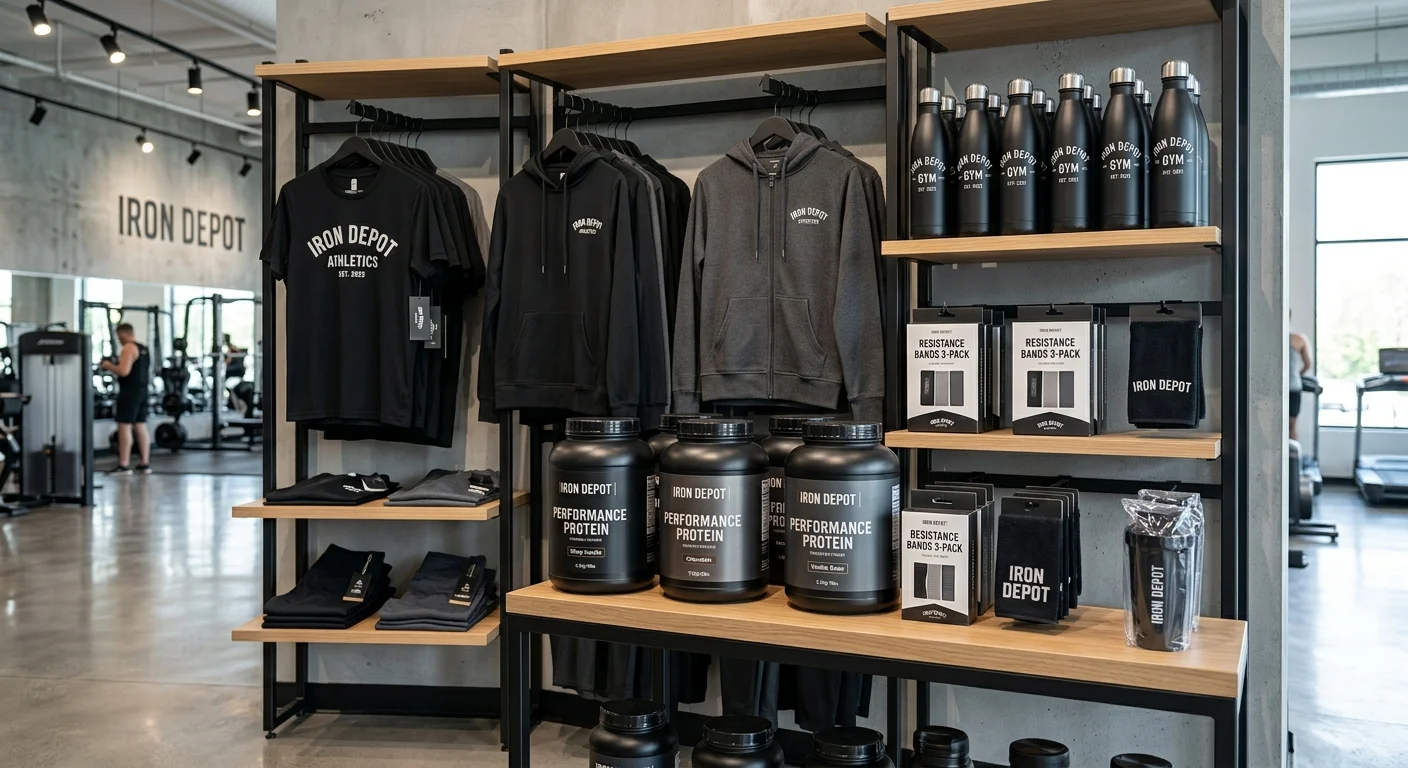
Not every product deserves shelf space in your gym. The wrong inventory ties up cash, collects dust, and drains your focus. The right three categories — launched in the right sequence — can turn your retail operation from an afterthought into a real gym revenue stream .
Here's the framework that works: start with consumables, add apparel, then expand into accessories. Each tier builds on the last. Each one has a different margin profile, MOQ reality, and sell-through risk. Understand all three before you commit any capital.
Tier 1: Supplements — Your Lowest-Risk, Highest-Turnover Entry Point
Protein powder and grab-and-go consumables top the non-dues revenue charts in fitness facilities with pro shops. In clubs that retail products, supplements and beverages account for 30–40% of non-dues retail sales . That's not an accident. The demand already exists inside your four walls — you're just not capturing it yet.
Start with 1–3 SKUs. No more.
The goal isn't range. The goal is sell-through. Pick from this proven starter set:
1 whey or plant protein (vanilla or chocolate — these two flavours account for over 60% of flavour sales in mass sports nutrition retail)
1 pre-workout or BCAA formula
1 foundational daily formula — a greens blend, multivitamin, or performance vitamin stack
This set covers the three purchase occasions your members already have: post-workout recovery, pre-session performance, and daily wellness. You're not guessing at demand. You're meeting it with your own label on it.
The MOQ reality for gym-scale programs:
Most contract activewear manufacturers that work with gym and coach brands offer 100–300 units per SKU as a minimum opening order for tubs and jars. That's a realistic entry point. Stick packs and sachets start much higher — 5,000–10,000 units — so save those for later once volume justifies the commitment.
Before committing to any SKU, run this simple filter:
Can I sell 80–100% of my MOQ within 6–9 months at my current active member count?
With 300–500 active members and just 5–10% converted into repeat buyers, moving 100–300 units over six months is very doable. If the math doesn't clear that bar, cut your SKU count — don't cut your standards.
Shelf life is your risk management tool. Standard private label protein powders carry 18–24 months from manufacture. Pre-workouts and BCAAs run in the same range. Capsule and tablet supplements often stretch to 24–36 months . Insist on at least 18 months of remaining shelf life at the time of receipt. Also, skip liquid RTDs in your first wave — shorter shelf life (often 9–12 months) plus higher shipping costs raises your write-off risk fast.
Certification: the one filter you can't skip
For fitness centres marketing to serious athletes or positioned as premium facilities, activewear supplier certification is not optional. Your baseline checklist:
GMP-certified facility — non-negotiable for any dietary supplement
HACCP plan in place as a food safety baseline
NSF Certified for Sport or Informed Sport/Informed Choice for at least your flagship performance SKU — critical if any members compete in tested sports
Budget limits you to one premium certification layer? Put it on your pre-workout or performance blend . That's where contamination risk perception is highest among members.
Tier 1 margin snapshot:
Product | Cost (100–300 MOQ) | Recommended Retail | Gross Margin |
|---|---|---|---|
Protein tub (900g) | $8–$12 | $29–$49 | 55–70% |
Pre-workout (250–300g) | $6–$10 | $24–$39 | 60–70% |
The rule: don't stock any SKU where your projected sell-through falls below 3 inventory turns per year at your target margin. Can't clear that threshold? It doesn't earn shelf space.
Tier 2: Branded Workout Apparel — Your Highest-Visibility Brand Builder
Apparel doesn't just generate revenue. It turns your members into walking brand placements — inside and outside your facility. A member wearing your branded workout apparel to the grocery store, on a run, or at another gym is doing passive marketing for you at zero cost per impression.
Data from boutique studios and fitness clubs is clear: tees, tanks, hoodies, and caps are the top-selling logo items , with sizes S–XL covering around 90–95% of member demand. Female-dominated studios see leggings and sports bras drive 30–50% of merch revenue . Mixed gyms tend to move more tops than bottoms in unit volume.
Your Tier 2 MVP launch set:
1 unisex tee in a core colour (black is your safest opener)
1 women's crop or tank if your member base is 50%+ female
1 hoodie — your high-price anchor piece
1 snapback or beanie — one-size, high visibility, low inventory complexity
MOQ guidance by production method:
For your first two to three drops, don't go straight to custom OEM cut-and-sew activewear. Start with blank garments plus screen print, DTF, or embroidery decoration . Decorators and sportswear suppliers offer 50–100 pieces per colour and design at this level — with mixed sizes often available within that MOQ. Full custom cut-and-sew yoga leggings and sports bras from Asian sportswear factories require 200–500 pieces per style . That's too much inventory risk before you know what your members will wear.
On fabrication: generic promo vs. gym-grade
This distinction matters for premium positioning. Spec your garments to perform:
Polyester or poly-spandex with moisture-wicking treatment (150–180 gsm for tees; 220–260 gsm for leggings)
4-way stretch construction for any bottom (73–78% polyester / 22–27% spandex is standard)
Anti-odor antimicrobial finish on performance tops — a real differentiator from generic branded merch
Flatlock seams in leggings and bras to eliminate chafing
Custom activewear woven neck labels or silicone heat-transfer logos for a premium unboxing feel
Members will notice the quality difference on the first wear. That experience converts a first purchase into a repeat buy and a real brand association.
Tier 2 margin snapshot:
Product | Cost | Retail | Gross Margin |
|---|---|---|---|
Branded tee | $6–$10 | $25–$35 | 60–70% |
Leggings | $12–$20 | $45–$75 | 55–65% |
Operational note: Plan apparel drops quarterly . Lock designs 60 days before your in-club launch date. This covers the standard 25–45 day bulk production and delivery window from screen print or embroidery decorators, plus buffer for approvals.
Tier 3: Gym Accessories — High Margin, Low Expiry Risk
Accessories are where margin percentage often peaks across your entire in-house gym product line . There's no shelf life to manage — no spoilage, no formulation risk, no certification complexity. The main inventory risk is a logo redesign making old stock look dated. That's a problem you want to have.
Start narrow:
1 resistance band set (3–5 bands in a branded pouch)
1 TPE yoga mat with logo print (if your programming includes stretching, mobility, or yoga elements)
1–2 small strength accessories — lifting straps and wrist wraps are a natural fit for strength-focused communities
MOQ benchmarks for accessories:
Resistance band sets with logo printing and pouch: 100–300 sets
Yoga mats (TPE or natural rubber) with logo: 100–200 pcs
Grip gloves, straps, wraps: 200–500 pairs depending on material and construction complexity
These ranges fit gym-scale inventory capacity well. You're not over-committing capital, and you're not chasing a national retail volume model.
Add perceived value without adding cost:
Small design decisions can lift the perceived quality of your accessories:
Resistance gradient mapping printed on bands (light / medium / heavy / X-heavy, with kg or lb equivalents) — cuts confusion and reinforces professionalism
Co-branded mesh or poly storage pouches — adds just $0.20–$0.60 per set at MOQ 200–500, but lifts unboxing quality sharply
QR codes on labels linking to your gym's exercise library or a dedicated landing page — negligible print cost, opens a digital upsell path into online coaching or programming
Tier 3 margin snapshot:
Product | Cost (at MOQ) | Retail | Gross Margin |
|---|---|---|---|
Resistance band set (3–5 bands + pouch) | $4–$8 | $19–$39 | 65–80% |
TPE yoga mat (6mm, logo printed) | $6–$10 | $29–$59 | 65–80%+ |
Grip gloves / lifting straps | $3–$8 | $15–$30 | 60–75% |
The Sequencing Logic — Why This Order Matters
Many gym owners want to launch apparel first. It feels like the boldest brand statement. Resist that urge.
Apparel requires size forecasting, style decisions, and higher per-SKU inventory commitment. Get the order wrong and you're sitting on 40 medium hoodies no one wants. Supplements are different. They get used up. They need replacing. A member who buys your protein powder this month will need more next month . That repeat purchase behaviour builds the retail habit inside your gym — and funds the capital you'll put back into your apparel and accessory tiers.
Start with custom branded protein powder as your proof-of-concept SKU. Prove the sell-through. Prove the margin. Build the habit in your membership base. Then expand. That sequence is how a small investment in private labelling grows into a compounding fitness brand identity — one that gets stronger every quarter.
Low-Cost Startup Framework and Supplier Vetting Checklist
The biggest mistake gym owners make entering private label isn't picking the wrong product. It's over-engineering the launch before a single unit has sold.
Keep it tight. Two to three hero SKUs is the right starting point — not ten, not five, not even four. A lean SKU count cuts your tooling costs, your MOQ exposure, and your inventory risk — all at once. Here's the three-item pilot stack built for fitness centres:
1 ingestible — a single whey protein flavour (vanilla or chocolate, 1 kg format)
1 apparel item — a unisex tee or legging in two to three sizes
1 accessory bundle — a 3-piece resistance band set with a branded pouch
That's your minimum viable product line. Prove sell-through on those three before you expand.
The SKU Approval Filter (Weeks 1–2)
Before committing capital to any product, run it through this three-question filter:
Does the landed COGS land at 25–35% or less of your planned selling price? If the unit economics don't work on paper, they won't work on a shelf.
Does the product use a single formula or pattern , with size variations only? Multiple formulas mean multiple MOQs. That kills your cost efficiency at low volumes.
Can it share packaging components — the same jar size, label dimensions, or box dieline — with your other SKUs? Shared components cut your print run costs and design fees by a clear margin.
Any SKU that fails one of these filters doesn't make the launch roster.
Packaging and Design: What It Costs
You don't need a full branding agency for your first run. Here's what your design budget actually looks like:
Scope | Typical Cost |
|---|---|
Logo + simple label set (template-based) | $150–$500 |
Full visual system + 3 SKUs (packaging, mockups, guidelines) | $500–$2,000 |
Ready-made label templates + designer customisation only | $20–$80/template |
The smartest cost-reduction move? Buy ready-made label templates and hire a freelancer just for customisation and regulatory copy. Platforms like 99designs or Fiverr deliver solid results at the lower end of that range.
For packaging layout, follow a clean front/back hierarchy:
Front panel : brand name, product name, primary benefit claim, net weight — no more than three font styles
Back/side panel : supplement facts or size chart, usage instructions, allergen statements, warnings
For supplements, put your protein grams per serving and BCAA content front and centre. For apparel, call out the GSM and fabric composition (e.g., 80% nylon / 20% spandex). These details signal quality to members who know what they're looking for.
Want the premium shelf look without the premium price? Go matte laminated labels or pouches . It adds around 5–15% to your print cost versus gloss — but it's the standard finish for products that look like they belong in a premium fitness environment.
The Supplier Vetting Checklist
Most gym owners skip due diligence here — and pay for it later with delayed shipments, inconsistent quality, or products that fail compliance checks. Score every potential activewear supplier across these eight dimensions on a 1–5 scale before signing a proforma invoice.
MOQ and Scalability
- Initial MOQ targets: ≤500 units for supplements and accessories, ≤300 pieces per style for apparel
- Non-negotiable: get written confirmation the supplier can scale to 2,000–5,000+ units per SKU without reformulating or changing materials
Certifications and Compliance
For supplements:
- GMP-certified facility (NSF, NPA, or equivalent)
- Certificate of Analysis (COA) per batch — must cover identity, potency, microbial counts, and heavy metals
- FDA 21 CFR 111 knowledge for US-bound products; EFSA-compliant ingredients for EU markets
For apparel:
- REACH compliance for dyes and finishes
- OEKO-TEX Standard 100 certification — a clear differentiator for premium positioning
Lead Times
- Sample dispatch: ≤15 days for custom flavours or patterns
- Mass production: ≤30 days from artwork approval and deposit for initial MOQs
- Confirm the express air freight option (5–10 days door-to-door) for emergency replenishment before you sign
Sample Policy
- Supplements: free samples plus shipping, or $20–$80 per flavour for full-size pilots
- Apparel and accessories: $30–$150 per sample set — push for full refund against your bulk purchase order and get it in writing on the proforma
Quality Assurance
- Request copies of all relevant certifications (GMP, ISO, REACH, OEKO-TEX)
- Ask for both a recent internal lab report and a third-party COA for a comparable product
- Confirm their standard defect allowance and their rework or refund policy in writing
Commercial Terms
- Get a written price ladder by quantity (500 / 2,000 / 5,000 units) before negotiating
- Confirm IP and tooling ownership — your formula and brand assets belong to you alone
- Make sure the supplier accepts an indemnification clause and agrees to cooperate on product liability matters
Corporate Verification
- Legal company name, registration document, and tax ID
- Minimum 3–5 years in business
- Two client references — even anonymised — and confirmation of main export markets
Working Capital Reality Check
A three-SKU pilot doesn't require the budget most gym owners imagine. Here's what the actual cost stack looks like:
Budget Level | Structure | Estimated Spend |
|---|---|---|
Conservative pilot | 3 SKUs × 150 units avg at ~$8 landed COGS + branding + freight | $5,000–$8,000 |
Aggressive launch | 3 SKUs × 500–1,000 units + ad spend | $20,000–$30,000 |
The landed COGS breakdown per unit breaks down like this:
- Supplements (private label whey, 1 kg): $6–$9 at 100–500 unit MOQ
- Apparel (tees or leggings): $6–$12 ex-factory at 100–300 units
- Accessories bundle (bands + pouch): $3–$6 ex-factory at 100–300 sets
- Packaging, labels, inserts: $0.30–$1.00 per unit
- Freight and duties: 8–20% of COGS for small air-freighted pilots
For most independent fitness centres, the $5,000–$8,000 conservative pilot is the right first move. Prove margin and sell-through on that initial run. Then reinvest the gross profit into your next inventory wave.
One Legal Item You Cannot Skip
Launching supplements — even just a house-brand protein powder — means product liability insurance is not optional. Most US retail channels and B2B partnerships require a minimum of $1M per occurrence and $2M aggregate coverage, with vendors named as additional insured. Startup premiums at this level run $800–$2,500 per year based on your product category and sales volume. That's a small number compared to your potential liability exposure.
Also, every supplement label must carry the required DSHEA structure/function disclaimer — "This statement has not been evaluated by the Food and Drug Administration. This product is not intended to diagnose, treat, cure, or prevent any disease." Keep all claims in structure/function territory ("supports muscle recovery") rather than disease claim language ("treats inflammation"). One non-compliant label can derail your entire line.
This framework isn't theoretical. It's the same approach that turns a gym's retail shelf from an afterthought into a compounding fitness brand identity — starting with a controlled, low-risk pilot that funds its own expansion.
Pricing Formulas and Member Promotion Execution Steps
Wrong pricing on your private label products costs you money. Worse, it quietly damages the premium brand you worked hard to build.
The good news: the math is simple. The execution is repeatable. Set it up once, and your pricing structure takes care of itself.
The Core Pricing Formula
Start with this rule. Stick to it on your first run:
Retail Price = Landed Cost × 2.5 to 3.0
That's your anchor. Everything else builds from it.
"Landed cost" means your true all-in unit cost — product, packaging, labels, freight, and duties. Not just the ex-factory price of your activewear supplier quotes. A 1 kg private label protein tub with a $10 landed cost puts your retail price at $25–$30. At $12 landed, you're pricing at $30–$36.
Want to work backwards from a target margin? Use this version:
Retail Price = Total Variable Cost ÷ (1 − Target Margin)
Example: variable cost of $10 with a 40% target margin → $10 ÷ 0.60 = $16.67 retail . Fast, clean, and every unit sold pulls its weight on your P&L.
Build a Member Pricing Tier — Then Protect Your Base Price
Most gym owners make the same mistake here. They cut prices across the board instead of building a tier structure.
Don't slash your retail price for everyone. Build a VIP member tier instead.
The formula is simple:
Base Price (public retail) = Landed Cost × 2.5–3.0
VIP Member Price = Base Price × 0.80 (20% off for active members)
Promo Price = Base Price × (1 − promo %) for short-term campaign windows only
This structure does two things at once. First, it protects your everyday price. Nobody sees your product as "always on sale." Second, it rewards loyalty with a real, exclusive benefit that non-members don't get access to.
For bundle offers, use this formula:
Bundle Price = Sum of Individual Items − Bundle Discount %
A protein tub at $30 plus a shaker at $15 equals $45 retail. Offer the bundle at $38 — a $7 saving — and you've lifted average transaction value while moving two SKUs in one sale.
The Four-Step Promotion Execution Sequence
Run every member promotion through this exact sequence. No shortcuts.
Step 1 — Set your base price first. Lock your cost-plus formula before any promotional layer goes on top. A base price that's off will make every promo worse, not better.
Step 2 — Define the member tier and formula discount. Assign your VIP price using the Base Price × 0.80 formula. This is a standing, always-available benefit — not a time-limited campaign.
Step 3 — Run short-term promotional windows on top. Launch day, new product drops, quarterly challenges — these are the right moments for a deeper promo (Base Price × 0.70, for example). Keep the window tight: 7–14 days maximum. Go longer than that, and you start training members to wait for discounts instead of buying at full price.
Step 4 — Review, measure, and adjust. After each campaign window closes, pull the numbers: units sold, gross margin realised, member vs. non-member purchase split. Use that data to sharpen your next promo — not to start guessing from scratch again.
This sequence isn't complex. Gyms that skip straight to "run a promo" without completing steps one and two end up discounting a price they never set right in the first place. That's how margin disappears without anyone catching it.
Get the formula right. Build your pricing tiers with a clear structure. Protect your base price — it's a brand asset, and it deserves to be treated like one.
Building the Brand Moat: LTV Expansion and Retention Data
Retention isn't a membership problem. It's a brand problem.
Most gym owners treat churn as something to fix with discounts, freeze policies, or contract terms. But the fitness centres with the strongest retention numbers aren't fighting churn with contracts — they're removing the desire to leave. That's what a private label line does at its deepest level.
Here's the mechanism. A member buys your branded protein, apparel, and accessories. Your brand stops being a place they visit. It becomes part of how they see themselves. Switching gyms no longer means cancelling a direct debit. It means walking away from a system they've built around themselves. That friction is worth more than any lock-in clause you could write.
The LTV Math Behind the Moat
Private label's retention impact feeds straight into your numbers through a simple formula:
LTV = Average Order Value × Purchase Frequency × Customer Lifespan
Pull any one of those three levers upward, and LTV compounds. A branded product line pulls all three at once. Members spend more per transaction (AOV lifts with bundles). They buy more often (consumables drive repeat visits and repeat purchases). And they stay longer (identity-based loyalty extends lifespan).
What to Track on Your Brand Moat Dashboard
Stop guessing at retention health. Track these six metrics on a regular basis:
12-month retention rate — your baseline moat measurement
Repeat purchase frequency on private label SKUs
Ancillary spend per member beyond membership fees
Cohort LTV by acquisition source — which channels bring your longest-staying members?
Engagement with branded touchpoints — product purchases, apparel worn in-gym, social tags
Competitors who can't replicate your moat aren't failing because of your formula or your logo. They're failing because they don't have your two years of cohort data. That data shows which members buy, when they rebuy, and what keeps them around. No competitor can shortcut that. It builds into a structural advantage that only grows over time.
Conclusion
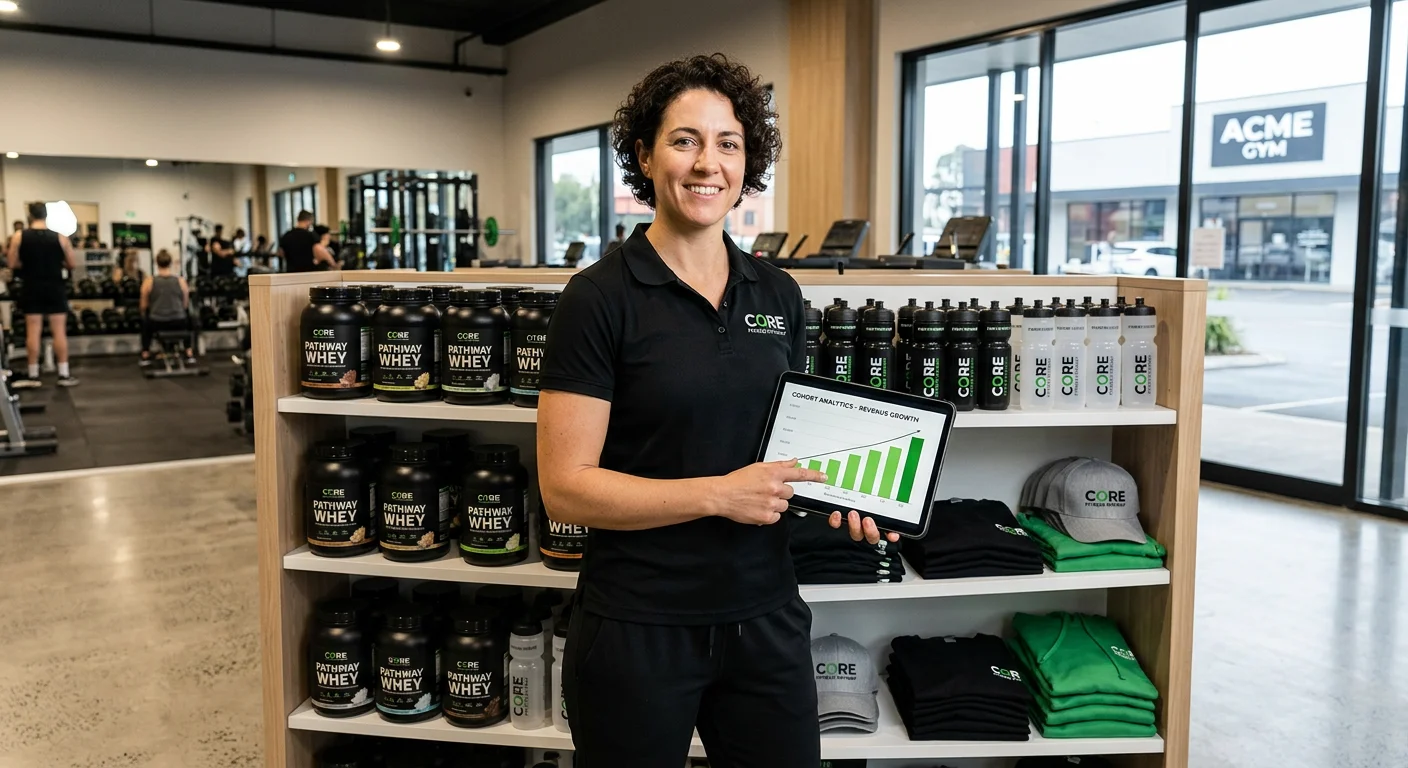
The math is simple. Every protein tub, branded water bottle, and custom fitness apparel piece on your competitor's shelf builds their margin — not yours.
Private labelling isn't a side project. It's the layer that turns your fitness centre from a membership business into a brand — one that members wear, use, and connect with. Gyms that win long-term don't just sell equipment access. They sell belonging. Something members feel is truly their own.
You've seen the margin data. You have the fitness wear supplier checklist. You know which categories to prioritize first.
Now it comes down to one decision: start small, start now.
Pick one product. Your custom protein powder or a signature water bottle works well. Place that first MOQ order. Then let your members do the marketing for you.
The gym that owns its brand owns its members' loyalty. And that is a gap no competitor can close by cutting prices.