You've got 90 days to launch your custom gym shorts collections, and you're staring at a spreadsheet of fabric weights, inseam lengths, and color combos with zero data to back your choices.
Most private labe gym shorts manufacturers pick designs based on Pinterest boards. Then they order 500 units of a style that flops, and their margins tank before the collection even launches.
This guide skips the fashion history lesson. Instead, you'll get the exact design variables—pocket placement, waistband construction, color-blocking ratios—that separate best-sellers from dead stock in the gym shorts private label space. You'll also walk away with a scoring checklist and a low-risk testing framework (think 20-50 units, not 500) to validate demand before you scale production.
How to match the length of pants (Inseam) with popular price range of target market?
Inseam is the single most returned-for-fit variable in gym shorts. Get it wrong by even 2 inches, and you'll see return rates spike. In the custom fitness apparel supplier world, one inch changes how a short fits the thigh, the crotch, and the visual proportion of the whole look.
Step 1: Map inseam to shorts category.
Gym shorts follow function. The height×0.6 pants formula doesn't apply. Here are the lengths by category:
3" inseam: compression and lifting shorts, bestseller on Instagram-driven fitness brands and powerlifting niches
5" inseam: the safest, most universal length. Works across CrossFit, HIIT, and general gym-goers
7" inseam: basketball and running-inspired shorts, trending with streetwear-adjacent activewear buyers
9" inseam: loose, board-short style, popular with plus-size and older demographic channels
Step 2: Pull your channel's actual customer data.
Don't guess. If you're selling compression shorts custom for a female fitness influencer audience, 70% of your SKU volume should sit in the 3"-5" range. If your channel skews male, gym-bro, powerlifting communities, shift 60-70% of volume into 5"-7".
Step 3: Set a primary and secondary inseam split.
A working allocation model:
Channel Type | Primary Inseam | % of Stock | Secondary Inseam | % of Stock |
|---|---|---|---|---|
Compression-focused (female) | 3" | 65% | 5" | 35% |
General training (mixed) | 5" | 60% | 7" | 40% |
Basketball/streetwear | 7" | 65% | 9" | 35% |
Step 4: Adjust from real feedback.
If return comments say "too short for my build," shift the primary inseam up by 1 inch for that batch.
Pattern structure selection: Loose woven fabric, tight compression, and 2-in-1
Global compression wear hit 35.17 billion RMB in 2023, up from 33.83 billion the year before. That's a 4% jump in one year. By 2028-2029, the market's projected to reach 46.65-48.22 billion RMB , growing at a steady 5.1% CAGR. In dollar terms, compression apparel was around $16.3 billion in 2023 and is expected to nearly double to $26.7-27.4 billion by 2032-2033.
Tight, body-hugging structures are a growth category. If you're building a custom sportswear design lineup, compression shorts custom orders should anchor your core SKUs, not sit as an afterthought.
Why compression wins in specific channels
Industry data tracks three structural categories every year: pants (compression shorts), shirts, and cinchers. Analysts track these because they carry the most sales volume and revenue elasticity. Demand is concentrated in training, running, and recovery scenarios, where support and muscle compression matter more than looks.
But compression has a ceiling. Buyers with waist or hip concerns get steered toward oversized or straight-cut styles because tight, stretch fabric emphasizes exactly what they're trying to minimize. This is where loose woven shorts earn their spot. E-commerce platforms even categorize them separately: "No Stretch" for structured woven fabrics, "Lightweight" for anything under 150 gsm . Tag these correctly, and you cut return rates tied to sizing complaints.
2-in-1: the bridge structure
This is the design most sellers overlook. A 2-in-1 short combines a loose woven outer layer with a compression liner inside, solving two problems at once. It delivers muscle support and anti-chafing benefits while hiding body shape under a relaxed silhouette. For runners and mixed-training buyers who want function without looking "too tight", this structure outsells plain non-functional loose shorts.
Decision framework for your collection:
Structure | Best For | Key Attribute to Tag |
|---|---|---|
Compression | Training, powerlifting, female fitness influencers | High stretch, snug fit |
Loose Woven | Body-conscious buyers, casual/streetwear crossover | No stretch, ≤150 gsm, runs large |
2-in-1 | Runners, mixed-training, undecided buyers | Compression liner + relaxed outer |
Stock all three if your custom logo gym shorts collection targets a broad audience. Skip loose woven, and you lose the body-conscious segment. Skip compression, and you miss the highest-growth category in gym shorts trends 2024.
Fabric ratio and weight: Which parameters determine the return rate and repeat purchase rate?
Return rates for gym shorts rarely come from bad marketing copy. They come from a fabric spec sheet that doesn't match what a customer feels when the package arrives. Apparel return rates across fashion sit at 20-30% industry-wide , and "doesn't match description" is one of the top three reasons. In gym shorts fabric selection, that mismatch traces back to two numbers: fiber ratio and GSM.
GSM ranges by gym shorts function
Match your target weight to the shorts' job, not a generic "activewear" standard:
Moisture-wicking training shorts : 130-180 gsm. Below 130g, buyers report "see-through" and "feels cheap." Above 180g, complaints shift to "too hot, doesn't breathe."
Compression shorts custom liners : 180-220 gsm. This range holds shape without restricting movement.
Heavyweight, cold-season or fleece-lined shorts : 220-260 gsm. Anything lighter here triggers "not warm enough" reviews.
Deviations matter more than the target number itself. A batch that swings more than 5% from your locked GSM gets flagged in reviews as "quality dropped" — even when the fabric is technically within spec.
Fiber ratio decisions that protect margin and reduce complaints
Polyester/spandex blends (85/15 or 88/12) dominate moisture-wicking gym shorts because they balance stretch recovery with dry-fast performance.
Recycled nylon or recycled polyester cost 20-30% more than virgin polyester, but they cut "rough texture" and "pilling" complaints in mid-to-premium custom sportswear design lines.
If you're marketing recycled content, the labeled ratio must match your GRS transaction certificate batch numbers exactly. A mismatch here doesn't just cause a return — it gets your account flagged, and B2B buyers stop reordering entirely.
Batch testing before you place a bulk gym shorts order
Before scaling past your test run, request from any custom fitness apparel supplier:
Shrinkage rate and pilling grade from the last 3 production batches
Colorfastness data (target ΔE ≤ 1.5 against your approved swatch)
Post-wash GSM shift — coated or brushed fabrics can swing +3-7% or -3.5-6% after washing, which directly changes hand-feel between batches
Lock these numbers in writing. Suppliers who can produce this data consistently show measurably lower return and complaint rates across repeat orders.
Functional details: The influence of pocket type, inner lining structure and waistband technique on transformation
Pockets, liners, and waistbands don't just affect comfort. They move your conversion funnel. Total conversion rate = paying customers ÷ store visitors. Every functional detail you highlight above the fold either pushes shoppers toward checkout or gives them a reason to bounce.
Pockets that sell themselves
Skip the generic "side pocket" callout. Buyers want to know if their phone fits. A short with a zippered anti-theft pocket, tagged "fits iPhone Pro Max," consistently outperforms unlabeled styles in add-to-cart rate. Track this in an A/B split: Version A shows only fabric and size chart, Version B leads with pocket capacity and security features in the first two screens. Measure the browse-to-cart delta.
Liner structure as a retention lever
Moisture-wicking or anti-static liners are conversion copy. When you label a liner "mesh, quick-dry," monitor dwell time and bounce rate before and after adding that callout. A 7-14 day comparison window is usually enough to see a measurable shift in browse-to-cart conversion for training-focused SKUs.
Waistband engineering and return risk
Waistband construction drives size-fit anxiety more than any other spec. Adjustable waistbands with hidden elastic, side toggles, or back stretch panels reduce hesitation at checkout. Quantify the adjustment range (e.g., ±3cm) directly on the product page. Compare order-to-payment conversion and size-related return rates between adjustable and fixed waistbands. Sellers running custom logo gym shorts lines should treat capacity-labeled pockets, named liner tech, and quantified waistband flexibility as one combined conversion lever.
Color blending schemes and color strategies: Analyzing platform data,combination of safety colors and contrasting colors
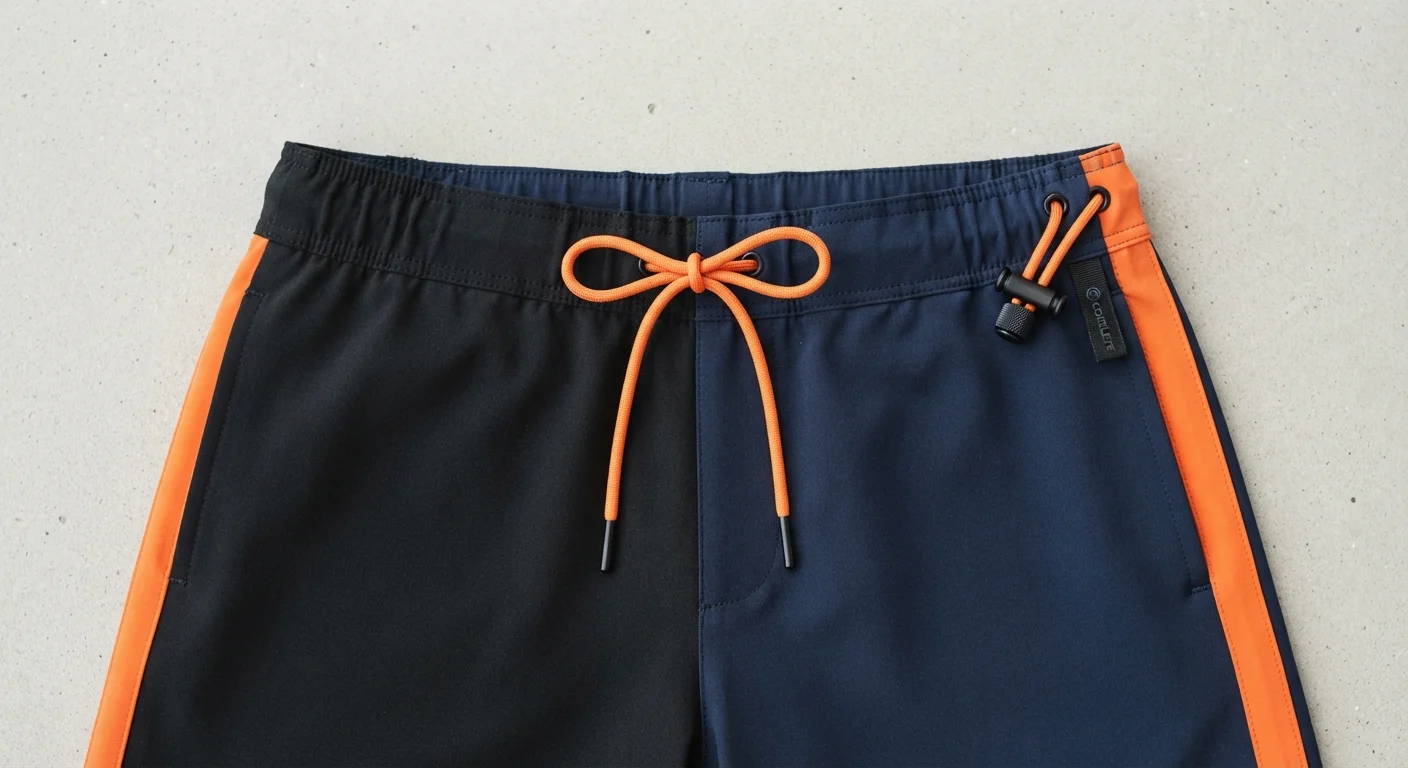
Color-blocking is a math problem. Platform-level color data across e-commerce and dashboards shows the same winning ratio applies to gym shorts: 80% safe color, 20% pop color. Translate that to fabric panels, and your main body (waistband, front panel, back panel) should sit in a low-saturation, neutral base—black, navy, heather gray. Your side stripe, drawstring, or pocket trim carries the high-saturation accent.
The area-ratio rule that prevents visual chaos
Lock these percentages into your spec sheet before sampling:
Safe color (main body): 60-80% of visible fabric area
Neutral secondary (piping, waistband lining): 10-25%
Pop color (side panel, logo thread, drawstring tip): 5-10%
Cap your total color count at 3 main families per SKU. More than that, and buyers perceive the design as cluttered. That shows up in lower add-to-cart rates on product listing pages.
Channel-specific combos that convert
Channel Type | Safe Base | Pop Accent | Pop % |
|---|---|---|---|
E-commerce/DTC storefront | White, light gray | Brand red (#E60023), orange (#FF6D00) | 15-20% |
Gym/training-focused custom logo gym shorts | Black, navy | High-vis orange (#FF9800), red (#E53935) | 5-10% |
Recovery/wellness lines | Teal, sage green | Muted yellow | 5-8% |
E-commerce data shows red and orange as the highest-converting pop colors on CTA elements. The same logic applies when that color sits on a side stripe instead of a checkout button. For gym shorts trends 2024, this safe-base-plus-single-accent formula outperforms multi-color patchwork designs on both conversion and reorder rate.
Best-selling product design evaluation checklist: Self-assessment form with 6 quantitative evaluation dimensions
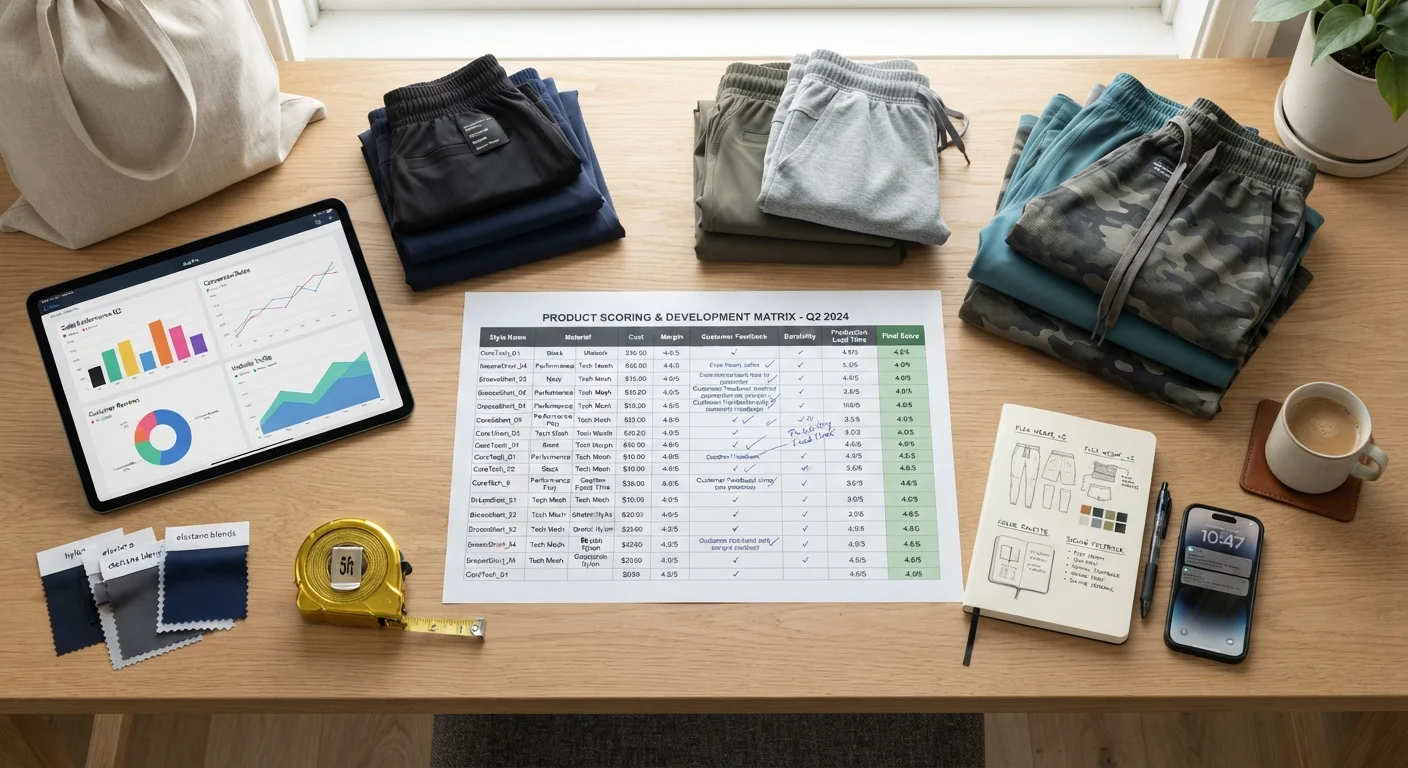
Design instinct gets you a sample. Data gets you a repeatable bestseller. Here is a scoring system that replaces "I think this looks good" with a number you can defend to a gym shorts factory, an investor, or your own P&L.
Score every custom gym shorts collection candidate across six weighted dimensions, out of 100 points total.
The 100-point framework
Dimension | Weight | What to Track |
|---|---|---|
Market demand | 20 pts | Search volume, sales growth, category monthly GMV |
Traffic acquisition | 15 pts | Keyword rank, CPC, exposure |
Conversion power | 20 pts | Click-through, add-to-cart, payment conversion |
Reputation barrier | 15 pts | Review count, rating, return rate |
Competitive intensity | 20 pts | BSR concentration, competitor count |
Risk/supply chain | 10 pts | MOQ, lead time, certifications, margin |
Set your thresholds, not just your gut
Category monthly sales in the $500K-$5M range signals real demand, not a niche fluke.
Core keyword CPC below $1.5 keeps customer acquisition costs low enough to scale.
Buyers paying a 10%+ price premium without hesitation means demand is real, not discount-driven.
Average review count under 300 in your target category means you can still break in without a decade of social proof stacked against you.
Top 10 sellers holding under 50% of category volume (top 3 under 40%) means the space is not locked up by two dominant brands.
Where the score lands
70+: green light. Move to production planning.
60-69: run a small-batch test before committing capital.
Under 60: drop it or redesign before you sample again.
Fields to copy into your own checklist
Track category monthly GMV, keyword search volume, keyword CPC, top-3/top-10 sales concentration, average review count, average rating, click-through rate, conversion rate, return rate, MOQ, lead time, certification risk, and projected net margin. Twelve fields. One spreadsheet. Score every SKU before you sample it.
Conclusion
Most private label fishing clothing sellers lose money because they guessed instead of tested. The inseam length, fabric weight, pocket design, and colorway are conversion levers, and you now know which ones move the needle and by how much.
So don't jump straight to a 500-unit bulk gym shorts order. Run your top 3 design candidates through the scoring checklist above, then place a 20-50 unit test batch. Let real buyers vote with their wallets before you scale production.
Pull out the checklist, score your next SKU right now, and place your test order this week. Your inventory risk and your margins will thank you.