Picking the wrong sports apparel wholesaler doesn't just cost you money — it costs you momentum. A delayed shipment kills your launch. An inconsistent fabric supplier destroys your brand reputation before it even has one. And a manufacturer who sounds great on Alibaba but ghosts you after the deposit? That's a lesson nobody wants to learn twice.
Sourcing private label athletic clothing for the first time? Or renegotiating with your current wholesale gym wear vendor? Either way, the gap between a supplier that grows your business and one that sinks it comes down to seven specific things. Most buyers never bother to check these upfront.
This guide gives you the exact evaluation framework — red flags, verification tactics, and questions to ask before you sign anything.
Fabric Technology & Performance Capability
Most first-time buyers miss this until it's too late: the fabric spec sheet is what separates real performance fabric activewear suppliers from companies that just screen-print polyester and label it "activewear."
The global performance textiles market is heading toward $92.34 billion by 2031 , up from $71.56 billion in 2024. That growth has one driver — consumers who test their gear and return what fails. Your moisture wicking fabric wholesale order needs to survive 10 wash cycles without pilling, fading, or losing stretch. Your return rate will expose what your supplier won't tell you.
So here's how to verify capability before you commit.
The Numbers That Matter
Ask every potential supplier for third-party lab reports. These should be recent — issued within the last 12–18 months — from SGS, Intertek, or OEKO-TEX-certified labs . Not internal factory PDFs. Not "available upon request." Real test reports, delivered before any deposit conversation begins.
What those reports should confirm:
Moisture wicking (AATCC 195): ≥10–15 cm vertical wicking in 30 minutes
Stretch recovery (ISO 20932): >90–95% recovery after 100–300 stretch cycles
Pilling resistance (Martindale): Grade 4–5 after 5,000–10,000 cycles
Colorfastness to washing (ISO 105-C06): Grade 4 or higher
Abrasion resistance : >20,000 Martindale cycles for mid-to-high-end active fabrics
For compression leggings, elastane content is critical . Light compression needs 12–20% elastane at 240–300 GSM. Squat-proof construction requires 20–30% elastane at 260–320 GSM. A supplier who can't quote these figures by fabric code doesn't know their own product line.
The Pre-Production Reality Check
Lab reports verify the mill's claims. Your own hands verify the supplier's honesty.
Order bulk-lot swatches — not the polished "salesman hangers" set aside for buyer visits — and run these tests yourself:
Wash test : 5–10 cycles matching your care label instructions. Check for pilling, color shift, shrinkage, and elasticity loss.
Stretch hold test : Mark a 10 cm segment. Stretch it to 15 cm. Hold for 30–60 seconds. Measure recovery at 5 minutes and again at 1 hour. Permanent elongation signals compromised elastane quality.
GSM verification : Weigh the swatch yourself. A ±5–7% variance from the declared GSM is normal. Anything beyond that points to fiber substitution — full stop.
Also request the fabric engineering sheet : fiber content (%), GSM, knit structure, width, finishes applied, and matching test data. Any established performance fabric supplier provides this as a standard document. A supplier who hesitates? That hesitation is your answer.
🚩 Red Flags to Watch For
Warning Signal | What It Means |
|---|---|
"Premium polyester blend" with no GSM or fiber % | They're hiding an underspec fabric |
Internal test reports only, no third-party lab | Claims can't be verified |
Sample passes, bulk order pills after 3 washes | Fiber substitution between sample and production |
Can't name the wicking or antimicrobial chemistry used | The "performance finish" washes out after 10–20 cycles |
Glossy brochures, zero numerical performance metrics | Marketing is doing more work than the QC team |
The most dangerous supplier isn't the one with low prices. It's the one who talks a good game but can't back a single claim with a test standard reference number. Build your tech pack with exact specs — for example: "Moisture wicking: AATCC 195, vertical wicking ≥ 10 cm/30 min; Colorfastness: ISO 105-C06, Grade ≥ 4" . Then require suppliers to sign off on those figures as binding performance requirements — not suggestions.
Quality Control Systems & Consistency
Here's a number worth paying attention to: brands with documented QC systems see defect rates below 2–3% at AQL 2.5. Factories running ad-hoc end-line checks? Expect 5–10% or worse. That gap doesn't just hurt your margins — it determines whether your brand makes it through the first 12 months.
The math adds up fast. Every 1% increase in defect rate costs a mid-size sportswear brand tens of thousands of dollars per year. Factor in rework, customer returns, discount markdowns, and reverse logistics. Online sportswear returns from quality issues alone hit 8–10% of sales without upstream controls. Tighten the QC pipeline upstream, and that figure drops below 3–5%.
The question isn't whether a supplier "has QC." Every factory claims they do. The real question is whether they can prove it at each production stage .
The Five-Stage QC Verification Framework
A credible sports clothing quality control process is not a final inspection box-check. It runs in five distinct stages. Ask for documentation at every one of them.
1. Incoming Material Inspection
Raw materials need inspection before a single stitch is sewn. Use a 4-point fabric grading system with a pass threshold of ≤20 points per 100 yards . GSM tolerance gets documented at ±5% of the declared spec. Color consistency checks run against approved lab dips and shade bands under D65 lighting — not fluorescent showroom lights.
Ask for these records up front. No fabric inspection logs? Don't trust anything that comes after.
2. Pre-Production & First Article Approval
This is where most buyers get burned. A supplier runs your pre-production sample in a clean sampling room under ideal conditions, then shifts to bulk production on a different line with different operators.
Require a signed PP sample approval sheet that locks in:
- Size spec vs. actual measured values
- Stitch type per seam (e.g., 4-needle 6-thread flatlock for compression leggings)
- SPI targets: 10–12 SPI for sports knits, 8–10 SPI for heavier constructions
- Print positioning tolerance: ±5 mm from center
No signed sheet, no deposit. That's the policy.
3. Inline Process Control
This stage separates serious bulk sports clothing manufacturers from cut-and-pray operations. Real inline QC means documented checks every 1–2 hours during active sewing. At minimum: 2 garments per size per line, with checks on stitch density, seam appearance, and panel alignment.
Ask to see their DHU (defects-per-hundred-units) target . A well-run sportswear line keeps DHU below 2–3% . Request control charts or check sheets that show trend tracking across shifts. A supplier showing only pass/fail stamps with no trend data is operating blind.
4. Mid-Production Inspection
For orders over 3,000 pieces, require a formal mid-production check at 25–50% completion — run by either an internal QA team or a third party. The report must cover sample size (80 pcs), defect rates broken down by category, and corrective actions signed off by the production manager.
Never done a mid-production check before? That's not a process gap. That's a process choice.
5. Final AQL Inspection
This is non-negotiable. Require ANSI/ASQ Z1.4 or ISO 2859-1 random sampling with documented AQL levels. The industry standard for premium activewear:
AQL 2.5 for major defects
AQL 4.0 for minor defects
General Inspection Level II, Single Sampling plan
For reference: a 1,200-piece lot requires a sample of 80 pcs , with acceptance at 5 majors / 7 minors per the AQL table. Put this language straight into your purchase contract:
"Shipment released on pass result at AQL 2.5 major / 4.0 minor per ANSI/ASQ Z1.4. Seller bears rework and re-inspection costs if failed."
What to Demand as Proof (Not Just Promises)
Documentation is the baseline. What separates real QC from PowerPoint QC is execution evidence . Ask for these before releasing payment:
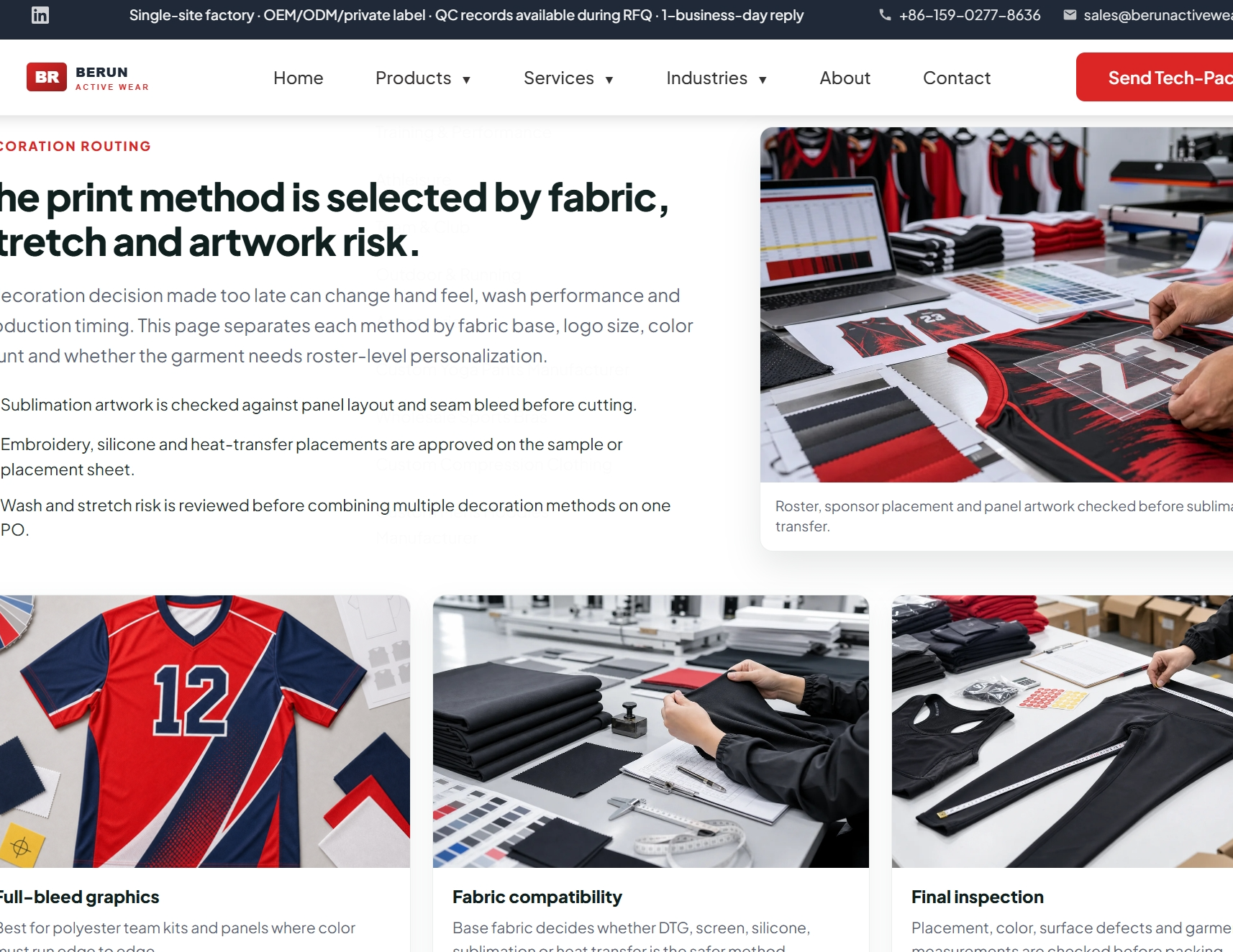
Unedited 30–90 second videos — showing QC staff measuring garments against a printed spec sheet on a measurement table, defects marked with stickers and placed into labeled rejection bins, and final packing line checks with barcode scanning
Timestamped photos — heat transfer printing with temperature/time display visible, plus the inline QC station showing that day's DHU count on a defect board
Rework logs — covering date, line, defect type, quantity, and root cause. Not just a pile of rejects in a corner
Tie your payment structure to this. Hold the final 10% balance until you receive the complete final inspection report with photos, a signed QC checklist, and defect statistics from final inspection.
The QC Checklist Your Supplier Signs Before Production Starts
Build this into your tech pack as a binding Quality Agreement appendix:
Inspection Point | Standard / Tolerance |
|---|---|
Seam strength (pull test) | 15–20 lbs minimum |
Thread ends | ≤3–5 mm trimmed |
Print position tolerance | ±5 mm from spec |
GSM variance | ±5% of declared spec |
Sizing — key POMs (chest, waist, hip) | ±1 cm (S–XL), ±1.5 cm (plus sizes) |
Colorfastness to washing | Grade 4+ (ISO 105-C06) |
Label and barcode accuracy | 100% SKU/size/color match |
🚩 Red Flags to Watch For
Warning Signal | What It Means |
|---|---|
"We check every piece" — no written SOP | Unstructured visual inspection; no acceptance criteria |
Can't produce past inline QC forms | No inline process exists — end-line checks only |
Dismisses SGS, Bureau Veritas, or Intertek audits | They don't want independent eyes on the floor |
Offers per-piece compensation but no root-cause analysis | Expect the same defects on your next order |
Vague DHU claims with no historical data | The number is made up, not measured |
The factory that says "our typical DHU is 1.8% for leggings lines — here are last month's reports" sits in a different category from the one saying "don't worry, our quality is very good." Words are free. Signed AQL reports aren't.
OEM/ODM & Customization Depth
"Customization" means two very different things. One version means swapping your logo onto someone else's leggings. The other means owning your fit, your paneling, your IP — and building something no competitor can copy by clicking "order" on the same catalog page.
Most sportswear factories offer the first. Very few deliver the second.
This gap — ODM versus true OEM depth — is where brand builders either gain a real competitive edge or end up selling the same silhouette as thirty other Shopify stores.
ODM vs. OEM: The Practical Difference
A standard ODM sportswear factory gives you logo swaps, a few color options, and maybe a fabric upgrade. The pattern stays fixed. The silhouette stays fixed. So does every other brand's version of that garment.
A genuine OEM sportswear manufacturer works from your tech pack. You get custom grading rules for your target market — US sizing versus EU body shapes. Stretch orientation gets engineered by garment zone — higher GSM at the knee, lower at the back panel. Seam placements belong to you, because you spec'd them.
One key point about IP: in an OEM setup, design IP belongs to you . In ODM white-label deals, the factory keeps the block. Your "exclusive" style can quietly show up in someone else's collection next season.
The Tech Pack Stress Test
Don't just ask a supplier whether they do OEM. Show them a complex style and watch what happens.
Send something that needs real engineering — a performance training top with asymmetric front paneling, raglan sleeves, side mesh panels, and a full-body sublimation graphic that crosses multiple seams. Then ask these questions:
"How will you manage tension distribution around the armhole?"
"What seam types do you recommend for high-stress versus low-stress zones?"
"How do you maintain print registration across seams during sublimation and cutting?"
A strong ODM OEM sportswear partner comes back within 24–72 hours with a marked-up tech pack. It covers stitch types (4-thread overlock, 6-needle flatlock), recommended SPI per seam position, panel resizing notes for sublimation shrinkage (1–3 mm), and a grading table for your full size run.
A weak operation replies: "This is too complicated. Please choose from our existing styles."
That one exchange tells you more than three sales calls ever would.
Verify In-House vs. Subcontracted
"We can do it" tells you nothing without knowing who does it. Ask for hard proof — machine lists, videos, photos — showing they handle these in-house:
Cut-and-sew : flatlock, coverstitch, bar-tack, auto-cutting. Check whether they can execute asymmetric paneling and curved seams at volume.
Sublimation : Do they own the printers and heat presses? Confirm max print width (1.6–1.8 m standard), color profile, and panel-to-panel registration tolerance (≤2–3 mm is acceptable).
Embroidery : Look for multi-head machines (6–12 heads minimum), plus the right backing for stretch fabrics — cut-away or stretch backing, not tear-away.
Hardware : Branded YKK or SBS zippers, jacquard elastics, silicone grippers — all should be specifiable, not just whatever sits in the warehouse.
Factories that outsource pattern drafting or printing lose tolerance control at every handoff. That variance lands in your bulk order.
Sampling Rounds & Revision Mechanics
Ask up front how many sample rounds are included. A solid activewear production partner covers 1–2 development samples plus one pre-production sample (PPS) — either included in the cost or offset against a confirmed bulk order.
Standard turnaround benchmarks for a competent factory:
First pattern + proto: 10–20 days after confirmation
Revision rounds: 7–15 days each
PPS after final approval: 7–10 days
Also check: are you talking straight to the pattern room and technical team , or does everything go through a sales rep? Direct technical access is non-negotiable for multi-round fit development.
🚩 Red Flags to Watch For
Warning Signal | What It Means |
|---|---|
Can only change logo/print on fixed stock bodies | Basic private label, not OEM — zero IP protection |
Can't provide pattern files (DXF, Gerber) or explain grading rules | Catalog-only operation; no in-house pattern capability |
Sample fees exceed 3× target FOB price with no engineering rationale | Subcontracting; no internal technical competence |
Blanket "not possible" on asymmetric paneling or cross-seam sublimation | Rigid mass-production setup; can't handle brand-specific construction |
Can't explain shrinkage allowances or elastane impact on compression | Traders posing as manufacturers — they don't own the process |
Run the same tech pack through two factories at the same time. Build a simple scoring sheet: response time, pattern accuracy, quality of technical questions, print and tension handling detail, and number of proactive suggestions. A true custom sports apparel wholesale manufacturer scores on technical depth — not just on saying yes.
Minimum Order Quantity (MOQ) & Production Scalability
Sports clothing MOQ is the number that separates a supplier who fits your business from one who silently drains it.
Get this wrong and you're either sitting on $40,000 in unsold leggings or paying 40% above unit cost just to run a test batch. Neither is a good place to build a brand.
Here's what experienced buyers know that first-timers don't: MOQ isn't a fixed wall. It's a negotiation tied to real manufacturing constraints — fabric lot sizes, dye minimums, line setup costs. Understand why the number exists, and you can work around it.
The Numbers Behind the Number
Most cut-and-sew sportswear factories set bulk MOQs at 300–500 pieces per style for smaller operations. Larger export manufacturers scale that up to 1,000–5,000+ pieces . But that top-line figure doesn't tell the full story.
The MOQ that hits your order hardest is the breakdown:
Per colorway minimum : 100 pcs per color within a 300-piece style MOQ (3 colors × 100 pcs)
Per size minimum : A 100-piece color run often splits as S:M:L:XL = 17/33/33/17 units
Fabric mill floor : Greige fabric mills require 800–1,500 m per color . Dye-lot minimums run 200–400 m per color . These upstream limits shape what the garment factory can offer you
Drop below those color minimums and surcharges kick in fast — extra screen setups, separate dye lots, disrupted line scheduling.
What Sub-MOQ Orders Cost You
Before agreeing to any "flexible MOQ" offer, get the exact surcharge table in writing. A solid benchmark looks like this:
Order Size | Price Surcharge |
|---|---|
50–100 pcs | +40% |
101–200 pcs | +20% |
201–299 pcs | +10% |
300+ pcs (full MOQ) | 0% |
Run that math against a base price. Say your FOB target is $8.00/unit and you're running a 150-piece test batch. You're paying $9.60/unit — a 20% premium before freight, duties, or 3PL fees.
That's not a deal-breaker for a pilot run on its own. It becomes one if the factory never mentioned it until after the deposit.
The Scalability Questions That Matter
Checking activewear production lead time stability at higher volumes is just as important as nailing the initial MOQ. Ask these questions — and get written answers:
What is your current monthly capacity for similar sportswear categories?
What is your average capacity utilization rate ? (70–85% is healthy; above 90% means no buffer for your rush order)
Can you absorb a 30–50% order increase month-over-month across 3–4 consecutive months?
What happens to lead time at +30% volume? At +50%?
A factory running at 95% capacity and promising 45-day turnarounds can't back that up. The floor simply doesn't have the room.
How to Negotiate Lower MOQs Without Wrecking Your Pricing
Suppliers start moving on price and MOQ once they see predictability from you. Here are three tactics that work for wholesale pricing sports apparel :
Consolidate across colorways, not styles. Hit the style-level MOQ with fewer SKUs and more color options. Spreading thin across multiple styles makes it harder to reach any single threshold.
Use stock fabrics and standard trims. Skipping custom mill minimums is the fastest way to cut your effective MOQ in half. A factory pulling from existing fabric inventory doesn't need 800 meters to start your run.
Share a 6–12 month forecast by style family. Factories lower MOQs for buyers who show repeatable volume. A written rolling forecast tells the factory you're a planning partner — not a one-time test order.
Build a Pilot-to-Scale Structure Into the Contract
Don't treat MOQ as a one-time favor. Build a formal ramp structure into the contract from the start:
Cycle 1 (Pilot) : 150 pcs per style at base price +20% surcharge
Cycle 2–3 : Buyer commits to 300–400 pcs per cycle; factory drops surcharge to +10%, then 0%
Credit clause : Hit ≥80% of forecast in Cycle 1, and the factory credits back half the surcharge as a rebate on the Cycle 3 invoice
Add explicit lead-time caps to this — 60 days standard, 75 days at +50% volume. Include an air-freight cost-sharing clause if they miss. The factory gets predictable scheduling. You get a clear path to full wholesale pricing sports apparel rates without tying up too much capital upfront.
🚩 Red Flags to Watch For
Warning Signal | What It Means |
|---|---|
High MOQ with zero breakdown by fabric, color, or size | Hidden structural limits they don't want you to question |
No surcharge table — "we'll figure it out" | Charges appear after deposit; no recourse |
Capacity utilization above 90% with aggressive lead-time promises | Delays are built in before you've even placed the order |
Offers to cut MOQ but shifts to unvetted subcontractors | Quality control drops the moment volume goes down |
Refuses to commit to lead-time impacts at +30–50% volume | No production planning process; purely reactive |
The right wholesale gym wear vendor doesn't just hand you a number. They explain where it comes from. They show you the surcharge schedule without being asked. They walk you through what happens when your order doubles. That kind of transparency — before any money changes hands — is the clearest sign you've found a supplier built for long-term growth, not just a single transaction.
Lead Time Stability & Supply Chain Management
Thirty days of unsold inventory sitting in a warehouse isn't a storage problem. It's a lead time problem. It started the moment you accepted a supplier's vague "approximately 45 days" promise without pressing for what that means.
Lead time variability is a direct tax on your working capital. The math is unforgiving. Every time your supplier's standard deviation on delivery dates doubles, your required safety stock doubles with it. That's cash tied up in buffer inventory instead of new styles, marketing, or growth. For seasonal sportswear drops — where your campaign window is fixed and your launch date is non-negotiable — a "short but unpredictable" lead time is worse than a longer, stable one.
The Numbers You Should Be Asking For
Don't accept a single average figure. Ask every potential wholesale gym wear vendor for a 12-month data extract covering:
On-time delivery (OTD) rate — % of purchase orders delivered on or before the promised ex-factory date, broken down by month and order complexity (replenishment vs. new style development)
Lead time distribution — average production lead time from PO confirmation to ex-factory, plus the standard deviation and the percentage of orders more than 7 days late
Delay attribution split — what percentage of delays trace back to fabric/trim procurement, cut-and-sew capacity, or logistics/carrier issues
That last point matters more than most buyers realize. A factory that blames "the forwarder" every quarter — and keeps no backup carrier relationships — isn't managing your activewear production lead time . They're just describing it after the fact.
🚩 Red flag : A supplier who gives you one headline number ("our average is 45 days") with no OTD trend data, no lead time histogram, and no milestone breakdown has no real visibility into their own process.
Milestone Maps & Material Buffer Policies
Every confirmed PO needs a documented production milestone schedule — not just a single ex-factory date. A well-run sportswear supply chain tracks:
Fabric and trim arrival at the factory warehouse
Cutting start and finish
Sewing start and finish
Finishing, QC (inline + final AQL), packing
Forwarder handoff and FOB date
Ask the supplier to share a WIP tracking report from a completed order — with real dates at each milestone against the original plan. A factory running on a whiteboard and phone calls is a factory where your launch date becomes the first casualty of a late fabric shipment.
On the material side, push for their written buffer policy on core performance fabrics:
How many days of on-hand coverage do they hold for standard moisture wicking fabric wholesale materials — black, navy, heather grey?
Do they run vendor-managed inventory (VMI) with key mills, or do they order fabric after your PO confirmation?
That second question is a litmus test. A supplier who orders all materials after deposit confirmation shifts every supply risk onto your timeline, your launch window, and your cash flow.
Contract Language That Protects You
Vague commitments break down under pressure. Build these into every purchase contract before any deposit moves:
Define the lead time clock : Does it start from deposit? From PP sample approval? From final tech pack sign-off? Each factory counts this differently. Spell it out.
Milestone penalty clauses : Late ex-factory dates beyond an agreed tolerance (5–7 calendar days is standard) trigger a defined chargeback — not a conversation.
Peak-season contingency requirements : Get written documentation of alternative capacity (sister facilities, pre-approved subcontracting lines) and earlier cut-off dates around CNY, Golden Week, and Q4 Black Friday windows.
Weekly WIP reporting : % of fabric received, % cut, % sewn, % packed — by style and PO, with a rolling forecast ex-factory date against original commitment.
🚩 Red Flags to Watch For
Warning Signal | What It Means |
|---|---|
"Approx. 45 days" with no milestone breakdown or OTD history | No production visibility; promises based on habit, not data |
Delays blamed on mills or forwarders with no mitigation plan | No secondary suppliers or carrier backup; reactive, not managed |
No defined material buffer for core fabrics | All procurement risk lands on your timeline post-deposit |
Can't share a WIP report from a closed order | No tracking system exists beyond a single delivery date |
No peak-season contingency plan | Your Q4 launch competes with everyone else's — with no backup |
One tip worth adding to your planning calendar: build a 10–15% buffer onto every stated production lead time for fashion and seasonal drops. A factory quotes 60 days? Plan for 66–69. Use the weekly WIP data to compress that buffer if things run ahead — but don't plan as if they will.
The suppliers worth keeping are the ones who flag a fabric delay on Day 8 and hand you a revised milestone map with two mitigation options already laid out. That behavior — not a polished sales deck — is what sports apparel wholesale supply chain management looks like at scale.
Pricing Structure & Wholesale Value Alignment

Price looks simple on paper. Three months into production, your margins can collapse without warning.
Wholesale gross margins for sports apparel brands run 45–65% on the brand side. A 5–10% cost swing from unplanned testing fees, relabeling charges, or freight adjustments can wipe out over 30% of your planned margin for the season. That's not a rounding error. That's the difference between a profitable launch and a cash flow crisis.
Know What You're Paying For
Before accepting any FOB quote, ask your supplier to break it down. For a mid-tier performance tee, the cost split should look like this:
Fabric & materials : 45–60% of FOB
Trims & packaging : 5–8%
Cut & sew labor : 10–18%
Decoration (screen print, heat transfer): 5–12%
Overhead & admin : 5–10%
Factory margin : 8–15%
That last number matters. A factory margin below 5% is a red flag — it signals instability, hidden cuts, or a bait-and-switch incoming. Above 20% means there's negotiating room at scale. Either way, you need to see the full split.
A supplier who hands you an all-in per-piece number and won't show fabric yield, consumption, or GSM is hiding something. Don't accept that.
Demand a 3-Tier Pricing Matrix
A credible wholesale pricing sports apparel quote shows at least three volume tiers. Here's a real-world benchmark for a 150–160 GSM polyester performance tee with a one-color front print, FOB Asia:
Order Volume | Indicative FOB Price |
|---|---|
100 pcs | ~$4.50–$5.20 |
1,000 pcs | ~$3.10–$3.60 |
5,000 pcs | ~$2.40–$2.90 |
Look for threshold cliffs — price drops of $0.25 or more at 1,000 or 3,000 pieces. Use those breakpoints to structure your color and size curve.
Then lock that matrix in writing for 6–12 months . Adjustments should be permitted only when a defined raw material index moves more than ±5%. Get that in the contract.
Account for the Costs That Don't Show Up in the Quote
First-time buyers get hit hardest here. The FOB price is just the starting line. Build these line items into every landed cost calculation:
Lab testing : $80–$250 per test group for standard protocols. Complex chemical suites (REACH, Prop 65) can reach $400–600 per submission
Woven main labels : $0.03–$0.08 per unit at volume
Heat-transfer labels : $0.05–$0.12 per unit
Hangtags : $0.04–$0.10 each
Upgraded polybags (bio-based, printed, resealable): $0.03–$0.12 extra per piece
Third-party AQL inspection : $150–$300 per man-day. Spread across units, that's $0.02–$0.05 per piece
Sample/proto charges : $30–$200 per style. Negotiate credit back against confirmed bulk orders
Push every supplier to list these as explicit line items — not buried inside "admin" or "misc." That's where margin erosion hides most of the time.
Build Your Full Margin Picture
Start with landed cost — FOB plus freight, duties, brokerage, QC, and a 1–3% rework allowance. Then run the full margin stack:
Target wholesale gross margin : 50–60% on landed cost
Example : $4.00 landed cost → wholesale price to retailers at $8.00–$9.00 (50–56% margin)
Retailer SRP : 2.0–2.5× wholesale for mid-market activewear
Stress test : model a +10% landed cost and −10% average achieved price scenario. Gross margin below 40–45% means your cost base isn't aligned with wholesale reality
🚩 Red Flags to Watch For
Warning Signal | What It Means |
|---|---|
FOB quote well below market (e.g., $1.60 for a performance tee where fabric alone costs $1.20–$1.40) | Expect a "technical adjustment" surcharge after the deposit clears |
Refuses to share a cost breakdown by category | Hiding excessive margin or unstable subcontracting |
Charging $0.40–$0.80 extra for basic moisture management on standard polyester | That finish should be built in already — ask for the chemical spec sheet |
Same spec, same MOQ, but reorder quote varies >10% with no raw material justification | No pricing discipline. Track historical FOB by style and challenge anything beyond ±5% |
Fabric wastage above 8–10% on basic knits, or vague "defect allowance" charges | Standard wastage for tees and shorts is 3–7%. Anything beyond that needs a line-item explanation |
The best suppliers hand you a detailed cost breakdown before you ask. They flag index-driven adjustments early. They lock pricing on confirmed programs. That kind of transparency isn't a bonus — it tells you exactly how they'll behave when things get complicated.
Communication Responsiveness & After-Sales Support
A supplier who answers every email within 20 minutes during the quoting phase — then goes silent for 72 hours after your deposit clears — isn't a communication partner. That's a sales team with an ops problem attached.
Research backs this up: buyers are 2.4× more likely to stay loyal to suppliers who resolve issues fast and keep them informed. Response speed in the first hour of inquiry boosts conversion. The stat that matters most for sourcing decisions, though, is the post-sale figure. Most factories drop that responsiveness once the money moves.
Run a Pre-Contract Stress Test
Before any PO, send a multi-part technical RFQ . Measure the response against these benchmarks:
First acknowledgment: ≤1 hour during business hours
Complete, accurate answer to all parts: ≤24 hours
Test across at least two channels (email + WhatsApp or WeChat) and log response times across 3–5 interactions
Don't test with a simple pricing request. Send something that requires real knowledge — moisture-wicking spec confirmation, the AQL standard they use for seams and logos, size tolerance charts, and a direct after-sales scenario: "If 3% of units show print peeling after one wash, what's your corrective action, timeline, and cost split?"
A factory that answers with a structured, numbered response — citing specific turnaround times, defect thresholds, and evidence requirements — has a real process in place. One that replies with "don't worry, our quality is very good" has a sales rep.
Demand a Written After-Sales Policy With Numbers
"We'll handle any problems" is not a policy. Push for a written SOP that specifies:
Policy Element | What to Require |
|---|---|
Defect rate trigger for free remanufacture | Stated as a % of units per batch |
Replacement production lead time | 10–20 days is a realistic benchmark for sportswear basics |
Defect claim acknowledgment window | 24–48 hours + documented action plan |
Evidence format accepted | Photo + video (not full physical return — saves freight) |
Coverage scope | Colorfastness, print peeling, seam failure, pilling, size deviation, lab test failures |
They can't produce this document on request? That's not a paperwork gap. It's a signal about how disputes get handled when the stakes are real.
Verify the Account Structure Before You Need It
Know who owns what before a problem surfaces:
One named account manager for day-to-day communication
One named technical lead for pattern, print, and fabric decisions
A defined escalation step — sales manager or owner — if disputes aren't resolved within 3 working days
Factories without this structure force you to restart the conversation every time an issue comes up. That costs you days. In seasonal sportswear, lost days mean missed launch windows and marked-down inventory.
🚩 Red Flags to Watch For
Warning Signal | What It Means |
|---|---|
Response drops from <2 hrs to >48 hrs after deposit | Structural post-sale neglect, not a one-off delay |
Blames size issues on "international conversion" with no corrected grading sheet | Weak technical accountability and no improvement loop |
No written defect policy — just verbal reassurances | Disputes get handled ad hoc; expect friction and delays |
Can't state their average complaint resolution time | No tracking system exists; problems disappear instead of getting solved |
Accepts disputes through formal legal channels only | Built-in friction to discourage claims — not a partner structure |
The suppliers worth building with treat your technical questions as joint risk management , not as a test to survive. They flag issues before you ask. They track resolution times. They hand you an escalation path on Day 1.
That behavior — consistent before and after the PO — is the clearest sign of a wholesale partner your brand can scale with.
Conclusion
Picking the right sports apparel wholesaler isn't just a vendor decision — it's a brand-defining bet .
The seven dimensions we've covered — from moisture-wicking fabric technology and quality control systems to ODM/OEM sportswear customization depth and activewear production lead time — go far beyond simple evaluation criteria. They protect you from the expensive mistakes that destroy first-time sourcing relationships before they ever get off the ground.
Here's what most buyers learn too late: a supplier that fails your sample test will fail your customers. A vendor that avoids MOQ questions today will hold your inventory hostage tomorrow. These aren't edge cases — they're patterns.
So before your next supplier call, do three things:
Build your scoring sheet
Rank each dimension by priority
Set your non-negotiables in writing
The best wholesale sports apparel partners aren't stumbled upon — they're qualified .
Your sourcing process is a strategic function. Treat it like one. Stop gambling on vendors and start building supply chain relationships that grow alongside your brand.