Picking the wrong manufacturing method for your activewear line can drain your budget, frustrate your customers, and stall your brand before it gains traction.
Yet most founders — standing at the crossroads of seamless vs cut-and-sew activewear — make this call based on guesswork, a activewear supplier's sales pitch, or whatever their competitor seems to be doing.
Here's the truth: neither method is better across the board. Each one comes with real trade-offs — across performance, cost structure, design flexibility, and scalability. Those trade-offs matter within the context of your specific brand , not in isolation.
What follows breaks it all down. You'll see how each construction method affects how a garment feels during a deadlift or a downward dog. You'll also get the hard economics — MOQ, lead time, and unit cost — that will shape your margins from day one.
Performance & Comfort: How Each Method Affects the Wearer
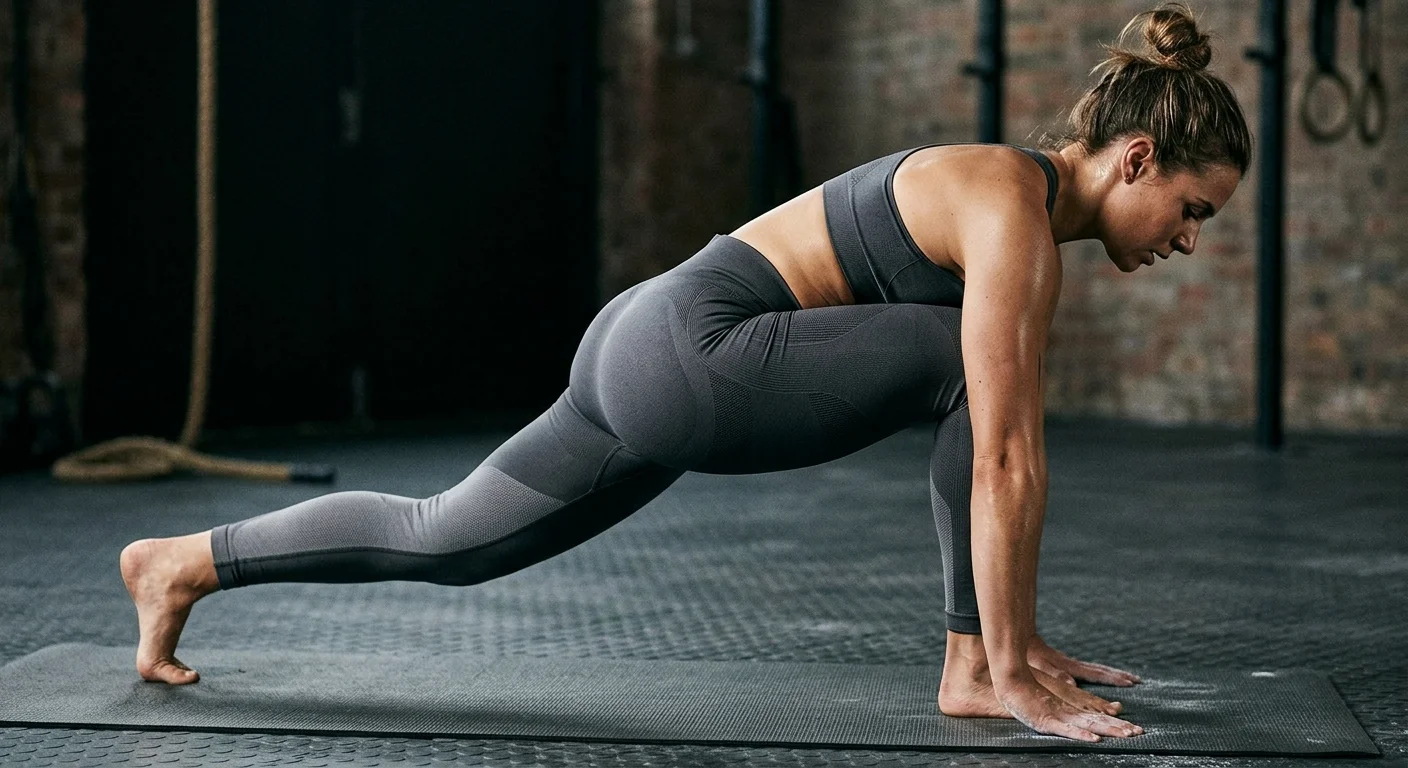
How a garment is built determines how it behaves under pressure — and that pressure is real.
Drop into a squat. Hold a warrior pose for ninety seconds. Your leggings are either working with your body or fighting it. That gap in experience is what separates a forgettable activewear line from one that earns repeat customers.
Friction, Fit, and the "Second Skin" Factor
Seamless construction cuts out the side seams and most junction points. Those are the spots that cause chafing. For long workouts, yoga sessions, or any close-to-body wear, that's a bigger deal than most founders expect early on. The fabric moves across your body without pinching or shifting — it just goes with you.
Cut-and-sew garments can be comfortable too. But their comfort depends on seam thread quality, stitch construction, and seam thickness . Every junction point is a potential pressure spot. More panels means more places for irritation to build up over a two-hour training session. That adds up fast.
Stretch, Recovery, and Size Compatibility
Here's a number worth knowing: seamless fabrics stretch 25–35% more than cut-and-sew constructions of the same material. In real terms, a seamless legging fits a wider range of movement and a wider range of body shapes — all within the same size run.
That changes how you think about sizing:
Seamless handles in-between sizes well. Customers who sit between a small and a medium will find seamless garments far more forgiving.
Cut-and-sew needs precise grading. Size steps run 10–15% larger between increments to keep the pattern accurate.
Durability and Failure Points
The two methods fail in different ways — and for different reasons.
Seamless garments have no traditional side seam. So there's no side seam blowout . Cut-and-sew failures tend to show up as thread unraveling, seam splitting, and stitch erosion at high-stretch zones. Sports bras and leggings take the worst of it, especially with repeated intense use.
Seamless construction also lets you knit compression zones, ventilation panels, and support structures into a single piece — no extra panels, no added bulk, no friction points. Cut-and-sew can hit similar functional zones, but it takes more panels, more seams, and more variables. Each one is another thing that can wear down comfort over time.
For performance wear — where skin contact is constant and movement is extreme — these aren't small differences. They're the entire product.
Design Flexibility & Aesthetics: Where Each Method Wins
Design isn't decoration. It's architecture. The method you choose to build your garments decides what you can — and cannot — create at all.
Cut-and-sew and seamless aren't just different production techniques. They're different visual languages. Know which one fits your brand. Otherwise, you risk spending twelve weeks developing a product the wrong method could never deliver.
Cut-and-Sew: The Toolkit for Bold, Complex Design
Cut-and-sew is the method of options. More panels means more decisions. More decisions means more creative control.
Color blocking is where this stands out most. A single activewear top runs 2–4 color zones. Push it to a collab or a statement piece, and you're looking at 5+ distinct blocks. Each piece gets cut on its own, then stitched together with a 0.25"–0.5" seam allowance. That keeps angled and curved joins clean.
Multi-fabric construction is just as doable. A standard training tight might combine a 250–320 g/m² polyester-spandex main body with 120–180 g/m² mesh panels at the underarm or lower back. Those ventilation zones cover 10–30% of the total garment area. High-performance brands build a single pant from three or more distinct knit weights all the time:
Dense fabric at the seat and quad
Lighter weave at the knee flex zone
Mesh along the inner leg
Structural details — pockets, zippers, princess seams — all need real seam lines to work. Zippered pockets in training shorts run 12–18 cm wide and 15–25 cm deep. Geometric seam placements pull 4–8 cm of waist shaping through vertical or diagonal cut lines on their own. A structured streetwear hoodie can carry 20–30 individual seam lines before you add a single graphic.
Print and decoration follow the same logic. Screen printing runs A4 to A3 across flat panels. Heat-transfer logos land at 5–8 cm for standard chest placement, up to 20–30 cm for leg graphics. Embroidery badges sit at 3–6 cm diameter. These aren't hard limits — they're standard ranges cut-and-sew handles without any structural compromise.
Design iteration speed matters too. Updating a cut-and-sew silhouette means drawing new block lines on an existing pattern, cutting the pieces, assigning fabrics, adding seam allowances, and sampling. A fast-fashion activewear brand can turn around a colorway refresh or a fabric swap in just 1–2 sample rounds.
Seamless: The Toolkit for Precision, Texture, and Minimalism
Seamless knitting doesn't give you more pieces to work with. It gives you one piece — and asks you to do everything with it.
That's a real constraint. It's also a design philosophy that certain brands build their entire identity around.
The visual signature of seamless is a clean, unbroken surface . No side seam. No panel junction. The garment reads as one continuous form. Any visual difference comes from knit structure, not cut lines . Compression bands — 4–8 cm wide across the waist, thigh, or back — create functional zones. They also act as visual dividers without breaking the garment's surface. Jacquard patterns, honeycomb textures, and eyelet mesh zones get programmed directly into the knit. Nothing gets sewn in afterward.
Logo integration works at 4–10 cm wide for chest placement. Textural stripe detailing runs 1.5–5 cm wide, repeating around the torso or leg. Raised texture — the kind that catches light and adds dimension — sits at 0.5–2 mm of surface relief. These are quiet, precise distinctions. That's exactly the point.
Seamless does hit limits around structure. Zippers, welt pockets, princess seams, and geometric color blocking with hard edges all need real seam lines to hold shape. A seamless garment works with 1–2 yarn systems in a single tube. Add a material that's too different — say, a heavy scuba panel next to a lightweight mesh zone — and you need post-knit cut-and-sew work. That adds both complexity and cost.
The Match Between Aesthetic and Method
Brand Direction | Right Method | Why |
|---|---|---|
Streetwear, bold colorblock, multi-fabric | Cut-and-sew | Needs real seam lines for color zones, pockets, structure |
Minimalist, performance, tech-feel | Seamless | Clean surface, integrated compression zones, no visible panels |
Fashion-forward with fast iteration cycles | Cut-and-sew | Pattern edits are faster than reprogramming knit machines |
Core training, yoga, body-hugging basics | Seamless | Single-form construction fits the aesthetic |
The decision isn't about which method looks better. It's about which method can build the product your brand is promising.
Cost, MOQ & Lead Time: The Manufacturing Economics Breakdown
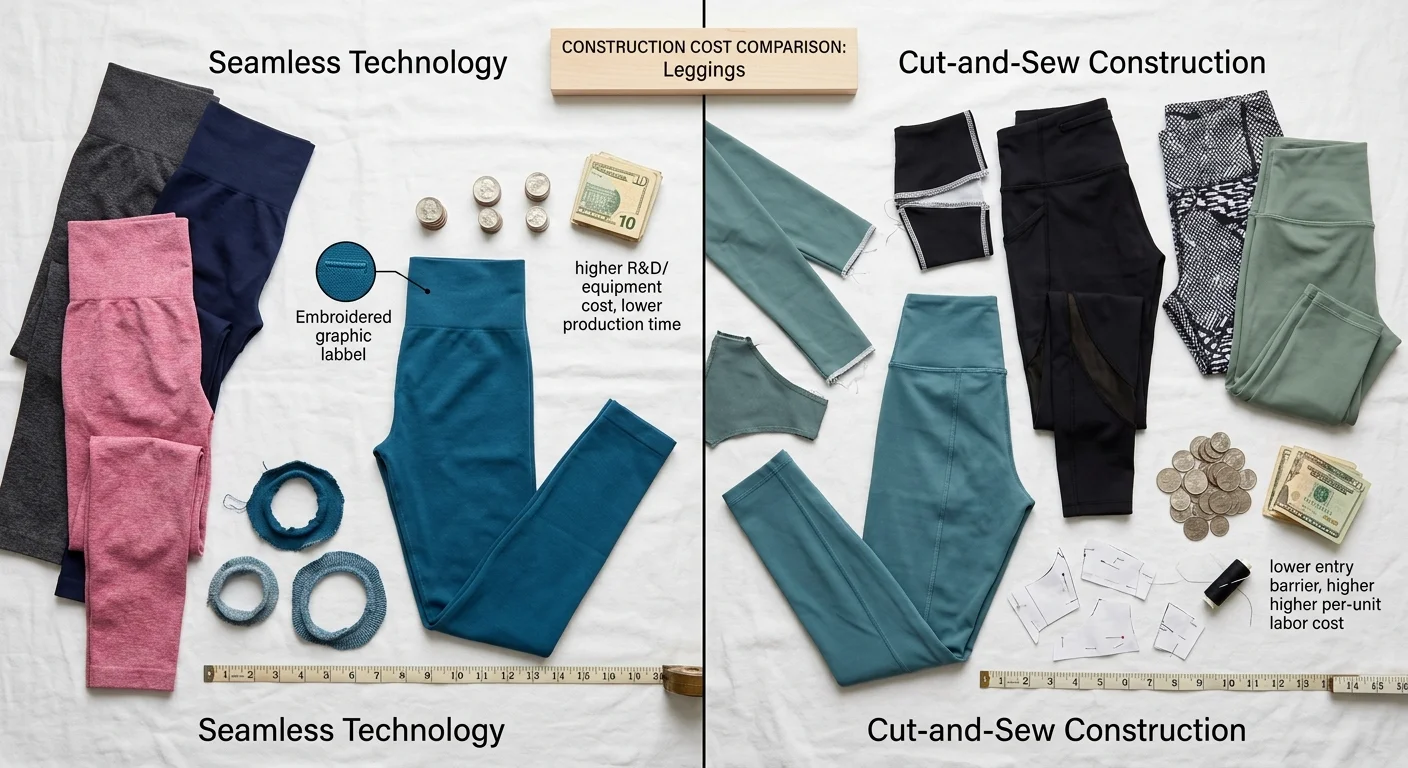
The method you choose doesn't just shape how your garment feels. It shapes how your cash flows.
Both seamless and cut-and-sew carry real costs. They hit at different stages, in different amounts, for different reasons. Get this wrong and you'll either burn capital before your first sale — or lock yourself into a structure your brand can't grow out of.
The Two Cost Structures, Stated Plainly
Seamless front-loads cost into machine setup and programming. Once that's done, production runs lean. No cutting, no fabric waste from pattern offcuts, and next to zero material loss. Unit economics improve fast at volume. That makes seamless the right structure for high-reorder, stable SKUs — your core leggings, your signature sports bra, the style that never leaves your lineup.
Cut-and-sew works the opposite way. Entry cost is lower and development is more flexible. But each unit carries material waste from the cutting process. Cost scales with fabric quality, construction complexity, and order size. For a brand testing the market or running multiple silhouettes, that flexibility is worth more than the savings seamless delivers at scale.
MOQ: What You're Committing To
Seamless : Typical MOQ runs 300–500 units per style . That floor exists to spread machine programming and setup costs across enough units to make the math work.
Cut-and-sew : New brands can often start at 50–150 units per style . Growing brands tend to land at 200–500 units . Established operations run 500+ units as standard.
Lower MOQ almost always means higher unit cost. That's not a negotiating failure — it's arithmetic.
What Cut-and-Sew Development Costs
Development Stage | Typical Cost Range |
|---|---|
First sample / proto | $100–$400+ per style |
Pattern making + grading | $150–$600+ per style |
Basic knit top (unit cost) | $8–$25+ per piece |
Complex bottoms, lined styles, outerwear | $18–$70+ per piece |
More panels, more fabrics, more revision rounds — every variable pushes the upper end.
The Hidden Cost Nobody Talks About
Seamless changes are expensive. Adjusting a knit structure, resizing a compression zone, or altering the yarn layout means reprogramming the machine. That's not a quick fix — it's a billable reset. Seamless rewards brands that nail their specs before production starts.
Cut-and-sew changes are cheap by comparison. Adjust a block line, recut the sample, restitch. Most modifications wrap up in 1–2 sample rounds . Your brand iterates fast — new colorways, seasonal silhouette tweaks, trend-reactive drops — cut-and-sew gives you room to move.
Lead Time: The Real Calendar
Cut-and-sew full production cycles run 8–20 weeks from brief to delivery. Here's how that breaks down:
Pattern development + first sample: 1–3 weeks
Each revision round: 1–2 weeks per round
Fabric and trims sourcing: 2–8+ weeks
Bulk production: 3–10+ weeks
International freight: 2–8+ weeks
Enterprise-scale orders with consolidated colorways? Expect 75–110 days . Simple basics with stock fabrics can land closer to 75–90 days . Technical performance styles with multiple materials push to 100–110+ days .
Basic styles with in-stock fabric? As fast as 4–8 weeks — but the conditions need to line up.
The Three-Way Trade-Off
Every sourcing conversation hits the same wall:
Lower MOQ = higher unit cost
Shorter lead time = more activewear factory resources, often higher cost
Lower unit cost = higher MOQ, longer lead time, or simpler construction
You don't get all three. You pick two and manage the third.
Seamless makes economic sense once you're scaling a proven style — high reorder velocity, stable specs, long production runs. Cut-and-sew makes economic sense while you're building the catalog, testing demand, or running a brand where speed-to-market matters more than margin optimization.
Know which stage your brand is in. That's the decision.
Sustainability: Which Method Is More Eco-Friendly?
Fabric waste isn't an abstract environmental metric. It's a real number with physical consequences. For every 1,000 cut-and-sew leggings produced, 125 kg of fabric becomes offcuts — pre-consumer waste that never becomes a product, never reaches a customer, and ends up landfilled or incinerated.
That's the baseline reality of cut-and-sew. Industry data puts standard fabric loss at 10–18% of total material consumed. Patagonia's Tier-1 facilities in Vietnam recorded 18% fabric waste — around 640 tonnes — with polyester making up the largest share. The dye, water, and chemical energy embedded in that discarded fabric? Already spent. Gone before a single garment ships.
Seamless manufacturing works on a completely different logic. Garments are knit to shape from the start. No cutting tables. No marker layouts. No offcuts. Yarn input matches the exact loop structure of the finished piece. Waste comes down to yarn ends and QA rejects — that's it. Market analyses put the material savings at up to 30% compared with cut-and-sew .
The energy picture follows the same pattern. A seamless producer runs three core steps: yarn production, knitting, finishing. Cut-and-sew needs seven — cutting, multi-panel sewing, pressing, and multiple sewing line operations. One seamless operator measured the gap at 35% lower energy consumption for comparable garments. Fewer steps means less heat, less labor, less overhead.
The Recycled Materials Multiplier
For brands building an ESG story, seamless adds another layer of advantage. Seamless knitting machines work with recycled polyester (rPET) and recycled nylon yarns — nylon-6 recovered from fishing nets included. Pair near-zero cutting waste with recycled yarn inputs, and the numbers get hard to ignore:
Lower upstream carbon intensity per kilogram of yarn
Near-zero pre-consumer waste per finished garment
Measurable, reportable impact at every stage
That combination — recycled synthetics plus seamless construction — produces real, quantifiable claims: "X% fabric waste reduction," "Y% recycled fiber content." Both feed straight into ESG metrics that retail buyers and sustainability-focused consumers are pushing for harder every season.
Cut-and-sew does have options. Marker efficiency improvements, offcut recycling programs, and recycled input materials all help. But each of those tools works against a 10–18% waste baseline . Smart pattern engineering can shrink that number — not erase it.
For stretch activewear where both methods are viable, seamless is the cleaner process. The data holds up across waste, energy, chemistry, and durability. The environmental gap between the two isn't close.
Seamless vs Cut-And-Sew: Side-By-Side Comparison Table
All the details covered above come down to one reference point. Use it.
Dimension | Cut-And-Sew | Seamless |
|---|---|---|
Process | Fabric cut from rolls using patterns. Pieces sewn together across multiple steps. | Yarn knitted into garment shape on circular machines (e.g., Santoni). No side seams, or very few. |
Best-Fit Product Types | Structured styles: jackets, complex training wear, streetwear, woven bottoms. | Body-hugging performance gear: leggings, sports bras, base layers, compression wear. |
Design Freedom | High — color blocking, pockets, zippers, multi-fabric panels, geometric seam lines. | Moderate — texture zones, jacquard logos, ribbed waistbands. Structural shaping is limited. |
MOQ | ~300 units/style/colorway | ~600–1,000 units/style/colorway |
Sample Lead Time | 10–18 days | 15–25 days (includes machine programming) |
Bulk Lead Time | 30–50 days | 35–55 days |
Unit Cost Behavior | Lower entry cost. Cost goes up with complexity and fabric choice. | Higher setup cost. Unit price drops fast at higher volume. |
Fabric / Yarn | Polyester or nylon + 20–30% spandex . You can switch across weights and constructions. | Nylon + spandex yarn. Lower spandex %, but a high-density knit structure handles the compression. |
Size Grading | Precise grading. Each size step adds ~10–15%. | Machine cylinder diameter sets the limit. Most brands run narrow size ranges. |
Durability Risk | Seam blowout and thread unraveling at high-stretch zones. | No side seam means no seam failure. Strength comes from the knit structure itself. |
Material Waste | 10–20% fabric lost to cutting offcuts. | Near 0% waste — yarn used matches the finished garment. |
Decoration Options | Screen print, sublimation, embroidery, heat transfer, color blocking — very flexible. | Jacquard logo, textural zones, limited heat transfer. Large-scale prints don't work here. |
Brand Scale Fit | Startups, multi-style catalogs, design-forward lines. | Mid-to-large brands running high-reorder core SKUs. |
The number that drives most decisions:
Need under 300–500 units per style? Cut-and-sew.
Running a core style at volume with stable specs? Seamless.
Everything else in this table follows from those two realities.
Which Manufacturing Method Is Right for Your Activewear Brand?
Three variables drive the answer: your brand stage, your product type, and your budget. Get those three aligned, and the right method becomes clear.
Here's how to work through it.
Stage One: Where Is Your Brand Right Now?
Early-stage brands (under 5,000 units per year, 100–500 units per style)
Start with cut-and-sew. Full stop. Seamless development costs $1,500–$3,000 per style in programming and setup alone — before you know the market even wants the product. Cut-and-sew samples run $150–$500 per style. You can hit sportswear MOQs of 50–150 units per colorway with in-stock fabric. You move fast, keep losses small, and stay liquid.
Growing brands (5,000–50,000 units per year, multiple categories)
This is where you split the catalog. Add seamless to your one or two highest-reorder styles — the legging that never goes out of stock, the sports bra with a three-month waitlist. Keep everything seasonal, design-driven, or construction-heavy in cut-and-sew. Each method now runs in the lane where it performs best.
Established brands (50,000+ units per year, multi-channel distribution)
Run both. Seamless covers 1–3 core performance SKUs — around 40–60% of total volume. Cut-and-sew handles the other 60–80% of your SKU count: fashion collabs, outerwear, capsule drops. Fewer seamless styles at high volume. Broader design range through cut-and-sew.
Your Product Type Narrows It Further
If you're making… | Go with… |
|---|---|
Core leggings, sports bras, base layers | Seamless (if volume supports it) or cut-and-sew with flatlock construction |
Hoodies, jackets, structured outerwear | Cut-and-sew — zippers, pockets, and seam shaping need it |
Design-forward pieces with color blocking | Cut-and-sew — seamless can't hold hard color edges |
High-frequency basics at retail $60–$100+ | Seamless makes sense at scale |
Three Founder Profiles — One Clear Recommendation Each
Profile A: Budget-conscious DTC startup, $5,000–$20,000 first order
You're planning 3–6 styles at 80–200 units per colorway. Skip seamless for now. Use cut-and-sew with factory in-stock fabrics (nylon/polyester + spandex). Target unit production cost: $8–$15 per piece. Put your budget into two proper sample rounds. First, a fit sample to confirm sizing. Then a pre-production sample to lock down fabric, thread, logo placement, and construction. Those two rounds help you avoid expensive bulk corrections down the line.
Profile B: Performance yoga brand, target retail $60–$100 per set
Go hybrid. Core leggings and base-layer tops go seamless — 28–32 needle count nylon/spandex, tubular knit with bonded gusset and waistband. Structured outerwear and design pieces stay cut-and-sew with flatlock seams to cut friction. Plan for at least three sample rounds on your hero legging: initial fit, adjustment round, final pre-production sign-off. Compression, hand-feel, and size consistency all get settled at that stage.
Profile C: Multi-category athleisure brand, $50,000–$300,000 seasonal budget
You need two sportswear factory relationships. One seamless specialist covers your core SKUs — leggings, fitted shorts, base layers — at 30–50% of total volume. A cut-and-sew performance factory handles everything else: hoodies, woven jackets, fashion-season drops. Both factories build from your unified tech pack. One QC standard runs across the full line.
The Decision, Simplified
Your brand stage decides which method fits your budget. Your product type decides which method is built for the job. Your unit budget decides whether the numbers hold up.
A $60 retail legging from a brand moving 10,000 units per year calls for a very different answer than a $30 training short from a brand placing its first 100-unit test order.
Match the method to where your business actually stands — not to some ideal version of what seamless or cut-and-sew is supposed to be.
FAQ: Common Questions About Seamless and Cut-And-Sew Activewear
Founders ask the same questions. The answers don't change — but they're worth having in one place.
Q: Is seamless more expensive to manufacture?
Upfront, yes. Seamless knitting machines (Santoni and similar) run $150,000–$300,000+ per unit. That capital cost spreads across every garment the machine produces. At high volume, seamless unit costs drop fast. Near-zero waste and single-step production cut out labor that cut-and-sew builds into every panel junction. At low volume, cut-and-sew wins on cost. Standard sewing equipment costs a fraction of the price. The math shows it.
Q: Can I get low MOQ with seamless?
Not as low as cut-and-sew. Seamless factories need 500–1,000 units per style per color . The machines require continuous runs to stabilize knitting tension and justify setup. Cut-and-sew MOQs of sportswear start at 50–300 units depending on the activewear factory. For a brand placing its first order, that gap matters.
Q: Which is better for leggings?
It depends on what the legging needs to do.
Seamless gives you compression zones, mesh ventilation, and body-mapped stretch built into the knit. No seams to chafe. No panels to shift. It's the right call for yoga, cycling, and high-movement training.
Cut-and-sew handles bold prints, color-blocking, zippered pockets, and mixed fabric weights. Same product category. Different jobs.
Q: What are the real design limits of seamless?
Seamless handles jacquard logos, ribbed waistbands, and textural zones well. It cannot deliver hard-edge color blocking, all-over sublimation prints, heavy embroidery, or structural pockets. Those features all need real seam lines. Your brand aesthetic lives in graphics-heavy or fashion-forward territory? Cut-and-sew is the method that can build what you're selling.
Q: How do the production workflows differ?
Seamless runs three steps:
- Yarn feeds into a computerized circular knitting machine
- The tube knits to shape with programmed compression and mesh zones
- Minimal finishing follows — waistband edge, label, heat fusing
Cut-and-sew runs seven steps:
- Fabric rolls get inspected
- Panels are marker-plotted and cut
- Pieces join via overlock, coverstitch, or flatlock seams
- Waistband attaches as a separate piece
- Branding gets applied
More steps. More variables. More seams.
Conclusion
Both seamless knitting and cut-and-sew are solid paths to building a great activewear brand. The real question is which path fits your brand right now .
Launching with tight MOQs and a performance-first product like sports bras or leggings? Seamless gives you a technical edge with less material waste. Building a fashion-forward athleisure line with bold prints and structural variety? Cut-and-sew hands you the creative control you need.
The worst decision isn't picking the "wrong" method. It's picking one without knowing what it costs you — in time, money, and flexibility.
You now have the full picture. The next move is yours.
Ready to figure out which manufacturing method makes sense for your product? Talk to the Berun team — we work with both methods every day. We can help you build a sampling plan before you commit to a single unit.