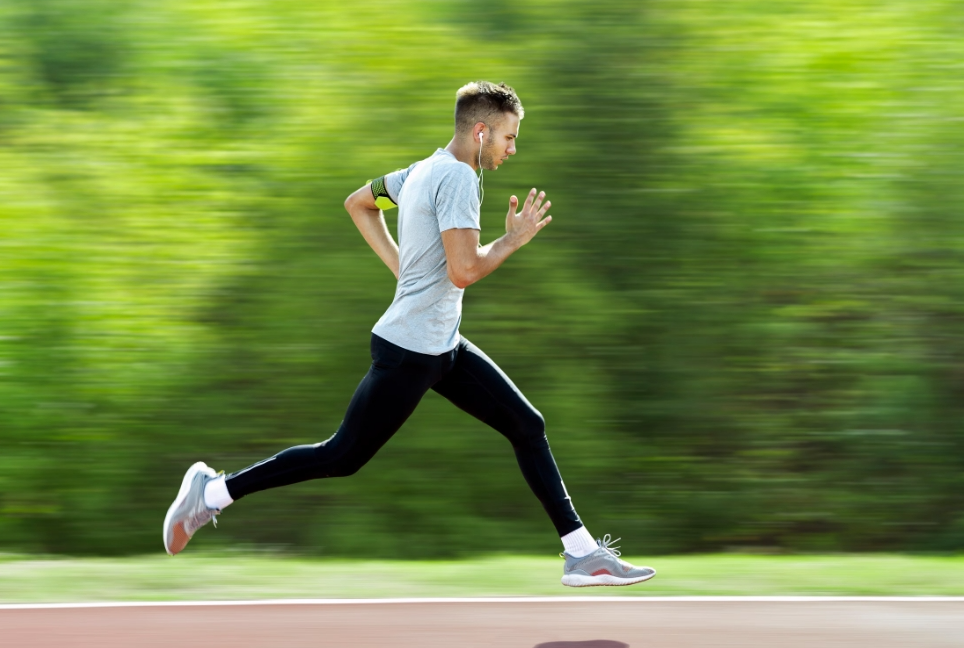
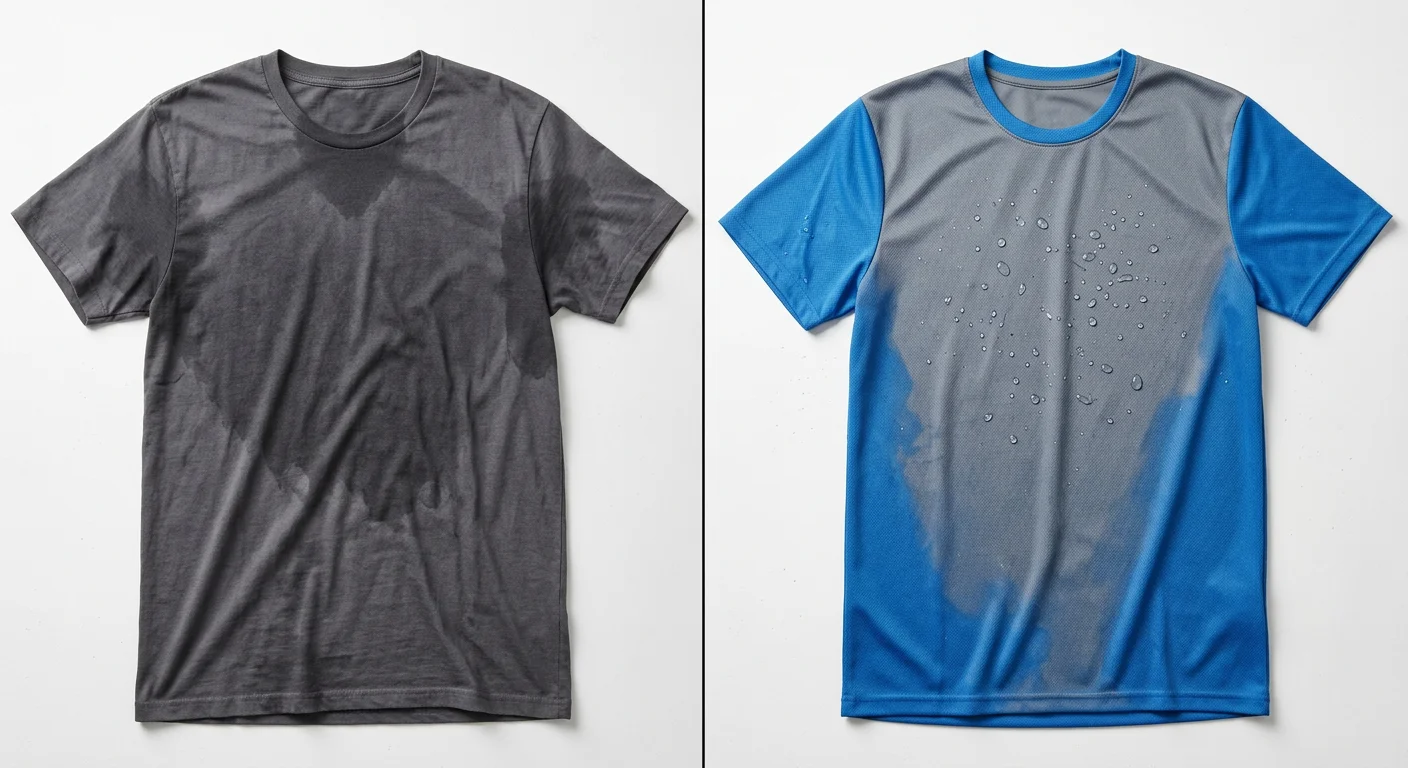
That soaked-through cotton tee clinging to your back mid-run? Yeah, we need to talk about that.
Finishing a workout feeling like you're wearing a wet paper towel tells you everything. The gap between functional and fashionable is real — and your fabric choice plays a bigger role than most people think. Dry fit functional shirts have dominated athletic wear for a reason. But cotton isn't going down without a fight, and it still has a loyal fanbase.
So before you drop $45 on another Nike Dri-FIT — or fall back on your $8 Hanes — here's what you need to know. This breakdown covers which fabric performs for your specific workouts, your climate, and your budget. Real numbers. Real sweat scenarios. No fluff. Your body deserves the right choice, not just the default one.
Scenario-Based Performance Breakdown: Running, Strength, Hiking & Daily
Four different workouts. Four different sweat realities. Fabric choice isn't a one-size-fits-all decision — not even close.
🏃 Running: Where Cotton Loses Every Single Time
Here's the truth about running in cotton: your shirt absorbs sweat like a sponge and never lets go.
Cotton fibers carry a moisture regain rate of 8–10% . The fabric holds onto water at a cellular level. After a 5K at high intensity, a standard cotton tee can gain 10–15% in weight. Saturated zones feel even heavier. That wet-paper-towel sensation isn't just uncomfortable. It's physics working against you.
Dry fit functional shirts change that completely. Polyester's moisture regain rate sits at under 1% . Instead of absorbing sweat, it pushes moisture outward through capillary channels — your skin stays far drier as a result. A 130–150 g/m² performance polyester shirt gains less than 5% in weight during the same run.
Drying speed tells the same story:
Dri-FIT / polyester: surface-dry in 15–30 minutes
Cotton: still damp after 60–120 minutes
Bottom line for runners: Log more than 20–30 minutes at real effort, and cotton works against your body. Look for 100% polyester or polyester-spandex blends at 120–150 g/m² , flatlock seams, and transferred (not woven) labels. Chafing is real — the right construction stops it.
🏋️ Strength Training: Cotton's One Legitimate Comeback
Strength training is the one scenario where cotton earns its place back — and here's why.
A temperature-controlled gym with rest periods between sets means your sweat output stays much lower than steady-state cardio. A 180–220 g/m² mid-weight cotton tee keeps moisture levels under 10–12% during moderate lifting. No major weight gain. No uncomfortable cling.
There's also a functional reason to choose cotton here. It has a slightly higher surface friction. During heavy bench press, barbell rows, or dumbbell work, that natural grip between your arm and the bench actually matters. Smooth synthetic fabrics can feel slippery under load.
That said, CrossFit-style circuits, supersets, or high-density conditioning work push sweat volume up fast. That's where polyester-nylon-spandex blends (10–20% elastane) in a semi-compression fit take over. They spread sweat as a thin layer across the surface. The between-set cooldown stays comfortable — no cold, clingy mess against your spine.
The call:
- Standard strength sets with rest periods → cotton or cotton/spandex 95/5 blend, relaxed fit
- High-volume supersets or CrossFit → functional synthetic, semi-compression
🥾 Hiking: This Is Where Cotton Gets Dangerous
"Cotton kills" isn't just a saying the outdoor community throws around. It's grounded in real thermal physics — and it matters most when you're miles from a trailhead.
During a 6–8 hour hike at 60–75% max heart rate , your body produces steady, moderate sweat for hours. At high humidity, cotton can reach moisture saturation of 30%+ . At that point, the fiber's insulating air pockets collapse and fill with water instead. Add 15–20 km/h wind , and your body surface temperature can drop 1–3°C . That's not discomfort. That's the start of a cold-weather emergency.
Breathable athletic shirts built for hiking use a totally different construction:
Base layer: 150–170 g/m² synthetic wicking fabric (polyester/nylon + 5–10% spandex), or a ~150 g/m² merino wool base (17.5–19.5 micron) for cold-weather warmth and natural odor resistance
Sun protection layer: UPF 40–50+ nylon/polyester shell with 80–150 L/m²/s breathability — blocks 97–98%+ of UV radiation
Rainy/high-humidity days: Skip pure cotton. A 30–40% cotton / 60–70% polyester blend gives you a softer feel with solid quick-dry performance
The body temperature regulation fabric principle here is layering. Synthetic or merino pulls moisture away from your skin and keeps your temperature stable. Cotton does the opposite — it traps moisture, then pulls warmth away from your body.
🚶 Daily Wear & Commute-to-Workout: The Honest Middle Ground
Power-walking to the train, taking the stairs hard, and squeezing in a noon workout — the fabric decision gets more layered here.
Light activity through the day — moderate humidity, air-conditioned offices, short bursts of movement — keeps cotton in a workable zone. A 180–200 g/m² combed cotton tee in 50–60% relative humidity holds moisture levels around 8–12% . It feels soft and natural without obvious cling.
The shift toward synthetic vs natural fiber activewear happens at the transition point. You sweat through your commute, then walk into a meeting 20 minutes later. A 150–170 g/m² polyester-nylon-spandex shirt goes from damp to dry in under 30 minutes — no visible moisture stains left behind. Many of these shirts also carry anti-odor treatments (silver ion or antimicrobial finish) that slow odor buildup across a full day.
The daily wear verdict:
- Pure lifestyle / light movement → high-grade combed cotton or cotton/spandex 95/5
- Active commuting with outfit continuity needs → lightweight synthetic blend with anti-odor finish and quick-dry construction
The fabric debate isn't about which material is better in some absolute sense. It's about matching material properties to what your body actually demands — hour by hour, workout by workout.
Quantified Data: Moisture Management, Dry Speed & Post-Wash Durability
Numbers don't lie. The performance gap between cotton and polyester is bigger than most people expect.
How Much Water Is Your Shirt Holding?
Start with the raw numbers. At standard lab conditions (20°C, 65% relative humidity), cotton holds 7–8.5% of its own dry weight in moisture . Polyester? Just 0.2–0.4% . That's not a small gap — that's a completely different category.
Now take that into a real workout. A 100% cotton tee soaked through during heavy exercise can gain 40–50% of its original dry weight in absorbed sweat. Your shirt doesn't just feel wet. It gets heavier — shoulders drooping, fabric sagging, every stride or rep carrying extra load you didn't plan for.
A microfiber polyester performance shirt in the same conditions? Weight gain stays under 5–10% . The one-way transport structure works like this: the inner face repels water, and the outer face spreads it outward. Sweat moves away from your skin instead of sitting against it. Your shirt stays close to its original weight through most of your session.
That's the core mechanic behind Nike Dri-FIT technology and the wider category of sweat wicking technology . Engineered polyester filaments and knit geometry push moisture from skin to surface. This expands the evaporation area and cuts the "wet cling" that cotton wearers know well.
Drying Speed: The 3–5× Reality Check
Cotton knits fall into the "fast absorbing, slow drying" category. Performance polyester belongs to "fast absorbing, quick drying" — and the actual drying times back that up.
At equal temperature and ventilation, a quick-dry polyester sports tee reaches a comfort-dry state 3–5× faster than a cotton tee of similar weight . Some lab tests on residual moisture content show polyester hitting target dryness in one-third to one-fifth of the time cotton needs.
In practical terms:
- Dri-FIT / performance polyester: surface-dry feel in 15–30 minutes post-workout
- Cotton: still carrying noticeable dampness 60–120 minutes later
The reason isn't complicated. Polyester absorbs almost no moisture at the fiber level. There's less water stored to begin with. Add a high one-way transport index and a wide moisture-spreading area on the outer face, and evaporation speeds up fast. Your skin feels the difference right away.
50 Washes Later: Which One Still Performs?
Most comparison articles skip this part. This is where the long-term value gets decided.
Cotton after 50 home wash cycles:
- 3–5% dimensional shrinkage is standard, even with quality construction
- Collar shape relaxes and distorts over time
- Fiber surface gets stiffer with each wash — that soft feel on Day 1 won't be there on Day 150
- Absorbency stays high, but shape retention breaks down
Functional polyester after 50 wash cycles:
- Less than 2% dimensional change — the fit you bought is the fit you keep
- Moisture management holds up well. The wicking mechanism is built into the structure — capillary geometry and yarn architecture. It's not a surface coating that washes away
- Quality anti-odor workout clothing finishes — silver-ion or antimicrobial chemistry — maintain ≥60% reduction in odor-causing bacteria through 50 launderings. This holds when the treatment is dosed at the right level, based on AATCC 100 standard testing
That last point matters for anyone wearing these shirts daily. Anti-odor performance isn't just a Day 1 feature on a well-made functional shirt. It holds across dozens of wash cycles. That's what you need rotating through 3–4 workout shirts per week.
The durability summary in plain terms:
Metric | Cotton (after 50 washes) | Performance Polyester (after 50 washes) |
|---|---|---|
Dimensional change | 3–5% shrinkage | <2% change |
Hand feel | Gets stiffer over time | Stable |
Moisture function | Absorbency intact, slow-dry unchanged | Wicking structure preserved |
Anti-odor finish | N/A | ≥60% bacteria reduction maintained |
Paying $35–45 for a lightweight gym shirt built on quality polyester construction? The per-wear cost over 12–18 months of regular use often beats a $12 cotton tee that loses its shape by month four. That's the ROI conversation worth having — and the data gives you a solid foundation to make the call.
Training Environment Decision Matrix (Temperature × Humidity × Intensity)
Three variables decide your fabric choice before you even lace up: temperature, humidity, and how hard you're pushing. Get the mix wrong, and no amount of motivation fixes a shirt working against your body's cooling system.
Here's the framework that cuts through all the guesswork.
The Heat Stress Bands (Your Environmental Starting Point)
Stop thinking in raw temperature numbers alone. Your body feels the combined load of temp + humidity — sports science measures this as Wet Bulb Globe Temperature (WBGT) . For real-world training, break that into three bands:
Low stress — Air temp below 20°C at any humidity, or 20–28°C with RH ≤ 60%. Your body cools well. Cotton can keep up.
Moderate stress — 20–28°C with RH at 40–70%. Sweat rate climbs. Cooling starts to strain. Fabric choice starts to matter.
High/extreme stress — Above 28°C with RH ≥ 60%, or any condition where WBGT hits 25°C+. Your body can't cool itself by sweating. Cotton becomes a problem.
Here's the number worth knowing: WBGT ≥ 27°C at high intensity causes measurable work-capacity loss — over 10% productivity drop in occupational heat studies. That's not a small gap. That's your performance walking out the door in a soaked cotton tee.
Intensity Multiplies Everything
Your metabolic output isn't just fatigue — it's heat production, measured in watts:
Intensity 1–3 (light): 100–200W — gentle yoga, recovery walks, casual movement
Intensity 4–6 (moderate): 200–350W — steady-state running, field drills, brisk hiking
Intensity 7–10 (high): 350–500W+ — HIIT, intervals, competitive sport, loaded uphill
Higher intensity lowers your safe environmental threshold. At 400W output (hard intervals), heat stress risk starts at WBGT 27°C. Drop to 200W (easy walk), and that threshold rises to 31°C. You can wear cotton on a gentle morning walk at 28°C. Sprint repeats at the same temperature? Cotton fails you. Same day. Two very different fabric needs.
The Decision Matrix: Read Your Conditions, Get Your Answer
Save this. Screenshot it. This is your 30-second decision tool.
Temp Bands: T1 = below 20°C | T2 = 20–28°C | T3 = above 28°C
Humidity Bands: H1 = below 40% | H2 = 40–70% | H3 = above 70%
Temp / RH | Intensity 1–3 (Low) | Intensity 4–6 (Medium) | Intensity 7–10 (High) |
|---|---|---|---|
T1 + H1/H2 | ✅ 100% Cotton | Cotton or light blend; dry fit if >60 min | Dry fit for intervals/hills |
T1 + H3 | Cotton (short sessions) | Dry fit preferred >45 min | Dry fit mandatory — wet-cold risk |
T2 + H1 | ✅ 100% Cotton | Either; dry fit for running/field | Dry fit (most cases) |
T2 + H2 | Cotton ≤60 min | Dry fit recommended | Dry fit mandatory |
T2 + H3 | Light cotton at very low effort — better: dry fit | Dry fit mandatory | Dry fit + cooling strategy |
T3 + H1 | Dry fit preferred >30 min | Dry fit mandatory | Dry fit + mesh/ultra-light |
T3 + H2 | Dry fit even for brisk walks | Dry fit mandatory | Dry fit mandatory + shorten session |
T3 + H3 | Dry fit mandatory at all intensities | Dry fit + close monitoring | Reschedule if possible — if not: dry fit, cooling, short bouts |
Outdoor duration overlay: Training 2+ hours under direct sun at any temp/humidity? Skip the table. Go straight to moisture-wicking performance base + UPF 30–50+ long-sleeve shell . Solar radiant heat adds a thermal load that temperature and humidity numbers alone don't show.
Three Clear Scenarios That Summarize the Whole Matrix
"Cotton OK — Comfort Priority" : Below 20°C, intensity 1–3, session under 90 minutes. Your sweat rate stays low enough that cotton's slow-dry nature never becomes a real issue. Wear what feels soft.
"Dry Fit Required — High Heat + High Intensity" : Above 28°C with humidity over 50%, or any moderate-to-high humidity condition with intensity at 5+. Cotton soaks through, clings to your skin, and blocks sweat from evaporating. A 120–150 g/m² moisture-wicking polyester with mesh ventilation panels isn't a luxury here — it's the practical choice.
"Performance + UPF — Long Outdoor/UV" : Multi-hour outdoor sessions with strong sun exposure. This is where breathable athletic shirts with UPF 40–50+ construction do real work. Lightweight poly-nylon blends at 110–150 g/m² with a bit of mechanical stretch manage moisture and block UV — without trapping heat in the process.
The matrix removes the guesswork. Check your conditions, check your planned intensity, read the output. Your fabric decision is made.
Budget-Tiered Performance Tee Recommendations & Manufacturer Options
Spending more doesn't mean performing better. But skipping quality entirely has a real cost too.
Here's the honest breakdown: there's a solid performance tee at every activewear price point. The question isn't whether you can afford a good shirt. It's about matching the right construction to your training habits — and knowing what you're getting (and giving up) at each level.
Under $15 — The Entry Performance Tee
This tier exists, it works, and it doesn't need an apology.
Gildan Performance , Port & Company PC380 , and the basic lines from Hanes and Fruit of the Loom all land in the $7–13 range. They run 100% polyester jersey at 130–150 g/m² with a basic wicking finish. Not glamorous. Not engineered. But they do move sweat, dry faster than cotton, and hold up well for low-demand use.
Who this is for:
- Training 1–2× per week at light-to-moderate intensity
- Corporate team events, gym orientations, group fitness days
- Anyone trying out performance fabric before spending more
The ROI logic is simple: high replacement frequency, low unit cost. The fabric softness fades after 20–30 washes. You replace it and move on. No heartbreak. No big loss.
$15–30 — The Core Training Tee (The Sweet Spot)
This is where the real value lives for most active people.
A 65/35 poly-cotton blend or a polyester-spandex build (5–8% elastane) at 150–180 g/m² delivers the mix of performance and durability that entry-level shirts can't match. The cotton fraction softens the hand feel without hurting moisture management. The spandex adds stretch to move with you through squats, pulls, and lateral drills.
What sets this tier apart from the budget line isn't just fabric — it's anti-odor treatment . Silver-ion or chitosan antimicrobial finishes at this level cut bacteria growth through 30–50 wash cycles . That's the difference between a shirt you want to wear again and one that sits at the bottom of the hamper.
Key specs to look for:
- Weight: 150–175 g/m² for year-round versatility
- Drying rate: >70% dry within 30 minutes — the standard benchmark for mid-tier quick-dry performance
- Construction: flatlock seams, tagless interior, basic shoulder tapering at minimum
Retail range: $19.90–$29.90 on DTC channels. Build your training wardrobe around this tier if you're working out 3–4× per week at moderate to high intensity.
$30+ — The Pro/Elite Tee
Training 5+ sessions per week ? Running long distances, doing CrossFit-style conditioning, or pushing through extreme heat and humidity? This tier stops being a luxury. It becomes a practical choice.
The construction steps up in a big way:
- High-stretch compression fabric (polyamide or polyester + 20–30% spandex) with graduated pressure zones for muscle support
- Seamless circular knitting with localized mesh ventilation panels
- Thermal-management yarns : hollow fiber, PCM microcapsules, or activated carbon fibers that cut perceived skin temperature by 1–2°C
- Heat-bonded seam tape and reflective detailing on technical cuts
Retail range: $35–60 for flagship training tees; $50–100 for premium compression tops. The ROI case is clear — at this training load, you're putting these shirts through serious use. The per-wear cost over 18 months often runs lower than cycling through budget tees that lose their shape by month four.
A Manufacturing Note for Brand Builders
Developing your own performance tee line instead of shopping retail? The three-tier framework lines up with how activewear factories like Berun Activewear ( berunactivewear.com | [email protected]) structure custom OEM activewear programs.
Their setup is worth knowing:
- MOQ of 50–100 activewear pieces per colorway — workable for small brands testing all three price tiers at once before scaling volume
- Entry line: stock 100% polyester constructions with standard sizing blocks — FOB cost stays in the $3–6 range
- Core line: factory-developed custom activewear blends with antimicrobial finish — FOB $5–9 depending on fabric and order volume
- Pro line: seamless knitting, heat-press bonding, compression fabrications — higher FOB, but the technical build supports a premium retail activewear price with substance behind it
Certifications to confirm with any activewear manufacturer: OEKO-TEX Standard 100 for chemical safety, ISO 9001 for quality consistency, and GRS compliance if recycled polyester and a sustainability angle matter to your brand.
The tier you choose — buying or building — should match where you train, not where you hope to train someday. That's the whole point of the decision matrix above. Use it.
Long-Term Cost-Per-Wear & ROI Analysis for Active Users
The $45 price tag on a performance tee stings a little. The $12 cotton one feels like a win at checkout. But that math falls apart fast. Start tracking what you spend over a year of real training. The numbers tell a different story.
Here's the formula that changes everything:
True Cost Per Wear = (Purchase Price + Maintenance Costs − Resale Value) ÷ Total Wears
Stop comparing sticker prices. Start comparing this .
The Frequency Rule That Decides Everything
How often you sweat is the single biggest variable in this equation — more than brand, more than fabric technology, more than what's on sale.
Train 1–2× per week at low intensity? Cotton wins. You won't rack up enough wears to justify the performance premium. The math never catches up.
Train 3–5+ sweaty sessions per week? Performance fabric becomes the smarter financial move — and fast. A well-built polyester tee at that frequency can hit 150–250 wears over five years . That's serious cost-per-wear compression working in your favor.
High-frequency exercisers who shop by sticker price end up replacing cotton tees every four months. Then they wonder why their gym budget feels bloated.
Where the Premium Pays Off
A Dri-FIT or quality performance shirt runs 2–3× the price of a comparable cotton tee . That sounds like a loss. But the number hides something: performance fabric in active use lasts 1.8–2.2× longer before it breaks down past the point of comfort.
Do the math with real numbers:
Purchase Price | Realistic Wears | Cost Per Wear | |
|---|---|---|---|
Cotton tee | $25 | ~60 wears | ~$0.42/wear |
Performance tee | $60 | ~150 wears | ~$0.40/wear |
That's not a typo. The more expensive shirt ends up cheaper per wear — and that's before factoring in maintenance costs.
The Hidden Costs Most People Ignore
Cotton carries a sneaky maintenance burden that never shows up on the hang tag.
You need careful wash cycles to prevent shrinkage. The collar warps. The fabric stiffens. Replacements come sooner than expected. Add the time cost of a shirt that takes two hours to dry and still smells like yesterday's session.
Performance polyester cuts most of that hassle. Machine washable. Quick-dry. No-iron in most cases. Those savings belong in the maintenance column of your cost-per-wear formula — and they add up across 200+ wears a year. That's real money back in your pocket.
Your Personal ROI Checklist
Before your next purchase, run through this:
Estimate your wears per year — be honest, not aspirational
Add maintenance costs — detergent, drying energy, replacement frequency, your actual time
Divide total lifetime cost by realistic wear count
Compare cost per wear — not the activewear price on the tag
The bottom line: Train hard and often? Treat your performance tee like a utility asset, not a fashion splurge. A higher upfront cost only makes sense when it drops your lifetime cost-per-wear. For serious active users, it almost always does.
Conclusion
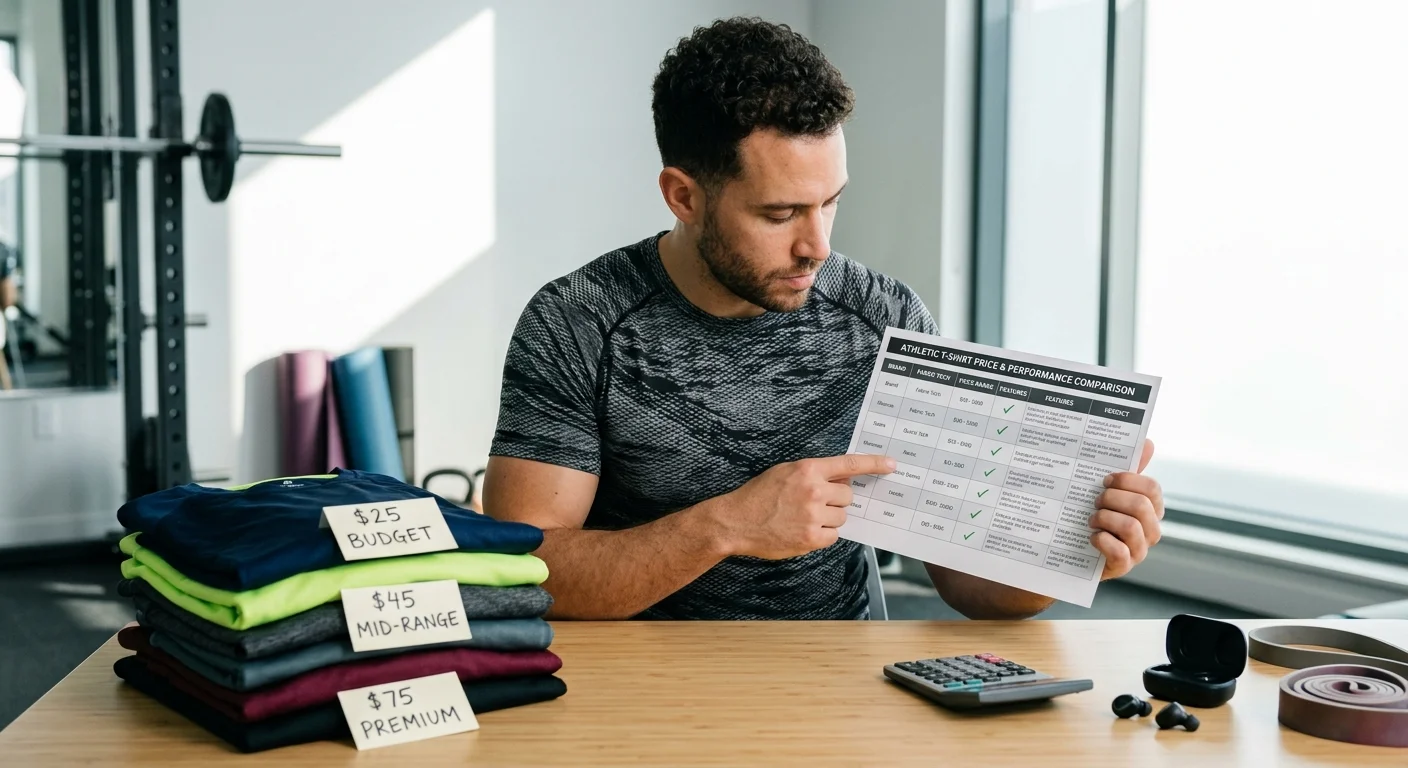
Here's what the sporting goods store won't tell you: there's no single "better" shirt — just the right shirt for your sweat situation.
You train three to five days a week. You're soaking through cotton tees that feel like a wet blanket by mile two. Switching to Dry Fit Functional Shirts isn't a splurge — it's the obvious move. Faster drying. Less chafing. No more funky-smell regret. Your body will thank you on rep forty.
But your "active lifestyle" is a Sunday hike with your dog and one gym visit mid-week? A quality cotton blend is enough. Simple as that.
Use the decision matrix. Check the budget tiers. Stop overthinking it.
The best workout shirt is the one you stop noticing mid-run. It stays out of your way while you crush it.
Now go sweat. On purpose.