Choosing between USA vs overseas activewear manufacturing isn't always clear-cut — yet most brand founders treat it like a guess. Pick the wrong activewear factory and you face bloated costs, missed launch windows, or quality complaints that tank your reviews before you build real momentum. Pick the right one, and your margins improve, your customers stay loyal, and your supply chain scales with your growth.
No universal "better" option exists here. There's only the right fit for your brand's current stage, budget, and growth goals. Below is a straight, no-fluff breakdown of every factor that moves the needle — plus a decision framework you can put to work today.
Head-to-Head Comparison: 8 Factors That Matter
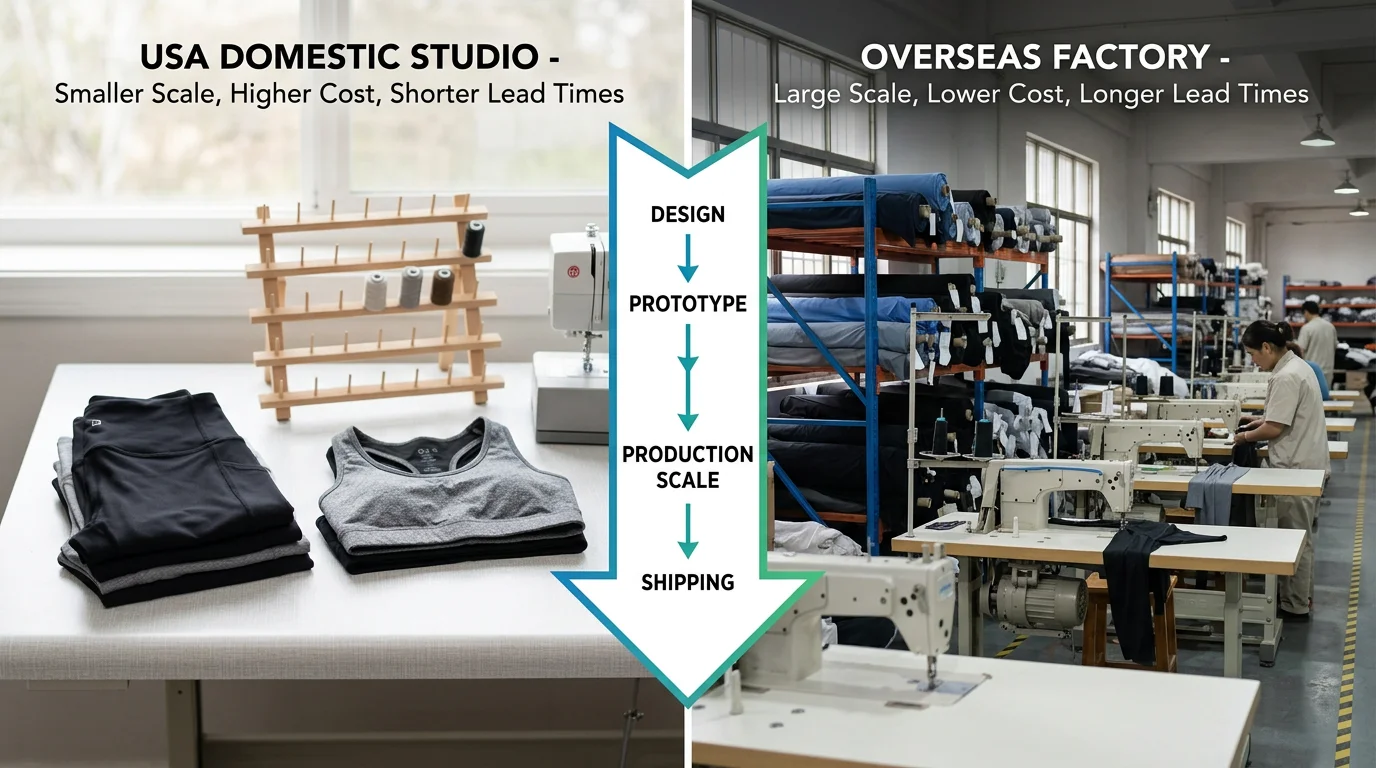
Eight variables separate a profitable activewear supply chain from a costly mistake. Here's the unfiltered data on each one.
1. Unit Cost (Performance Wear Manufacturing Cost)
The numbers are clear. Overseas activewear factories in China and Southeast Asia produce basic leggings, yoga pants, and sports tops for $4–$8 per piece — fabric and cut-and-sew included, before logistics and duties. US domestic factories running identical styles land at $10–$18 per unit . Complex designs or sub-100 piece runs push past $20 .
Fabric choice widens that gap further. Standard polyester-spandex blends run $2.50–$4/meter . Step up to premium imported performance fabric — Korean or US-made technical textile — and you're at $5–$8/meter . That adds 20–40% to your finished goods cost.
Volume matters here. At 500 units per style, you pay 15–25% less per piece compared to 100-unit runs. Scale to 1,000 units and that discount reaches 30–40% . Tight margins? Batch size is your single biggest lever.
Verdict: Overseas = lower cost. USA = premium cost, worth it when brand positioning supports it.
2. Minimum Order Quantity (Activewear MOQ)
Standard overseas factories — the ones with real production lines — require 500–1,000 units per style/colorway . Add custom fabric development or technical detailing, and MOQs can climb to 2,000 units . That's serious capital exposure for a brand that hasn't tested demand yet.
The market has changed, though. A growing group of overseas low-MOQ specialists now accepts 100–200 units for test runs. Some activewear vendors even take 1–50 piece sample and blank orders for concept testing — close to zero commitment.
US factories work differently. Small studios start at 50–100 units per colorway . Mid-scale domestic manufacturers ask for 100–300 units . Sub-100 orders tend to trigger sample setup surcharges.
Verdict: Traditional overseas factories = high MOQ barrier. Flexible overseas suppliers = more accessible than you'd expect. USA factories = better for small-batch testing.
3. Lead Time (Production + Transit Combined)
Speed is where domestic manufacturing justifies its price. US factories with stock fabrics and simple construction deliver samples in 5–10 days , bulk orders in 15–30 days , and domestic freight in 2–7 days . Total door-to-warehouse time: 30–45 days .
Overseas timelines run longer. With stock fabric and confirmed patterns, expect 7–14 days for sampling and 30–45 days for production. Sea freight to the US tacks on another 25–35 days . Total time from sample approval to inventory: 60–90 days is the real number. Air freight cuts this to 45–60 days , but the added cost bites into your margin.
Chasing trend cycles or running seasonal drops? A 60-day lead time isn't just a hassle — it's a real strategic risk.
Verdict: USA manufacturing = fastest to market. Overseas sea freight = longest cycle. Overseas air freight = middle ground at higher cost.
4. Quality Control (Activewear Quality Control)
Quality overseas is more reliable than most people assume. Many mid-to-large overseas activewear manufacturers carry ISO 9001 certification and run structured fabric testing — colorfastness, pilling resistance, stretch recovery, moisture-wicking performance — targeting ≥95% batch pass rates. Finished goods inspection follows AQL 2.5–4.0 standards, holding defect rates at ≤2–3%.
Performance fabric benchmarks are specific. Quality four-way stretch fabric should reach ≥150% elongation . Proper moisture-transfer fabrics beat standard polyester by 20–35% in test conditions.
US factories have a proximity advantage. You can run frequent on-site audits, join fit reviews, and request 100% visual inspection on small-batch orders. Iteration cycles are shorter. Catching a defect at unit 20 instead of unit 800 has clear financial benefits.
The real risk overseas isn't bad factories — it's unvetted small factories with inconsistent output. Get a third-party inspection done before shipment. Non-negotiable with any new overseas partner.
Verdict: Certified overseas factories = reliable at scale. Small overseas factories = inconsistent without verification. USA factories = easier real-time oversight.
5. Communication Efficiency
A 12–15 hour time difference between the US and China/Southeast Asia creates a real delay. Send a question Monday morning in New York, get an answer Tuesday morning — best case. Most overseas factory contacts use Email, WhatsApp, or WeChat. English is functional, not technical. Complex construction details need detailed tech packs, annotated photos, and physical samples to fill the communication gap.
US factories cut out that friction entirely. Same time zone means actual phone calls. In-person visits are possible. Fit sessions, pre-production reviews, and design changes take days — not weeks of email back-and-forth.
Verdict: Overseas communication = workable, but needs structured documentation. USA = faster collaboration, better for complex performance wear development.
6. Intellectual Property Protection
Overseas factories running multi-client production lines create real IP exposure. Patterns, prints, and brand details can get copied — by accident or on purpose. Your protection toolkit: bilingual NDAs , limits on sample sharing with other clients, and tiered information sharing (give each vendor only what they need to know).
US factories sit inside a legal framework you can enforce directly. NDA terms fall under familiar law. Pattern ownership goes to the brand — documented, auditable, and defensible in court.
Verdict: Overseas = IP risk is real, but manageable with contracts and clear protocols. USA = stronger legal protection from day one.
7. Scalability
Overseas manufacturing is hard to beat at growth stage. Mid-to-large Chinese activewear factories run 50,000–200,000 units per month, handle 10–30 concurrent styles in a single season, and — once patterns are set — turn repeat orders in 20–30 days.
US factories top out at 5,000–20,000 units per month . A sudden large-volume order needs advance scheduling. Overflow demand often means turning business away or paying rush premiums.
Verdict: Overseas large factories = built for brand scaling. USA factories = solid for controlled growth, but limited at high volume.
8. Brand Narrative Value
"Made in USA" is more than a label — it's a positioning asset. In premium performance wear, sustainability, and social-responsibility categories, domestic manufacturing supports 10–30% retail price premiums when you back it with strong brand storytelling.
Overseas production still has narrative power. Brands sourcing GRS-certified recycled fabrics or OEKO-TEX certified technical textiles from Korea or Japan can build strong stories around sustainability, global technical partnerships, and performance innovation. Those angles land well in the activewear market.
Verdict: USA manufacturing = "local, ethical, premium" story. Overseas manufacturing = "global performance, sustainable materials" story. Both work — execution is what separates them.
Factor | Overseas (Large Factory) | Overseas (Low-MOQ) | USA Domestic |
|---|---|---|---|
Unit Cost | ✅ Low ($4–$8) | ✅ Low–Mid | ❌ High ($10–$18+) |
MOQ | ❌ High (500–1,000+) | ✅ Flexible (100–200) | ✅ Low (50–300) |
Lead Time | ❌ Long (60–90 days) | ❌ Long | ✅ Fast (30–45 days) |
Quality Control | ✅ Stable (ISO/AQL) | ⚠️ Variable | ✅ Easy oversight |
Communication | ⚠️ Time zone friction | ⚠️ Time zone friction | ✅ Real-time |
IP Protection | ⚠️ Needs contracts | ⚠️ Needs contracts | ✅ Strong legal framework |
Scalability | ✅ High (50K–200K/mo) | ⚠️ Limited | ⚠️ Moderate |
Brand Narrative | ⚠️ Requires strategy | ⚠️ Requires strategy | ✅ Built-in "Made in USA" |
Which Manufacturing Route Fits Your Brand Stage?
Your brand stage determines everything. A manufacturing strategy built for 10,000 units per month will wreck a brand still searching for product-market fit — and the reverse is just as true. Here's a stage-by-stage breakdown you can use right now.
Stage 1: Early-Stage Brand (Under 10 SKUs, Limited Capital)
Start with low-MOQ domestic production or small-batch overseas sampling . Your one job at this point is validating market demand. Don't lock capital into 1,000 units of a style nobody's tested yet.
What this looks like in practice:
- Build a complete Tech Pack first — fabric composition, GSM, Pantone color codes, size spec, and construction notes. This document is your single source of truth. No factory conversation starts without it.
- Require a Pre-Production Sample (PPS) before approving bulk — every time. Check hand feel, fit, and fabric performance. Don't rely on how it looks in photos.
- Stick to high-velocity basics: sports bras and leggings . SKU discipline at this stage is what keeps you in business.
Key production benchmarks to track:
- Sample turnaround: 1–2 weeks
- Bulk production: 4–6 weeks
- Air freight: ~1 week | Sea freight: 4–5 weeks
- Quality baseline: AQL 2.5/4.0 , plus colorfastness, abrasion resistance, and seam strength
Stage 2: Growth-Stage Brand (PMF Validated, Expanding DTC or Wholesale)
This is where a hybrid manufacturing model becomes your strongest tool. The split is simple: overseas for core repeatable styles, domestic for new launches and limited drops .
Overseas production covers volume and margin. US production covers speed-to-market and risk control on unproven designs. Both serve a different purpose — you need both running at once.
Recommended production split:
- Overseas line: Core basics — leggings, sports bras, training tees. These protect your margins and keep replenishment smooth.
- US domestic line: New designs, capsule collections, collab pieces. Test conversion before committing to large-scale inventory.
Run DTC and wholesale together? Standardize your QC documentation now — PPM/PPS records, AQL reports, packing lists, and HS codes . Wholesale partners will ask for this. Gaps in your records are the fastest way to lose a retailer relationship.
One non-negotiable rule: sample before bulk, every time . Never approve a new style at quantity without a confirmed PPS.
Stage 3: Scaling Brand (Funded, Large-Scale Distribution)
At this stage, overseas production is your primary engine . Large overseas factories offer cost structures, replenishment speed, and output capacity that no domestic operation can match for high-volume SKUs.
That said, keep a small US production line running . This is a brand investment, not just a manufacturing choice. Use it for:
- PR capsule drops with "Made in USA" positioning
- Holiday or event-specific limited releases
- Brand storytelling that supports a 10–30% retail price premium
What matters most at scale:
- Shift your KPIs from "fast iteration" to stable unit cost and on-time delivery
- Keep logistics documentation tight: carton dimensions, gross/net weight, HS codes, full packing lists
- Lock your core basics to high-efficiency factories and send low-volume styles to flexible production lines
The Simplest Decision Rule You'll Find
Brand Stage | Best Strategy |
|---|---|
Still finding PMF | US manufacturing or small-batch overseas — validate first |
PMF confirmed | Hybrid model — basics overseas, new styles domestic |
Scaling distribution | Overseas-primary + small US PR line |
Every successful activewear brand follows the same pattern: prove it small, scale it overseas, keep a domestic line for your brand story . The brands that run into trouble are the ones that skip step one.
The 5-Question Decision Framework: Which Is Right for You?
Five questions. That's all you need to find the right manufacturing path for your activewear brand — no guesswork, no six-month research spirals.
Work through each one with a clear head. Your answers will point you straight to a solid sourcing decision.
Q1: What's your retail price point?
Your price position is the first filter. It shapes every decision that follows.
Under $40/unit? To hit margins above 60%, you need a landed FOB cost of $6–10. That math works in China, Vietnam, Cambodia, or India — and nowhere else at this price tier.
$40–$80/unit? You have real options. US small-batch production (CMT at $15–25/unit) or a quality Asian factory both work here. The next four questions will decide which one fits better.
Over $80/unit with a "locally made" brand story? US or European small-batch manufacturing is the right move. The premium price supports the higher production cost.
Q2: How many units per style, per colorway?
Volume is the second filter — and the most misunderstood one.
Under 200 units/colorway: US domestic studios are your most cost-efficient option at this scale. Asian factories charge a 10–20% small-order surcharge, plus multiple rounds of international freight. Those add-ons eat the unit cost advantage fast.
200–500 units/colorway: This is the gray zone. Run the total landed cost comparison (production + sampling + freight + duties) before you commit to either path.
Over 500 units/colorway: Asian mid-to-large factories win on total cost. Unit prices run 30–60% lower than domestic, and the fixed sampling fees spread across the full order volume.
Q3: How fast do you need to go from design to shelf?
Your timeline is what separates brands that can use overseas production from those that can't.
US small-batch studios: 2–3 weeks sampling → 4–6 weeks production → 3–7 days domestic freight. Total: 8–12 weeks.
Asian factories via sea freight: 3–5 weeks sampling → 6–10 weeks production → 4–6 weeks ocean transit. Total: 14–22 weeks.
Asian factories via air freight: Cuts down to 10–16 weeks — but air freight runs 3–5× the per-kg cost of sea.
A launch window under 12 weeks leaves you two real choices: domestic manufacturing or an air-freight overseas strategy. Plan 4–6 months out, and Asian factories become the stronger option.
Q4: What's your capital position and risk tolerance?
Be straight with yourself here. This question separates smart early-stage strategy from expensive mistakes.
Run the numbers: 5 styles × 2 colorways × 400 units, at $10/unit landed cost = $40,000 in inventory capital — before a single dollar of marketing spend. That's the real figure most founders miss until they're already committed.
Under $20,000 available capital: Go with US or local small-batch production. Keep runs at 50–150 units per colorway. Protect your cash. Prove demand first.
$50,000+ with existing sales data: Asian factories with 800–1,000+ unit runs make sense. The volume justifies the upfront spend and locks in much lower per-unit costs.
One rule holds at every budget level: spend your first two seasons proving the style, then move winning SKUs to Asian production for scale. Brands that skip this step are the ones sitting on $60K of the wrong inventory.
Q5: How complex is your product to build?
Construction complexity is the final variable. Most brand founders underestimate it.
Basic flatlock-sewn leggings, sports bras, training tops? Most US small-batch studios handle these without issue. Low-complexity styles are where domestic production performs best.
Seamless knit, compression-zone construction, bonded seams, or race-spec technical fabrics? This is specialized work. Dedicated Asian activewear factories — with in-house pattern engineers, custom knit mills, and compression-grade fabric development — are built for it. Most US small-batch studios don't have the equipment or capacity for these builds.
3D texture, laser-cut ventilation panels, or placement printing? Check that any factory you're considering has documented experience with these processes. If they outsource it, your cost and timeline both go up.
Your Decision in 30 Seconds
Your Situation | Recommended Path |
|---|---|
< 200 units/colorway + tight timeline + limited capital | US domestic small-batch |
200–500 units/colorway + flexible timeline + moderate budget | Hybrid or vetted Asian factory |
500+ units/colorway + 4–6 month runway + growth capital | Asian mid-to-large factory |
High-complexity technical product at any volume | Specialized Asian activewear factory |
The right manufacturing partner isn't the cheapest one or the closest one. It's the one that fits where your brand stands right now.
Can You Do Both? The Hybrid Manufacturing Model Explained
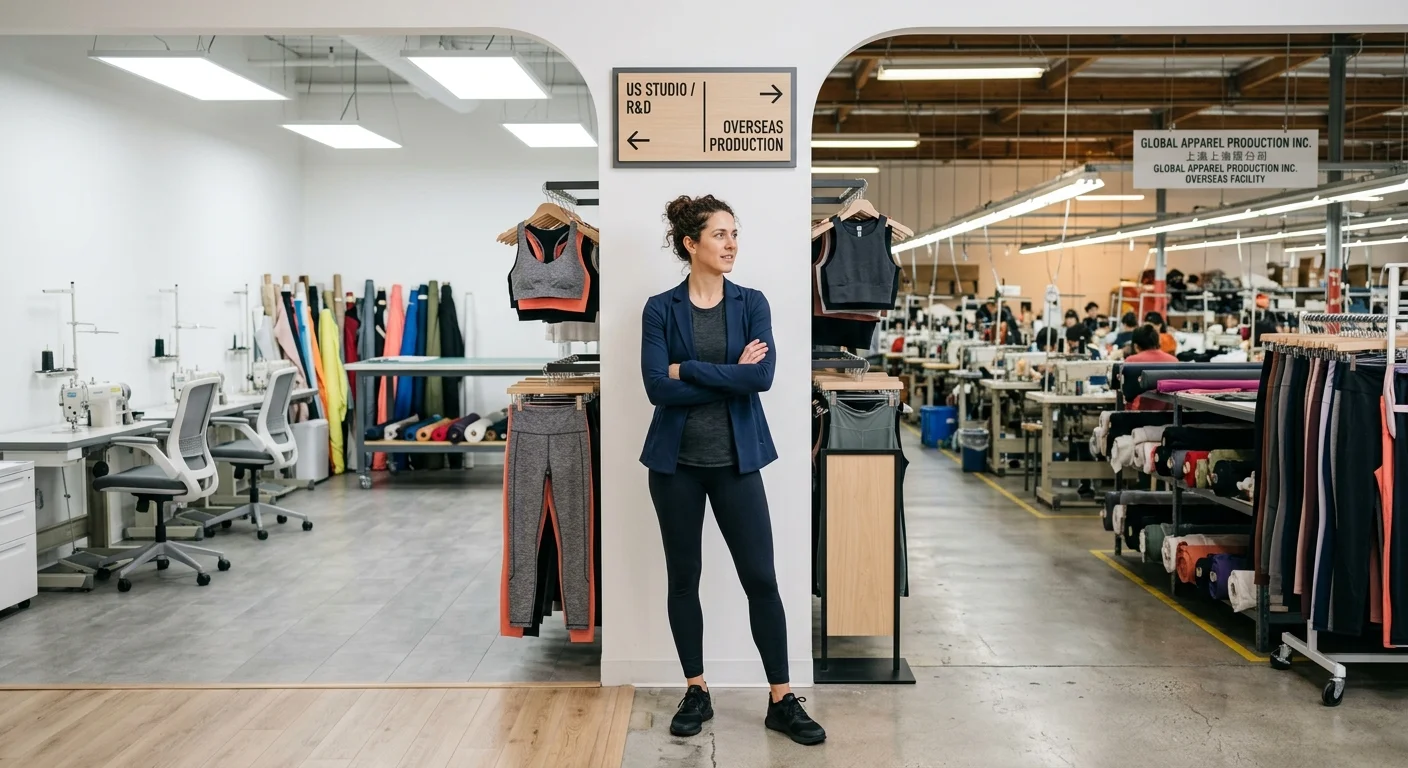
Most brands treat this as a binary choice. It isn't.
The smartest activewear brands run two production tracks at once. That's what makes them hard to compete with. Domestic manufacturing handles testing, trend-led drops, and demand validation. Overseas manufacturing handles proven, high-volume replenishment. One model feeds the other.
Here's the core logic: test and learn in the U.S., then copy at scale offshore once demand is proven and your PP sample is sealed.
How the SKU Split Works
Not every style belongs on the same production track. Here's how to divide them:
Domestic line: New designs, seasonal drops, limited collaborations, and any style you haven't sold yet. Smaller, faster, lower risk.
Overseas line: Core basics with consistent reorder patterns — styles clearing 1,000+ units per run are the strongest fit here. This is where your margin lives.
Borderline styles: Demand is there, but volume doesn't yet justify overseas development costs. Keep them domestic until the numbers move.
The rule is simple: lock the style at home first, move it overseas after validation.
Why the Math Works
Overseas production runs 30–50% cheaper per unit before logistics. After freight, duties, and inspection, stable high-volume runs still deliver 15–30% net savings . That's real margin — but on proven styles only. Committing offshore volume to an unvalidated design is how brands end up sitting on $60K of the wrong inventory.
The hybrid model also protects you on the operational side. Domestic runs keep your launch calendar safe from ocean-freight delays. Overseas runs protect cash flow by keeping large capital commitments off unproven SKUs. Brands using this model have reported 34% shorter inventory cycles and 19% lower markdowns . Why? Trend-sensitive items stay in fast, small domestic runs. They don't get locked into bulk offshore buys.
One Brand Standard, Two Factories
The biggest risk in dual sourcing isn't cost — it's quality drift. Your customer receives one brand. They don't care which factory made it.
So both production tracks need the same non-negotiables:
One complete tech pack per style — shared with both factories, no exceptions
PP samples approved and sealed before production starts anywhere
Identical quality standards — same AQL benchmarks, same colorfastness requirements, same seam strength specs
All factory terms documented in writing — expectations, tolerances, and specifications on paper, not in memory
The Execution Path in 5 Steps
Build one standardized tech pack per style
Run the first production at home — launch fast, validate demand
Track sell-through. Move winning SKUs offshore. Drop the rest.
Set quality checkpoints so both factories follow the same approval criteria
Coordinate delivery calendars — keep fast-turn domestic drops separate from lower-cost offshore replenishment cycles
This is activewear private label manufacturing done right. Seasonal trend items stay domestic. Proven core basics go offshore. The brand scales without the supply chain falling apart.
FAQ: What Activewear Brand Founders Ask Most
Real questions from founders who've done the research and still aren't sure. Here are the answers — direct, data-backed, no fluff.
Q: Does "Made in USA" automatically mean better quality?
No, not quite. US factories offer tighter labor standards and faster communication. But your leggings or sports bra performance comes down to fabric blend and construction — not geography. A 20–30% spandex nylon blend with flatlock seaming delivers the same result whether it's cut in Los Angeles or Ho Chi Minh City.
Overseas factories have a real edge in two areas: high-volume compression wear and technical fabrics like moisture-wicking or recycled fiber. Major athletic brands use them for a reason.
US manufacturing costs 30–100% more per unit. That's worth it for small-batch testing. For scale, the math rarely works out.
Q: I have a tight budget. What's the minimum viable starting point?
Start with 3–5 core SKUs (leggings, sports bra, training short), 2–3 colorways each, and a total run of 150–300 pieces . Using stock fabrics at an overseas factory, expect MOQs of 30–50 pieces per colorway.
Factory cost for compression leggings or sports bras runs $8–$18/unit . Your first production budget? Plan for $3,000–$10,000 .
To protect cash flow, follow these steps:
- Run 2–3 sample rounds ($80–$250 per sample style)
- Pre-sell online to validate demand
- Then place a small production order
Q: Can I start in the US and move overseas later?
Yes — and this is the smartest sequencing available to you. Here's how it works:
Produce 100–300 units domestically first
Validate fit, pricing, and return rates
A style hitting consistent sales of 50–100+ units per month is ready to move overseas for cost savings
Before transferring production, lock in your core specs:
- Fabric weight (200–260 GSM)
- Four-way stretch recovery rate
- Colorfastness rating (AATCC Grade 3–4)
These benchmarks stop the "looks identical, wears completely different" problem from happening. During the transition, run a dual-sourcing model — bestsellers go overseas, new or limited-color styles stay domestic.
Q: How do I protect my IP when working with overseas factories?
Start before you contact any factory. Register your trademark first — USPTO for the US market, local registries for export markets.
Build these protections into every overseas contract:
- No producing your patterns for other brands
- No selling your styles on their own channels
- No sharing your tech packs with third parties
For prints or licensed elements, file design registrations in your primary sales markets. Mark copyright on labels and packaging too.
One hard rule: never hand your full collection to a new factory upfront. Test with 1–2 styles first. Watch the market for unauthorized copies. Then expand the relationship.
Q: Can I negotiate MOQ down from overseas factories?
Yes — here's how. Ask if the factory carries stock fabrics and existing base patterns . Factories that do will often drop MOQs from 200–300 pieces per colorway down to 50–100.
Use a "same-base, multiple-colorway" structure. One legging pattern in three colors counts toward a combined fabric volume — not three separate MOQs.
Even better: negotiate on total order quantity rather than per-style MOQ . Many factories require just 300–500 pieces total. You can spread that across 4–8 styles.
Share a 12-month purchase forecast of 3,000–5,000 units. Factories stop seeing you as a one-time order and start treating you as a long-term client worth investing in.
Q: How do I ensure my product hits professional performance standards on a limited budget?
Spec it in your tech pack from day one. Define clear, measurable targets:
- Moisture transfer speed
- Stretch recovery at 120% elongation (≥95% return)
- Pilling grade
- Abrasion cycles
Ask for factory-supplied fabric test reports or third-party lab data. These should cover colorfastness, shrinkage, and sweat resistance.
Then run a 10–30 person wear test across three activity types — running, lifting, yoga. Use a scored questionnaire covering waistband slip, sheerness, and friction discomfort. Styles scoring 80/100 or above move to bulk. Everything else goes back for revision.
Small brands can find near-professional-grade product within a few dozen samples this way. No six-figure testing budget needed.
Why Brands Working with a Specialized Overseas Activewear Manufacturer Get the Best of Both Worlds
The top-performing brands aren't picking between domestic control and overseas cost savings. They're getting both at once.
That's not a marketing claim. It's the real advantage of working with a specialized sportswear OEM manufacturer over a generic cut-and-sew factory.
Here's what actually separates them:
Generic overseas factories offer low unit costs — but they require 500–1,000+ pieces per style. That's serious capital on the line before you've confirmed a single design works. Specialized custom activewear manufacturers flip that model. MOQs run 100–150 pieces per style, 50 pieces per color, with mixed size/color lots to cut inventory risk. You keep the 30–50% unit cost advantage without tying up cash flow in an unproven SKU.
The technical gap is just as large:
Fabric access: Specialized factories operate inside manufacturing hubs with direct access to sports-grade nylon-spandex, recycled polyester, and compression knits. GSM ranges hit 200–300 for leggings and 140–180 for tops. Most domestic studios can't match those prices or that selection.
Development support: You get pattern-making built for high-stretch construction, 2–3 sample rounds with real stretch recovery data (95–98% after 50 cycles), shrinkage held to ≤3%, and AQL 2.5 final inspection before a single carton leaves the floor.
Communication infrastructure: Dedicated English-speaking account managers handle your account. Video QC reports and weekly PO tracking updates keep you informed at every stage — the kind of visibility that once required domestic production.
The standard timeline from a quality specialized manufacturer: tech pack to first prototype in 10–21 days , prototype to PP sample in 7–14 days , bulk production in 30–45 days . That's not a generic factory pace. That's a process built for activewear brands.
The result? You test 3–5 new styles per season without overloading inventory. Freed-up capital goes toward marketing and customer acquisition. And you still hit landed unit costs that protect your margins at mid-market retail price points ($40–$60).
Want to see what this looks like for your specific SKUs? Berun's team offers free fabric swatch sets, a no-obligation manufacturing consultation, and a factory selection checklist covering every key screening question — MOQs, activewear specialization, QC standards, and true landed cost mapping. [Get in touch here →]
Conclusion
Your manufacturing decision today shapes your brand's margins, quality reputation, and growth path for years ahead.
Here's the bottom line: there's no single "better" choice between domestic and overseas activewear manufacturing. The right answer depends on your brand stage, budget, and goals. Startups focused on low MOQs and tight unit costs will find overseas partners — like China's specialized sportswear OEM manufacturers — hard to beat. Brands targeting premium retail or "Made in USA fitness apparel" positioning may find the higher cost of domestic production worth it.
Most winning brands stop picking sides at some point. They build a hybrid model that pulls the strengths from both options.
Don't let supply chain confusion slow your launch or hold back your growth. Get a free quote from Berun Activewear and work with a manufacturer who has already solved these exact challenges for hundreds of brands worldwide.
Your next collection deserves a sharper, smarter manufacturing strategy.