Fabric choice is the quiet variable that separates a great golf shirt from a bad one. A good shirt performs through all 18 holes. A poor choice leaves your customer tugging at a damp collar by the fifth tee.
Sourcing for a private label golf apparel brand? Outfitting a tour team? Building a golf apparel line from scratch? The material decisions you make early on determine everything else — fit, function, wash durability, and how your customer feels wearing it.
The moisture-wicking golf fabric space has changed a lot heading into 2026. High-stretch performance knits have improved across the board. The options today are better than before — and yes, more complex too.
So here's a straight breakdown of what works, what's overhyped, and how to match the right lightweight golf apparel fabric to every garment in your lineup.
Polyester Performance Knits: Why It Dominates 80% of Modern Golf Polos
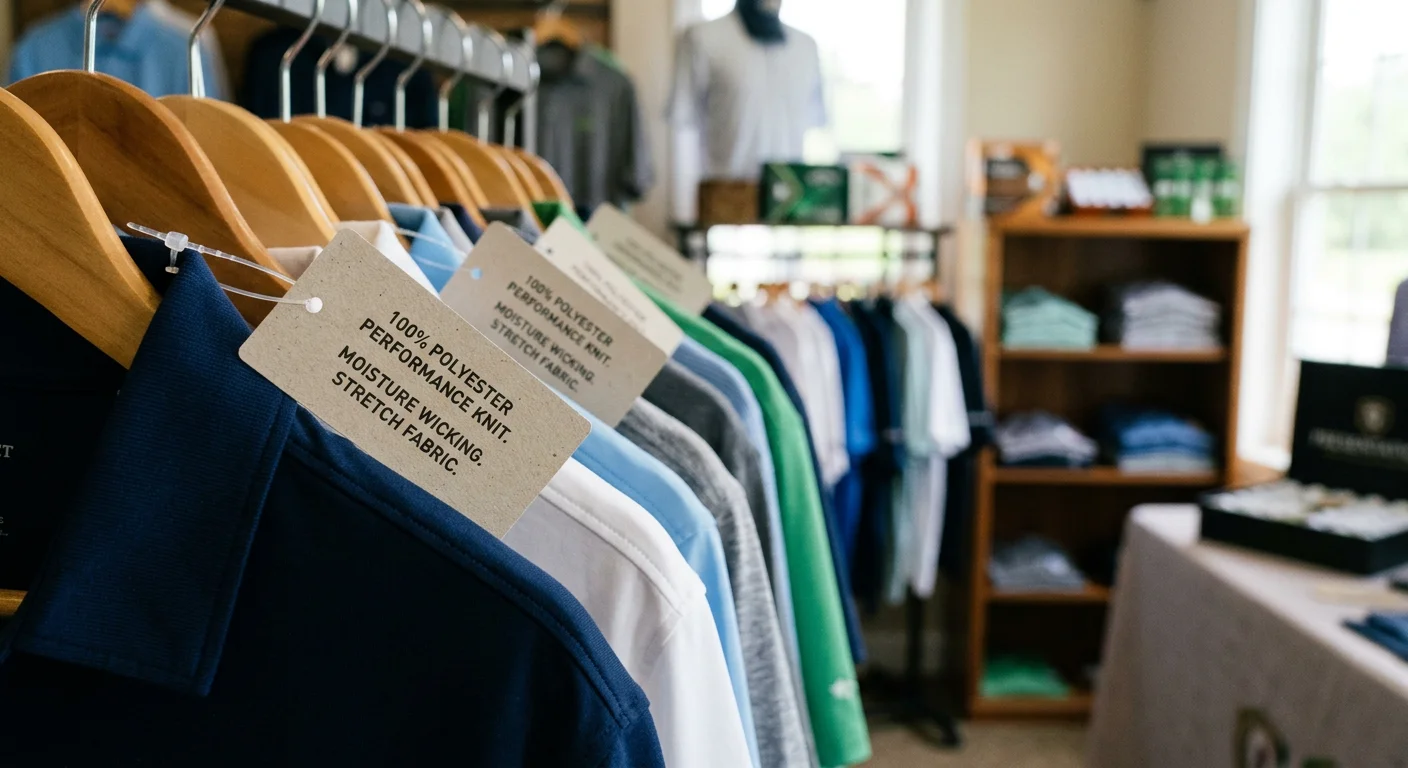
Walk through any golf pro shop today and pull the tags on the polos. Chances are, eight out of ten will say some version of the same thing: 100% polyester performance knit. That's not a coincidence — it's a supply chain consensus built over two decades of real-world testing.
The reason polyester took over isn't complicated. It dries fast. It holds color through repeated industrial washing. It stays shape-stable after a hundred laundry cycles in ways that cotton doesn't. For anyone managing bulk reorders, that consistency matters just as much as the performance specs do.
Knit Structure Is the Variable Most Buyers Miss
"Polyester polo" tells you almost nothing useful. The knit construction under that label is what determines how the shirt performs on the course.
Here's how the four main structures break down:
Micro-piqué — The classic golf polo texture. Small raised loops create surface air channels. That improves breathability and gives the shirt a structured, athletic look. It's the best default choice for stable bulk programs.
Interlock — Denser, smoother, cleaner drape. Go with this one when the brief calls for a more refined, sharp-looking finish.
Jersey — Softer feel, more casual movement. Works well for lifestyle-leaning golf lines. Less ideal for performance-first briefs.
Mesh — Maximum airflow. Reach for this one when the end-use environment is hot and high-exertion.
Quick sourcing shortcut: breathability over hand feel → micro-piqué or mesh. Cleaner finish over airflow → interlock.
Functional Polyester vs. Standard Polyester
Not all performance polyester is built the same. Standard polyester handles durability and color retention well. What it doesn't do on its own is move sweat away from the body.
Moisture-wicking golf fabric is a specific engineering choice. It's built through fiber cross-section geometry, yarn construction, knit structure, or finishing treatment — sometimes a mix of all four. A polo spec sheet that reads "100% polyester" without calling out moisture-wicking , quick-dry , or moisture management is a yellow flag. Push back on it.
High-spec golf polos carry UPF 50 protection , blocking 98% of UV radiation . That's a meaningful spec for customers logging four-hour rounds in direct sun.
rPET: Sustainable Without the Performance Trade-off
Recycled polyester (rPET) has reached near-parity with virgin polyester for golf polo use. The performance gap most buyers worry about — durability, color stability, quick-dry — comes down to yarn quality and knit construction. Whether the fiber was recycled or not is a secondary factor.
The practical rule: compare GSM, fabric structure, moisture-wicking test results, and post-wash shape stability side by side. A supplier claiming rPET performance should be able to show you GRS (Global Recycled Standard) certification. That document confirms both the recycled content and full supply chain traceability.
Three Specs to Put in Every Polyester Golf Polo Brief
Before approving a sample or locking in a bulk order, check these three things:
Knit construction — micro-piqué, interlock, jersey, or mesh (not just "polyester")
Functional callouts — moisture-wicking, quick-dry, or UPF 50 stated clearly on the spec sheet
Sustainability documentation — GRS certificate if rPET content is claimed
A golf apparel supplier who answers all three without hesitation is showing you something important about how they run their operation.
Spandex & Elastane Blending Ratios: How Much Stretch Does a Golf Swing Need
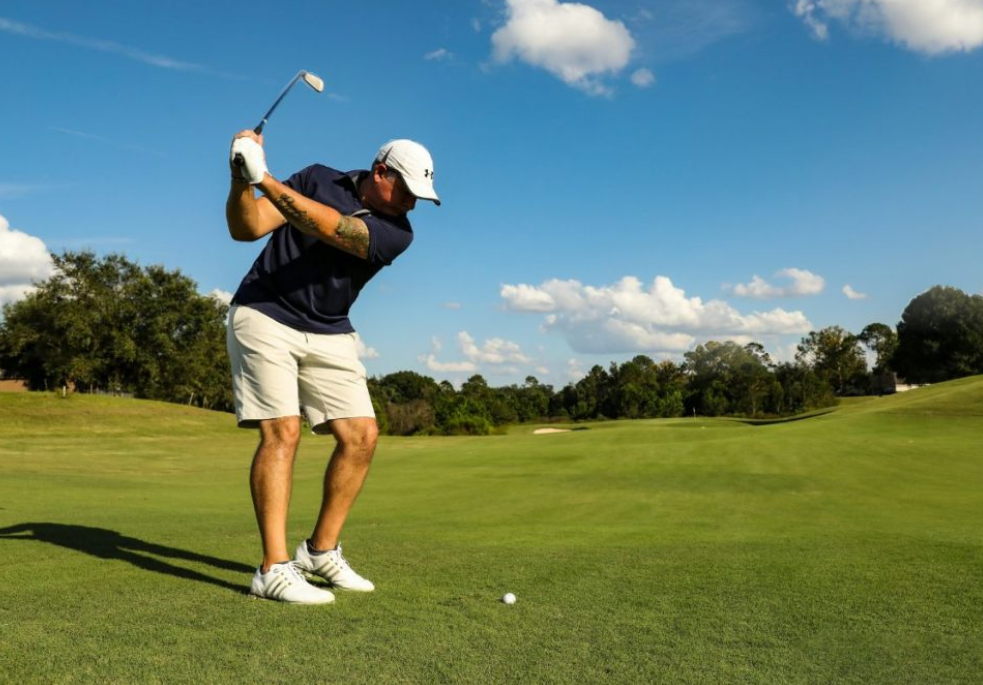
A full golf swing demands 90 degrees of shoulder rotation, deep hip turn, and knee flex — all in one fluid motion. The spandex percentage in your fabric decides whether the garment moves with that motion or fights it.
The numbers matter here. Here's the breakdown:
Light Stretch (3–5% Spandex): Comfort, Not Performance
A 97/3 or 95/5 polyester-spandex blend gives you comfort stretch — around 10–15% fabric extension . That's enough to take the stiffness out of a polo. It's not enough to support hip rotation on a big swing, though. For golf pants in a conservative cut, 3–5% spandex cuts restriction compared to zero. But the knees and seat will bag out faster. Recovery is moderate at best.
Best for: relaxed-fit polos and tailored-look trousers where the cut does most of the mobility work.
Moderate Stretch (10–12% Spandex): The Golf Performance Sweet Spot
90/10 polyester-elastane is where most performance golf brands land — and for good reason. Four-way stretch knits in this range deliver 25–35% extension in both warp and weft . That's what a full backswing and follow-through need. The fabric snaps back after repeated shoulder turns and torso rotations. No permanent distortion.
This is the blend behind most four-way stretch golf fabric claims you'll see on polo spec sheets. For upper-body garments, 88/12 hits the same performance level.
One QC benchmark worth knowing: premium 90/10 fabrics should hold ≥85% stretch recovery after 50 wash cycles . Dimensional stability should stay within 3% shrink/growth after laundering.
High Stretch (15–20% Spandex): More Than Most Golfers Need
80/20 and 85/15 blends deliver 40–60% four-way extension with strong snap-back. That puts you in compression territory — leggings, training underlayers, swimwear. Some performance golf base layers use 88/12 for strong recovery. At 80/20, the fit reads compressive. Conservative golf consumers will push back on that.
Higher elastane content also makes the fabric more sensitive to heat washing, tumble drying, and UV exposure. The durability tradeoff is real.
The 2-Way vs. 4-Way Decision for Golf Garments
This distinction matters more than most sourcing briefs give it credit for:
2-way stretch (elastic across the width) helps with stride and sitting. It won't support vertical motion. Shirts ride up at the top of the backswing. Pants resist knee bend on uneven lies.
4-way stretch (horizontal + vertical) moves with the full swing sequence: backswing, downswing, follow-through, and a long step on a sloped fairway.
Practical spec guidance by garment:
Garment | Recommended Blend | Stretch Type | Target Extension |
|---|---|---|---|
Performance polo | 90/10 – 88/12 polyester-spandex | 4-way | 25–35% |
Athletic/training top | 85/15 – 80/20 | 4-way (compressive) | 40–60% |
Performance pants/shorts | 92/8 – 90/10 | 4-way woven or warp-knit | 20–30% |
Conservative trousers | 97/3 – 95/5 | 2-way woven | 10–15% |
The sourcing rule that holds across garment types: 10–12% spandex for upper body, 8–10% for performance bottoms . Anything below 5% is a comfort upgrade, not a performance spec. Anything above 15% is compression — build for it with purpose, or stay away from it.
Nylon vs Polyester For Golf Pants & Outerwear: A Performance Comparison
Two fibers dominate the stretch-woven golf pant category. On a spec sheet, they look nearly the same. On the course — and in your customer's waistband after hour three of a summer round — the difference is real.
Here's how nylon and polyester stack up across the specs that matter for pants and outerwear.
Weight & Stretch: Where Nylon Earns Its Price Premium
Premium nylon-spandex golf trousers run 140–190 g/m² . Polyester-spandex versions land at 160–210 g/m² — heavier, with a slightly more structured hand. For hot-weather rounds, that weight gap is noticeable. Fabrics below 200 g/m²? Nylon-based constructions outperform polyester on perceived cooling, and that gap is consistent.
Stretch numbers are close but not identical:
Nylon 85–92% / elastane 8–15% : weft stretch 20–30%, warp stretch 15–25%. The hand feels buttery and smooth.
Polyester 90–95% / elastane 5–10% : weft stretch 15–25%, warp stretch 10–20%. Firmer feel — functional, but less refined.
Tour-fit upscale lines spec 88–90% nylon / 10–12% elastane . Value-tier programs default to 90–95% polyester / 5–10% elastane .
Abrasion Resistance & Durability: Polyester Wins This Round
Nylon stretch wovens test at 40,000–70,000 Martindale rubs . Polyester stretch wovens hit 50,000–100,000 rubs . You're outfitting cart riders who drag pants across seats all day, or customers who wash their gear often — polyester holds up longer under that kind of mechanical stress.
Minimum benchmarks worth building into your spec sheet:
- Light nylon golf pants: ≥30,000 rubs at 12 kPa
- Light polyester golf pants: ≥40,000 rubs at 12 kPa
Moisture & Odor: A Genuine Trade-off
Polyester's moisture regain sits below 1% — it's hydrophobic. Add a wicking finish and it dries fast. Nylon absorbs 2–9% moisture by weight . That sounds like a downside, but it actually creates a cooler sensation against skin in high heat.
On odor: polyester traps oils over time. That's a known issue in anti-odor fabric for golf applications. Nylon resists oil absorption. So premium travel-pant buyers tend to favor it for repeated wear between washes.
Outerwear: Which Fiber Belongs on a Golf Shell?
For wind and rain jackets, the choice breaks down by priority:
Polyester face + DWR + membrane : DWR finishes last longer on polyester. The fiber resists saturation. Best for steady rain and maximum wet-weather durability.
Nylon face + DWR + membrane : Thinner, softer, quieter during the swing. Go this route for lightweight golf apparel fabric builds where packability and swing freedom come first.
One thing to keep in mind: nylon shells wet out faster once DWR degrades. That hurts breathability at the membrane. Spec nylon outerwear? Build DWR reactivation guidance into your care label.
The Sourcing Decision, Simplified
Priority | Go With |
|---|---|
Hot-weather comfort, premium drape | Nylon 80–92% / elastane 8–20% |
High durability, frequent laundering | Polyester 90–95% / elastane 5–10% |
Lightweight, quiet golf shell | Nylon face + DWR + membrane |
Maximum rain resistance | Polyester face + DWR + membrane |
Nylon carries a real price premium. Golf pants in nylon blends retail at $100–150+ , while polyester-based options dominate the $50–120 range. Whether that premium makes sense comes down to your end customer's use case — not which fiber sounds more technical.
Cotton & Cotton Blends in Golf Apparel: Natural Feel vs. Pure Performance
Cotton doesn't dominate golf performance specs. It doesn't need to. It wins somewhere else — the moment your customer pulls a polo out of the bag and decides they want to wear it again.
That matters more than most sourcing briefs admit.
About 63% of golf shirts at retail carry moisture-wicking features. Most of those aren't cotton. Synthetics own the performance lane. But cotton is coming back in higher-end and lifestyle-oriented lines, often with performance treatments added. For specific golfer segments, it's the right call.
Where 100% Cotton Still Belongs
Pure cotton earns its place in three specific scenarios:
Member-course and resort play — casual 9–18 hole rounds in mild, dry conditions. Natural handfeel and classic look matter more than sweat management here.
Skin-sensitive golfers — customers with eczema, psoriasis, or allergy-prone skin who find synthetic knits irritating. Cotton's hypoallergenic properties are a real differentiator.
Frequent club members — people who wash their polo every week and want a shirt that feels solid and familiar, not technical.
Cotton has clear weak spots too. It struggles with heavy sweating, humid conditions, and long tournament days. Pure cotton absorbs and holds moisture — up to 24–27× its own weight in lab conditions. That's a problem for a customer walking 18 holes in summer heat. The shirt gets heavy, clingy, and stays that way.
A Blend Fixes What Cotton Can't
Cotton/poly/spandex tri-blends are where the most useful product development is happening right now. A 55–65% cotton / 30–40% polyester / 3–5% spandex construction gives you something practical. The shirt still feels like cotton — user data backs this up as long as poly stays under 50%. You also get real shape retention, faster drying, and enough stretch to support a full swing.
Spandex plays a key role here. Cotton has zero natural elasticity. Adding just 3–5% spandex changes the swing experience for competitive amateurs and handicap-focused players. They get unrestricted shoulder rotation and hip turn. That's not a small thing.
Performance differences in practice:
Wrinkle resistance — blends hold shape through 18 holes. Pure cotton starts showing collar and sleeve distortion by the front nine.
Drying speed — performance blends dry much faster. Cotton stays damp and adds weight in humid conditions.
Color fastness — polyester in the blend improves wash durability across seasons.
Pima & Double-Mercerized Cotton: The Premium Tier Argument
Building a natural-feel-first line for resort or member-course positioning? Cotton quality tiers create real product differences worth paying for.
Pima cotton uses extra-long staple fibers — 35–40mm vs ~28–30mm for standard upland cotton. This produces finer yarns with a smoother surface, less pilling, and a softer feel. Pima yarn costs 30–60% more than standard cotton in mass-market sourcing. That premium shows up in the finished product.
Double-mercerized cotton (mercerized twice — once in yarn form, once as fabric) takes it further:
Silk-like handfeel with measurable dimensional stability
Strength increase of about 10–20% over unmercerized cotton
Better dye uptake and color brilliance that holds through repeated washing
Together, Pima + double mercerization can push fabric costs 40–80% above basic cotton piqué . At retail, that supports $80–120 polo price bands vs the $40–70 range for standard cotton. That's a clear, defensible position for club-facing or resort-channel lines.
The Performance Finish Question
More brands are spec'ing moisture-management finishes on cotton to close the gap with synthetics. The improvement is real, but it has limits:
Treated cotton drying time drops ~30–50% vs untreated cotton in lab conditions
Vertical wicking rate can climb from near-zero to 8–12 cm/30 min — useful, but still below performance polyester, which regularly exceeds 20–30 cm
Most brands underestimate the durability ceiling. These finishes hold up for 20–40 home launderings before you see real decline. High-heat drying and harsh detergents break down both the fiber and the finish at the same time. For a lifestyle polo worn once or twice a week, that's one to two seasons of solid performance benefit. For tournament gear washed hard and often? You're looking at one season — less if care instructions get ignored.
Build your care label to reflect that. Set customer expectations straight from the start.
The Right Line Architecture
Product Line | Fabric Spec | Target Customer |
|---|---|---|
Member/resort casual | 100% Pima cotton, double-mercerized, 180–200 g/m² | Club members, resort golfers, cool–mild conditions |
Hybrid performance-lifestyle | 55–65% cotton / 30–40% poly / 3–5% spandex | Semi-competitive, practice + social play, warmer climates |
Pure performance | 85–95% polyester / 5–15% spandex | Tournament players, hot/humid conditions |
Cotton's role in a solid golf apparel lineup isn't to beat performance polyester. It's to serve the customer who wants to feel good putting the shirt on — and keep that feeling through a relaxed afternoon round. Get the fiber grade right, match the blend to the use case, and that customer will come back for more.
Merino Wool & Mid-Layer Fabrics: The Best Choices For Cool-Weather Golf Rounds

Cold morning tee times change the fabric equation. Drop to 10–15°C with a steady wind cutting across the fairway, and that polyester polo from July starts working against you.
Merino wool fills that gap better than anything else on the market right now.
Weight Is Everything — Pick the Right GSM for the Condition
Merino isn't a single product. GSM ranges from featherweight base layers to dense fleece mid-layers. Pick the wrong weight in either direction, and you lose swing freedom or warmth.
Here's the practical breakdown for golf:
150–180 gsm — Lightweight base layer territory. Breathable, close-fitting, moves with the backswing. Best for 15–20°C conditions with low wind — early autumn or late spring rounds.
200–300 gsm — The core range for cool-weather golf. It handles brisk morning starts, shaded fairways, and long waits on the tee. Go with 180–220 gsm for spring/fall programs. Step up to 250–300 gsm for windier, colder rounds.
250–400 gsm wool fleece — Heavier mid-layer builds. Great at trapping body-warmed air. Less suited for high-swing-volume play — the added bulk shows up at the top of the backswing.
Merino vs. Polyester Fleece: How to Split Your Line
Both materials belong in a cool-weather golf program. They just serve different customers.
Factor | Merino (180–220 gsm) | Polyester Fleece |
|---|---|---|
Temperature regulation | Active, adapts to exertion level | Passive — steady warmth |
Odor resistance | Strong natural resistance | Traps oils over time |
Packability | Thin, easy to layer | Bulkier at equivalent warmth |
Swing freedom | Better at lower weights | Depends on construction |
Price point | Higher | Lower |
Care complexity | Requires attention | Easy wash |
Merino owns the premium channel. Better handfeel, natural odor resistance, and temperature regulation that adjusts as you move between sun and shade across 18 holes. Polyester fleece covers the accessible tier. Lower cost, simple care instructions, and faster turns on bulk reorders.
Addressing the Care Concern Before Your Customer Does
Merino's biggest sourcing objection isn't price. It's wash anxiety. Buyers worry about shrinkage, deformation, and end customers who ignore care labels.
Here's the practical counter: merino's natural odor resistance means your customer washes it less. A 180–220 gsm merino mid-layer worn twice a week doesn't need laundering after every round. That's a real selling point — not just a marketing line.
Build your spec around machine-washable merino constructions where possible. Pair that with a clear care label, and the objection largely goes away.
Sustainable Fabrics For Golf Apparel in 2026: Recycled, Bio-Based & What's Worth It
The sustainability conversation in golf apparel has moved past good intentions. In 2026, brands need to show receipts — certifications, LCA reports, real emissions data — and buyers who can't produce them are losing shelf space.
Here's what's real, what's overhyped, and where the performance trade-offs sit.
rPET: The Practical First Move
Recycled polyester (rPET) tops the list of sustainable materials in golf activewear sourcing right now. The reason is simple: it works. A 90–95% rPET / 5–10% spandex knit delivers moisture-wicking, durability, and abrasion resistance within 10–20% of virgin polyester performance benchmarks. Most golfers will never notice that gap.
The environmental math holds up too. Industry LCA data puts rPET's greenhouse gas emissions 30–60% lower than virgin PET per kilogram of fiber. That's a solid number you can use in ESG disclosures and retailer pitches.
One combination worth flagging: rPET + dope dye (solution dyeing) . Dope-dyed rPET cuts out the conventional aqueous dyeing step completely. That drops water use and energy consumption further. For a performance golf polo, this is the strongest intersection of sustainability and low operational cost right now.
The honest limitation: rPET is still a synthetic fiber. Microplastic release during washing remains unsolved. It's a real improvement over virgin polyester — not a clean break from it.
What to ask your activewear supplier:
- Valid GRS (Global Recycled Standard) certificate with product scope (yarn / fabric / finished garment)
- Transaction Certificate (TC) per shipment confirming recycled content percentage
- Upstream chain coverage — bottle flake, pelletizing, yarn spinning — to avoid certificate borrowing
A polo made from rPET can back up a claim of 6–10 recycled plastic bottles per garment, depending on weight and composition. That's a concrete story your retail channel can use.
Bio-Based Nylon: Premium Performance With a Shorter Fossil Footprint
Bio-based nylon — derived from castor oil — is gaining traction in golf pants and outerwear where structured drape and four-way stretch matter. A 70–80% bio-based nylon / 20–30% spandex construction performs close to the 88/12 nylon-spandex benchmark , which sets the standard for performance golf trousers.
The carbon reduction is real but modest. Castor oil-derived nylon cuts carbon footprint 10–30% versus conventional petroleum-based nylon. The exact number depends on the formulation and production region.
The trade-off is price. Bio-based nylon fabric runs 20–40% above standard nylon per yard. To justify that premium, you need either a brand narrative strong enough to support a retail markup, or a B2B client with ESG commitments that make the cost defensible on paper.
Practical sourcing note: A "bio-based nylon" claim is hard to quantify in a B2B negotiation without third-party bio-based carbon content testing — such as ASTM D6866 methodology. Ask for the test report. No report from a golf apparel supplier? Treat the sustainability claim as marketing, not spec.
Bamboo: Comfort Story, Not a Performance Spec
Bamboo fabric is soft. The odor resistance is real. For a lifestyle or member-course polo, it earns its place in a line architecture.
The sustainability claim, though, is messier than the marketing suggests. Most commercial bamboo fabric is bamboo viscose — a chemically heavy process that uses the plant as raw material input, not a clean natural fiber. The environmental advantage is strongest at the agricultural end (fast-growing, low-pesticide crop). At the fiber production stage, that advantage shrinks.
Performance-wise, same-weight bamboo viscose dries 20–40% slower than polyester or nylon knits. For tournament or hot-weather applications, that's a meaningful gap. For casual lifestyle rounds and brand storytelling, it's manageable — in blends with organic cotton or recycled fibers that balance hand feel with structural stability.
The honest positioning: bamboo belongs in your lifestyle and resort casual tier. Don't put it in a performance or competition spec without serious blending and clear expectation-setting with buyers.
What "Sustainable" Costs in 2026
Fabric | vs. Conventional Baseline | Price Premium |
|---|---|---|
rPET knit golf fabric | vs. virgin polyester | +10–20% |
Bio-based nylon | vs. standard nylon (88/12) | +20–40% |
Bamboo functional blend | vs. standard cotton/poly | +10–30% |
Brands that build a dedicated sustainable line can recover the fabric premium through retail price increases of 5–15% . You also gain access to ESG-driven retail channels and higher-intent customer segments — younger golfers in urban practice and boutique club environments, where environmental positioning drives purchasing decisions.
The certification stack that holds up in B2B negotiations: GRS for recycled content, OEKO-TEX® STANDARD 100 for chemical safety, and bluesign® APPROVED for process-level environmental controls. Get all three into your supplier qualification checklist before any sustainable fabric claim goes on a hangtag or a pitch deck.
Best Fabric Combinations By Golf Garment Type: A Quick-Reference Selector
Every garment in a golf line has a different job. A polo manages heat and sweat through four hours of walking. Pants need to hold structure through a full hip rotation without bagging at the knee by hole twelve. Outerwear has to compress into a bag pocket and still block wind on the back nine. Solving one of those problems does not solve the others. Each garment needs its own fabric spec.
Use this as your sourcing shortcut.
Golf Polo
Tier | Fabric | GSM | Key Spec |
|---|---|---|---|
Entry / Team | 95/5 poly-spandex micro-piqué | 160 g/m² | Wicking + quick-dry finish |
Mid / Club | 90/10 poly-spandex micro-piqué | 180 g/m² | UPF 30+, 4-way stretch |
Premium / Tour | 82/18 poly-spandex jersey | 190 g/m² | UPF 50+, anti-odor, Bluesign |
Cotton alternative | 100% mercerized cotton piqué | 200 g/m² | Pre-shrink finish, soft handle |
Golf Pants
Tier | Fabric | GSM | Key Spec |
|---|---|---|---|
Entry | 97/3 poly-spandex stretch twill | 190 g/m² | Crease-resistant, basic DWR |
Mid – performance | 90/10 poly-spandex double-weave | 210 g/m² | Wicking waistband lining |
Mid – comfort | 62/35/3 cotton/poly/spandex twill | 220 g/m² | Chino handfeel, slower dry |
Premium | 86/14 nylon-spandex double-weave | 200 g/m² | DWR, stain-resistant, UPF rated |
Golf Outerwear
Tier | Fabric | GSM | Key Spec |
|---|---|---|---|
Entry shell | 100% polyester ripstop | 140 g/m² | Basic DWR, packable |
Mid softshell | 94/6 poly-spandex softshell | 180 g/m² | 5–10K water resistance |
Premium shell | 88/12 nylon-spandex 3-layer bonded | 210 g/m² | Taped seams, high breathability |
Clubhouse / travel | 60–70% cotton / 30–40% polyester fleece | 260 g/m² | Comfort-first, minimal protection |
Golf Shorts
Tier | Fabric | GSM | Key Spec |
|---|---|---|---|
Entry | 96/4 poly-spandex stretch twill | 170 g/m² | Quick-dry, basic wicking |
Mid – performance | 90/10 poly-spandex micro-ottoman | 190 g/m² | 4-way stretch, subtle texture |
Premium | 87/13 nylon-spandex technical woven | 185 g/m² | DWR, UPF 30–50+ |
One pattern runs through every tier above: elastane percentage is the clearest signal of performance intent.
Here is how it breaks down:
Entry builds use 2–5% elastane. That gives you basic comfort stretch and nothing more.
Mid-tier bumps to 8–10%. That is enough for real swing mobility.
Premium specs hit 12–15%. Polo performance builds go even further — up to 18–20% — for full four-way stretch recovery across repeated rounds.
The second signal worth tracking: fiber upgrade from polyester to nylon at the premium tier , mainly in pants and outerwear. As covered earlier in this guide, nylon carries a real price premium. Your channel and your customer determine whether that premium fits your line — not which fiber sounds more technical on a spec sheet.
2026 Golf Fabric Trends: Zoned Performance Knits, Anti-Odor Tech & Lightweight Stretch Wovens
Three things are reshaping golf fabric specs for 2026: bodies engineered around a swing, odor-fighting tech that holds up through the wash cycle, and lightweight wovens that have pushed traditional cotton twill into the background.
Zoned Performance Knits: Engineering the Polo Around the Swing
The single-fabric polo is fading out. Body-mapped construction replaces it with different knit structures in different zones. Each zone is spec'd to match what that part of the body does during a swing.
Here's how the mapping breaks down:
Upper back / scapula area : mesh or open-knit panels, targeting 50–80% elongation in weft with ≥90% recovery. This zone takes the most strain during backswing and follow-through.
Underarm and side torso : jacquard micro-mesh for heat and sweat release. These panels run 15–30% lower GSM than the main body — think 130–150 gsm mesh against a 170–190 gsm primary knit.
Shoulder yoke and rib-side panels : denser, higher-modulus knit to hold the garment in place. Stretch is capped at 20–30% — you want structure here, not give.
Sleeve cap and bicep : balanced interlock or double-knit. Recovery prevents bagging through the downswing. Elongation lands at 30–50% .
Center back spine channel : a narrow 3–5 cm vertical mesh or engineered jacquard vent running along the spine. It started as a running-category idea. Now it shows up in premium golf polos as a heat-release channel that keeps shoulder support intact.
For 2026 competitive polo specs, the standard content benchmark is 90–92% polyester / 8–10% spandex in the main body panels. Brands going for a softer, more natural feel are testing 50–60% polyester / 30–40% lyocell or viscose / 5–10% spandex blends. These work on the course and hold up off it.
Build your zoned knit spec around three GSM levels in one garment: 170–180 gsm core, 130–150 gsm mesh zones, 190–200 gsm stability panels . Request lab results for air permeability ( ASTM D737 , targeting >300–400 L/m²/s @ 100 Pa for mesh zones) and stretch recovery ( ASTM D2594 ) for each panel type on its own. Choose engineered jacquard transitions between zones instead of cut-and-sew seams. This cuts seam irritation and keeps the swing path clean.
Anti-Odor Tech: What Lasts, What Fades
Not all anti-odor treatments perform the same. The gap between a topical silver-ion finish and an antimicrobial fiber isn't a marketing claim — it shows up in how many washes your customer gets before the function disappears.
Technology | Wash Durability | Best Application |
|---|---|---|
Silver-ion topical finish | 20–30 washes; premium up to 50 | Entry/mid-tier polos |
Silver in filament yarn | 50–100+ washes | Premium tour polos, base layers |
Photocatalytic finish (TiO₂) | 30–50 washes (light-activated) | Light-colored outer layers |
Dope-dyed antimicrobial fiber | 50+ washes, minimal loss | Sustainable + performance positioning |
For entry-line programs, a silver-ion topical finish gets the job done. Look for ≥90% bacterial reduction after 20 washes per AATCC 100 , backed by a lab report. For premium or tour-level specs, silver-in-filament or dope-dyed antimicrobial fiber is the stronger choice. The function sits inside the fiber itself — not on the surface.
One adjustment worth making before your hangtag copy goes to print: test data shows 30-wash durability? Label it effective for 25 washes . That buffer protects your brand from customers running hotter wash cycles than the test protocol uses.
Dope-dyed antimicrobial fiber has an extra edge for 2026 sustainability positioning. Pigment and antimicrobial agent go in during fiber spinning, so there's no standard aqueous dyeing step. That drops water and chemical use by 60–80% versus standard dyeing — a concrete number for ESG conversations with retail buyers.
Lightweight Stretch Wovens: The Quiet Takeover of Golf Bottoms
Traditional cotton twill golf pants — 220–260 gsm, less than 15% stretch, one-way — are losing ground faster than most sourcing teams have updated their briefs. The shift isn't dramatic. It's steady, functional, and now mainstream.
By 2026, technical stretch wovens are on track to hold 60–80% of performance men's golf bottoms volume in major brands. The adoption curve tells the story:
2015–2018 : stretch wovens at 20–30% share in performance lines
2019–2022 : athleisure crossover brings jogger silhouettes onto the course; share reaches 40–50%
2023–2026 : technical joggers replace chinos as the default — not the exception
The fabric specs driving this: 85–92% recycled polyester / 8–15% elastane , or 88–90% nylon / 10–12% spandex . GSM drops to 130–180 for warm-season builds, 180–220 for three-season. Four-way stretch hits ≥20–30% in both directions. High-end constructions push to 40–50% extension . DWR finish is standard. Drying time targets under 30 minutes from saturated to touch-dry.
For 2026 bottoms programs, aim for 140–170 gsm on warm-season pants and shorts, and 180–210 gsm for three-season. Cost-sensitive programs can spec 100% polyester wovens with 10–15% mechanical stretch via textured yarns. No elastane needed — and it still performs. In every case, three things matter most: articulated patterning at the knee and seat , directional stretch mapped to hip rotation, and a GSM light enough that the pants don't feel like heavy chinos once they're on the course.
How to Evaluate a Golf Apparel Fabric Supplier: A B2B Buyer's Checklist
Most sourcing decisions go wrong before the first sample arrives. The golf apparel supplier looked credible. The spec sheet had the right keywords. The price worked. Then the bulk order showed up — the UPF rating didn't match the certificate, the stretch recovery bagged out after fifteen washes, and your client started asking hard questions.
Here's how to avoid that situation.
Step 1: Pre-Qualify on Paper Before You Talk Price
Ask for these documents upfront. No exceptions.
ISO 9001 certificate — confirms a quality management system exists
OEKO-TEX STANDARD 100 — chemical safety for skin-contact garments
GRS certificate (if rPET is claimed) — must include product scope and transaction certificates per shipment
Current golf fabric spec sheets — GSM, fiber content, UPF rating, stretch specs
Third-party test reports for those spec sheets — not internal documents
Check the UPF, colorfastness, and pilling numbers against the required thresholds. If any fall below, stop there. A supplier who fails paper pre-screening won't perform better under production pressure.
Step 2: Know the Test Standards — and the Numbers That Matter
A supplier sends you a test report. You need to read the numbers and know what they mean.
Moisture management (moisture-wicking golf fabric)
- Spreading speed on fabric surface: ≤5 seconds (target ≤3 seconds)
- Vertical wicking height at 30 minutes: ≥8–10 cm
- Moisture vapor transmission: ≥5,000 g/m²/24h (ASTM E96)
Quick-dry performance
- Drying time to 105% of initial weight: ≤20–30 minutes under standard lab conditions. Cotton sits at 60–90 minutes for comparison.
- After 10 wet/dry cycles: performance retention ≥80%
UV protection (UV protection golf clothing fabric)
- UPF ≥30 : qualifies as "good protection"
- UPF ≥50, UVA transmittance ≤2% : the standard for tour-facing and premium outdoor positioning. Verify under AATCC 183 or AS/NZS 4399.
Four-way stretch golf fabric recovery
- Transverse elongation: ≥20–25% ; longitudinal: ≥15–20%
- Residual deformation after 20% elongation held 30 minutes: ≤5–8%
Colorfastness (all four)
- Wash (AATCC 61), light (AATCC 16), perspiration and friction (AATCC 8/116): all ≥Grade 4
Pilling resistance
- ICI or Martindale after 2,000–5,000 cycles: ≥Grade 4
Abrasion and dimensional stability (pants and outerwear)
- Martindale abrasion: ≥20,000 cycles without breakage (premium club uniforms: 30,000+)
- Shrinkage after AATCC 135: |ΔL| ≤3% in both directions
Step 3: Run Your Own Lab Verification
Supplier test reports are self-reported. Take that seriously. Shortlist three to five candidates. Pull one to two representative samples from each — a golf polo knit and a stretch woven for pants. Send them to an independent third-party lab for:
Pilling
UPF
Stretch and recovery
Colorfastness
Dimensional stability
A variance of ±5–10% against the supplier's numbers is normal. A gap beyond that needs a direct conversation. Pay attention to how the supplier responds. Those who explain the gap and offer corrective steps are showing you how they'll handle real production problems — that's useful data.
Step 4: Get the Fabric on a Body, on a Course
Lab numbers don't play golf. Organize three to five experienced players for two to three full 18-hole rounds in the samples. Collect feedback on:
Breathability through mid-round heat
Drying speed after a sweaty front nine
Swing freedom — focus on the backswing shoulder and follow-through hip
Friction comfort at collar, underarm, waistband
Build a simple internal scoring sheet: function ≥40%, comfort ≥30%, appearance stability ≥30% . Lab data and on-course feel pointing in the same direction — that's a real answer.
Step 5: Ask the Operational Questions That Separate Real Suppliers From Sample Houses
Before any commercial conversation, get direct answers on these:
MOQ
- "What's the MOQ per fabric, per color — and does it differ between polo knits, stretch wovens, and outerwear shells?"
- "Do you support color/size mix within a single order? For example: 200 pieces per color, 600 pieces per style?"
- "Do you hold stock in core colors (black, white, navy) at lower MOQ — say 50–100 pieces — for sampling or small custom runs?"
Sampling timeline
- "How long from formula confirmation to lab dip?" — Industry standard: 5–7 days for lab dip, 10–15 days for a finished garment sample.
- "Can you deliver fabric swatch + lab dip + first garment sample within three weeks?"
- "What's your sampling fee, and is it credited against bulk?" — OEM standard range: $50–$150 per style.
Color consistency
- "Do you use a spectrophotometer with ΔE CMC control? What's your batch-to-batch tolerance?" — Target: ΔE ≤1.0–1.5
- "Do you run 4-point fabric inspection, with grading for shade variation, streaks, and contamination?"
- "Can you provide lab dip retention samples, first-batch samples, and per-shipment color archives?"
Sustainability documentation
- "Can you trace your rPET to the yarn spinner? Do you have GRS transaction certificates per shipment?"
- "Is your OEKO-TEX or Bluesign certification at the factory level or limited to specific fabrics?"
- "Do you have ZDHC/RSL chemical compliance reports from the last 12 months — covering heavy metals, formaldehyde, APEO?"
A supplier who answers these questions without hesitation — with documents, not verbal assurances — tells you a lot about how their operation runs day to day.
Supplier evaluation isn't a formality. This is where your product quality gets decided, three months before your customer ever touches the garment. Run the checklist. Verify the numbers. Watch how suppliers behave under scrutiny — that behavior repeats itself at scale.
Conclusion
Fabric selection isn't a footnote in golf apparel design — it's the whole story.
Sourcing moisture wicking golf fabric for a private-label polo line? Finalizing blending ratios for a seasonal collection? Every decision you make at the material level shapes everything that follows. It affects how the garment performs under a full swing. It determines how it holds up after 50 washes. And it decides how your customers feel wearing it on hole 18.
The right fabric combination exists for every garment category and every budget tier. You now have the technical framework to make that choice with clarity.
Your next move : Take this guide into your next golf apparel supplier conversation. Ask the hard questions — four-way stretch golf fabric certifications, recycled content percentages, MOQ flexibility. Need a manufacturing partner who can already answer all of them? Berun Activewear is worth a serious look.
Good materials make good golf apparel. Everything else is just finishing.