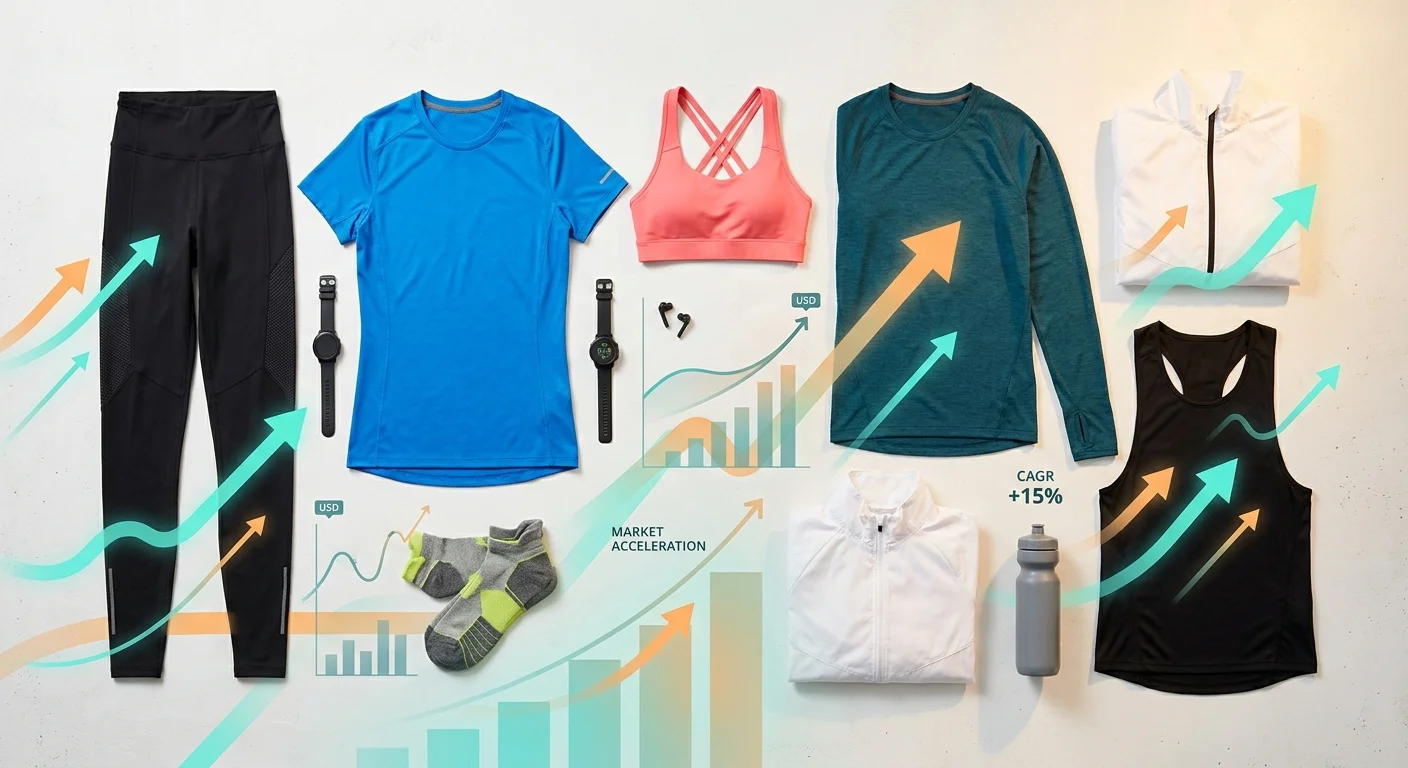
Between pandemic lockdowns and Monday morning Zoom calls in leggings, the fitness apparel industry crossed a point of no return. What started as a lifestyle shift turned into a full market transformation. In 2026, the numbers are hard to ignore.
The global athleisure market expansion is moving toward a valuation that's changing how investors allocate capital. DTC founders are rebuilding brand roadmaps around it. Legacy sportswear giants are scrambling to protect shelf space they once held by default.
Raw market size tells only half the story, though. The real signal — the one most industry overviews bury in a footnote — is which forces are driving growth right now. More than that, it's where the white space still sits.
That's what this breakdown is here to answer.
2026 Global Market Scale & CAGR Benchmarks
The numbers are in. They're worth a close look.
Global fitness apparel is heading toward USD 245–250 billion in 2026 . That's up from an estimated USD 220 billion in 2024–2025. The growth rate sits at ~5.5% CAGR — quiet on paper, but far more meaningful once you see what's driving it.
Most market overviews skip this part: a 5.5% compounding rate in a mature consumer category is not slow growth. It's separation from the pack. Biotechnology runs at 13.6% CAGR. Enterprise SaaS at 13.7%. But both sectors demand heavy capital and deep technical infrastructure. Activewear is different. It's a consumer habit — low barrier to entry, fast adoption, and wide open to new players.
By the late 2020s, the industry is set to pass USD 280–310 billion .
What this trajectory signals for decision-makers:
Gym clothing consumer demand is no longer cyclical. It now behaves like recurring spend — steady, predictable, and consistent
The workout apparel revenue growth curve runs on wellness behaviors. Fashion cycles don't drive it anymore
US consumers are spending USD 60 billion per year on fitness-related categories in 2026. That works out to USD 733 per goal-oriented household
That last number deserves attention. Habitual spend is defensible spend. And defensible spend is what builds lasting brands.
Fitness Clothing Market 2026: Sub-Category Velocity & Share Distribution
Aggregate numbers hide the real story. The top-line figure lands somewhere between USD 283 billion and USD 373 billion in 2026. That range shifts based on how wide you draw the category line. The real intelligence sits one level deeper — in sub-category velocity.
Here's how the lanes break out:
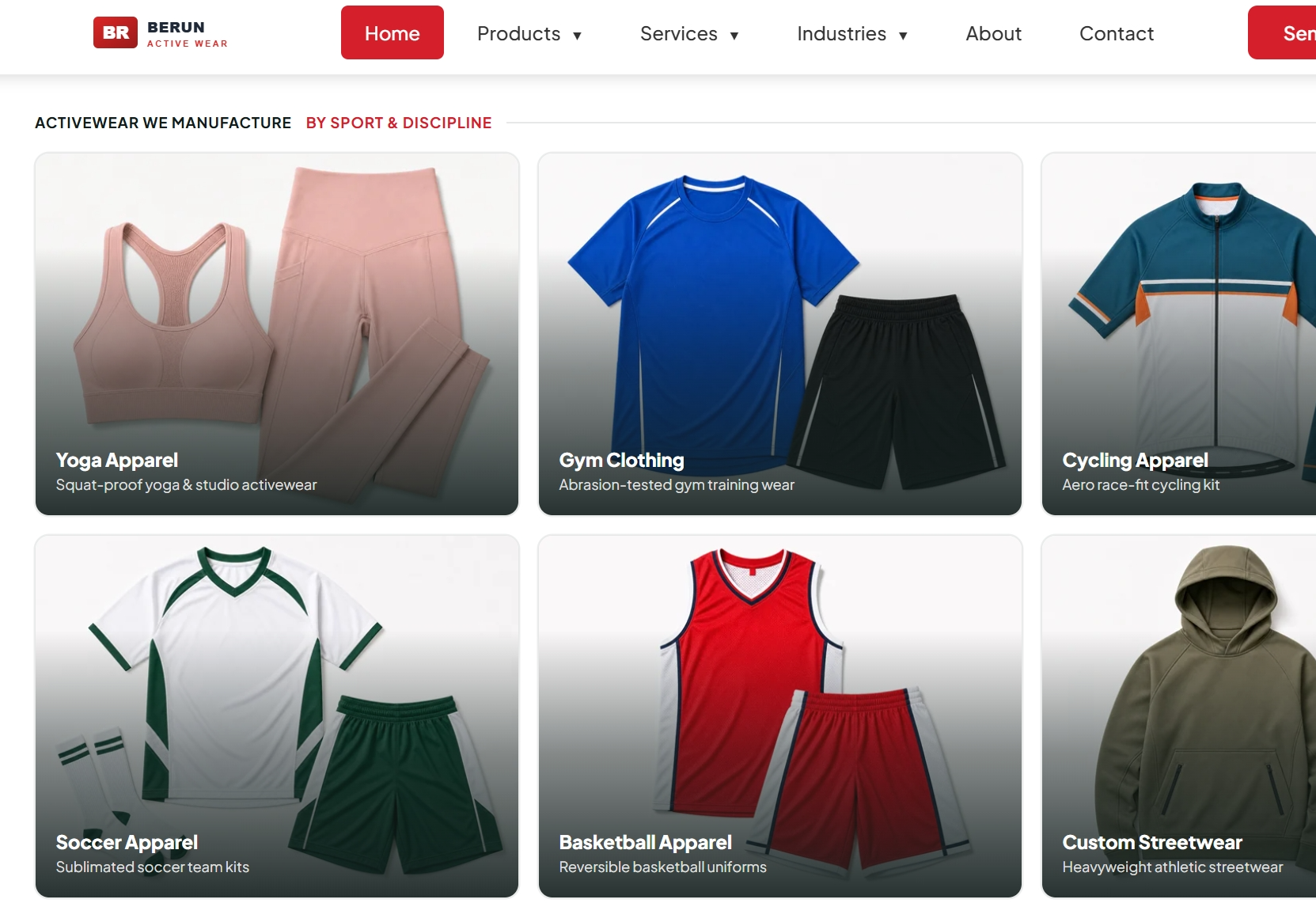
High-velocity core — Women's leggings, yoga pants, sports bras, and bra-top sets. This is the demand engine. Women's activewear holds the largest revenue share across every major market snapshot. It's not a trend. It's the gravitational center of the entire category.
Growth-velocity expansion — Men's joggers, training shorts, technical tees, and hybrid athleisure basics. The men's lane is where activewear brand competition is moving fastest at the SKU level. Slim fits and crossover styling are pushing that growth. New silhouettes keep entering the space, and buyers are responding.
Premium-velocity niche — Compression tights, recovery tops, and post-workout support layers. Performance apparel sits at an estimated USD 47.7 billion in 2026. The segment is smaller, but margins run higher and customers stay longer.
Price-premium storytelling of activewear — Sustainable and recycled-fiber lines pull a clear markup over standard product. Modest fitness lines are also gaining ground. Right now, that positioning lane is underpriced — which means there's open space for brands willing to move early.
📊 Infographic reference: Track the 2022–2026 growth curve alongside sub-category share distribution and fastest-growing SKUs by segment — those three panels show the market's structural story faster than any paragraph.
Your entry strategy lives in this breakdown — not in the headline number.
Mainstream Athleisure Expansion & Workplace Casualization Shift
Denim didn't lose the wardrobe war without a fight. It got outpaced, SKU by SKU, drawer by drawer. Leggings and joggers now hold the shelf space that jeans once owned by default.
That's not a cultural observation. It's a market structure event — and the numbers behind it are hard to ignore.
The global athleisure market hit $425 billion in 2025 . Forecasts put it at $941 billion by 2034 , compounding at 9.2% CAGR . A second forecast pegs the 2035 figure closer to $952 billion . The exact ceiling depends on where you draw the category boundary. But the direction is clear.
More telling than the scale is the velocity gap . Athleisure is growing at more than twice the rate of the broader apparel market . US sportswear tracked at 3.0% CAGR against just 1.3% for the combined apparel and footwear category. That gap is the real competitive signal.
What's Driving It: Workplace Casualization
The pandemic didn't create this shift. It sped up a structural change that was already forming beneath formal dress codes.
Hybrid work removed the last friction point. Office environments stopped requiring polished separates. So consumers stopped buying them. That spend moved toward versatile pieces — items that go from a morning workout to a standing desk to a casual dinner with no bag change needed.
MarketResearchFuture puts it plainly: performance activewear has "moved well beyond gym walls and onto office floors" , now purchased with similar frequency as traditional business casual . NPD Group data backs that up — athleisure bottoms have replaced jeans at a 1:1 ratio in many US closets.
The product mix confirms the behavior. Leggings, joggers, and technical tops account for over 60% of athleisure clothing revenue . T-shirts alone represent 38.51% of global category revenue. These are core basics — bought often, repurchased regularly, and resistant to seasonal fashion swings.
What This Means for Product Strategy
Versatility isn't a marketing angle here. It's the actual purchase driver.
Consumers pick items based on stretch recovery, breathability, and soft handfeel — not sport-specific performance specs. The fastest-growing sub-type within athleisure is yoga apparel : low-impact, studio-appropriate, and equally at home running errands, working remotely, or going out casually.
For anyone thinking about product positioning in this space, the commercial direction is specific:
4-way stretch leggings and joggers with a clean, tapered silhouette
Neutral color palettes that read as officewear, not gymwear
Minimal branding — quiet logos outperform sport-graphic treatments in this buying context
Soft, breathable knit tops that don't signal their athletic function
The core demand driver — workplace casualization plus hybrid work norms — isn't a trend. It's a permanent reset in how consumers think about functional dressing. Brands that build their SKU lineup around that reality, rather than chasing performance-spec halo products, are moving with the current. Not against it.
Hybrid Fitness Models & Home-Workout Apparel Demand Surge
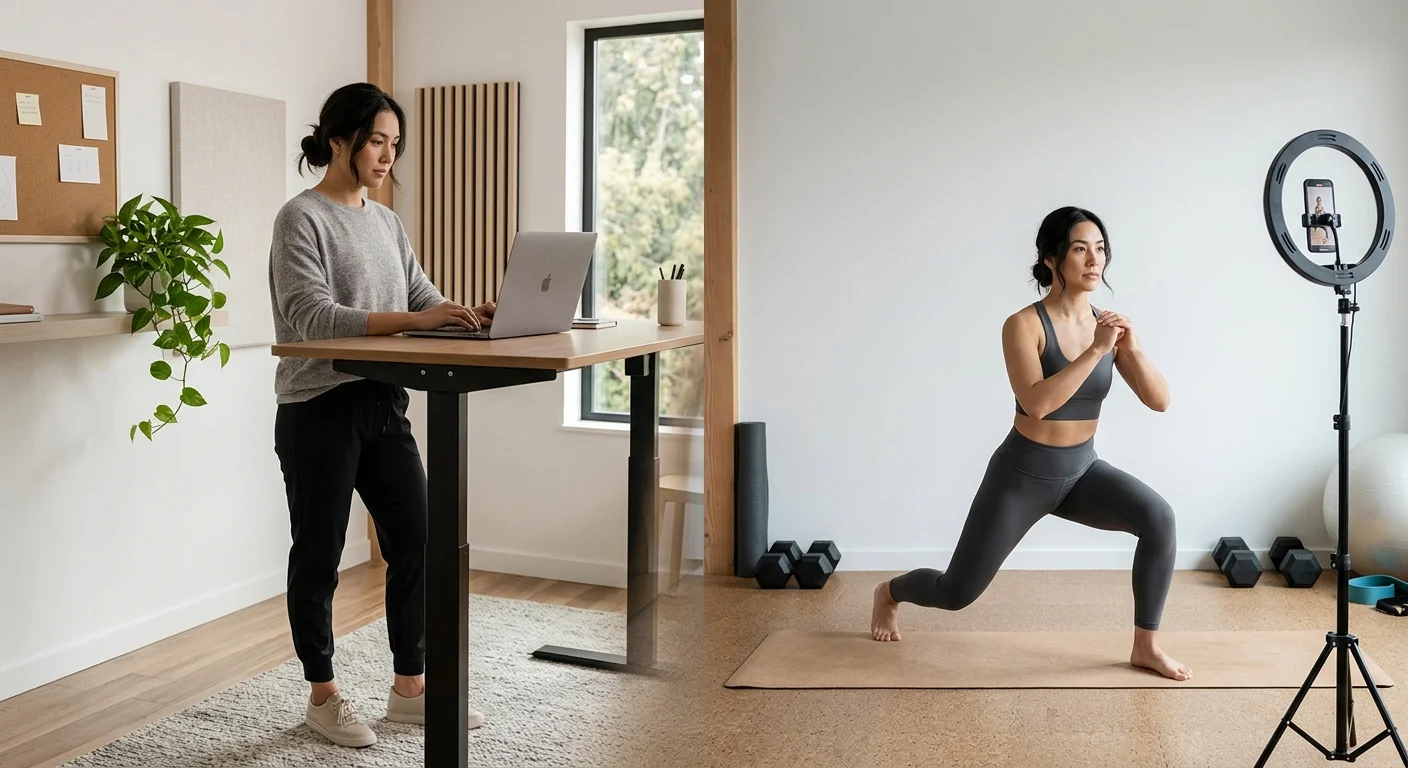
The gym didn't disappear. It split into two locations — one with squat racks, one with a ring light and a phone stand.
By 2026, hybrid fitness is no longer a pandemic workaround. It's the default model. Fitness operators now bundle in-club and digital memberships as standard. People split their sessions across studios, outdoor runs, and living room floors. That shift has a direct product consequence: every outfit needs to work in both places.
The wash-wear cycle picked up fast. Hybrid users stack more sessions per week than gym-only members — shorter home workouts on top of 1–3 in-person days. That means more leggings, more bras, more tops moving through the laundry. Multipurpose, quick-drying pieces are no longer a bonus feature. They're the baseline.
Camera-Ready Is Now a Product Spec
Here's what changed the product brief: workouts are filmed now. Zoom classes, TikTok clips, YouTube follow-alongs — a real share of home workouts happen on screen. Visual performance is now a real technical requirement.
The specs that matter are specific:
High-opacity, minimal-sheer fabrics that hold up through squats and dynamic movement on camera
Color-blocked, high-contrast designs that show up clean on a compressed phone screen
Matching bra-and-legging sets built for a 9:16 vertical frame — cohesive, clean, intentional
Gymshark built a big chunk of its DTC growth right here. Seamless, body-contoured sets. Coordinated seasonal colors dropped in collections. Glute-contouring construction that looks good on camera. None of that was accidental. It was merchandising built around how hybrid-active communities use and share content.
The commercial upside is clear. Matching-set bundling lifts average order value by 25–40% compared to selling tops and bottoms as separate pieces. That number gets stronger when you frame it as a "hybrid week pack" or "online class starter kit" — targeting users who need multiple camera-ready outfits each week.
Any brand looking for entry points here should know: the hybrid fitness group isn't a niche. It's the growth edge of gym clothing consumer demand in 2026. The product brief it creates is more specific, more defensible, and more repeatable than chasing seasonal fashion trends.
Performance Fabric Technology & Wearable Data Synergy
The fabric touching your skin is becoming a sensor array. This isn't a product roadmap item for 2030 — it's shipping now, and the market is moving fast.
Global smart textiles hit $4.3 billion in 2022 and are heading toward $6.6 billion by 2026 at an 18% CAGR . Sports and health applications are driving most of that growth. These are garments that measure heart rate, muscle oxygen saturation, joint angles, posture, and local skin temperature — while you move.
What the Fabric-Wearable Stack Does
The commercial logic is straightforward. Smartwatches and GPS units capture broad metrics — pace, overall HR, rough calorie estimates. What they can't do is pinpoint where on the body stress is landing.
Smart compression garments fill that gap. Strain sensors built into leggings detect how load spreads across joints. They also flag repetitive motion errors before those errors turn into injuries. MIT's digital knit textile research takes this further — pressure-sensing knits read posture and movement patterns straight from the garment surface. The data output matches what external IMUs produce.
The result is a layered performance system:
- Wearable device : pace, VO₂ proxy, overall HR
- Smart textile : local pressure maps, muscle activation patterns, gait asymmetry, skin temperature variance
Together, those two data streams produce personalized training loads and real-time injury risk alerts. Neither device can do that on its own.
The Construction Behind It
Performance e-textiles build on existing foundations. The base is polyester/spandex blends — 80–90% polyester, 10–20% elastane . Synthetic bases handle repeated washing well. They also hold 4-way stretch for steady sensor-skin contact and pull moisture away from embedded electronics. So the sensors get added without giving up the fabric performance serious athletes expect.
Brands watching this space should note one more shift: sustainable smart textile development is now running alongside performance gains. Researchers are weaving triboelectric and piezoelectric energy-harvesting fibers straight into performance fabrics. Movement and friction power the sensors. That removes battery dependency and keeps data collection running across full training sessions — no recharging breaks.
That convergence — performance fabric technology paired with real-time biometric output — is where the next strong product premium will come from.
Social Commerce, Creator Economy & Micro-Brand Proliferation
The storefront is dead. The feed is the store now.
Global social commerce is moving toward $2.11 trillion in 2026 — growing at 29.12% CAGR . U.S. social commerce alone will cross $100 billion this year. TikTok Shop claims $23.41 billion of that. These aren't discovery numbers. They're purchase numbers.
The behavior shift is clear: 70% of global shoppers now buy through social platforms. 82% use social media as their main product research channel. The scroll replaced the search bar. The checkout button lives inside the content now.
Creator Partnerships Are a Sales Channel — Not a Marketing Budget Line
eMarketer is clear on this. Creator partnerships are a direct-sales tool with SKU-level tracking — not a brand-awareness play. Amazon's 2026 guidance says the same thing. Stop running one-off campaigns. Build long-term creator relationships . Measure them by sales and customer lifetime value .
That model gives independent activewear brands a real edge. A trainer with 80,000 loyal followers can launch a capsule drop. They push it through short-form video and livestream commerce. The conversion rates far exceed what traditional ecommerce can deliver. Live shopping converts at up to 30% . Standard ecommerce sits at 2–3% .
The setup that makes this work needs three things:
- Native content that feels organic, not scripted
- Real-time inventory sync so stock matches demand
- Fulfillment readiness for sudden viral spikes
Skip the last two and you'll break on your best day.
For DTC fitness brands entering now, the playbook is a creator-affiliate hybrid . TikTok and Instagram drive demand. In-app checkout handles conversions. Seasonal challenge-based drops tied to limited-edition colorways keep buyers coming back. Legacy wholesale distribution of activewear? Optional. Community? Non-negotiable.
Sustainability Mandates & Ethical Supply Chain Premiumization
Regulations don't ask permission. They arrive. Then the market reorganizes around them.
The EU Green Claims Directive is reshaping sustainable activewear right now. Generic language — "eco-friendly," "green," "conscious" — is getting pulled from product pages across Europe. Replacements must be third-party verified, lifecycle-backed, and methodology-specific. Comparative claims like "greener than conventional polyester" need like-for-like evidence to hold up under regulatory review. The vague sustainability story isn't just a positioning risk. It's a compliance liability.
That pressure doesn't stop at EU borders. Retailers and sourcing platforms are moving ahead of regulators. SMETA audits, GRS certification, and OEKO-TEX documentation are shifting from preferred Fitness Apparel supplier criteria to baseline onboarding requirements. No verified claims stack? No shelf access. The rule is that simple.
The Certification Bundle That Commands 20–30% Higher Prices
Here's what the data shows: brands that combine GRS + OEKO-TEX Standard 100 + SMETA on their core activewear ranges are pricing 20–30% above comparable non-certified products — with no meaningful volume loss.
The premium comes down to trust compression. Certifications take the cognitive work out of assessing legitimacy for the consumer. Greenwashing risk drops out of the purchase decision. Retailers give certified lines priority placement in curated edits. The GRS logo on a hangtag signals chain-of-custody control across the full recycled polyester path — from post-consumer plastic bottle to finished legging.
For gym clothing consumer demand that filters by values, that certification stack isn't marketing. It's a purchase criterion.
Where the Margin Protection Lives
Recycled fiber and certification costs run higher upfront. The offset is structural:
Concentrate certifications on the top 20% of SKUs by revenue — hero leggings, sports bras, core tees. Focus certified volume where sell-through is most predictable.
Lock in long-term contracts with compliant mills to stabilize pricing on GRS-certified recycled polyester and GOTS-certified organic cotton.
Use certifications as trusted signals that cut the paid content spend needed to justify sustainability claims to skeptical buyers.
The regulatory side strengthens the business case further. Brands with documentation-ready supply chains — gym clothing manufacturer mapping to tier-2 and tier-3, SMETA audits refreshed every two years, LCA-benchmarked impact data — face lower risk of shipment blocks, product recalls, and retailer chargebacks as EU and UK rules tighten through the late 2020s. That stability adds real value to the margin line. It just doesn't show up in a standard cost model of fitness apparel.
Recycled PET data shows 30–50% lower GHG emissions versus virgin polyester. Organic cotton delivers 80–90% water-use reduction against conventional. Those aren't just sustainability report numbers. They're verifiable LCA inputs that hold up under retailer scrutiny — and now, regulator scrutiny too.
What This Means for Brands Entering Now
Third-party validation has shifted. It's no longer a differentiator. It's table stakes for listing on major EU and UK ecommerce platforms, getting into retailers' sustainable curated edits, and staying protected against NGO and regulatory greenwashing investigations.
The entry requirement is clear: GRS scope and transaction certificates, OEKO-TEX Standard 100 across major fabric groups, SMETA 2- or 4-pillar audits for manufacturing partners, and a per-style documentation pack that gives buyers bill-of-materials breakdowns with certified content percentages.
Brands that build this infrastructure early gain something beyond compliance. Retailers pushing to increase traceable goods on shelf will reward certified lines with better visibility and full-price positioning. That's negotiating leverage non-certified competitors can't match. In a category where activewear brand competition is compressing margins at the commodity end, the ability to hold price at a 20–30% premium without discounting is the operational moat worth building.
Underserved Opportunity 1: Inclusive Sizing & Maternity Performance Lines
A USD 15–20 billion gap doesn't hide. It just sits there, waiting for someone to claim it.
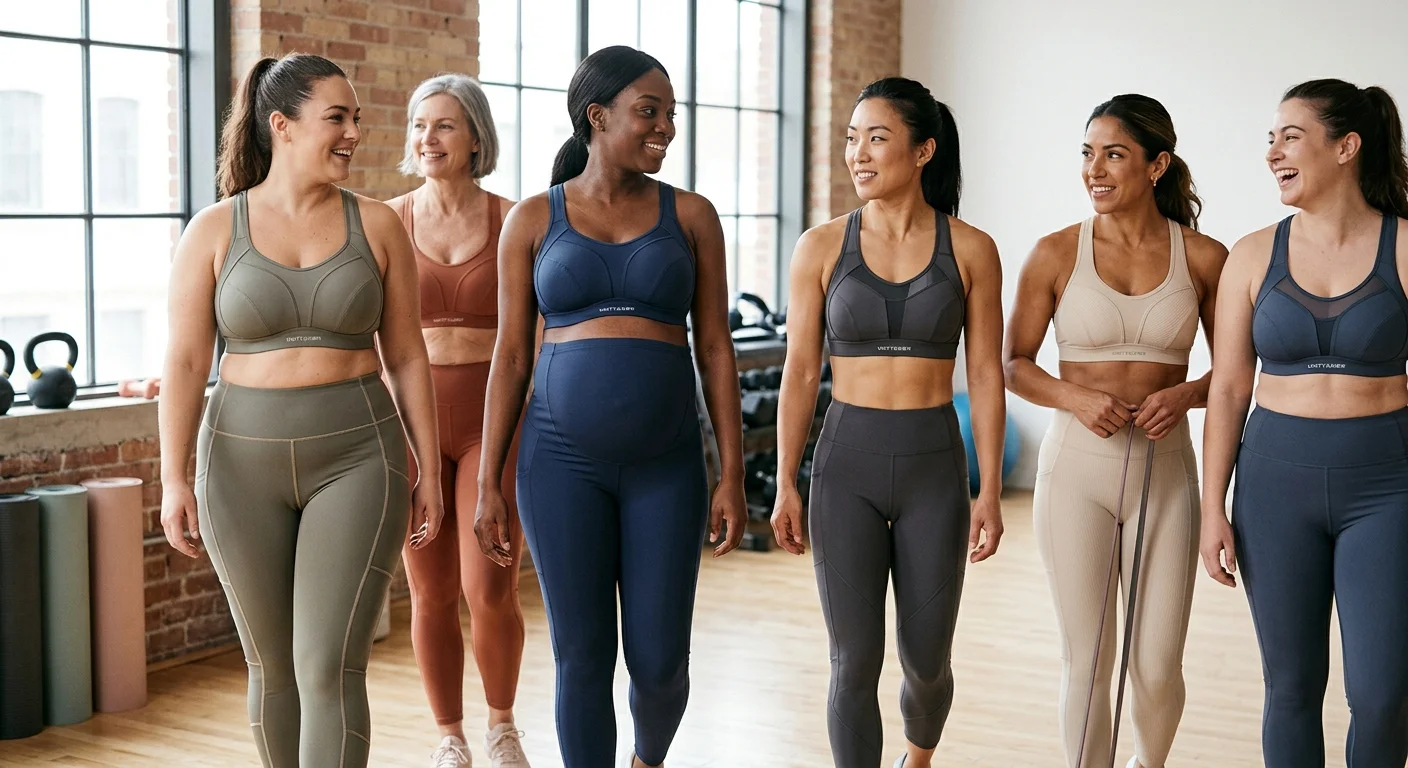
The plus-size activewear market is projected to hit USD 20–30 billion by 2028 . Performance maternity adds another USD 2–3 billion on top. That's a segment growing 2–3 percentage points faster than standard women's activewear. Yet most major brands still treat it as an afterthought.
Here's the core problem. Almost every top-5 sportswear label caps performance lines at 2XL . High-support sports bras rarely go above DD. Maternity-specific technical pieces are scarce, underpowered, and often buried in a seasonal side collection. The engineering hasn't caught up with the demand.
The biomechanics data shows how costly this gap is. 60–70% of women with D+ cups report breast pain during exercise. Poor bra support increases vertical breast displacement by 50–100% . That leads to shorter workout sessions and less participation overall. These aren't minor complaints. They're real barriers to activity. No mainstream brand has fully addressed them.
The customer economics make the investment clear:
Plus-size DTC buyers show repeat purchase rates 1.5–2x higher than straight-size customers
Brands that run true XS–4XL size lines with dedicated fit blocks see size 14+ customer CLV rise 2–4x within 12 months
Maternity performance programs built around pre-natal through post-partum transitions generate lifecycle CLV 3–5x that of a standard one-time buyer
The gap here is technical, not just commercial. Filling it takes dedicated curve fit blocks with non-linear grade rules, seamed-cup sports bra construction supporting 30–46 band and B–H cup ranges, and maternity legging panels built for specific trimesters — not a catch-all "bump-friendly" stretch fabric. Brands that publish verified performance specs — "tested to support DD–G cups at 10 km/h" — will own this space before it gets crowded.
Underserved Opportunity 2: Men's Athleisure & Technical Recovery Gear
Men's activewear is a multi-billion dollar market. The major players have gotten it wrong.
The numbers tell the story. Men account for 35–45% of total athleisure purchases in major Western markets. That points to a USD 150–200 billion opportunity by the early 2030s — growing at ~9–10% CAGR alongside the broader category. Add the compression and recovery segment on top — projected from USD 1.14 billion in 2024 to USD 1.94 billion by 2034 — and the technical recovery sub-segment grows even faster, at 8.2–12.8% CAGR .
The gap isn't in demand. It's in product.
Nike, Adidas, Under Armour, and 2XU own the performance lane. Their compression tights work. But they look like compression tights — clinical aesthetics, heavy branding, zero crossover appeal. A man wearing 2XU recovery gear on his commute looks like he forgot to change. That's the exact problem no one has solved.
The Three SKUs Nobody Has Built
The white space is clear:
Structured performance jogger — clean rise, trouser-like silhouette, 4-way stretch with anti-odor finish, hidden zip pocket sized for a 6.7" phone. Looks like a chino. Performs like a track pant.
Odor-control training short system — bonded outer shell with a built-in compression liner that delivers zoned compression . Antimicrobial treatment tested to 30+ wash cycles .
Post-workout recovery pant — matte fabric, solid neutrals, graduated compression targeting calves and quads. Built for 2–4 hours of wear after training , including the commute home.
The positioning is straightforward: "Office-ready, gym-proven. Built-in recovery without looking like gear."
Brands that build around that brief — neutrals, tonal logos, hidden utility — aren't chasing a trend. They're claiming space that the category leaders have left wide open.
Underserved Opportunity 3: Circular Fashion & Verified Recycled Fabric Tracks
15% of discarded U.S. clothing and textiles gets collected for reuse or recycling. The rest goes to landfill. That's not a sustainability crisis. It's a product gap — sitting in plain sight.
Here's the tension. 65–70% of Gen Z and Millennial shoppers say sustainability shapes what they buy. But price and performance still close the deal. Luxury brands have run circular pilots. Niche eco labels have built full identities around rPET. The middle of the market — mass and mid-tier performance activewear — has done almost nothing. No verified recycled-fiber options at price parity. No traceability. Just vague green language printed on a hangtag.
That's the gap worth entering.
What "Verified" Requires
Say you're building a circular position without documentation. That's a compliance risk now — not a competitive edge. The execution standard is specific:
GRS-certified rPET and recycled nylon — post-consumer PET bottles and post-industrial nylon waste, blended at 30–100% depending on end use. Full chain-of-custody paperwork is required.
Batch-level QR codes on care labels. Each code links to: GRS certification IDs, source stream origin, and LCA-derived CO₂e savings vs. virgin equivalent.
Digital traceability infrastructure built on platforms like Reverse Resources. One scan shows the full path: waste origin → recycler → yarn → mill → fitness apparel factory.
The Circular Fashion Partnership tracked over 100 tonnes of textile waste through digital tracing at commercial scale. The infrastructure is already there. Most brands just haven't connected it to their product development process yet.
Where the Volume Sits
B2B is the fastest path to scale. Corporate procurement teams are writing recycled-fiber content and traceability requirements directly into RFPs — for uniforms, branded merchandise, and team kits. Boutique fitness studios are looking for vendor partners whose values match theirs, for both staff and member apparel. These are recurring, high-volume accounts. Circular options are almost nowhere on their current activewear supplier lists.
The product strategy is clear:
Launch a distinct recycled-fabric performance track — GRS-backed rPET leggings, recycled nylon tights, core training tees
Price it at parity or a modest 10–15% uplift over mainline
Back every price premium with verified recycled content and a quantified carbon reduction per garment
Woolmark's circularity data shows increasing garment wears can cut environmental impact by up to 68% . Use durability as an environmental claim — not just a product feature.
Sustainable activewear tracks could make up 25–30% of new SKU launches by the late 2020s . Brands building verified circular infrastructure now won't be chasing that number. They'll set it.
Conclusion
The numbers don't lie. Neither does the timing.
The fitness apparel industry isn't seeing a temporary spike. It's going through a structural reset driven by five forces that show no signs of stopping:
Lifestyle integration
Technology-embedded fabrics
Creator-fueled distribution
Sustainability premiumization
A DTC model that rewards speed over scale
Still on the fence about entering this market? Here's what's on the table. This is a projected multi-billion dollar industry growing at a CAGR that outpaces most nearby categories. Three underserved segments remain wide open — inclusive sizing, men's athleisure, and circular fashion. A brand with the right positioning and real conviction can move in now.
The athleisure market expansion isn't waiting for perfect conditions. Neither should you.
Your next move isn't research — it's a decision. Pick your segment. Validate your angle. Build something the market hasn't seen yet.
The window is open. The question is whether you'll walk through it.