You've already done the hard part — committing to uniforms that look like your brand. Now comes the question that trips up even the most seasoned team managers: embroidery or heat seal?
Both methods put your logo on a jersey, polo, or training kit. But the similarities stop there.
Pick the wrong one and you're dealing with real problems:
Cracked patches after a season of washes
A logo that puckers on stretchy activewear
A setup cost that blows your entire branding budget on a 10-piece order
This guide breaks down embroidery vs heat seal uniform branding across four key areas: durability, cost, fabric compatibility, and real-world best uses. You'll walk away with a clear, confident decision — before a single garment gets decorated.For organizations sourcing branded uniforms in bulk, working with an experienced activewear uniform manufacturer can also help determine the most suitable decoration method based on garment fabric, usage, and budget.
Embroidery vs Heat Seal: Head-to-Head Comparison Across 8 Key Dimensions
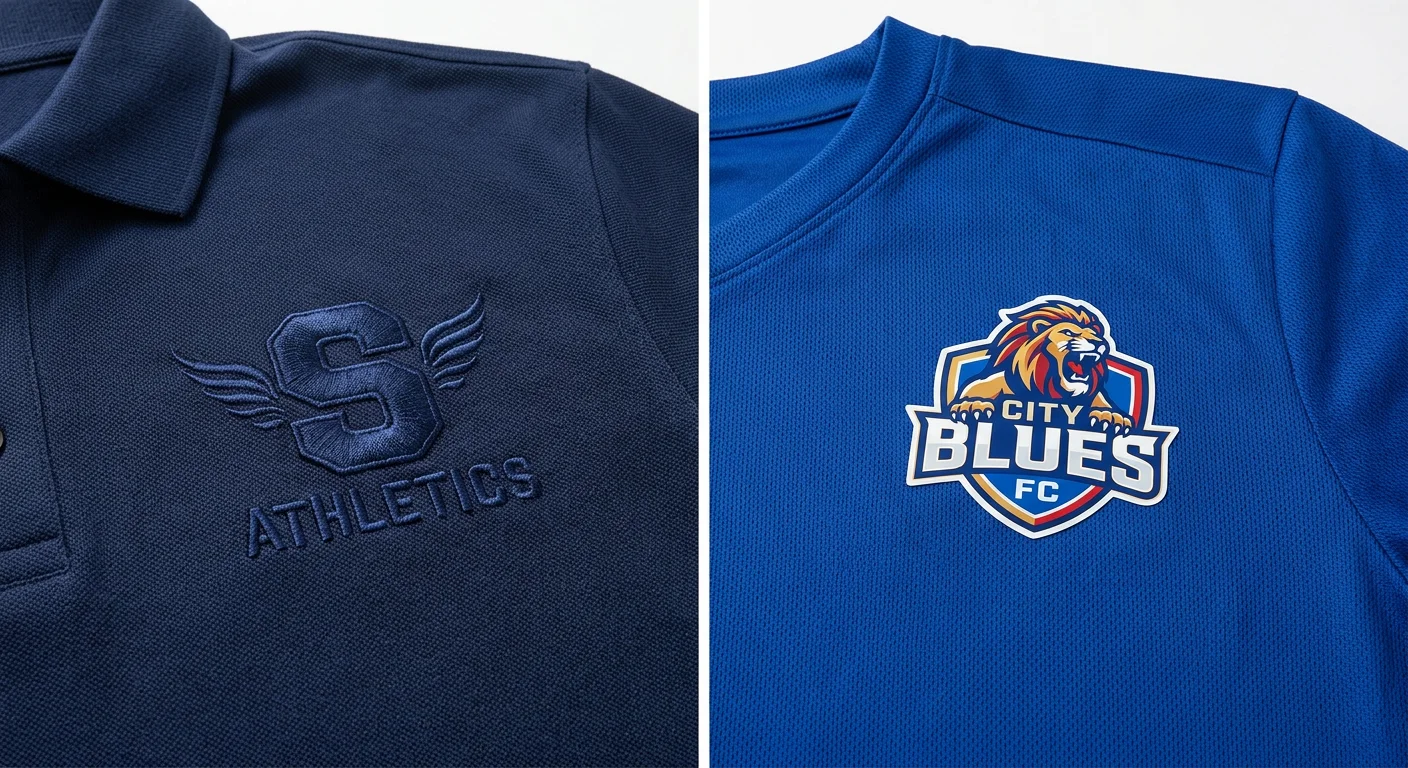
Most people pick the wrong method — not because they didn't care, but because nobody laid out the real differences. Here they are.
1. Durability: How Many Washes Before It Falls Apart?
Embroidery is built to last. Industry testing runs quality embroidered logos through 50 commercial heavy-cycle washes — the kind that destroys most decorations — and the stitching holds. You might notice a slight surface fuzz over time. You won't see any fading, cracking, or peeling. For long-term embroidered workwear logos , this is the gold standard.
Heat seal patches tell a different story. A quality heat transfer label must survive at least 20 standard home washes (30–40°C) without blurring or colour loss. Many do hold up fine. But the risk factors are real. High-temperature dryers, stretchy fabrics, and mismatched adhesive films all speed up cracking and edge lifting.
The key difference: Embroidery doesn't crack. Heat seal can — and often does, under the wrong conditions.These performance differences are also worth considering when developing private label activewear uniforms, where long-term durability and consistent brand presentation directly influence customer satisfaction.
2. Cost: Setup Fees, Per-Piece Pricing & Where the Math Tips
This is where things get interesting.
Embroidery | Heat Seal | |
|---|---|---|
Setup/digitizing fee | $20–$50 per design | $10–$30 per design |
Per-piece cost | $1–$4 (based on stitch count) | $0.20–$1.00 |
50-piece order total | ~$130 (~$2.60/piece) | ~$55 (~$1.10/piece) |
200-piece order total | ~$430 (~$2.15/piece) | ~$160 (~$0.80/piece) |
At 50–200 pieces , heat seal wins on cost — every time, by a clear margin. Embroidery makes sense when your budget allows and you want that premium, tactile finish that holds up for years.
3. Fabric Compatibility: What Works (and What Really Doesn't)
Embroidery works well on:
- Polo shirts (180–230 g/m² cotton or cotton-poly blend)
- Structured jackets, nylon shells, cotton twill workwear
- Baseball caps and beanies with a backing structure
Embroidery struggles on:
- Thin, high-stretch knit fabrics — the needle tension causes puckering and distortion that no amount of pressing will fix
Heat seal bonds well to:
- Polyester and nylon (the ideal base for activewear branding techniques )
- Cotton blends, T-shirts, and hoodies at controlled temperatures (130–160°C)
Heat seal fails on:
- Pure wool and untreated natural fibres — adhesion is poor without special primer coatings
- High-stretch Lycra/Spandex — you need specialist elastic film, or the patch cracks and lifts after the first real training session
4. Design Complexity: Colours, Fine Details & Minimum Line Width
Embroidery has real limits. Most machines run 6–15 thread colours , and designs top out at 6–8 colours per logo . Minimum letter height sits at 4–5mm . Minimum line width sits at 0.8–1.0mm . Gradients and photo-realistic imagery can't be reproduced — they get stripped down into clean, graphic shapes.
Heat seal has almost no limits. Digital heat transfer hits 300–600 dpi photo-realistic resolution , handles unlimited colours and gradients at no real cost increase, and renders lines as fine as 0.5–0.7mm . Got a logo with shadows, fine typography, or complex layering? Heat seal is the one method that does it justice.
5. Visual Texture & Finish
Embroidery gives you something you can feel — a raised, tactile finish that reads as premium and intentional. It's the right pick for corporate uniform branding where first impressions carry weight.
Heat seal delivers a smooth, flat, or lightly film-textured finish. On sportswear, that's a feature, not a flaw — no added bulk, no interference with fabric movement, clean lines at full speed.
6. Production Speed & Flexibility
High-stitch-count embroidery takes time per piece. It suits stable, mid-to-large-run orders where the design stays the same season to season.
Heat seal works on a different timeline. Films get produced in bulk first, then heat-pressed onto garments fast. For large sports uniform decoration orders with tight deadlines, this pipeline is much faster. For small, last-minute runs? Heat seal is flexible in a way embroidery rarely matches.
7. Minimum Order Quantity (MOQ) Considerations
Embroidery digitizing fees are fixed no matter the quantity. A 10-piece order carries a very high per-unit cost because of this. Most decorators run more cost-efficiently from 50+ pieces upward.
Heat seal's lower setup cost makes small-batch sports uniform customization a real option. Need 15 jerseys for a community football club? Heat seal makes that order economical. Embroidery doesn't.
8. Longevity Under Stress: Stretch, Heat & Heavy Use
For activewear and high-performance sportswear , this factor often decides everything. Embroidery on stretch fabric creates tension points. The stitching resists where the fabric wants to stretch, which leads to discomfort and eventual distortion.
Heat seal, with the right elastic film, moves with the fabric. A quality heat seal patch on polyester performance wear survives repeated high-intensity washing cycles without separating — as long as the fabric type and adhesive film match from the start.
That last point matters more than most people realise. Picking the right logo application method for apparel isn't just about looks. It's about knowing how your fabric moves, how often it gets washed, and what that logo needs to survive long-term.
Pros and Cons of Embroidery for Uniform Branding
Embroidery has dressed people with purpose for centuries. On a corporate polo or a hotel concierge jacket, that history still comes through.
Where Embroidery Excels
The biggest advantage is longevity. A well-digitized embroidered logo can survive 100+ commercial wash cycles without fading, cracking, or lifting at the edges. That's not a marketing claim. It's why construction companies, hospitality groups, and industrial teams request embroidery for garments that go through heavy-duty laundering every week.
Thread holds color in a way most print methods don't. It keeps its Pantone match from unit #1 to unit #500. For multi-site corporate uniform branding, that consistency matters a lot.
There's also a tactile quality you can't capture in a photo. You feel it the moment you put on a corporate polo, a hotel front-desk tunic, or a fleece jacket. Embroidery looks polished and premium in a way flat printing can't match. The raised texture tells people someone paid attention to the details.
For design specs, a left-chest logo of 70–90mm wide hits the sweet spot — clear, proportional, and cost-efficient. Company name text works at 5–7mm letter height . Caps carry a front crest of 45–60mm without putting stress on the seam. Stay within those ranges and embroidery delivers strong, reliable results.
Where It Falls Short
The limitations are clear. Ultra-thin and high-stretch fabrics cause real problems. Dense stitching on lightweight performance knits creates puckering and stiffness. The embroidered panel pushes back where the fabric needs to flex. On waterproof shells, the needle punches through the membrane and breaks the seal.
Large, complex designs are also a cost trap. A full-chest graphic or a logo with gradients and fine typography will spike your stitch count, slow machine time, and push unit costs well above what heat seal would charge for the same result. Embroidery is not built for big, complicated artwork. Simple, clean designs are where it performs best.
Pros and Cons of Heat Seal for Uniform Branding

Heat seal is the method that steps up where embroidery falls short.
Small runs. Complex logos. Tight turnarounds. Fabrics that needle and thread would destroy. In all of those cases, heat seal steps in and gets the job done.
Where Heat Seal Delivers
Small batches and personalisation are where heat seal truly shines. There's no digitizing file, no setup plate, and almost no fixed cost. A 15-jersey community football club order is just as cost-effective as a 200-piece corporate rollout. Every jersey needs a different name, number, or job title? Each change takes 10–30 seconds at the press. No reprinting. No reordering.
For organisations dealing with ongoing staff turnover, this is more useful than most people expect. Keep a stock of blank garments and a set of pre-made heat seal patches. Someone joins on Monday — their branded uniform is ready by Monday afternoon.
Production speed is another real advantage. A single heat press handles 150–300 pieces per hour on standard-sized logos. Event T-shirts, seasonal sports kits, last-minute project uniforms — lead times run 1–3 days. That's a fraction of what embroidery takes.
Complex, multi-colour artwork costs almost nothing extra. Full gradients, photographic detail, fine typography at 0.5–0.7mm line width, unlimited colour combinations — none of these push up unit pricing the way they would with screen printing or embroidery. A full-colour sponsor logo panel costs about the same as a single-colour version.
Heat seal patches work across different garment types from one stock of badges — polyester polos, cotton workwear, softshell jackets, high-visibility vests. The main requirement is that the fabric surface handles a 140–160°C application temperature.
Where Heat Seal Falls Short
The real limitation is durability under sustained stress.
Under normal home-washing conditions — 40°C, gentle detergent, no tumble dryer — a quality heat seal decoration holds well through 50–75 washes before adhesion starts to soften at the edges. Past 100 washes, edge lifting becomes more common. Seams and areas that fold or stretch often show it first.
Industrial laundering speeds up that process fast. Commercial dryers running at 80–90°C, used three to five times per week, can trigger edge lifting after just 20–30 cycles. Bleach and high-alkaline detergents cause their own damage. They break down PU and PVC transfer films. Fine line details are usually the first to show micro-cracking — often after just 10–20 bleach-wash cycles.
For hospital scrubs, kitchen whites, or any uniform on a commercial laundry rotation, these are real risks. Plan around them before you order.
Comfort is the other factor that doesn't get mentioned enough. Large heat seal panels — full chest prints, back graphics — block airflow in those areas. In hot working environments or during intense training, you'll feel the heat build up. Some heat seal materials also have a rubbery surface feel on lighter, fitted garments.
Choosing Heat Seal
Use heat seal when… | Avoid heat seal when… |
|---|---|
Order size is under 200 pieces | Uniforms go through industrial laundering |
Logo has gradients, photos, or many colours | Garments are bleached on a regular cycle |
Fabric is polyester, nylon, or a performance blend | High-stretch areas (knees, elbows) carry the logo |
You need personalised names or roles per garment | Long-term durability over 100+ washes is non-negotiable |
Fast turnaround is critical |
The right choice isn't always the most durable one. It's the one that fits how the uniform gets used — and how long it needs to hold up.
Best Uses by Industry: Which Uniform Branding Method Fits Your Team?
Most teams don't pick the wrong method because they didn't try hard enough. They pick wrong because they match a decoration technique to a garment — when they should match it to a life .
How long will this uniform be in service? How often does it get washed, and how? What does it need to say about the people wearing it? Answer those questions directly. The right method becomes clear on its own.
Corporate, Hospitality & Healthcare: Where Embroidery Earns Its Cost
A hotel concierge jacket or a nurse's uniform isn't a seasonal item. It gets worn, washed, and worn again. Sometimes five days a week. Sometimes through a 75°C industrial laundry cycle. For one to three years straight. That's where embroidery makes complete sense.
Polyester embroidery thread is built for this kind of punishment. It holds its colour through high-temperature washes, bleach exposure, and commercial dryers. Heat seal adhesive isn't built to do that. For corporate uniform branding in healthcare, hospitality, and professional services, embroidery isn't the premium choice — it's the practical one.
The typical layout: a 70–90mm wide left-chest logo , clean and contained, in one to three thread colours. Department names or staff roles stitched at 8–12mm letter height . Formal, proportional, and consistent across hundreds of units. On fitted polo shirts, structured vests, and front-desk jackets, that raised texture looks deliberate and polished. That's the impression a brand at a hotel check-in counter or hospital reception desk needs to make.
Sports Teams & School Clubs: Heat Seal as the Smarter Workhorse
A match jersey lives a very different life. It's 100% polyester, lightweight, and cut for movement. It needs a player number, a club crest, a possible sponsor logo, and a last name across the back. Embroidery would make it stiff, heavy, and expensive. Heat seal was made for this.
For sports uniform decoration , the standard hybrid approach is worth knowing:
Left chest: small club badge or school crest in embroidery — 30–50mm, tactile and long-lasting, placed on the training jacket or warm-up top
Back: large squad name, mascot graphic, or player number in heat transfer — 30–35cm wide, full colour if needed, produced digitally with no added cost per colour
This split isn't arbitrary. The badge on a training jacket will still be there in five years. The number 9 on a match jersey might belong to a different player next season. Match the method to the permanence of the content. That's the logic that saves money and avoids regret.
For school clubs ordering 15 to 30 jerseys with individual names and numbers, heat seal's flexible MOQ keeps the whole project affordable. No fixed digitizing fee per name. No per-colour surcharge on a complex crest.
Events, Promotions & Short-Term Projects: One-Season Logic
For event staff T-shirts, trade show crews, or seasonal promotional uniforms, the thinking shifts. A garment worn twice doesn't need to survive 75 washes. It needs a bold visual, a quick turnaround, and a per-unit cost that fits an event budget.
Heat transfer covers all of that. Full-colour artwork, a 25–30cm front print, back URL or QR code — ready in days from a digital file. No plates. No minimums that make small runs painful.
Here's a practical approach retail and experiential marketing teams use: keep customer-facing staff in embroidered polos, reused season to season. Outfit one-day event volunteers in heat-sealed cotton tees. Same brand, different lifespan, different method — and the budget holds up.
Quick reference by industry:
Industry | Recommended Method | Why |
|---|---|---|
Corporate / professional services | Embroidery | Long wear cycle, formal finish, industrial laundry |
Hospitality & hotels | Embroidery | Frequent washing, high-visibility first impressions |
Healthcare / medical | Embroidery | High-temp laundering, compliance requirements |
Sports teams & clubs | Heat seal (+ embroidery hybrid) | Polyester fabric, player personalisation, cost flexibility |
School uniforms | Embroidery (polos/jackets) | Durability over 1–2 year wear cycle |
Events & promotions | Heat seal | Short lifespan, complex artwork, fast turnaround |
The Hybrid Approach: Combining Embroidery and Heat Seal on the Same Uniform
Here's what experienced uniform buyers figure out: the choice between embroidery and heat seal isn't always either/or.
The smartest setups use both — on the same garment.
The logic is simple. Embroidery goes where permanence matters. Heat seal goes where flexibility wins. Together, you get a uniform that holds up like a long-term investment and adapts as things change.
The Standard Split: Chest + Back
The most common hybrid setup works like this:
Left chest: Embroidered club badge or company logo — 60–80mm wide , in 100% polyester thread for wash resistance. This element stays consistent for years.
Back panel: Heat transfer for large sponsor logos, player numbers, or department identifiers — 250–300mm wide , full colour, printed digitally.
That back graphic in embroidery? At 20,000–40,000 stitches, costs climb fast. Switch it to heat transfer and you save 30–50% on that panel alone — without affecting the chest badge quality at all.
Who This Works For
Sports teams with rotating sponsors get the clearest benefit. The embroidered club crest survives 100+ washes without changing. The sponsor logo on the back can be swapped out as contracts change — at a fraction of the cost of redoing full kits.
Multi-location hospitality and retail teams use a similar split. The embroidered brand logo stays on the chest for a polished, lasting look. Seasonal promotions or role identifiers go on aprons or sleeves as heat-transferred graphics. Updating campaign artwork runs 20–30% of the garment's total value — far cheaper than replacing the whole piece.
Large enterprises with department variations keep one unified embroidered company logo across all staff. Role differences get handled by small heat-transfer strips — 60×20mm on the sleeve or 80×40mm on the back. A department change means swapping one patch. That patch swap runs about 10–20% of the full uniform price .
One Production Note Worth Knowing
Embroider first. Heat press second. The needle tension and hoop pressure from embroidery can crack or crease a heat transfer film that's already sitting on the fabric. Get the embroidery done and press it flat first. Then the heat transfer goes on straight and clean — positioning accuracy stays within ±2mm .
How to Choose: A Decision Framework for Uniform Branding
Five factors determine which method fits your needs. Work through them in this order, and the right answer becomes clear.
Budget (highest priority). This is your hard limit — set it before anything else. Embroidery costs more to set up but gets cheaper per unit on large, stable orders. Heat seal keeps small runs affordable. Know your per-unit ceiling before you talk to a activewear supplier.
Order quantity. Under 50 pieces, heat seal wins on cost almost every time. Above 200 pieces, embroidery's per-unit price gets competitive — and its longer lifespan starts to justify the difference.
Fabric type. Polyester performance wear and embroidery don't mix well. Stretch fabrics pucker under a needle. Waterproof membranes take puncture damage from the stitching process. Your uniform is built for movement? Heat seal is the right technical choice — not just the cheaper one.
Design complexity. A clean two-colour chest logo looks sharp in thread. A sponsor panel with gradients and fine typography does not. Match the method to what the artwork needs — not what you prefer on paper.
Expected lifespan. Uniforms that go through industrial laundering every day for two or more years? Embroidery justifies its cost. For seasonal kits or one-off event gear, that durability premium adds nothing to your value.
Before You Contact a Supplier
Come prepared with four things:
Your logo as a vector file (AI, EPS, or SVG) plus Pantone colour references
Your target logo placement and dimensions (left chest at 70–90mm is the standard starting point)
Your wash frequency each week and whether industrial laundering is involved
Your total quantity, plus any personalisation requirements — names, numbers, role titles
Custom Activewear Suppliers give you precise quotes when you give them precise details. Vague briefs produce vague pricing — and costly surprises after you've already committed.
FAQ: Embroidery vs Heat Seal Uniforms — Your Top Questions Answered

Straight answers to the questions buyers search for — no fluff, no sales pitch.
Which method holds up better in the wash?
Embroidery, by a wide margin. Quality polyester embroidery thread is built to outlast the garment itself. We're talking hundreds of commercial wash cycles with no cracking, fading, or lifting. Industrial-grade heat seal patches are tough too. They target 50–100 heavy-duty washes with proper application and laundering within the right temperature ranges. Standard heat transfer films are a different story. Most hold well for 20–40 home washes before edge lifting starts. Your uniforms go through commercial laundry every day? Embroidery or industrial-grade patches are the only real choices.
Does polyester fabric change the calculation?
Yes. Embroidery on mid-weight polyester — polos, jackets, structured workwear — works great. The trouble comes with ultra-thin, high-stretch performance knits. Dense stitching causes puckering on those fabrics, and no amount of pressing will fix it. Heat seal bonds well to polyester, but you need low-temperature adhesive films to avoid scorching. Make sure your decorator uses polyester-specific materials before placing your order.
What's the minimum order for embroidery?
Smaller than most people expect. Many decorators accept orders from 2–12 pieces . Embroidery's main fixed cost is digitizing — a one-time fee of $25–$75 per design , no matter how many pieces you order. So small runs are more accessible than you might think.
Which one costs less?
It depends on the context. Here's a quick breakdown:
Small batches with simple logos — Embroidery's digitizing fee spreads across fewer pieces, but the per-unit cost stays stable and the result looks premium.
Large runs with complex, multi-colour artwork — Heat seal keeps total cost lower and turns around faster.
High staff turnover — Pre-made heat seal patches save you money. Re-embroidering new garments every time someone joins the team adds up fast.
Conclusion
Choosing between embroidery and heat seal isn't a technical decision — it's a brand decision. One tells your team's story through texture and permanence. The other speaks through precision and versatility. No option is better across the board. The right answer sits in the details: your fabric, your budget, your wash cycle, and what you want people to feel when they see your logo.
So here's the short version. Embroidered workwear logos belong on structured garments built to last a decade. Heat seal belongs on performance activewear where clean lines and lightweight comfort matter most. And sometimes? You need both.
You don't have to sort this out alone. At Berun Activewear , we help teams across Australia work through this choice — and then bring it to life. Request a free activewear sample or custom quote and see the difference for yourself.