You've spent good money on custom activewear apparel. The last thing you want is a logo that starts cracking after a dozen washes. Yet that's what happens — teams, brands, and buyers pick the wrong printing method without knowing what they're getting.
Heat transfer vs screen printing isn't just a technical debate. It's a decision that shapes how long your garments stay sharp — through sweat, repeated washing, and real athletic wear. Both methods have their strengths. Both have a breaking point.
Before locking in a bulk order of custom sportswear, you need to know which method holds up under pressure — and which one falls apart at the worst possible moment. This comparison cuts through the noise and gives you the clearest, most practical breakdown you'll find.
Wash Durability: How Many Washes Can Each Method Survive?
Numbers don't lie — logo durability comes down to wash count. That's the real measure.
Here's the breakdown that matters most for anyone ordering custom sportswear or branded activewear at scale.
Screen Printing (Plastisol Ink): Built to Outlast the Fabric
Plastisol screen printing sets the durability benchmark in the custom apparel industry. Nothing else comes close.
The commercial-grade standard is ≥30 machine washes without significant cracking or peeling. That's just the baseline. With ink that's been fully cured, real-world performance goes well beyond that floor.
Trade professionals put it plainly: "A fully cured plastisol screen printed t-shirt should outlast the shirt itself." In real terms, that means 50+ washes under normal home laundering conditions . In many documented cases, the fabric gives out before the print does.
The conservative range you'll hear in trade circles: 18–30 washes as the minimum acceptable threshold. The realistic ceiling for quality work? The garment's entire lifespan.
Heat Transfer: Solid, But With a Ceiling
Standard heat transfer printing targets 20–30 washes as a conservative durability goal under normal conditions. High-performance transfer films — the kind used in premium custom sportswear — can reach 30–50 washes in controlled lab testing at 40–60°C.
There's a key caveat: high-temperature tumble drying cuts that number fast. In heavy athletic use, heat transfer prints carry a noticeably higher risk of cracking, peeling, and color fade compared to fully cured plastisol screen printing.
The Washing Conditions Multiplier
Raw wash counts tell only part of the story. How you wash matters just as much as how many times you do it.
Hot water (60°C+) speeds up print aging — 5 high-temperature cycles can match the wear of far more cold-water washes
Tumble drying above 60°C drops effective durability by 0.6–0.8x for both heat transfer and screen printing
Harsh detergents or bleach do far more damage to heat transfer and DTG prints than to fully cured screen printing ink
For high-frequency athletic use — think 3–5 washes per week — screen printing holds print integrity across 6–12 months of heavy rotation . Heat transfer prints under those same conditions show clear degradation sooner, especially with industrial laundering in the mix.
Bottom line: Screen printing wins the wash durability race. Heat transfer is a capable option — but under repeated, high-intensity washing, the gap shows up fast.
Cracking, Peeling, and Fading: Where Each Method Fails First
Every printing method has a failure signature. The way a logo breaks down tells you more about the process than any marketing spec sheet ever will.
Here's the reality: screen printing and heat transfer don't fail the same way. They also don't fail at the same time. Knowing where each method cracks first gives you the power to match the right process to your actual use case.
How Screen Printing Fails
With screen printing, cracking almost always shows up before fading . This is most visible on large-format chest logos printed with standard plastisol ink on athletic wear.
Cracking comes down to one of three culprits:
Under-curing: Ink that cures below 150°C or for less than 60–90 seconds leaves the elastic resin without a complete cross-link. The result? Visible cracking after 30–50 high-temperature washes.
Ink layer too thick: Dry film thickness above 80–100µm combined with fabric stretch of 20–30% creates stress fractures at high-tension zones — shoulders, chest seams. You'll see this in as few as 5–10 wear-and-wash cycles.
Wrong ink formula on stretch fabric: Standard PVC-based plastisol has a break elongation of just 5–10%. Once your knit fabric stretches past its design limit, micro-cracks appear first at the print edges.
There is one exception. Small-area logos printed with high-stretch water-based or PU inks tend to fade and lose gloss before they crack. These can survive 50+ high-intensity training sessions before any real cracking appears in high-flex zones like underarms.
Fading with screen printing is almost always a curing or ink-thickness problem — not a washing problem. Thin ink layers from high mesh counts (300–400+) combined with fast print speeds drop color density by 10–20% within just 5–10 washes.
How Heat Transfer Fails
Heat transfer follows a different failure sequence. Edge lift comes first. Then peeling. Fading is the last thing to go.
The physics are straightforward. Standard heat transfer film has an elongation rate of 10–15%. Activewear fabric stretches 30–40% during movement. That gap creates stress the film can't handle — most visibly across large chest numbers, letters, or full-coverage logos.
The failure triggers stack up fast:
Insufficient press temperature or time: The recommended range is 160–170°C for 15–20 seconds. Drop to 140°C for 10 seconds, and the adhesive never bonds properly. Edge lift shows up after just 5–10 washes — you'll see corners curling 2–3mm before the center even looks worn.
Low press pressure: Below 2 bar (vs. the recommended 3–4 bar), edge adhesion is weak from the start. High-intensity movement tears those edges loose fast.
Surface contamination: Sweat residue, fabric softener, or body oils on the garment before pressing push surface energy below 38 dyn/cm. The adhesive can't bond — and the first wash makes that clear.
Once the edge lifts, peeling follows. Print adhesion that falls below 1N/25mm causes large-scale delamination after 20 washes. What's left behind is a ghost-like transparent film shadow on the fabric.
The Friction Factor
Picture high-friction activewear use — backpack straps across a chest logo, repeated equipment contact, or skin-on-fabric rubbing during HIIT. These two methods respond very differently.
Screen printing's cured ink layer resists friction through surface hardness. Damage shows as micro-scratches and localized dulling. Heat transfer's topcoat is softer. Friction wears through the protective film layer first, causing visible hazing and whitening after 50–100 hours of contact wear.
The bottom line: Screen printing cracks before it fades. Heat transfer lifts and peels before it fades. For high-stretch, high-friction custom sportswear — that distinction determines which logo survives a full season, and which one doesn't.
Durability Comparison by Key Factors: Screen Printing vs. Heat Transfer
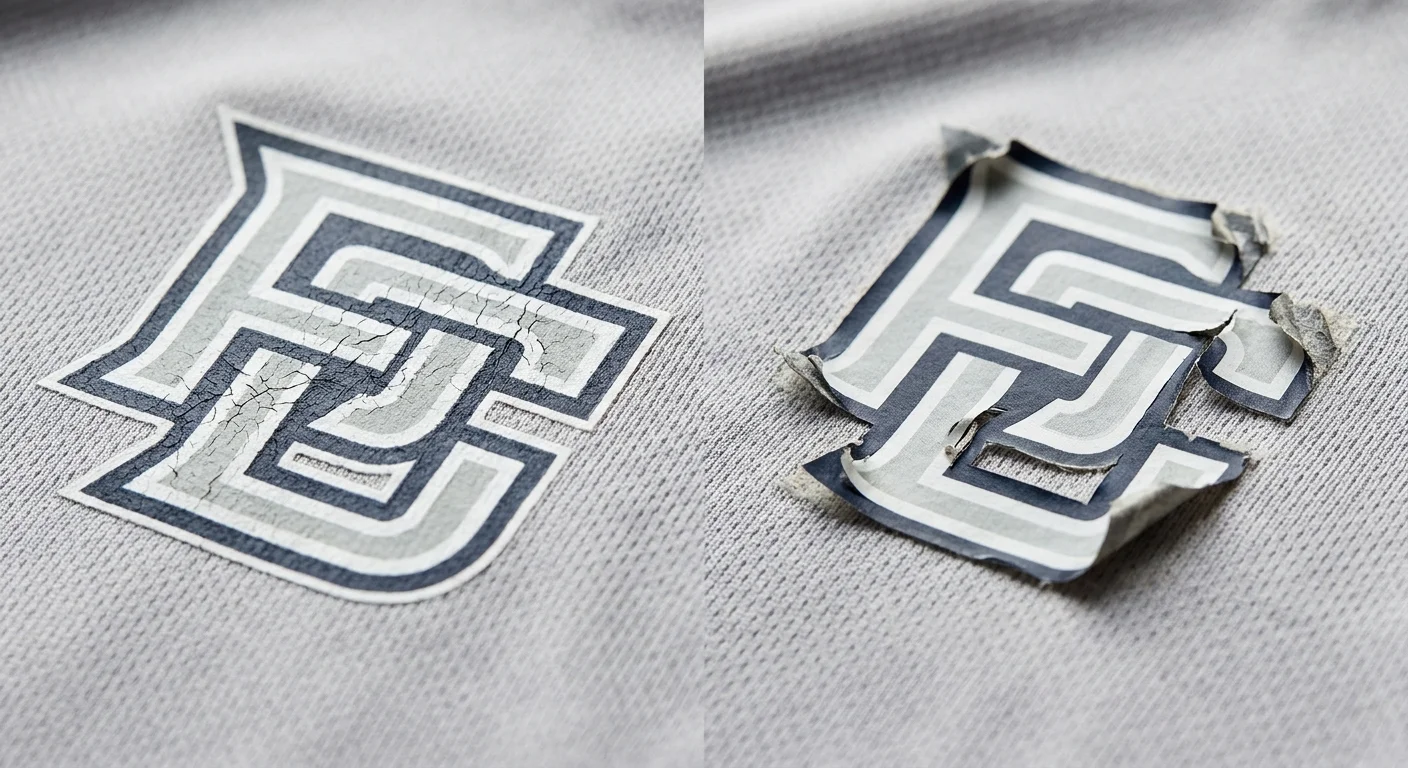
Six key factors decide whether your logo still looks sharp after 80 washes — or starts falling apart after 25. Here's how screen printing and heat transfer compare across each one.
Factor | Screen Printing | Heat Transfer |
|---|---|---|
Wash Lifespan | 50–80 washes with minimal fading | 25–30 washes before visible degradation |
Crack Resistance | Ink bonds with fibers — holds for years | Surface film breaks under repeated flexing |
Peel Resistance | Ink becomes part of the fabric | Adhesive wears down; edges lift and separate |
Color Retention | High saturation past 50+ washes | Noticeable dulling by wash 20–30 |
Hand Feel Over Time | Stays smooth and thin | Gets rougher as cracks and edges develop |
Fabric Compatibility | Strong on cotton; works on polyester with the right ink | Moderate on polyester; weaker adhesion over time |
Performance Scores for Activewear Use Cases
Raw specs only tell part of the story. What matters is how each method holds up under real conditions — heavy washing cycles, UV exposure, and constant stretch.
High-frequency machine washing (2–3x per week, 80–120 washes per year)
- Screen printing: 8–9/10 — cured plastisol on heavy cotton clears 80 washes without major cracking or fading. Team uniform producers rely on it for exactly this reason.
- Heat transfer: 4–6/10 — cross the 50-wash mark, and cracking plus edge peeling become expected, not just possible.
Outdoor UV exposure (training and competition wear)
- Screen printing: 7–8/10 — thick ink layers slow color fading by a good margin. Some plastisol yellowing can show up after a full year of heavy outdoor use.
- Heat transfer: 5–6/10 — the exposed adhesive and pigment layer breaks down faster under UV heat and temperature shifts. The film gets brittle, and colors fade out quicker.
High-stretch performance fabrics (running, yoga, HIIT)
- Screen printing: 7–8/10 — with the right ink formula, the cured layer handles 1,000+ flex cycles before micro-cracking appears. Even then, it shows up in extreme strain zones only.
- Heat transfer: 3–5/10 — as a surface film, it can't keep up with fabric stretching 30–40%. Repeated stretching causes craze lines and lifted edges. You'll notice it most on fitted athletic cuts.
Where Fabric Type Changes the Equation
On 100% cotton , screen printing performs at its best. Ink locks into the absorbent cotton fibers and delivers that 50–80 wash lifespan with solid consistency. Heat transfer on cotton works, but tumble drying heat combined with wash stress speeds up adhesive breakdown. For anything expected to last more than 30 washes, cotton + screen printing is the clear choice.
On polyester activewear , the gap gets smaller — but screen printing still leads. Using sublimation-blocking inks at controlled cure temperatures, screen printing holds up 40–70 washes on performance fabrics. Heat transfer on polyester is its weakest match. The smooth, low-polarity surface cuts adhesive bonding right from the start. That triggers an edge-lift-to-full-peel breakdown faster than on any other fabric type.
Best Use Cases: Screen Printing for Logo Longevity
Screen printing doesn't win every scenario — but for specific use cases, it's the clear leader.
Team Uniforms and Training Gear
Garments washed 1–3 times per week during a season need a tough print method. Plastisol screen printing on heavy cotton or poly-blends is the one method that holds up. A well-cured screen-printed uniform handles 30–80 wash cycles across a full season or two of hard use. You won't get the peeling or edge-lift problems that heat transfer brings under the same conditions.
Bulk Branded Apparel (50+ Units)
The cost math here is hard to beat. Setup costs are fixed — screens, registration, color separations. But the per-unit cost drops 30–60% as you scale from 20–30 pieces to 100–500 pieces. For staff tees, event apparel, or large-batch branded merch, no other method gives you that mix of durability and low cost per piece.
High-Wear Workwear
On durable workwear fabrics with regular industrial washing, quality screen-printed logos stay sharp and readable for 12–24 months . Two things matter here:
- Pick heavier fabrics with tight weaves
- Use open designs that flex with movement — not large solid ink blocks that crack under stress
The Simple Decision Rule
Screen printing makes sense for your order at ≥50 units , your design at ≤4 solid colors , and your garments need to last 50+ washes over 1–3 seasons. That's the sweet spot. No other method on the market matches screen printing's durability-to-cost ratio at that scale.
Best Use Cases: Where Heat Transfer Printing Wins
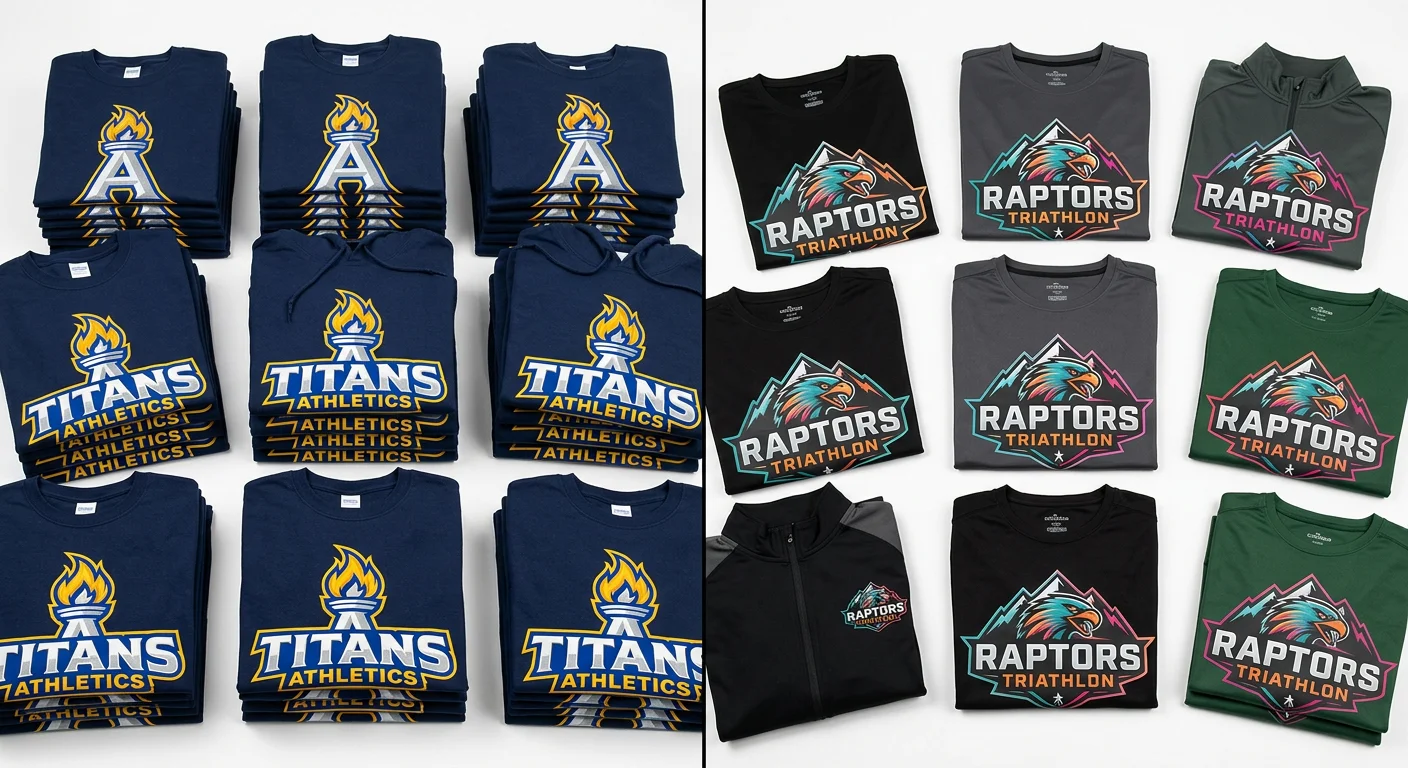
Heat transfer printing doesn't compete with screen printing on wash durability — it doesn't need to. It wins on a different playing field.
Some jobs are just a better fit for heat transfer. Faster. Cheaper. More flexible.
Small Runs and Designs That Change Often
Screen printing needs screens, color separations, and setup work. Those costs only pay off at high volume. Heat transfer skips all that — print the file, press it, done. Setup cost is near zero.
Heat transfer becomes the default choice for:
Order quantity under 50 pieces per design — no screen costs to spread across units
Designs that rotate often — weekly drops, event tees, school club shirts
Single-unit orders — heat transfer handles 1-piece minimums without extra charges
No other method touches heat transfer on cost efficiency at low quantities. That's the reality for small-batch custom activewear apparel.
Personalized Names and Numbers
Every jersey is different. Screen printing a unique name or number on each garment requires a new screen for every single variation. The cost math falls apart fast.
Heat transfer solves it. Print each name or number on demand. Press it in 10–15 seconds. Move on.
The standard approach for custom sportswear works like this: screen print or sublimate the base team logo in bulk, then heat transfer individual names and numbers onto each piece. You get bulk pricing on the main design. Personalization per unit costs nothing extra.
Complex, Full-Color, or Photo-Quality Graphics
Four-color gradients. Photorealistic images. Fine detail with thin lines and small text. Screen printing these designs requires expensive color separations and tight registration across multiple passes — it adds up fast.
Heat transfer (DTF and digital transfer film in particular) prints full CMYK in one pass. No separations. No registration problems. Your design with 4+ colors, gradients, or photo elements costs less under 50 units with heat transfer. That's almost always true.
Tight Turnaround Deadlines
Screen printing has hard minimums built into the process — exposure, washout, drying, registration. Heat transfer has none of that.
The workflow is four steps:
1. Print the transfer
2. Pre-press the garment 4–5 seconds to pull out moisture
3. Press 10–15 seconds
4. Done
A single 40×50cm heat press puts out 100–200 pieces per hour . For same-day or 24–48 hour rush orders — event uniforms, trade show gear, emergency restocks — heat transfer is the realistic option. Nothing else comes close on speed.
The picture is simple: heat transfer wins on flexibility, speed, and low-volume cost. Small order? Personalized pieces? Complex artwork? Tight deadline? Heat transfer is the right tool.
Cost vs. Lifespan: Which Method Delivers Better Long-Term Value?
The real cost of custom apparel printing isn't what you pay upfront — it's what you pay per wash.
That shift in thinking changes the whole picture. A method that costs three times more per unit can still be the cheaper long-term choice. It just needs to survive twice as many wash cycles. On the flip side, a method that looks cheap at checkout can bleed your budget dry through reprints, replacements, and brand damage you never planned for.
Here's how the math works.
The Break-Even Point Every Buyer Needs to Know
Screen printing carries a fixed setup cost — ¥80–300 per color for screen production. Heat transfer (digital/DTF) skips that cost. But the per-unit processing cost flips the equation at scale.
Using a simple model:
- Screen printing: ¥400 setup + ¥2/unit
- Heat transfer: ¥0 setup + ¥10/unit
Set them equal: 400 + 2N = 10N → N = 50 units
Under 50 pieces, heat transfer costs less. Over 50 pieces, screen printing wins. The gap grows fast as volume increases.
Cost Per Wash: The Metric That Matters Most
Method | Unit Cost | Expected Wash Life | Cost Per Wash |
|---|---|---|---|
Screen printing (plastisol, cotton) | ¥3 | 60 washes | ¥0.05/wash |
Heat transfer (sublimation, polyester) | ¥10 | 80 washes | ¥0.125/wash |
Screen printing gives you 2.5x better cost-per-wash value in this scenario. But the numbers can shift. Thicker multi-color ink layers can drop lifespan to 30 washes. Sublimation can hold 100. At that point, both methods land at ¥0.10/wash. Same value, different tradeoffs.
The Hidden Costs Nobody Quotes You
The invoice price is one part of the story. Pick the wrong method for your use case, and costs start piling up that never appear in the original quote:
Reprints and replacements: A 10% failure rate from cracking plastisol on high-frequency wash garments adds about ¥0.40/unit in hidden cost. That includes reprint and logistics fees.
Returns and complaints: Low-grade heat transfer film on cotton causes large-scale delamination. Your return rate climbs from 2% to 8%, and you absorb ¥0.30–0.50/unit in extra handling cost.
Brand damage: B2B buyers outfitting teams or staff face a real risk here. Logos that crack within two months don't just look bad. They send a signal about your quality standard — and that erodes repeat business.
The Practical Decision Framework
Go with screen printing for orders over 50 units with designs using 4 or fewer solid colors. It's the right call for garments that need to survive 50+ washes across one to three seasons. The cost-per-wash math favors it at scale by a clear margin.
Go with heat transfer for runs under 50 pieces. It works well for designs that change often. It's also the better pick for sublimation-quality durability on polyester performance fabric. Yes, the per-unit cost is higher. But you get flexibility. And with sublimation, you get exceptional wash longevity on synthetic materials.
The bottom line: neither method is cheaper across the board. The better long-term value comes from matching the method to your order volume, fabric type, and expected wear life.
Which Printing Method Is Best for Sportswear and Activewear Logos?
Sportswear doesn't forgive bad printing decisions. A gym logo that looks sharp on day one but hazes out by month two isn't a minor inconvenience. It's a brand credibility problem.
Three variables determine the right answer: fabric type, how the garment gets used, and how many wash cycles it needs to survive. Get all three right, and your logos outlast the garments. Get one wrong, and you're reprinting sooner than planned.
Here's the breakdown by category.
Polyester Performance Wear: Sublimation Is the Industry Standard
Running kits, cycling jerseys, team training wear — for polyester garments, dye sublimation is the gold standard . Professional sports brands use it without hesitation.
The reason is physics. Sublimation doesn't add a film layer on top of the fabric. The dye bonds into the polyester fibers. The result: zero cracking, zero peeling, and zero added weight . There's nothing sitting on the surface to crack or peel.
Performance benchmarks back this up:
Wash durability: Vivid color retention after 30–50+ cycles at 40°C. Most describe it as lasting the full life of the garment.
Stretch compatibility: Full 4-way stretch and compression fabrics are no problem. The print flexes because it is the fiber.
UV resistance: Maintains ΔE < 5 fading tolerance after standardized UV exposure. This makes it the right choice for outdoor competition wear.
One hard rule applies: sublimation needs ≥85% polyester in the surface layer. Drop below that threshold and color saturation suffers. You'll see the difference.
For small brand marks, chest logos, or sleeve badges on polyester activewear where sublimation isn't practical, high-stretch silicone or PU transfers are the professional fallback. Nike and Adidas use this exact combination on breathable athletic gear. These transfers pass 25–30 wash cycles at 40°C without edge lift — as long as you apply them right.
Cotton and Lifestyle Sportswear: Screen Printing Dominates
Gym tees, hoodies, fan shop apparel, casual training tops — screen printing on cotton or cotton-poly blends is the right call at volume.
The durability case is solid. For casual sportswear use, screen printing handles what matters most:
Bold team logos and wordmarks in up to 8–12 colors per design
Heavy wash frequency — 1–2 times per week across a full season — without edge lift or color loss
Soft hand feel that stays consistent across dozens of washes
For complex multi-color graphics or smaller runs under 50 pieces on cotton, DTF transfers are a practical choice. The feel is slightly more plastic than screen printing. But it's strong and flexible enough for casual gym and lifestyle use. Durability sits at 20–30 home wash cycles before fading shows — which fits what most buyers expect from this product category.
Compression Garments: One Rule Applies
Leggings, base layers, rashguards, fitted training tights — this is where most brands make expensive mistakes.
The fabric is high-stretch polyester/spandex or nylon/spandex. It moves non-stop. Every wear cycle stretches it hard, not just washing. Standard vinyl and rigid PVC inks crack under this kind of repeated pull — and they crack fast.
Two methods belong here, and only two:
Sublimation for full panels and integrated branding on polyester-rich blends. No added stiffness. No film layer to fail.
High-stretch silicone screen prints or silicone/PU transfers for small logo hits where sublimation isn't an option — solid-dyed nylon, for example.
Both are built to handle ≥100–150% elongation without cracking. That's the technical bar. Any method that can't meet it will fail on compression gear within weeks of real use. You'll see cracks and lifting fast.
The Decision Framework, Simplified
Garment Type | Best Method | Backup Option |
|---|---|---|
Polyester jerseys / team kits | Dye sublimation | Silicone/PU transfer for small logos |
Cotton gym tees / hoodies | Screen printing (≥50 units) | DTF for small runs or complex art |
Compression tights / base layers | Sublimation + silicone screen | Silicone/PU transfer only |
Casual lifestyle sportswear | Screen printing or DTF | Heat transfer for personalization |
One final point: DTG is not a viable option for performance sportswear logos. The industry is clear on this. Low durability on synthetics, poor abrasion resistance, and inconsistent results on dark performance fabrics make it a poor fit for any garment expected to survive a full season of athletic use.
Match the method to the fabric. Match the fabric to the use case. That's the entire decision.
FAQ: Screen Printing vs. Heat Transfer Durability — Common Questions Answered
Real buyers ask real questions. Here are straight answers.
Q: Which method holds up better on cotton T-shirts through repeated washing?
Screen printing wins this one — and it's not a close call. Cured plastisol ink on cotton handles 50+ wash cycles with no significant fading or cracking. High-quality heat transfer prints can reach 40–50 washes under ideal conditions. But edge lifting tends to show up before color fading does.
The decision rule is simple:
Long-term team uniforms, staff shirts, or promotional tees on cotton? Go with screen printing.
Small runs, complex artwork, medium-term durability? Heat transfer works fine.
Q: How long does a heat transfer print last?
Mid-to-high quality heat transfer holds up for 40–50 washes under normal home washing. After that, cracking, edge lift, or surface wear starts to show. Some DTF applications reach 40–60 washes — but that requires correct temperature, pressure, and timing during application.
Skip the care instructions and that number drops to 20–30 washes . Cold water, inside-out washing, no high-heat drying — these steps are non-negotiable for heat transfer longevity.
Q: Does screen printing fade? Under what conditions does it fail?
With the right ink and proper curing, screen printing holds color for years. You'll notice slight gloss loss long before any real fading sets in. Problems show up in three specific scenarios:
Under-curing: The print feels tacky and starts cracking within 10–20 washes
Mismatched water-based inks: Poor dye fixation causes color to bleed
Industrial bleach or high-heat drying: Even quality prints degrade after 30–40 wash cycles
Heat transfer fails in a physical way — cracking, peeling, film hardening. Screen printing fails in a chemical way — the color layer breaks down from wrong curing or harsh detergents. These are two different failure modes entirely.
Q: Which method is more durable on polyester activewear?
This one depends on the fabric blend.
On cotton-heavy blends (≥50% cotton) , screen printing dominates. You get 50+ wash durability without much fuss. On high-percentage polyester performance fabric , standard plastisol ink can cause dye migration and adhesion problems — especially with the wrong ink formula.
A well-tuned DTF or professional heat transfer on polyester? It holds up — 40–60 washes with proper application. Some printers argue it even outperforms screen printing on stretch integrity for synthetic fabrics.
Feel matters here too. Screen printing feels soft and blends into the fabric. Traditional HTV feels stiffer. That's a real drawback on lightweight performance wear.
Q: Can you combine both methods on the same garment?
Yes — professional sportswear producers do this all the time. The usual approach: screen print the main chest logo for softness and wash durability, then heat transfer individual names and numbers as needed.
Before you commit, verify two things with your activewear supplier:
Which process goes on which section (screen print / HTV / DTF)?
What's the tested wash count for each — ≥40 or ≥50 cycles?
For anything identity-critical — brand name, primary logo — don't use budget HTV. Save heat transfer for secondary details where the cost savings make sense.
Q: What care routine extends print life?
For screen-printed garments: Cold water wash, inside-out, no chlorine bleach, low-to-medium heat drying. Keep irons off direct print contact.
For heat transfer prints: Cold or warm water, always inside-out. High-heat tumble drying is the single biggest cause of edge lift — cut it out. No steam ironing over the print. An edge starting to lift? Press it down with a household iron, baking paper, and medium heat. That buys time — but it's a temporary fix, not a lasting solution.
Conclusion
Screen printing wins on raw durability for high-volume, simple-design orders. Plastisol ink on cotton-rich fabrics holds up wash after wash. Heat transfer printing earns its place too — design complexity, fabric variety, and smaller batch sizes all tip the scale in its favor.
What drives the decision? Your use case. Not the technology.
Performance activewear takes a beating. Training sessions, aggressive washing cycles, repeated wear — it adds up fast. Picking the wrong custom apparel printing method isn't just a visual issue. It drains your budget. The right choice keeps your brand looking sharp through every workout, every wash, every season.
Don't guess at it. At Berun Activewear , we match the right logo decoration technique to the right garment. Your uniforms stay sharp from the first wear to the hundredth.
Ready to get it right the first time? [Request a free sample or custom quote today →]