Choosing between China and Vietnam for your sportswear line is not a manufacturing question. It's a business strategy question in disguise.
The factory you pick shapes your margins, your lead times, and your tariff risk exposure. It also determines whether your brand grows or stalls.
Most sourcing guides online hand you a recycled list of bullet points and call it research. This one is different.
Are you a founder placing your first bulk order? Or a seasoned buyer rebuilding your activewear OEM supply chain after the latest trade policy shake-up? Either way, what follows is a direct, dimension-by-dimension breakdown of what each country delivers — plus a practical framework for deciding which one earns your next purchase order.
Head-to-Head Comparison: 7 Dimensions That Decide Your Sourcing Choice
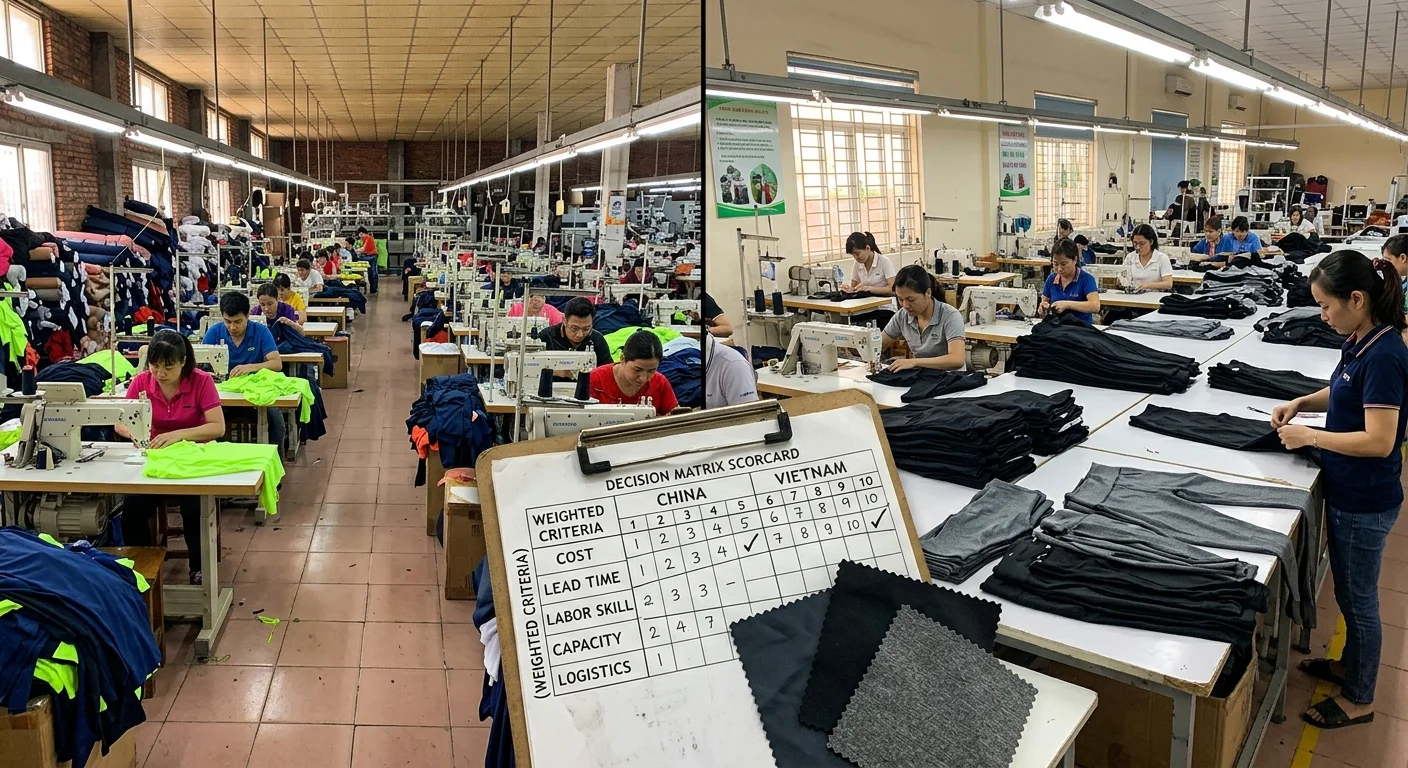
Numbers don't lie — but incomplete numbers do.
Most sourcing comparisons stop at unit price. That's like judging a house by the front door. Your activewear OEM decision carries real costs across seven dimensions. Miss any one of them, and that "cheap" factory ends up costing you more.
Here's how China and Vietnam stack up — dimension by dimension, with real weights attached.
1. Total Cost of Ownership (Not Just the Tag Price)
Unit price is the headline. TCO is the story.
Experienced procurement teams score athletic wear manufacturing cost with TCO weighted at 25–35% of their total sourcing score . They build a 12-month model that includes:
Unit price per SKU — China tends to have a slight edge here due to scale
Volume discounts — China factories often offer 3–5% breaks at 10k–50k units; Vietnam factories tend to range 2–4%
Payment terms — Net 60 vs. Net 30 creates a real working capital gap (around 0.2–0.5% cost advantage depending on your WACC)
Freight and duties — Vietnam's lower US tariff exposure can fully offset a higher unit price
Hidden costs — expedite fees ($500–$2,000 per late shipment), quality failures, and switching costs if you need to requalify
Don't pick a factory. Pick a 12-month cash flow model.
2. Quality and Reliability
A defect isn't just a number. It's $150 in scrap, rework, and reshipping — multiplied by every unit that fails.
The industry benchmark for gym wear bulk production at mature operations sits at ≤500 PPM (parts per million) defect rate. Best-in-class facilities target ≤200 PPM. Here's what that gap costs in real money:
300 PPM × $150 per defect event × 1M units = $45,000/year
1,200 PPM at the same scale = $180,000/year
That $135k gap belongs in your TCO model.
China's manufacturing base carries decades of ISO 9001 infrastructure and documented SOPs. Vietnam's quality tier is rising fast — but it swings wider by factory. Request FPY (first-pass yield) data. Target ≥98%.
3. Lead Time and Delivery Flexibility
Activewear production lead time is where supply chain decisions become brand decisions.
China: average 21–28 days from PO to shipment for established relationships
Vietnam: 28–42 days is more common, with fewer backup routes when disruptions hit
Target benchmarks for any serious sportswear supply chain partner:
- On-time delivery (OTD): ≥95–98%
- Order accuracy: ≥99%
- Expedite responsiveness: within 72 hours for emergencies
Vietnam factories are improving. China still leads on infrastructure — more shipping modes, more backup routes, more documented contingency plans.
4. Financial Stability and Risk Profile
The supplier quoting you well today needs to still exist in 18 months.
Assess factories from both countries on:
- Years in operation — an 18-year factory vs. a 4-year factory is a real risk difference
- Customer concentration — one brand holding >30–40% of their revenue means your order rides on that client's decisions
- Single-site exposure — Vietnam's manufacturing base clusters in fewer locations; China gives you more multi-site redundancy
Most procurement teams weight this dimension at 10–20% — higher for critical or high-volume categories.
5. Technical Capability and Scalability
Not every performance fabric supplier or yoga wear manufacturer is built for growth.
Ask both China and Vietnam factories these questions:
- Current capacity utilization — 70% leaves room to scale; 90% does not
- Maximum monthly output for your SKUs, plus committed ramp rate (e.g., +30% within 60 days)
- R&D investment as % of revenue — serious manufacturers invest 1–5%; innovation-focused ones exceed 10%
China's edge here is depth — decades of technical infrastructure, specialized fabric mills, and engineering talent. Vietnam is growing, but custom performance fabric development still trails behind.
6. ESG, Compliance, and Tariff Exposure
This dimension has moved from "nice to have" to a hard filter — a must-check for overseas garment manufacturing brands selling into the US or EU.
What to measure:
- Environmental certifications: ISO 14001, bluesign®, OEKO-TEX
- Labor audits: SA8000, SMETA completion with no major findings
- US tariff rates : China-origin sportswear faces 25–145% tariffs depending on category; Vietnam-origin goods sit noticeably lower under standard MFN rates
For brands selling direct to US consumers, Vietnam's tariff position alone can flip the entire TCO math.
ESG weight in modern decision matrices: 10–15% — and it keeps climbing.
7. Communication and Cultural Responsiveness
Bad communication doesn't show up in your quote. It shows up in your production delays.
Score factories on behavior, not promises:
- Response time : ≤4 business hours = 9–10/10; 48+ hours = below 5/10
- Quote turnaround : 3–7 days for standard items is professional; longer is a warning sign
- Issue resolution speed : how many days does it take to close a quality dispute?
China activewear factories with solid export infrastructure tend to have dedicated English-speaking account managers and cleaner documentation. Vietnam is more mixed — newer factories can have communication gaps that create real problems for private label sportswear production brands needing tight precision on spec sheets.
The Decision Matrix at a Glance
Dimension | Weight | China Advantage | Vietnam Advantage |
|---|---|---|---|
Total Cost of Ownership | 30% | Scale, discounts | Lower tariff exposure |
Quality & Reliability | 20% | Deep infrastructure | Improving rapidly |
Lead Time & Flexibility | 15% | Shorter, more routes | Adequate for non-urgent |
Financial Stability | 10% | Established players | Varies by factory |
Technical Capability | 10% | Clear leader | Growing |
ESG & Compliance | 10% | Improving | Tariff-compliant |
Communication | 5% | Stronger average | Factory-dependent |
Run your own numbers through this matrix. Weight the dimensions by what your brand needs — not by what everyone else prioritizes. A startup placing its first sportswear factory MOQ order values cost and communication differently than a scaling brand focused on delivery reliability at 100k units per month.
Pros & Cons Summary: China Sportswear Manufacturers
China's manufacturing reputation took four decades to build. Stitch by stitch, factory by factory — the infrastructure compounded over time.
For activewear OEM buyers, that history matters. You're not just buying a garment. You're buying into an entire ecosystem.
What China Gets Right
The supply chain is vertical — and that's rare.
Start from polyester filament. Move through performance fabric , cut-and-sew, and quality-certified export packaging. Most of that happens inside a single province. Sometimes inside a single industrial park. Fewer steps mean faster sampling, tighter feedback, and fewer points where things break down.
Here's what that looks like in practice for yoga wear manufacturers and performance brands:
UPF 50+ UV protection — standard across outdoor and running categories
≥99% antibacterial rates (AATCC 100/ISO 20743) — built into training tees and base layers
130–220 g/m² moisture-wicking knits — recover to within 10–15% of initial moisture levels in 30–40 minutes
90–95% elastic recovery on nylon/polyester-spandex four-way stretch — holds through high-intensity movement
GRS-certified recycled polyester and nylon for brands with sustainability commitments
Vietnam can't replicate this yet. Most of Southeast Asia's functional fabric ships in from China. That fact quietly eats into the cost savings of "going Vietnam."
MOQ flexibility is real — you just need to know where to look.
For private label sportswear production brands in the early stages, China's small-factory tier is open and accessible:
Shenzhen and Dongguan custom factories: 100 pieces per style , mix sizes and colors
Standard sampling turnaround: 7 days for basics; 3–5 days with fabric already in stock
Production line switching: some factories run weekly rolling schedules for DTC brands, adjusting volumes based on actual sales data
That's not a brochure claim. It's the operational model that drives most of China's cross-border ecommerce garment volume.
The price structure still works — read the numbers straight.
Raw numbers for gym wear bulk production at 100–500 piece MOQ ranges:
Product | FOB Factory Price |
|---|---|
Performance short-sleeve tee | $4–6 / piece |
Hoodie (fleece / French terry) | $8–18 / piece |
Seamless knit yoga pants | $7–15 / piece |
Labor costs run 70%+ below European and American equivalents. For brands pushing fast iteration — multiple colorways, monthly drops, rapid reorders — China's infrastructure absorbs that demand. Vietnam's newer factories can't match that pace yet.
Where China Creates Real Risk
The tariff exposure is structural, not temporary.
Since 2018, US-China trade friction has stacked additional duties onto most sportswear HS codes. The math is blunt: on a $5 FOB garment, an extra 10–25% tariff adds $0.50–$1.25 per piece . Scale that across a 10,000-unit run and it stops being a rounding error.
That's why mid-sized brands now split their sportswear supply chain — China handles complex technical styles and sampling, while basic-volume production routes through Vietnam or Bangladesh. Not abandonment. Hedging.
Quality isn't consistent across the tier.
Most sourcing guides skip this part. China has world-class factories. It also has workshops that photograph like world-class factories.
The real spread within Guangdong and Fujian alone:
Top-tier ISO 9001 + BSCI certified facilities: defect and rework rates below 1–2%
Unaudited small workshops: rework rates of 5–10% are documented
Color deviation between reorder batches: ΔE >1.0–1.5 is a recurring problem at inconsistent mills
Sizing drift: ±2–3 cm from spec sheets at under-standardized factories — this pushes online return rates up
For any serious athletic wear manufacturing program, third-party QC inspection (AQL 2.5 or 1.5) is not optional. Build it into your fixed budget.
Top-tier sportswear factories don't always need your order.
Nike, Adidas, and Puma have locked up substantial capacity at China's best facilities. For brands spending $100k–$500k per year , the negotiating position at premium factories tilts against you — higher prices, longer lead times, less room to revise specs.
China Is the Right Fit If You Are:
Building a technical performance line — compression wear, cycling kits, competitive running apparel — where functional fabric specs are non-negotiable
Running a DTC brand that needs low MOQ + fast sample turnaround for new weekly drops
Scaling a line that requires seamless knitting, laser cutting, heat-bonded seam tape , or body-mapping construction
Comfortable managing tariff exposure through product classification or dual-country sourcing
Your primary concern is cutting US import duties, and your product line stays straightforward — basic leggings, training tees, standard gym shorts. China's advantages shrink in that case. That's the point where Vietnam's numbers start making more sense.
Pros & Cons Summary: Vietnam Sportswear Manufacturers
Vietnam didn't become a serious sportswear manufacturing hub by accident. It earned that position order by order, audit by audit — and for the right brand profile, it makes a strong case.
What Vietnam Gets Right
Labor costs run about half of China's. That gap is real. You'll see it in your unit economics on high-volume, simple styles — training tees, leggings, shorts, basic uniform programs.
But the bigger advantage isn't wages. It's trade structure.
Vietnam's EVFTA and CPTPP memberships open tariff doors China can't access right now. Brands exporting to the EU or CPTPP-member markets can get duty reductions in the 3–12% range on qualifying products. On a $100,000 order , that's $3,000–$12,000 in real savings — before any unit price negotiation starts.
Vietnamese factories also outperform expectations on quality consistency for performance basics . Many have built solid expertise in synthetic and blended fabrics — the kind of activewear OEM work that needs strict QC and audit-ready documentation. Brands that need a clear compliance story will find that visibility easier to get in Vietnam than in China's larger, harder-to-track factory network.
Where Vietnam Creates Real Friction
Here's the honest picture: Vietnam's advantages shrink fast once your program gets complex.
MOQs run high. Factory tiers across the country push mid-to-high minimums. For small brands testing new styles, some minimums are just too steep to justify. Starting your first private label sportswear production run? Many Vietnam factories will turn you away.
Lead times run longer. Plan for 28–42 days as a starting point. There are also fewer backup options to lean on when disruptions hit.
Most sourcing guides skip this part: Vietnam activewear factories still buy most of their fabrics from China. That dependency stretches your supply chain timeline. It also brings back the same risk you were trying to move away from.
Wages are rising too. Stricter labor and environmental compliance is eating into the original cost advantage — and that pressure builds year by year.
Vietnam Is the Right Fit If You Are:
Producing large-volume, standardized styles — leggings, tees, shorts, uniforms — with low construction complexity
Selling into the US or EU and want FTA duty savings on your side
Building a brand around ethical sourcing and compliance transparency
Running a China+1 diversification strategy and need a solid second-country anchor
Your program needs frequent style changes, fast replenishment, or specialized construction? Vietnam's high MOQs and longer lead times will end up costing more than the tariff savings bring in.
How to Choose: A Practical Decision Framework for Sportswear Brands
The matrix above is a tool. This section is the instruction manual for using it.
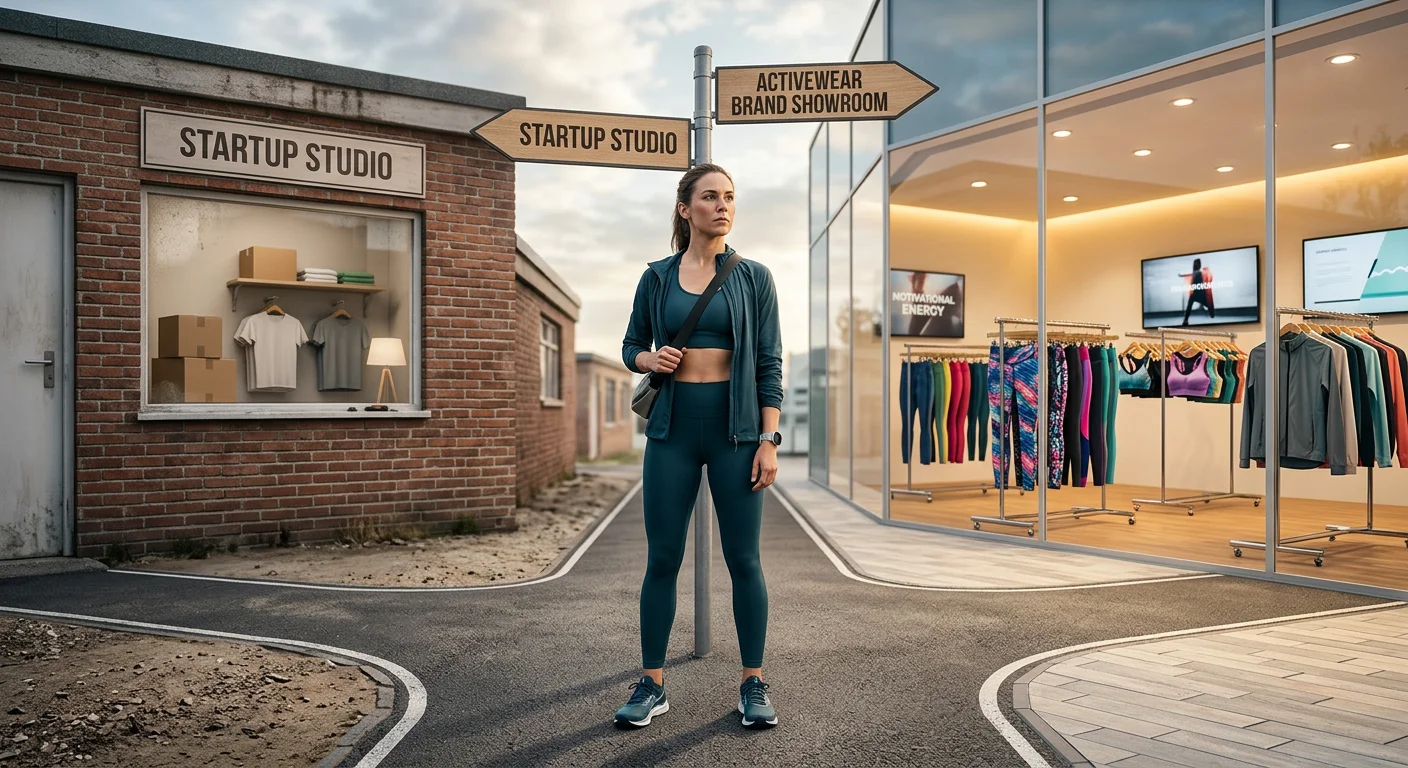
Your sourcing decision comes down to one question: what stage is your brand at, and what does that stage demand? Answer that straight, and the right country picks itself.
Start With Your Brand, Not the Factory
Before you evaluate a single supplier, lock down three things:
1. Who you're selling to — and what they pay.
Mass-market buyers spend $20–35 on leggings. Nike/Adidas customers pay $45–70. Lululemon customers expect $88–128 and don't apologize for it. Target customers spending under $40? You're building a mass-mid hybrid — China's cost structure fits that. Target customers who buy premium as a habit? Your flagship bottoms should sit at $80+. The sourcing story needs to match the price tag.
2. What you're launching.
Don't start with 40 SKUs. Start with 1–3 product categories — legging, sports bra, training tee — and 8–15 SKUs total. Keep construction tight. Complex technical specs like compression panels, bonded seams, and body-mapping? China's deep fabric ecosystem earns its place there. Standard cuts in basic performance fabrics? Vietnam becomes a real contender.
3. What volume you can commit to.
Startup-friendly factories quote 100–300 pieces per style per color. Performance-focused facilities want 300–500+. Under 300 pieces? China's small-factory tier — Shenzhen and Dongguan in particular — stays open to you. Most Vietnam factories will turn you away at that volume.
The Practical Decision Rules
Run through this fast:
Priority is US tariff reduction on straightforward styles → Vietnam. The math is blunt on basic leggings and tees.
Need custom performance fabrics, seamless knitting, or fast sample turnaround → China. Vietnam sources most functional fabric from China anyway.
Scaling past 10,000 units/month on standardized styles → Vietnam starts making real sense.
Doing frequent drops, rapid reorders, or testing new colorways each month → China's rolling production schedules handle that. Vietnam's lead times (28–42 days) don't.
The Short Checklist
Before you contact any factory, answer these:
Who : Target persona, sport, and spend level
Where to play : 1–2 use-cases + one pricing tier
What to launch : ≤3 categories, 8–15 SKUs, two collections designed ahead
How to make it : MOQ you can fill (100–300 pcs/style to start), 2–3 sample rounds budgeted
Get those four things on paper. Then let the decision matrix do the rest.
Sourcing Strategy by Brand Type: Which Country Fits Your Stage
Stage determines strategy. Where you source today should reflect where your brand is right now — not where you hope it will be in three years.
Here's what most sourcing guides skip: there is no single correct answer between China and Vietnam. There's just the right answer for your current stage .
Startup / Pre-Launch
You need low MOQs, fast iteration, and room to make mistakes without burning cash. China's small-factory tier — Shenzhen, Dongguan — lets you start at 100–300 pieces per style. Vietnam's minimums will turn you away before the conversation even starts. At this stage, speed and flexibility beat tariff savings every time.
Early Growth / Validation
Your styles are proving themselves. Volume is climbing. Vietnam starts making sense here — especially if you're selling into the US or EU. FTA duty savings kick in on standardized styles like leggings, tees, and shorts. Construction stays simple. Your compliance story stays clean.
High-Volume Scale
China's depth is hard to replace at scale. Complex technical construction, specialized performance fabric suppliers , seamless knitting, fast reorders — China handles all of it. Run Vietnam in parallel as your backup country for basic volume. That's not hedging for the sake of it. That's how strong sportswear supply chains get built.
Mature / Risk-Managed
Single-country sourcing is a single point of failure. Split volume across two countries on purpose. Use the decision matrix from the previous section to rank what matters most — cost, lead time, tariff exposure, technical capability. Then assign volume to match.
Brand Stage | Best Fit | Core Reason |
|---|---|---|
Startup | China (small factories) | Low MOQ, fast sampling |
Early Growth | Vietnam | FTA savings, compliance |
Scale | China + Vietnam | Depth + cost balance |
Mature | Multi-country | Resilience and leverage |
Know your stage. Then source to match it.
FAQ: Questions Sportswear Brands Ask Before Choosing a Factory
The wrong questions waste everyone's time. Here are the right ones.
On MOQ and volume:
- What's your MOQ — per style, per color, or per size run? (100–300 pcs/style works for startups. Most Vietnam factories won't go that low.)
- Can I mix sizes to hit the total? (e.g., 50 pcs per size across S–XL)
- How many production lines do you run? What's your monthly capacity for leggings?
On lead times:
- What's your on-time delivery rate for the past 12 months? Get a number. ≥95% is the floor.
- Is fabric sourcing lead time included in your bulk quote, or added on top?
On cost:
- Give me a full line-item breakdown — fabric per meter, CM, printing, packing, testing, sample fees.
- What gets credited back against my bulk order?
On quality:
- Do you run pre-production, inline, and final AQL inspections? Which AQL level — 2.5 or 4.0?
- Does your in-house lab test stretch recovery, colorfastness, and moisture-wicking? Show me the numbers.
On capability:
- What percentage of your output is sportswear?
- Can you do flatlock stitching, bonded seams, seamless knitting — all in-house?
On proof:
- Show me three recent activewear clients and five samples close to my styles.
- Can I visit the production floor?
Ask these before you sign anything.
Conclusion
The factory doesn't make your brand. Your decision does.
China gives you scale, speed, and a supply chain that runs with little effort. Vietnam gives you tariff relief, rising quality, and a buffer against geopolitical risk. Both are solid choices. The wrong move is picking based on price alone and ignoring everything else.
This guide comes down to one idea: match your manufacturing country to your brand's current stage , not your dream stage. A 500-unit yoga wear startup doesn't need the same factory as a 50,000-unit athletic wear OEM. That's fine. They serve different needs.
You've done the research. You've seen the comparison.
Now it's time to make the call.
→ Get a free quote from our sportswear production team — share your MOQ, fabric needs, and timeline. We'll tell you what's possible and how to move forward.