Finding a reliable sportswear manufacturer in Nigeria is harder than it should be. Most overseas buyers, local entrepreneurs, and procurement managers spend weeks searching — and still end up guessing. One wrong supplier choice means missed deadlines, inconsistent quality, or minimum order quantities that make no business sense.
This 2026 guide gives you something most sites skip: honest, well-researched profiles of the top 8 jersey manufacturing companies and activewear producers operating in Nigeria right now. You'll see their real production capacities, their honest tradeoffs, and the specific situations where each one performs best.
Placing a bulk sportswear order from abroad? Launching a private label brand locally? The right name on this list could change how your business runs.
Aso Sportswear Nigeria Ltd.
Location: Ikeja Industrial Layout, Lagos | MOQ: 30–50 sets (starter tier) | Lead Time: 14–21 days
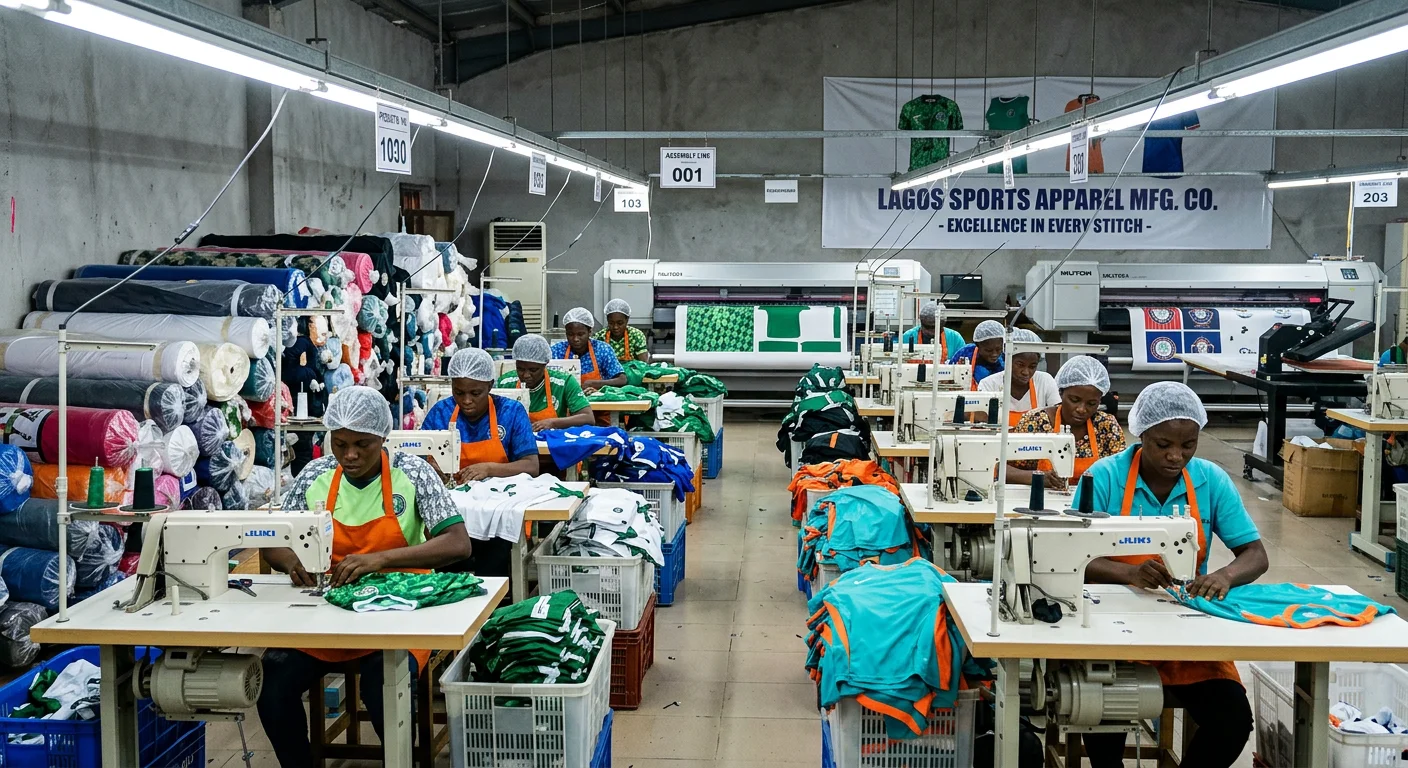
Aso Sportswear sits in the Ikeja/Ogba industrial belt. The sportswear factory in Nigeria is 8–12 km from Murtala Muhammed International Airport and within 25 km of Apapa's port gates. That location is no accident. You get fast access to both air freight and sea freight. For buyers who need consolidated shipments out quickly, this address is a real working advantage.
What They Make
The main product line is polyester-based football kits and training wear . Jerseys come in 130–180 gsm moisture-wicking mesh. Shorts feature elastic waistbands and inner drawcords. Tracksuits run USD 12–18 per set, depending on fabric weight. For fitted activewear — compression tops, women's leggings — they use polyester-spandex blends with 5–12% elastane.
Three printing methods are available:
- Dye-sublimation — full-body gradients and club colorways on a white polyester base, up to 1440 dpi resolution
- Screen printing — cost-effective for single or dual-color logos on runs of 50+ pieces
- Heat-transfer vinyl — individual names and numbers, though not the best choice for large coverage areas
One real limitation to note: complex 3D puff or silicone branding needs subcontracting. Embroidery is on the table, but it works best for small club crests — not high-density chest panels.
Capacity and Production
Standard single-shift output runs 15,000–25,000 units per month . During peak tournament seasons, they add partial evening shifts. Output then climbs to 30,000–40,000 units for simple kit combinations. AfCFTA is opening cross-border trade across Ghana, Benin, and francophone West Africa. To keep pace, expansion plans through 2026 target 35,000+ units per month. That growth gets backed by upgraded sublimation lines and added sewing capacity.
Pricing Breakdown
Order Size | Football Kit (Jersey + Shorts) |
|---|---|
30–99 sets | USD 11–14 / set |
100–299 sets | USD 8–11 / set |
300+ sets | USD 6.50–8.50 / set |
Basic training tees start at USD 4.50–7 per piece at 100+ units. Rush orders — 7 to 10 days — carry a 20–40% price premium, subject to available capacity.
Best fit for: Regional academy leagues, corporate wellness programs, and private-label gym brands placing 100–300 pieces per style.
Berun Active Wear
Location: Ho Chi Minh City, Vietnam | MOQ: 50–100 pcs/style | Lead Time: 25–35 days (bulk)
BeRun active wear earns its spot on this list through raw capability — not geography. This factory runs out of Vietnam, not Lagos. No Nigeria facility. No local presence at all. Yet if your brief covers private label sportswear with low MOQs, solid sublimation work, and full OEM support, skipping Berun over a location tag is a real miss.
What They Make
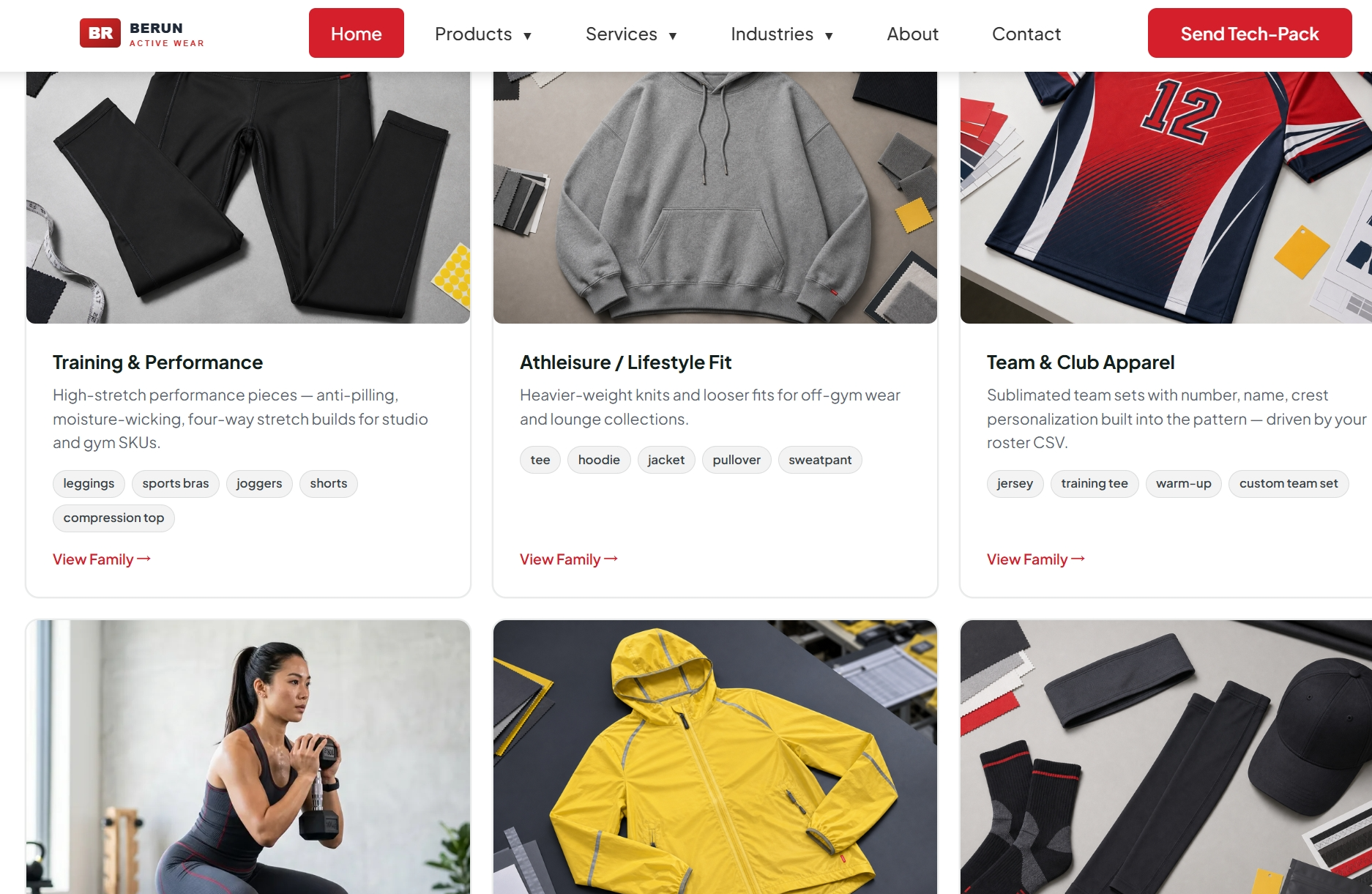
Berun is a cut-and-sew factory built around performance activewear for private label brands . Every step of production stays in-house, from fabric to finished piece. The product range is wide: leggings, sports bras, yoga sets, sublimated football jerseys, cycling kits, tracksuits, and athleisure pieces.
Fabric options break down cleanly:
- Polyester-spandex (160–220 GSM) for leggings and fitted tops
- Nylon-spandex blends for high-stretch yoga and compression wear
Build quality shows up in the details. You get flatlock stitching throughout, seam-tape reinforcement on stress points, and bonded edges on premium bras and leggings. These aren't shortcuts — they're the marks of a factory that knows activewear construction.
Decoration capabilities include:
- Full-coverage dye-sublimation for jerseys and cycling kits
- Screen printing for logos and text
- Heat-transfer and reflective vinyl for running pieces
- Custom sportswear woven labels, silicone patches, and brand-ready hangtags
Pricing and MOQ
Style Category | MOQ | FOB Price Range |
|---|---|---|
Sublimated sports jerseys | 100 pcs/style | USD 7–10/pc |
Leggings / yoga sets | 100 pcs/style | USD 8–15/pc |
Cycling / compression sets | 100 pcs/style | USD 18–30/set |
Trial / sample runs (stock fabrics) | 50 pcs/style | Quote-based |
Sampling takes 7–10 days after tech pack submission and deposit. Bulk production runs 25–35 days after sample approval. That's a realistic timeline — not artificially compressed.
Real Strengths and Honest Gaps
Berun works best for small-to-mid-scale brands that need full OEM sportswear support without factory-scale minimums . Vietnam's synthetic textile supply chain keeps pricing sharp. The sublimation output is strong, especially for team jerseys and cycling wear. Color consistency and print coverage hold up well across production runs.
The gaps are real, though. No OEKO-TEX or BSCI certificate numbers show up in open sources. Verify those directly before selling into regulated markets — don't assume. Also, this is a cut-and-sew operation only. Seamless knitting requests need to go elsewhere.
The bigger gap for some buyers: no AGOA eligibility, no Lagos presence, no ECOWAS logistics setup . Local Nigerian production and AfCFTA preferential routing are both off the table. Berun isn't built for that.
Best fit for: Overseas fitness and yoga startups that need low MOQs with custom sportswear branding, plus mid-scale private labels building out polyester-spandex activewear lines with consistent, repeatable quality.
LagosTex Garments Manufacturing Co.
Location: Apapa/Ogun Export Corridor, Lagos | MOQ: 300–500 pcs/SKU | Lead Time: 21–28 days
Institutional buyers — schools, state sports federations, corporate HR teams — don't need flair. They need a factory that delivers 2,000 matching kits on time, every time, without drama. LagosTex is built around that promise.
What They Make
The product focus is clear and narrow: school uniforms, corporate training kits, and league apparel built for durability over style. Core materials lean toward polyester-cotton blends and anti-pill fleece — solid choices for high-turnover institutional programs. Reinforced elbow and knee padding, seam taping on stress points, and consistent colorway matching across large size runs come standard here. These are not upgrades.
Polyester makes up 65% of all clothing globally. LagosTex works with that reality rather than against it.
Decoration options cover the institutional essentials:
- Screen printing for high-volume logos across bulk runs
- Heat-press transfer for variable names and squad numbers
- Stitched reinforcement on abrasion-heavy zones
Complex 3D graphics or fashion-led custom artwork push outside this factory's core range. That's not a criticism — it's a clear scope boundary worth knowing before you submit a brief.
Capacity and Order Structure
Production runs on 2–4 parallel assembly lines . There's a dedicated finishing and packing area built for staged dispatch. Output targets 25,000+ units per month , organized by phased delivery — by size run or colorway — to keep federation and school orders moving without holdups.
Export documentation readiness and ECOWAS trade compliance are built into the operating model. That matters for public-sector tenders or cross-border orders into francophone West Africa. You won't need to chase paperwork separately.
Pricing Signals
Order Tier | Estimated Range |
|---|---|
300–499 pcs/SKU | Quote-based; institutional pricing |
500–1,000 pcs/SKU | Volume discount applies |
Phased multi-SKU orders | Negotiated per delivery schedule |
Come prepared to the procurement desk. Bring a sample request, a size chart, decoration proofs, and a phased shipment schedule . Spell out incoterms and your delivery point before any bulk PO moves forward. This factory runs on institutional volume. Buyers who communicate in clear, precise terms get faster, better responses.
Best fit for: University sports councils, state athletics federations, and corporate procurement managers running annual uniform cycles — anyone who puts delivery reliability and repeatable quality ahead of small-run design work.
Kano Heritage Sportswear Factory
Location: Bompai Industrial Layout, Kano State | MOQ: 200 pcs/style | Lead Time: 18–25 days
Kano has been a textile trading hub for centuries. That history didn't disappear — it evolved. The factory sits inside the Bompai/Challawa industrial zone. It pulls cotton from northern Nigeria's key belts — Katsina, Kaduna, and Jigawa — all within 150–350 km overland. That short distance cuts inbound fabric costs by 5–15%. It also trims 5–7 days off raw-material lead times, compared to Lagos-based factories that import overseas yarn. Geography here is a real competitive edge, not a talking point.
What They Make
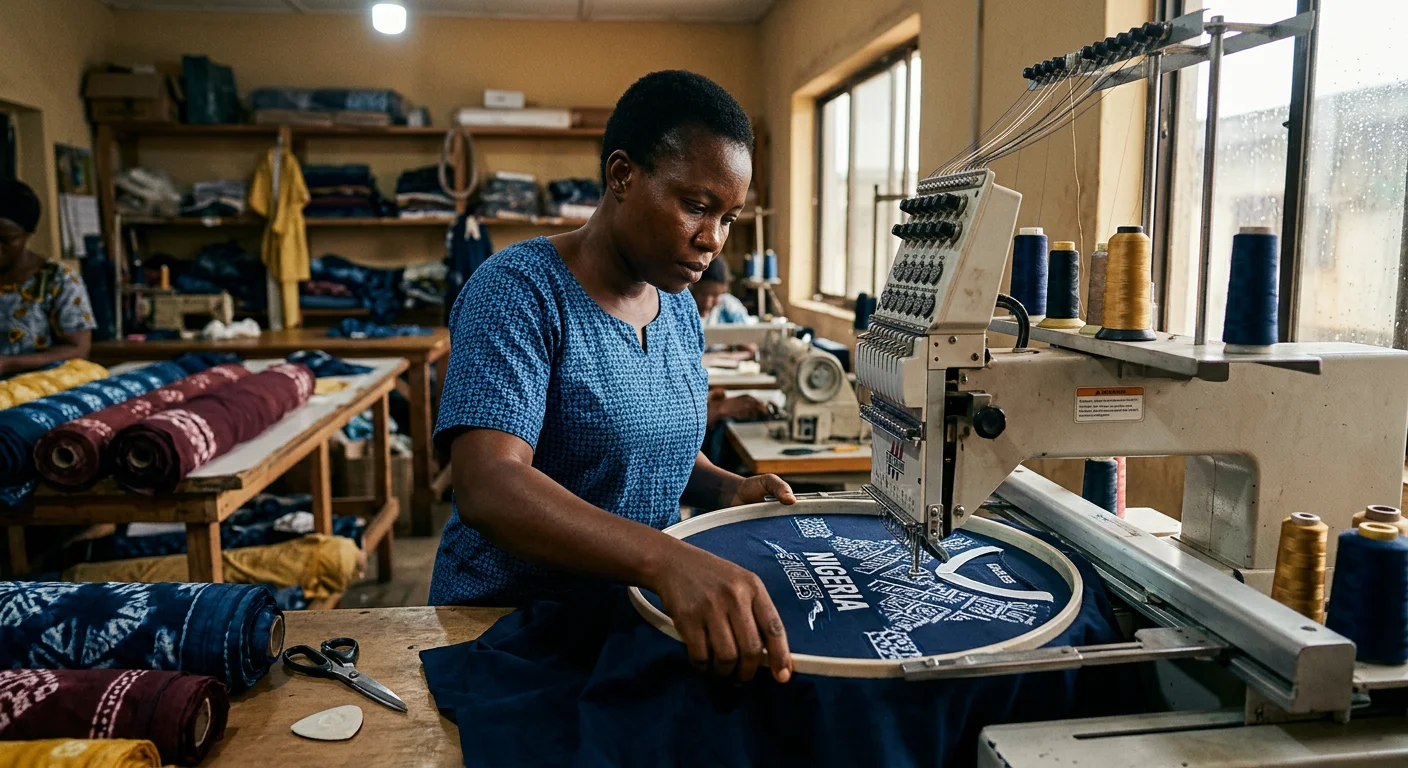
This is not a sublimation-first sportswear factory. The core identity is heavyweight cotton construction and artisanal embroidery . It's a focused niche that serves buyers other factories struggle to reach.
Core fabric range:
- Heavyweight cotton jersey — 220–260 gsm, 100% cotton or 90/10 cotton-poly blends
- French terry and fleece — 280–320 gsm for hoodies and warm-up tops
- Adire-inspired athletic blends — resist-dye-patterned 180–220 gsm poly-cotton, built for gym wear with cultural identity built into the fabric
The embroidery operation here is serious. Six to ten semi-automated heads, backed by hand-finishing tables, handle:
- Small chest crests at 4,000–8,000 stitches
- Large back emblems and martial-arts symbols at 15,000–30,000 stitches
- Satin-stitch lettering, felt-base vintage patches, and appliqué work for retro kits
There's also a dedicated heritage jersey line — retro football kits, long-sleeve rugby tops, contrast-collar club warm-ups. These are the anniversary and throwback pieces a sublimation house cannot reproduce with the same tactile feel.
Decoration capabilities:
- Screen printing: 4–6 color, plastisol and water-based inks, rated for 30–50 wash cycles
- Limited sublimation: numbers and logo panels on polyester sections only — no full-body all-over prints
That last point matters. All-over sublimation as a core need? This is the wrong factory. Detailed stitch work, cultural motifs, and cotton-rich construction? This is the right one.
Pricing and MOQ
Product Type | MOQ | Price Range |
|---|---|---|
Cotton training T-shirt (1-color print) | 200 pcs | USD 3.80–4.50/unit |
Fleece hoodie / crewneck with embroidery | 200 pcs | USD 6.50–9.00/unit |
Martial-arts warm-up set (embroidered back) | 200 pcs | Quote-based by stitch count |
Standard samples take 5–7 days . Heritage embroidery samples take 7–10 days . High-stitch-count logos go into the production schedule first. This keeps them from bottlenecking the final delivery window.
Honest Tradeoffs
The strengths are straightforward: a competitive northern cost structure, strong embroidery craft, and real fluency with Adire motifs and Hausa visual themes. For Nigerian and African diaspora brands building culturally grounded gym wear , that design knowledge is rare and hard to find elsewhere.
The friction points are just as clear. Kano to Lagos runs 1,000+ km overland. That adds 2–4 days of transit time, plus extra inland freight for any sea export. Generator reliance is common across Nigerian sportswear manufacturers — build buffer time into your production calendar. Also, the limited sublimation capacity is a hard ceiling for certain product categories.
Best fit for: Heritage athletics clubs ordering anniversary kits, martial-arts organizations needing well-built embroidered gi jackets, and African fitness brands building cotton-forward, culturally distinct training wear. So, anyone placing 200–1,000 pcs per style who values craft finishing over high-volume polyester output.
Abuja Elite Kits & Uniforms
Location: Gwagwalada/Lugbe Industrial Corridor, Abuja FCT | MOQ: 150 pcs | Lead Time: 15–20 days
Abuja runs on institutions. Federal ministries, police academies, university athletics departments, tournament organizers — these buyers keep the FCT's procurement calendar full year-round. Abuja Elite Kits & Uniforms sits right inside that ecosystem. This isn't a sportswear supplier for fashion-forward gym brands. It's built for the buyer who shows up with a size chart, a colorway spec, and a league kick-off date circled in red.
What They Produce
The core product range matches institutional demand: match kits, training wear, referee uniforms, and coaching staff apparel . Fabric construction centers on technical moisture-wicking polyester mesh with quick-dry finishing. That's a practical choice for organizations washing kits twice a week during tournament cycles.
Construction standards worth checking:
- Flatlock or double-stitch seams — built for high-wash environments
- Reflective and safety print options — useful for police, military academy, and event-staff orders
- Numbered customization across full squad runs, including goalkeeper and referee variants
Decoration options cover screen printing, heat-transfer, and sublimation panel work. Complex embroidery or full-body all-over sublimation falls outside the main focus here. Confirm the full scope before you brief artwork.
Capacity and Order Structure
Production output runs an estimated 5,000–8,000 units per month across multiple lines. Orders are structured around repeat league cycles and departmental colorway batches. That output level fits mid-scale institutional buyers well. It's not set up for 50,000-unit export runs — and that's not the target here.
Standard lead time: 15–20 days with fabrics and trims in stock. Complex embroidery or detailed graphic programs add time to that window. Build in a buffer before locking a delivery date.
The factory sits near the Gwagwalada and Lugbe industrial corridors. That location supports direct dispatch into central Abuja. You get a real advantage for federal-adjacent deliveries and same-week loading during tight tournament deadlines.
Before You Place an Order
Public procurement records and verified client references for this sportswear supplier are hard to find in open sources. That gap makes direct verification essential — not optional.
Your pre-order checklist:
- Confirmed site address and active production facility
- Capacity per product line and SKU, broken down by month
- Fabric GSM and composition documentation
- Stitch density, colorfastness, and wash-durability test results
- On-time delivery rate for past league or federation contracts
- Business registration, tax clearance, and vendor onboarding paperwork
- Past client types: schools, clubs, ministries, sports federations, security agencies
For institutional buyers running annual uniform cycles, ask about repeat-order pricing tiers and priority queue access during peak tournament seasons. Those terms are negotiable — but you need to raise them before the PO is signed.
Best fit for: League organizers, university sports councils, government procurement teams, and tournament operators placing 150–2,000 pcs per style . Ideal for buyers who need reliable turnaround, numbered customization, and a supplier already familiar with public-sector contract requirements.
OgunTech Apparel & Sublimation Works
Location: Ogun State Special Trade & Export Processing Zone, Lagos–Abeokuta Expressway | MOQ: 100 pcs/design | Lead Time: 12–17 days from art approval
Sublimation is a specific craft. Most Nigerian activewear factories treat it as a side job — one printer sitting in the corner of a screen-printing shop. OgunTech is built around it. That focus changes everything: print resolution, turnaround time, and output consistency.
What They Make
Every product runs on high-polyester performance knits. That's not a limitation. It's a deliberate choice that produces cleaner, sharper results.
Core fabric weights:
- 120–140 gsm interlock — running vests, esports jerseys, lightweight training tees
- 160–190 gsm pique/micro-mesh — football teamwear and structured training tops
- 200–260 gsm poly-spandex blends — compression shorts and performance leggings
Print quality is strong. Full-surface wrap printing covers the front, back, sleeves, and underarm gussets in one production pass. Resolution runs 600–1,440 dpi. Color accuracy hits Delta E < 2–3 against Pantone references on white bases. That level of precision matters for brands that need consistent, recognizable colors across every order.
Construction finishes are solid too. You get flatlock and coverstitch hems, plus 5-thread overlock on side seams. These are performance garments built to handle twice-weekly wash cycles. They're not display samples.
Capacity and Workflow
Production capacity runs at 12,000–18,000 units per month on a single shift. Add a second shift, and that climbs to 20,000–25,000 units — practical for lightweight sublimated jerseys and singlets.
The workflow is tighter than most factories at this scale:
1. Submit your art file (AI, EPS, SVG, or 300 dpi PNG)
2. Get a digital 2D mockup back for approval — usually within 1–3 days
3. Request optional physical strike-off panels for final color confirmation
4. Art approval starts the production clock: 12–17 days to dispatch for 100–500 pcs
An integrated CAD lab and laser cutting system hold ±1–1.5 mm accuracy on polyester knits. That keeps panel alignment tight — critical for esports jerseys and compression wear, where off-seam placement shows up right away.
Pricing
Product Type | MOQ | FOB Price Range |
|---|---|---|
Sublimated jersey / running tee (120–150 gsm) | 100 pcs | USD 5.00–7.00/unit |
Full-wrap leggings / complex personalization | 100 pcs | USD 8.00–11.00/unit |
Sample / fit test run | 1–10 pcs | Quote-based |
No screen charges. No minimum color fees. Sublimation is fully digital, so switching designs costs nothing extra beyond print time. That's practical for brands releasing frequent capsule collections or refreshing squad kits each season.
Honest Tradeoffs
The strengths are clear: top-tier gradient printing, low MOQs compared to screen-printing operations, fast digital design changeovers, and solid logistics access to Apapa/Tin Can ports via the Lagos–Abeokuta corridor.
The limitations are structural. Sublimation requires ≥80% polyester content. Cotton-dominant fabrics, dark base colors, woven outerwear, and padded jackets don't work here. Your product brief calls for heavyweight cotton hoodies with embroidery? This isn't the right factory. Also worth noting: sublimation ink and transfer paper are imported inputs. Naira volatility can shift pricing between your quote and production dates. Lock in your rate before approving artwork.
Best fit for: Diaspora fitness brands building African-print activewear lines, esports teams that need frequent graphic refreshes at 100–300 pcs, boutique cycling and triathlon labels that need precise panel color consistency, and private label sportswear startups that want strong all-over print quality without hitting factory-scale minimums.
DeltaWave Athletic Productions
Location: Aba Manufacturing Corridor (Abia State) + Port Harcourt Distribution Node, Rivers State | MOQ: 250 pcs/design | Lead Time: 16–22 days
The Niger Delta runs on two things: energy and logistics. DeltaWave Athletic Productions is built around both. The main production floor sits on the Aba–Owerri Road/Ariaria axis — Nigeria's densest garment manufacturing cluster. A finishing and distribution node operates in Port Harcourt's Trans-Amadi industrial zone. Together, this setup serves the buyers that matter most here: oil and gas corporate wellness programs, Niger Delta league clubs, and university athletic departments across Rivers, Bayelsa, Akwa Ibom, and Delta states.
That Aba-to-Port Harcourt link is 60–90 km. Two to three hours by road. For split-delivery corporate orders, that proximity is a real operational advantage — not a marketing line.
What They Make
The product focus is performance sportswear for hot, humid field conditions . Fabric choices reflect that focus:
Quick-dry polyester/spandex blends — 150–220 gsm jerseys and training tops with warp-knit mesh panels at side seams and underarms
Compression fabrics — 72–80% nylon or polyester / 20–28% spandex, 210–260 gsm, with >90% recovery rate after 50 stretch cycles
UPF 30–50+ construction — UV-protective yarns for outdoor Niger Delta conditions
The construction details are solid across the board. Zoned compression panels target quads, hamstrings, and core. Flatlock seams hold seam allowances to 3–4 mm — critical for high-sweat, high-movement use. Silicone gripper bands at hems stop ride-up during full-intensity play. These aren't premium add-ons. They're standard spec.
Decoration capabilities:
- Sublimation printing — disperse dye inks, ISO wash fastness 4–5, UV-resistant ink sets tuned for tropical sun exposure
- Screen printing — plastisol and PU inks for logos on cotton-blend wellness tees and polos
- Reflective transfer films — for industrial running clubs and nighttime safety gear
Capacity and Order Structure
Three to four modular flex-lines produce 9,000–14,000 units per month across jerseys, shorts, compression tops, and tracksuits. Lines switch between product categories within 4–6 hours. During peak tournament seasons, overtime and second shifts push output up by 15–25%.
Capacity breaks down as:
- 40–50% corporate training and wellness gear (oil and gas, banks, telcos)
- 30–40% regional league and club kits
- 10–20% university competitions and small-batch fan runs
Pricing and MOQ
Product | MOQ | Price Range (ex-factory) |
|---|---|---|
Sublimated football/rugby jersey | 250 pcs | ₦5,000–₦8,000/pc |
Full kit (jersey + shorts), corporate | 250 pcs | ₦10,000–₦14,000/set |
Compression tops/tights | 250 pcs | ₦9,000–₦15,000/pc |
Mixed sizes (S–3XL) within the MOQ are standard. Multi-SKU bundle MOQs — where jersey, shorts, and socks share a single graphic package — are open for negotiation.
Split shipments work for multi-site buyers. You get a first partial delivery (40–60% of order) at Day 12–16, with the balance at Day 18–22. Each consignment comes with its own invoice by branch location.
Honest Tradeoffs
DeltaWave's compression engineering and modular logistics are real strengths. This matters most for corporate clients managing deliveries across five or six regional offices from a single master PO. Pricing stays below imported brand equivalents and still holds solid construction standards.
The real constraint is sublimation throughput. With 1–2 large-format calender presses , complex all-over prints and photorealistic gradients slow things down. Your brief is heavy on detailed artwork or fast design changes? Build extra lead time into your schedule — or check press capacity before you commit.
Best fit for: Oil and gas corporate wellness teams, Niger Delta rugby and football clubs, and university athletic departments placing 250–1,500 pcs per style . You need zoned compression construction, split-delivery logistics, and a supplier that already knows how multi-site, multi-SKU corporate orders work.
Calabar ProFit Sportswear Ltd.
Location: Calabar, Cross River State | MOQ: Unverified — direct confirmation required | Lead Time: Unverified — request sample and bulk timelines (ask for each one separately)
Cross River State sits at Nigeria's southeastern edge. Rain falls for nine months of the year here, keeping the air humid and the ground wet. That climate shapes how a sportswear factory must operate. Humidity-managed fabric storage and moisture-aware production logistics are not optional in Calabar. They are baseline requirements — built into daily operations, not added later.
Calabar ProFit Sportswear Ltd. focuses on a clear product range: performance activewear, team kits, and private-label work. The Calabar Export Free Zone adds real value on top of that. Sportswear Manufacturers inside the zone get faster customs processing and duty exemptions. That matters a lot for buyers routing orders through maritime freight.
What You Need to Verify Before Moving Forward
Here's the honest reality: no verified public data exists for this company in open sources. No confirmed address, no audited capacity, no certified pricing, no documented client list. That gap does not disqualify them. It means your due diligence carries more weight than usual.
Before any purchase order moves:
- Confirm the exact facility address and whether it sits inside the Export Free Zone
- Request monthly output figures broken down by product type — jerseys, shorts, leggings, tracksuits
- Ask for fabric specification sheets: GSM, composition, colorfastness ratings
- Get a price ladder across at least three order volumes
- Collect sample lead time, bulk lead time, and rush-order premium in writing
- Ask for two or three buyer references — a school, a club, and a brand client work well for this
Best fit: eco-focused startups, diaspora e-commerce sellers, and community sports organizations. These buyers need smaller-batch, lower-risk production runs — not factory-scale volume.
Buyer's note: Do not proceed until you confirm the address, production capacity, and export documentation through your own checks. The potential is real. The verification work is yours to complete.
Conclusion
Nigeria's sportswear manufacturing sector isn't a backup plan — it's becoming the smart first call.
The eight Nigeria's sportswear manufacturers profiled here offer something rare: real production capacity, honest MOQ thresholds, and local accountability. AfCFTA is turning this market into West Africa's garment export engine. That matters whether you're a global brand cutting lead times with an OEM sportswear Nigeria partner, a Lagos entrepreneur launching your first private label sportswear Nigeria collection, or a school administrator ordering 200 football kits before the season starts. The right factory is on this list.
Your next move is straightforward. Shortlist two or three sportswear manufacturers from the comparison table. Request samples before committing to bulk orders. Ask about certifications and export history — get clear answers before signing anything.
The manufacturers worth your attention aren't hiding. They're stitching, printing, and shipping — right now, in Lagos, Kano, and Ogun.
Go find yours.