You found a pair of compression tights that fit well — the waistband sits right, the fabric hugs without suffocating, the length is what you wanted. Then you wear them for a long run. By mile four, the inner thigh seam turns into a slow-burning line of friction you can't ignore. Sound familiar? That frustration comes down to one overlooked detail: the stitching. The difference between flatlock and overlock seams matters more than most people realize. These two construction techniques look near-identical at a glance. But they perform in opposite ways against skin under pressure and movement. This guide breaks down what separates them, where each seam belongs on a compression garment, and how to spot the difference before you buy.For sportswear brands developing performance apparel, working with an experienced compression garment manufacturer can make a significant difference in seam construction, comfort, and long-term durability.
Flatlock vs Overlock: Side-by-Side Comparison Across 6 Key Dimensions
Six dimensions separate these two seam types. Not two, not three — six. Each one directly affects how a compression garment performs against your body. Here's what the comparison looks like.
1. Seam Bulk: How Much Ridge Are You Wearing?
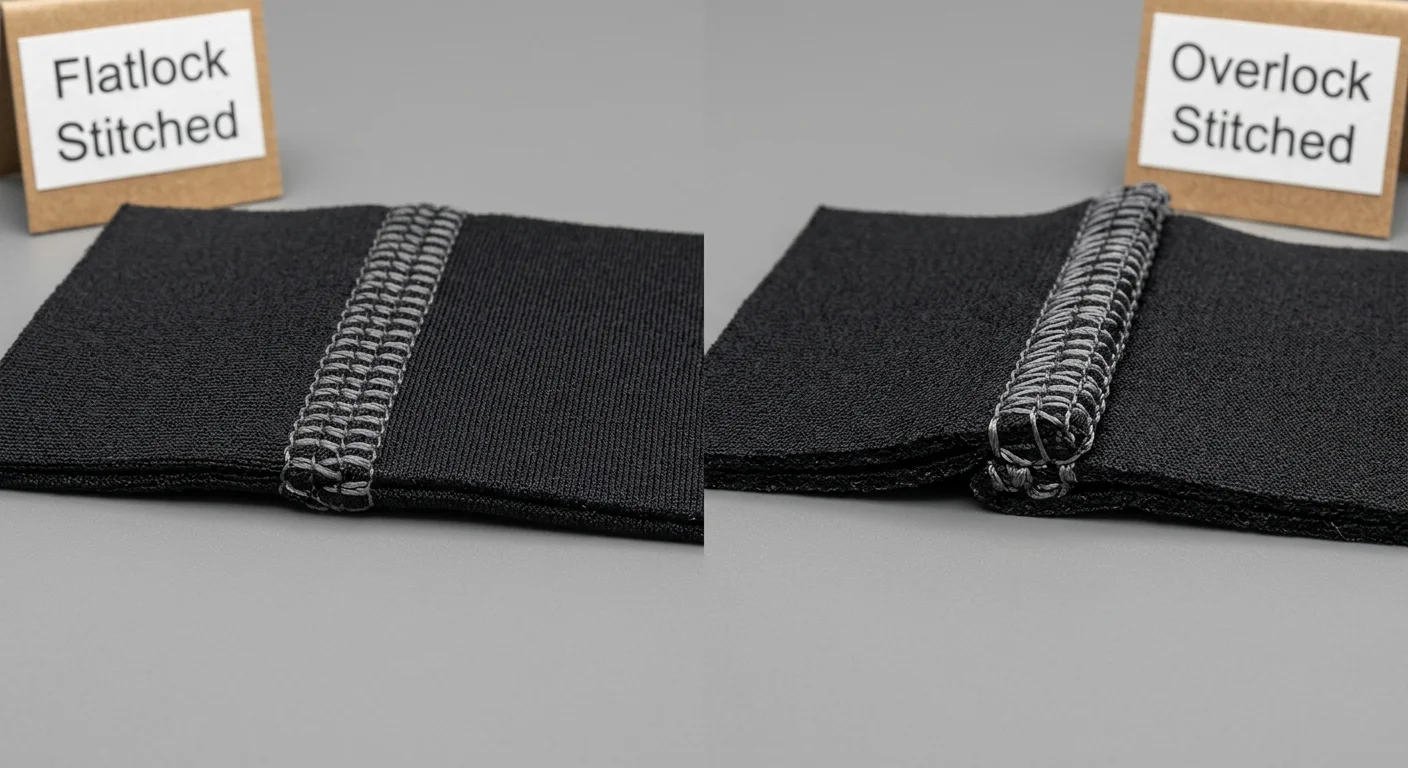
Flatlock joins fabric edges butt-to-butt — no overlap, no folded allowance underneath. You get a near-flush seam that sits like a plateau against skin.
Overlock layers two pieces of fabric on top of each other. It locks the edges, then presses that doubled-fabric ridge against you. Industry benchmarks put typical 4-thread overlock seams at 1.5–2× the thickness of true flatlock seams. That gap feels small on a hanger. On your inner thigh at mile four, it's a different story.
2. Skin-Contact Comfort: Where Chafing Comes From
Compression garments press seams into skin. That's the whole point — close fit, consistent pressure. The problem with overlock seams is their step-shaped cross-section . Overlapped fabric and thread stack up into a ridge. That ridge makes repeated contact with the same patch of skin.
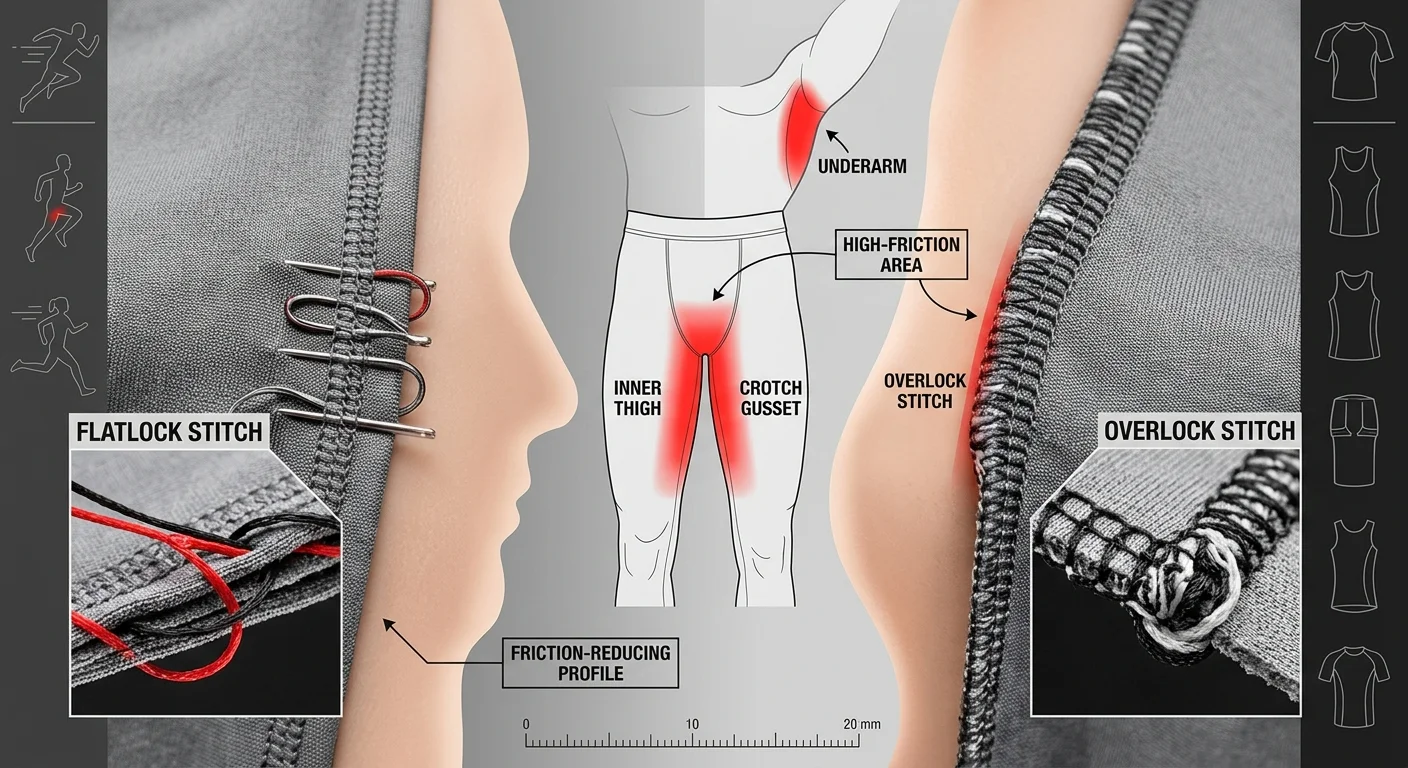
Flatlock removes that step entirely. Sportswear developers follow a practical rule: switch to flatlock wherever seam-to-skin pressure exceeds 5–7 kPa — inner leg, underarm, waist seams. Use overlock where pressure is lower. This isn't a style preference. It's an engineering decision.These engineering principles are especially important when developing custom compression garments for running teams, cycling clubs, and fitness brands.
3. Stretch Performance: Which Seam Moves With You?
Flatlock uses chain and cover-type stitch formations. These stretch with the fabric. Well-constructed flatlock seams hold up to ~120–150% extension without failure.
Overlock supports 110–130% — a bit less. The folded seam allowance concentrates stress at the fold during extreme extension. That's where it falls short.
For high-stretch compression zones (>30% elongation), flatlock is the right call . For moderate-stretch structural areas, overlock does the job fine.
4. Durability: The Trade-Off Nobody Talks About Upfront
Overlock is more forgiving. Its overlapping layers keep fabric held together even after stitches break. Flatlock failure works differently — once the chain unravels, the seam opens fast and far .
A well-tensioned flatlock on high-stretch knits reaches 80–90% of overlock's fatigue life . That's a real gap, but most wearers never hit that limit. The bigger risk is poor construction. A mis-tensioned flatlock unravels much faster than it should. That's why performance brands add bar-tacks at stress points — crotch intersections, pocket openings — wherever flatlock runs on skin-contact seams.
5. Production Cost: Why Not Every Brand Uses Flatlock
True flatlock needs specialized feed-off-the-arm machines — Yamato VG3721, Pegasus 4-needle units — priced at USD 4,000–6,000+ each. Standard factory-grade overlock machines run USD 800–2,500 . That equipment gap alone explains why flatlock is a specialty, not a standard factory offering.
The cost difference doesn't stop at machines. Flatlock operations produce 10–25% fewer pieces per hour than overlock. Thread consumption runs ~1.2–1.5× higher per seam . Put it together, and upgrading high-contact seams to flatlock adds USD 0.05–0.20 per garment . That sounds small. At high volume, it adds up fast.
6. Visual Aesthetics: The Seam You Can See
Flatlock creates a visible ladder or chevron pattern on both sides of the fabric. Panels meet edge-to-edge, and threads bridge the joint in plain sight. Many performance brands choose contrast-color flatlock thread on purpose. The seam lines become part of the visual design.
Overlock stays hidden inside the seam allowance. From the outside, you see a narrow ridge — functional, not decorative.
One key distinction to know : some factories fake flatlock by running a top-and-bottom coverstitch over an underlapping overlock seam . The surface looks close. The bulk and comfort do not match. True flatlock uses butt-joint construction. A brand that can't confirm that detail is most likely using coverstitch. That matters when you're comparing compression garment stitching types before making a purchase.
Why Flatlock Stitching Reduces Chafing in Compression Wear
Skin doesn't lie. After enough miles, enough pedal strokes, enough downward dogs, it shows you where your garment failed — and the damage follows the seam line.
The physics of chafing in compression wear are simple once you see them. Compression garments stay in continuous contact with skin. Running generates 160–180 steps per minute . That means an inner-thigh seam grinds through more than 10,000 rubs in a single hour of distance running. On a bike at 80–100 rpm, every pedal stroke creates micro-motion in the groin and seat zones — thousands of friction cycles per session. The seam isn't occasional contact. It's relentless contact.
What makes an overlock seam a problem in that environment is its shape. Folded seam allowance plus stacked fabric layers build a ridge that sits 1.5–3 mm above the fabric surface . Under compression fit, that ridge becomes a narrow pressure line. Every stride pushes it sideways across moist skin. Shear force concentrates along a tight, repeating path. The result: linear abrasions, redness, and in marathon contexts, bleeding along the seam line . Not from the fabric. From the ridge.
Flatlock removes that ridge. Fabric edges meet butt-to-butt — no overlap, no folded allowance, no stacked layers underneath. The seam profile drops to 0–0.5 mm . Contact pressure spreads across a wider, flatter area instead of focusing on one narrow line. Less height means less shear. Less shear means less abrasion.
Three flatlock stitch benefits make this work in compression wear:
Fewer layers at the join. One fabric layer plus thread, instead of two to three layers plus allowance. Less bulk means less edge stiffness pressing into skin.
Stretch compatibility. Premium compression fabrics contain 15–25% elastane . A flatlock seam stretches in sync with that. It moves with the body instead of sawing back and forth across it — which is what a stiffer overlock seam does under repeated extension.
Flat profile under pressure. Even compressed against skin at high tension, flatlock stays flush. There's no ridge to concentrate load.Achieving this level of seam precision requires a professional compression apparel factory equipped with true flatlock machines and experienced technical sewing teams.
Where This Matters on a Garment
Not every seam on a compression garment carries the same friction risk. Placement separates a functional flatlock decision from a marketing one.
Inner thigh and inseam — the highest-friction zone in running tights. Overlock seams here cause the majority of marathon chafe injuries on record. Flatlock seams at this location are the industry standard for chafe-free seam workout clothes built for distance running.
Crotch gusset — in cycling, an overlocked crotch seam creates a hard pressure point against the perineum under saddle load. Stacked layers plus sweat plus sustained compression leads to redness, raw skin, and localized swelling after long rides. A flatlock gusset seam keeps the join flat under that same saddle pressure. Point loading drops.
Underarm and armhole seams — overhead movements in yoga and HIIT drag a ridged armhole seam across axillary skin over and over. The irritation tracks the seam path directly. Flatlock here lies flat and stretches with the arm. The ridge that causes irritation is gone.
Shoulders and waistbands — lower friction than the zones above, but still in direct contact on every wear. Flatlock at these locations is standard in premium compression garment construction.
The manufacturing spec performance brands follow: six-thread flatlock at every high-friction zone — inner thigh, crotch gusset, underarm, shoulder yoke. This creates a full edge-to-edge join with balanced top and bottom thread structures that hold up under stretch. It's a single line in a tech pack. It's also the difference between a garment that performs at mile twenty and one that doesn't make it to mile four.
Best Seam Placement Strategy: Where to Use Flatlock vs Overlock on Compression Garments
The rule fits on a sticky note: flatlock where the body moves and sweats most, overlock everywhere else. Getting it right on an actual garment takes more precision than that.
Every compression garment has friction hotspots. Seam placement isn't about aesthetics or brand preference. It's about mapping those hotspots and assigning the right stitch to each one before anything gets cut.
Where Flatlock Belongs
These zones need flatlock on any well-built compression garment:
Inner leg and inseam — the highest-priority location. Non-negotiable on running tights and compression shorts.
Gusset and crotch panel edges — motion, heat, and sweat all meet here. A raised seam in this zone causes problems fast.
Underarm and armhole seams — arm swing repeats thousands of times per session. Flatlock stays flush through all of it.
Shoulder seams — critical on compression tops where panels cross the shoulder line under load.
Waistband junctions — elastic meets fabric here under sustained inward pressure.
Specify these in your tech pack as: flatlock, 12–16 SPI, 6-thread, true flatlock machine confirmed.These specifications are commonly included in private label compression wear product development to ensure consistent manufacturing standards across every production run.
Where Overlock Does the Job
Not every seam on a compression garment needs flatlock. These locations carry lower friction risk:
Outer side seams on leggings and shorts, with a design panel covering them
Back center seams on structured compression pieces where the seam path stays clear of primary movement zones
Broad structural joins where seam allowance bulk sits away from direct skin contact
Spec these as: overlock, 8–12 SPI, 4–5 thread.
The Cost Logic Behind Mixed Construction
Flatlock adds +20–45% unit cost and 10–30% more sewing lead time compared to overlock. Applying it everywhere isn't practical — or necessary. The smart approach uses flatlock at those five zones listed above. Overlock handles the rest. That split protects your margin without cutting corners on the seams that touch skin under pressure.
One verification step matters above all else: confirm the factory runs a true flatlock machine — not a coverstitch workaround — before you sign off on any premium compression garment spec.
Flatlock vs Overlock: Durability & Stretch Performance Under Compression
Compression fabric doesn't forgive bad seams. A typical compression tight runs 75–90% polyester with 10–25% spandex . That elastane content means every seam faces 80–120% elongation during a deep squat, a sprint, or a lunge. The stitching either keeps up with that stretch or it doesn't. No middle ground exists once fabric is under that kind of load.
How Each Seam Handles Stretch
Flatlock works because of its geometry. Two fabric edges meet butt-to-butt — no seam allowance, no folded layer underneath. The multi-thread ladder structure sits flat in the same plane as the fabric. The threads stretch with the fabric. Tensile load spreads across multiple parallel threads instead of piling up at a single fold. Specify 12–15 SPI on a flatlock seam and you get smooth, distributed extension with no gaping and no stress points.
Overlock behaves in a different way — and under high compression, that difference becomes a problem. The folded seam allowance plus the encasing looper threads build a layered structure that fights extension. Push the fabric past 80% elongation and you start seeing:
Edge roll
Seam cupping
Localized puckering
The seam holds together. It just stops moving with the body the way it should.Retailers and fitness brands sourcing technical apparel through a reliable compression wear wholesaler should also confirm the seam construction used before placing bulk orders.
Thread Count Changes the Equation
Not all flatlock is the same. 3-thread flatlock is the go-to standard for compression leggings and running tights. The extra thread adds density and abrasion resistance right where inner leg and gusset seams take the most beating. 6-thread flatlock is the spec premium brands choose for next-to-skin compression zones. It's stronger and less prone to pulling apart than a 4-thread overlock seam under long, high-stretch use.
What "Durable" Really Means Here
A seam can survive 50–100 wash cycles and still fail you. Overlock seams on marathon tights do exactly that. They hold together mile after mile, but generate enough friction to cause redness and raw skin along the inner leg. That's a seam that's intact but unwearable.
Flatlock's butt joint cuts edge roll risk under compression and extreme stretch. That's why performance brands require it for every high-contact zone. Not because overlock breaks — but because it chafes even when it doesn't.
How to Identify Flatlock Stitching Before Buying Compression Wear
Most compression garments look identical on the rack. The difference lives in the seams — and you can read them in under two minutes with your fingers and eyes.
Check the Inside First
Flip the garment inside out and run your fingertip along the inner thigh seam. That's your first data point.
What flatlock feels like: Near-flush with the surrounding fabric. You'll notice thread texture, but no step, no ridge, no raised edge. Seam thickness lands around 1.2–1.5× the base fabric — just a hair thicker than the panels on either side.
What overlock feels like: A distinct stacked ridge. Two or three fabric layers fold together, locked at the edge. Thickness hits 1.5–2× or more . You'll feel that step before you even look for it.
Repeat this at the crotch gusset and underarm seam. Those three zones are where flatlock matters most for chafe-free seam workout clothes . Find a hard ridge at any of those spots? The construction isn't built for distance.
Read the Stitch Pattern
Look at the seam on both sides of the fabric.
True flatlock uses a 4-needle, 6-thread structure . It shows 2–4 parallel stitch lines spread across a 6–10 mm width . Flip it over — the back shows a continuous ladder or mesh pattern that bridges both fabric edges. No separate serged thread loop. No folded allowance tucked to one side.
Overlock combined with coverstitch looks close on the surface. The back gives it away, though. Look for a visible serged edge loop and a fold of fabric pressed to one side. That's two separate operations, not one integrated flatlock seam.
Don't Trust "Flat Seam" Labeling Alone
This is where most buyers get misled.
Tags that read "flat seams" or "flat-stitched construction" don't guarantee true flatlock. That language often describes an overlock seam with a coverstitch pressed over the top. The seam allowance is still there — just flattened down. The internal layers remain. The friction risk remains.
The labels worth trusting: "flatlock stitching" or "4-needle 6-thread flatlock." A brand that can't confirm the machine type behind the construction? Assume it's a coverstitch workaround.
The cost gap explains why. Dedicated flatlock machines run USD 4,000–6,000+ . Standard overlock machines cost USD 800–2,500 . Not every factory invests in the difference.
Quick Buyer Checklist
Run through these five checks before buying any compression garment:
Inner seam structure — Can you see a folded seam allowance? Yes means overlock.
Stitch width and line count — 2–4 parallel lines across 6–10 mm is the flatlock signature.
Back-side appearance — A continuous mesh pattern with no single-side serged ridge means flatlock.
Pinch test — Seam thickness more than 50% above base fabric and stiff to the touch? Overlock. Around 20–30% thicker and still pliable? Flatlock.
High-friction zones — Inner thigh, crotch gusset, underarm. All three must pass. Fail any one of them, and the rest of the garment doesn't matter.
Flatlock vs Overlock for Specific Compression Wear Types
Each garment type puts its own demands on seams. A compression top used in a HIIT circuit is a different challenge from cycling shorts worn for three hours on a saddle. The seam that holds up in one context breaks down in another. Here's how the choice splits by garment type — and by the sport you're doing.
By Garment Type
Compression leggings have the least room for overlock seams. The inner thigh and crotch face constant friction. Target seam height here is ≤0.5 mm — that means 4–6 thread flatlock with 0–3 mm seam allowance. Go wider and you lose stretch. You also concentrate pressure in the wrong place. One spec worth noting: no front rise seam at the crotch. Leggings built without a center crotch seam cut out an entire friction line from the start.
Compression shorts follow the same logic at the inner leg and gusset. Overlock works fine on outer side panels — those panels don't press against skin under load. Keep overlock off every surface that contacts the groin and upper thigh.
Compression tops give you more room to work. Use flatlock at the underarm, side panels, and shoulder yokes — anywhere arm movement repeats and fabric rubs across skin. Center front and back seams, plus neckline binding, handle overlock without a problem.
Sports bras split the job into two clear zones. Structural seams — underbust band attachment, cup support — need the holding power of reinforced overlock or multi-needle coverstitch. Internal liner seams and any side seam that presses against skin under band pressure need flatlock or bonded tape. Keep those under 0.5 mm.
By Sport
Sport | Flatlock Required | Overlock Acceptable |
|---|---|---|
Running | Inner leg, crotch, gusset | Side seams, waistband |
Cycling | All saddle-contact zones | Outer leg, bib straps |
CrossFit / HIIT | Hip, knee, crotch flex points | Pocket edges, decorative panels |
Yoga | Inner leg, side seams | Lower-load structural seams |
Basketball | Inner leg, crotch | Outer side seams |
The pattern stays the same across every sport. High friction plus sustained compression means flatlock. Overlock carries structural load well — it just doesn't belong anywhere skin and seam stay in continuous contact under pressure. Map those zones first. Then spec the stitch.
FAQ: Quick Answers to Common Questions About Compression Wear Stitching
These five seam questions come up all the time. Here are straight answers.
Q: Is flatlock stitching worth the extra cost in compression wear?
For long runs or extended activity, yes. Flatlock adds about 5–10% to manufacturing cost . But it cuts seam bulk by 30–50% and drops skin pressure at the seam line by 2–3 mmHg compared to overlock. At mile fifteen, that difference is real.
Q: Can overlock stitching cause skin irritation?
It can. Overlock ridges stand 1.5–3 mm high and trap sweat underneath. In garments with 20–30 mmHg compression , skin contact over 2–4 hours raises the risk of heat rash and contact dermatitis. The inner thigh and waistband are the most common trouble spots.
Q: What's the difference between true flatlock and flatlock-look seams?
It comes down to construction. True flatlock joins fabric edges side by side using 4–6 threads . Seam thickness stays under 1 mm , and the stretch matches the base fabric. Flatlock-look seams just topstitch over a standard seam. The ridge and bulk underneath stay put. The surface looks close. The performance gap is wide.
Q: Do compression shorts use flatlock or overlock?
Most compression shorts under $50 use 3- or 4-thread overlock from top to bottom. Flatlock shows up in premium lines, and mostly in high-friction panels only. You start seeing shorts built with full flatlock construction at the $60–80 price point of compression shorts . That's where longer sewing time gets built into the unit cost.
Q: Does seam type affect how compression fits?
Yes — more than most labels will tell you. Rigid overlock seams can push local compression 2–5 mmHg above the intended pressure level. That creates visible marks and joint wrinkling. Flatlock keeps pressure distribution close to the target 15–30 mmHg range across the full seam length.
Conclusion
The seam on your compression tights isn't a small detail. It's the difference between a workout you grind through and one you enjoy.
Here's what matters: flatlock stitching lies flat against your skin. It removes the raised ridges that cause chafing on long runs, cycling sessions, or back-to-back training days. Overlock works fine in regular garment construction. But fabric pressed against your body for hours is a different story. At that point, the seam type becomes a comfort decision — not a technical one.
Before your next purchase, flip the garment inside out. Run your finger along the seams. Raised and bulky? Your skin will feel every ridge by mile six.
At berunactivewear , every compression piece comes with flatlock stitching built in. We treat seam quality as a standard — not an upgrade you pay extra for.
Your skin will thank you after the first wear.