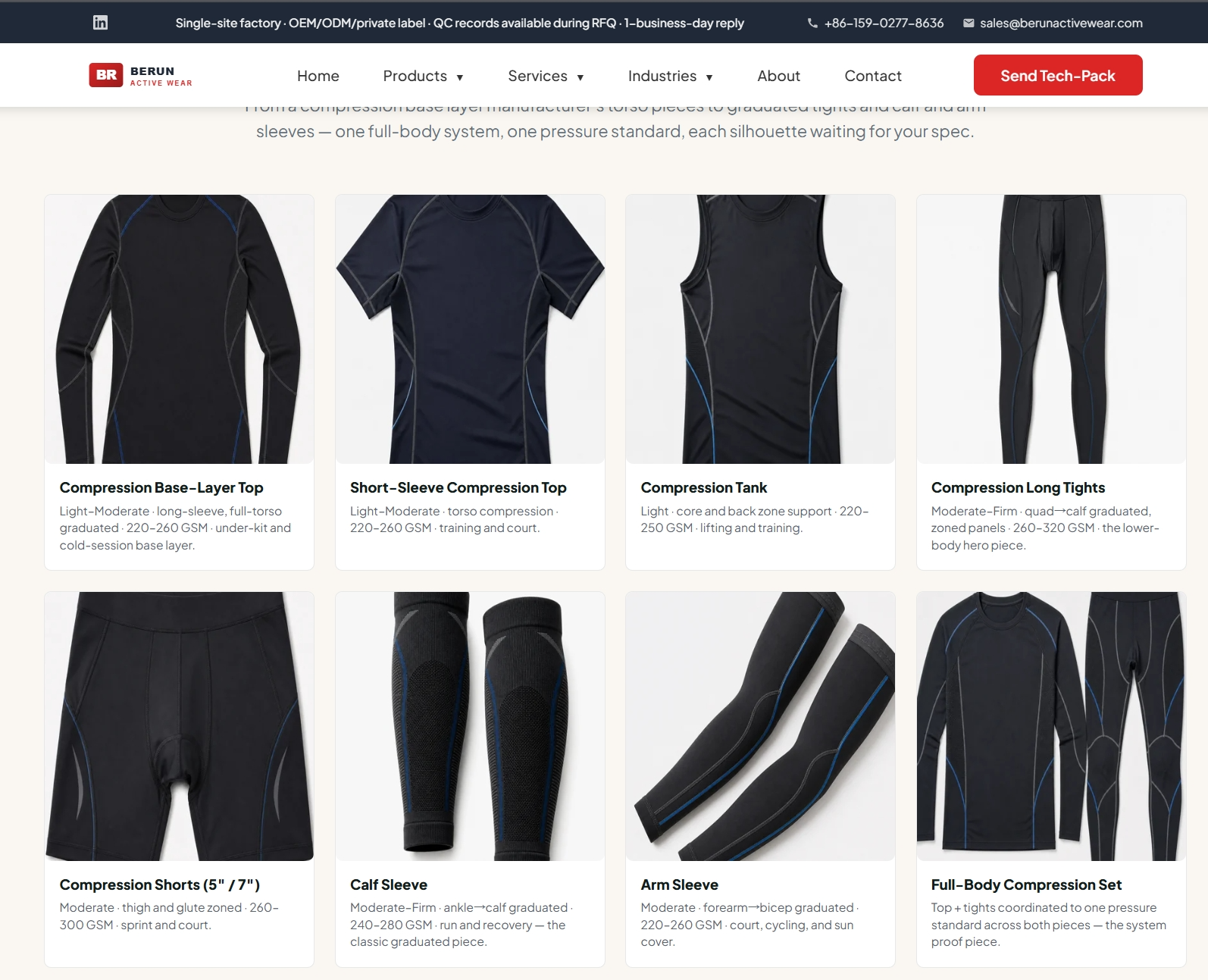
Try on compression tights that feel like a second skin. Then try ones that bunch, sag, or trap heat after ten minutes. That contrast alone will change how you think about fabric choice forever.
The real difference comes down to what's woven into the material: the spandex ratio, the fiber blend, the knit structure. Most shoppers — and plenty of buyers sourcing athletic compression fabric at scale — skip this and choose based on price or brand alone.Many brands developing custom compression clothing start by comparing fabric performance, not logos.
This guide changes that. By the end, you'll know:
Which fabrics deliver genuine graduated compression
Which blends perform best for breathability and moisture control
How to match the right textile to your sport, body type, and performance needs
What Makes a Fabric "Compression-Ready": The 3 Non-Negotiables
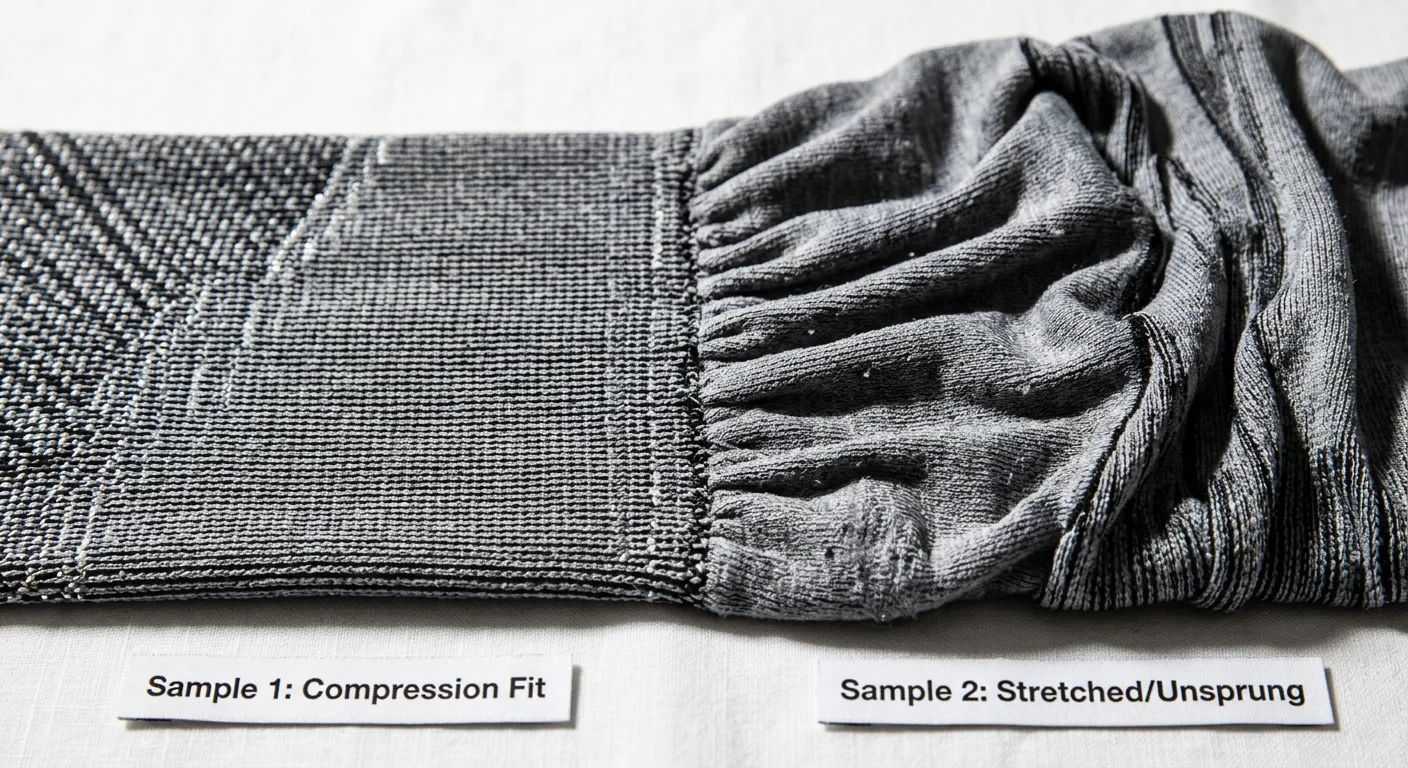
Not every stretchy fabric is a compression fabric. Most people don't realize how big that difference is.
A fabric earns "compression-ready" status by meeting three hard requirements — not two, not two-and-a-half. Miss one, and you're wearing glorified spandex leggings, not engineered athletic compression fabric.
#1: Precise, Measurable Pressure — Not Just "Tight"
Compression is a number. It's measured in mmHg (millimeters of mercury) — the same unit used in blood pressure readings. A fabric without a documented pressure output isn't compression wear. It's activewear with ambitions.
Here's what the pressure tiers look like in practice:
10–15 mmHg — light compression, suited for recovery and all-day wear
15–25 mmHg — medium compression, the sweet spot for training and competition
25–30 mmHg — firm compression, used in powerlifting and lower-range medical garments
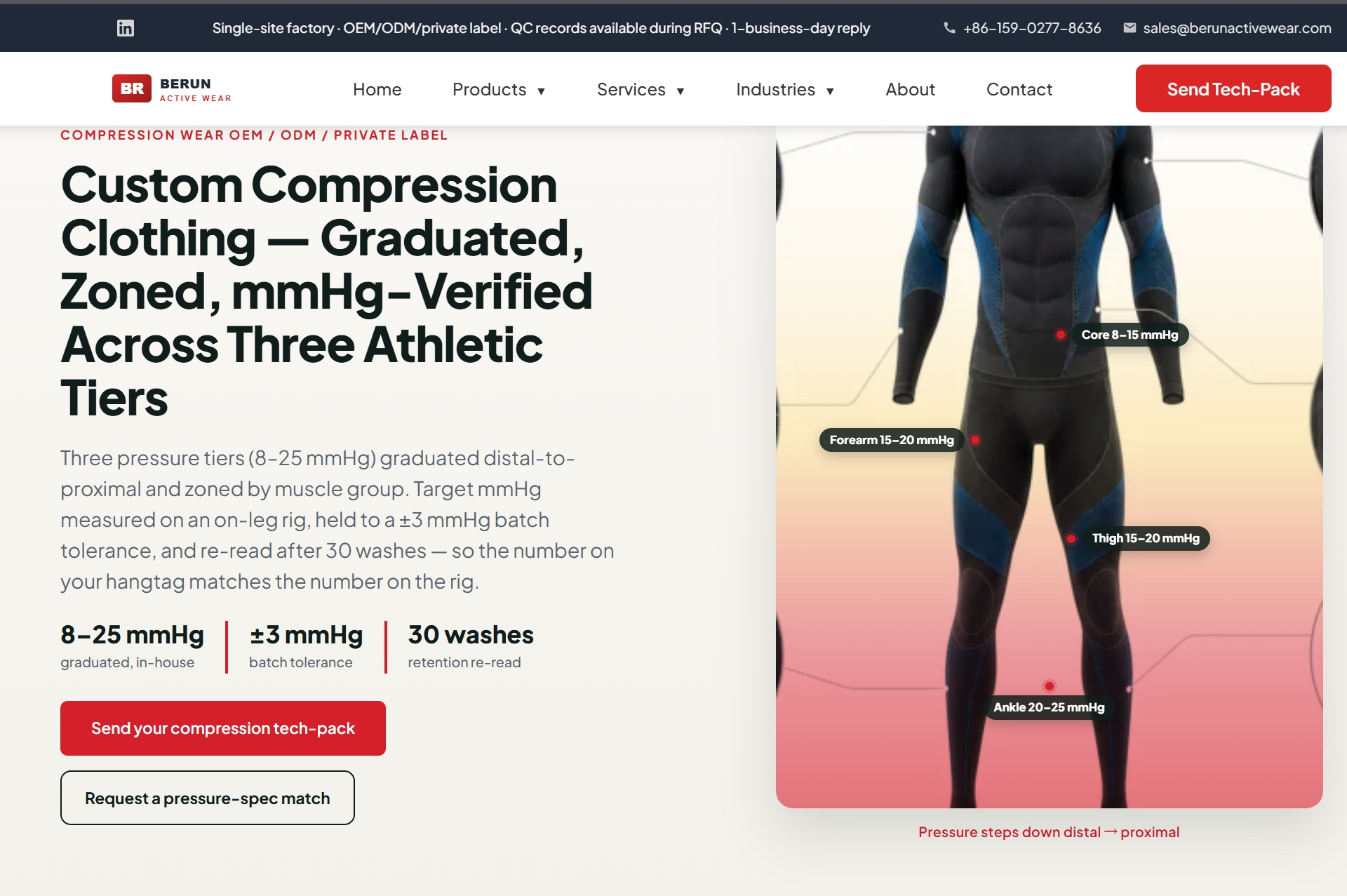
Hitting those numbers takes controlled spandex content — 20–30% of the total fiber blend. High-accuracy compression wear manufacturers hold spandex variance to ±2% per batch . The industry standard sits around ±5%. That gap creates inconsistent pressure across garment sizes.
Stretch-recovery is the other half of this equation. A compression-ready fabric must return to near-original length after repeated use. The benchmark: ≥90–95% length retention after 50–100 full-stretch cycles . Any fabric that stretches out beyond 10% and stays there has already failed.
#2: Recovery and Durability That Outlasts the Workout
A fabric that compresses on day one but loosens by week six isn't a compression fabric — it's a countdown timer.
GSM (grams per square meter) is the structural tell:
150–200 GSM — lightweight, breathable; good for running and recovery
180–250 GSM — standard range for performance tights and base layers
220–280 GSM — heavy-duty builds for powerlifting or high-contact sports
Hold your compression wear suppliers to these durability targets: ≥90% initial compression retained after 50+ wash cycles , with elastic fatigue testing showing ≤5–8% residual elongation after 1,000 stretch cycles. Heat is the silent killer here. High-heat drying breaks down elastic fibers faster than washing frequency does.
#3: Engineered Construction — Graduated, Zoned, and Consistent Across Sizes
This is where most off-the-shelf fabrics fall apart under scrutiny.
True graduated compression fabric doesn't push uniform pressure from ankle to thigh. It delivers more pressure at the ankle and less toward the calf and thigh — a measurable 20–30% higher mmHg at the ankle versus upper calf in functional compression socks and sleeves. Flat pressure readings along the leg are a red flag, not a feature.
The construction method behind this: controlled spandex ratios combined with engineered panel construction and precise size grading . Innovations like Liquid Lycra go further. Lycra goes onto the fabric to build defined compression zones that stretch less and hold more — no extra panels, no added bulk.Reliable compression garment OEM services depend on this level of production consistency.
Consistency is non-negotiable for anyone sourcing at scale. An S and an L garment should deliver similar mmHg profiles , scaled to limb circumference. That requires spandex variance held within ±2% across the entire production batch .
The compression-ready checklist in short:
Metric | Benchmark |
|---|---|
Spandex content | 20–30%, ±2% batch variance |
GSM range | 150–280 depending on use case |
Stretch recovery | ≥90–95% after 50–100 cycles |
Pressure output | Documented mmHg per size, graduated profile |
Wash durability | ≥90% compression retention after 50+ washes |
A fabric that can't be checked against these numbers isn't compression-ready — no matter what the label says.
Head-to-Head: Nylon vs. Polyester vs. Cotton-Spandex Compression Fabric Comparison
Three blends dominate the compression wear market. Each one makes trade-offs. Know what those trade-offs are before you buy or source. That's the difference between a garment that works and one that just looks like it should.
Nylon–Spandex: The Premium Performer
The standard blend sits at 70–80% nylon / 20–30% spandex . That high spandex ratio is why nylon-spandex sits at the top of compression performance benchmarks.
What it does better than anything else:
- Stretch and recovery. Nylon-spandex rebounds faster and more fully than the other two blends. Repeated stretch cycles don't flatten the compression profile the way lower-spandex blends can.
- Handfeel. Users describe it as "silky smooth." That tactile quality makes nylon compression gear feel premium, not just functional. It also has less shine than untreated polyester — a plus for anyone put off by a plasticky look.
- Abrasion resistance. Nylon fibers are tough. High-friction zones — inner thighs, knees — hold up longer than comparable polyester builds.
Where it falls short:
- Moisture. Nylon absorbs a small amount of water. It wicks and dries faster than cotton, but slower than polyester. Back-to-back training sessions, hot yoga, long runs in humid conditions — nylon users often report a slightly damp feeling between sets.
- Chemical sensitivity. Chlorine breaks down nylon fibers over time. Pool workouts and frequent harsh-detergent washing will cut the garment's lifespan short.
- Cost. Nylon fiber costs more than polyester. That difference shows up in the finished compression wear garment price.Many compression clothing wholesalers favor nylon-spandex for premium collections.
Best for: Performance sports compression, medical-adjacent garments, premium product lines where handfeel and brand positioning matter.
Polyester–Spandex: The Workhorse Blend
Target blend: 80–90% polyester / 15–20% spandex . The spandex ratio is lower than nylon blends. But that's a deliberate trade-off — polyester's fiber properties make up for it in ways that count for high-output use.
Where polyester-spandex wins outright:
- Moisture management. Polyester fibers are hydrophobic. Sweat moves through the fabric and evaporates instead of sitting against the skin. In side-by-side testing, polyester compression tights dry faster than nylon and far faster than cotton blends. For high-sweat sports, this isn't a minor edge — it's the deciding factor.
- Durability. Polyester–spandex compression fabrics show little fade, resist shrinkage, and hold their structure through repeated wash cycles better than either alternative. Chemical and chlorine resistance is much higher than nylon-spandex.
- Cost efficiency. This blend powers most mass-market compression tights and team sports gear. Strong performance, strong durability, lower price point.
Where it concedes ground:
- Handfeel. It feels crisper and less buttery than nylon. Many manufacturers fix this by peaching or brushing the surface — a finishing step that cuts sheen and softens the feel without hurting structural performance.
- Breathability under heat. Heavy GSM polyester knits can trap heat in hot conditions. Moisture-wicking offsets the warmth, but it's worth flagging for buyers targeting tropical markets or hot indoor environments.
Best for: High-sweat training, team sports uniforms, outdoor endurance events, frequent-wash commercial applications, budget-conscious sourcing without giving up compression function.
Cotton–Spandex: The Comfort Option (With Real Limits)
The typical blend: 90–95% cotton / 5–10% spandex . That spandex percentage tells you almost everything about where this blend sits in the compression hierarchy.
At 5–10% spandex, you're in comfort-stretch territory, not performance compression territory. The numbers make it clear:
Metric | Cotton–Spandex Reality |
|---|---|
Spandex content | 5–10% — below performance compression threshold |
Moisture behavior | Hydrophilic — holds sweat, dries slowly, gets heavy |
Recovery | Lower bounce-back than either synthetic blend |
Durability | Shrinks, fades, degrades faster under heat/wash |
Handfeel | Soft, familiar — the one area where cotton wins |
Under intense activity, cotton-spandex garments get heavier and clingy as they soak up sweat — the opposite of what you want from athletic compression fabric. Once wet, the fabric that felt breathable turns clammy fast.
Where cotton-spandex still has a real place: everyday fashion leggings, casual athleisure, light recovery wear, and any context where natural-fiber feel and moderate compression matter more than technical performance.
The Decision Matrix
Nylon–Spandex | Polyester–Spandex | Cotton–Spandex | |
|---|---|---|---|
Compression strength | ★★★★★ | ★★★★☆ | ★★☆☆☆ |
Stretch & recovery | ★★★★★ | ★★★★☆ | ★★★☆☆ |
Moisture wicking | ★★★☆☆ | ★★★★★ | ★☆☆☆☆ |
Breathability | ★★★☆☆ | ★★★☆☆ | ★★★★☆ |
Durability | ★★★★☆ | ★★★★★ | ★★☆☆☆ |
Handfeel | ★★★★★ | ★★★☆☆ | ★★★★☆ |
Cost efficiency | ★★★☆☆ | ★★★★★ | ★★★★☆ |
The short version: pick nylon-spandex for maximum compression with a premium feel. Go with polyester-spandex for high-sweat performance and long-term durability. Choose cotton-spandex for casual comfort — and only when performance isn't what you're asking from the garment.
Best Compression Fabrics by Use Case: Matching Material to Sport & Purpose
Fabric choice isn't universal — it's situational. That nylon-spandex blend keeping a triathlete's legs fresh at mile 80? It would be overkill — and stiff — on a yoga mat. Here's how to match material to mission.
Endurance Running & Cycling
Long miles need fabrics that hold their shape and manage heat at the same time. For tights and shorts, 75–80% nylon / 20–25% spandex gives you the abrasion resistance you need across high-friction zones.
In hotter conditions, shift to 80% polyester / 20% spandex . The hydrophobic fibers push sweat out faster. That keeps the fabric lighter as miles pile up.
Target 14–20% spandex (power stretch range) for sustained quad and calf support. Pressure-wise, aim for 15–25 mmHg at the ankle , graduated upward.
Research backs this up. Lower-body compression garments show measurable gains in muscle force recovery within 24–48 hours post-effort, compared to non-compression controls.
One construction detail worth noting: circular knit or warp-knit with 4-way stretch conforms to joint curves. It does this without creating pressure points on long efforts.
Strength Training & Powerlifting
The goal here shifts from moisture management to mechanical containment . Heavy loads produce muscle oscillation — those micro-vibrations that speed up fatigue. Stopping that takes high-modulus fabrics with real resistance to extension.
Minimum spec: 15% spandex , with 20% being the better target, in a 300–350 g/m² knit . The higher GSM is deliberate — thicker knits contain more and move less.
Stretch ratio targets to aim for: ~120–130% extension in both width and length . That's not the full-range snap you'd find in a running tight. Pressure in this range often hits 20–30 mmHg — the same borderline medical range used in high-performance recovery gear.
Team Sports: Soccer, Basketball, Rugby
Compression shorts and sleeves for team sports face one challenge lab benchmarks often miss: the laundry cycle . A compression short that bags out after 30 washes is dead weight by midseason.
Go with nylon–spandex blends at 15–20% spandex . Nylon holds its edge over polyester right here — it maintains compression recovery better through 50+ wash cycles .
For leg sleeves and shorts, choose denser, thicker knits. Upper-body compression tops can run a bit lighter while keeping the same spandex percentage. Build in ventilation zones where heat builds up.
Recovery Garments & Compression Socks
Recovery wear follows its own pressure rules. Light recovery sits at 10–15 mmHg . Moderate venous support moves to 15–20 mmHg . Serious post-race recovery tights target 20–30 mmHg — at that range, precise sizing isn't optional. It's structural.
Fiber choice branches by climate:
- Hot conditions → microfiber polyester-spandex (CoolMax® style) for rapid drying
- Cold weather → wool + nylon + spandex blends for insulation without losing compression
- Sensitive skin → soft cotton-blend with seamless construction
Graduated knit structure matters more than fiber type for recovery function. To execute it well, you need ≥20% elastane and high-precision knitting.
Low-Impact Sports: Yoga, Pilates, Dance
True compression isn't always the goal. Forcing it where it doesn't belong creates garments that restrict rather than support. For yoga and dance, 2–8% elastane gives you freedom of movement without circulatory pressure.
For targeted zones — waist, calves — integrate panels at 15–20% spandex . Keep the rest of the garment lighter.
Soft blends lead this category: cotton 90–95% / spandex 5–10% or modal / viscose 90–95% / spandex 5–10% . Both are breathable, gentle against skin, and built for hours of wear.
Quick Elastane Reference
Spandex % | Performance Level | Best For |
|---|---|---|
2–5% | Comfort stretch | Fitted athleisure, yoga tops |
10–14% | Mild compression | Light support, casual running |
14–20% | Power stretch / true compression | Most sports tights, sleeves, socks |
20–30% | High compression | Recovery gear, medical-sport crossover, race suits |
The elastane percentage is your fastest shortcut to knowing whether a garment will compress — or just cling.
How to Read a Compression Fabric Label: Practical Buying Checklist
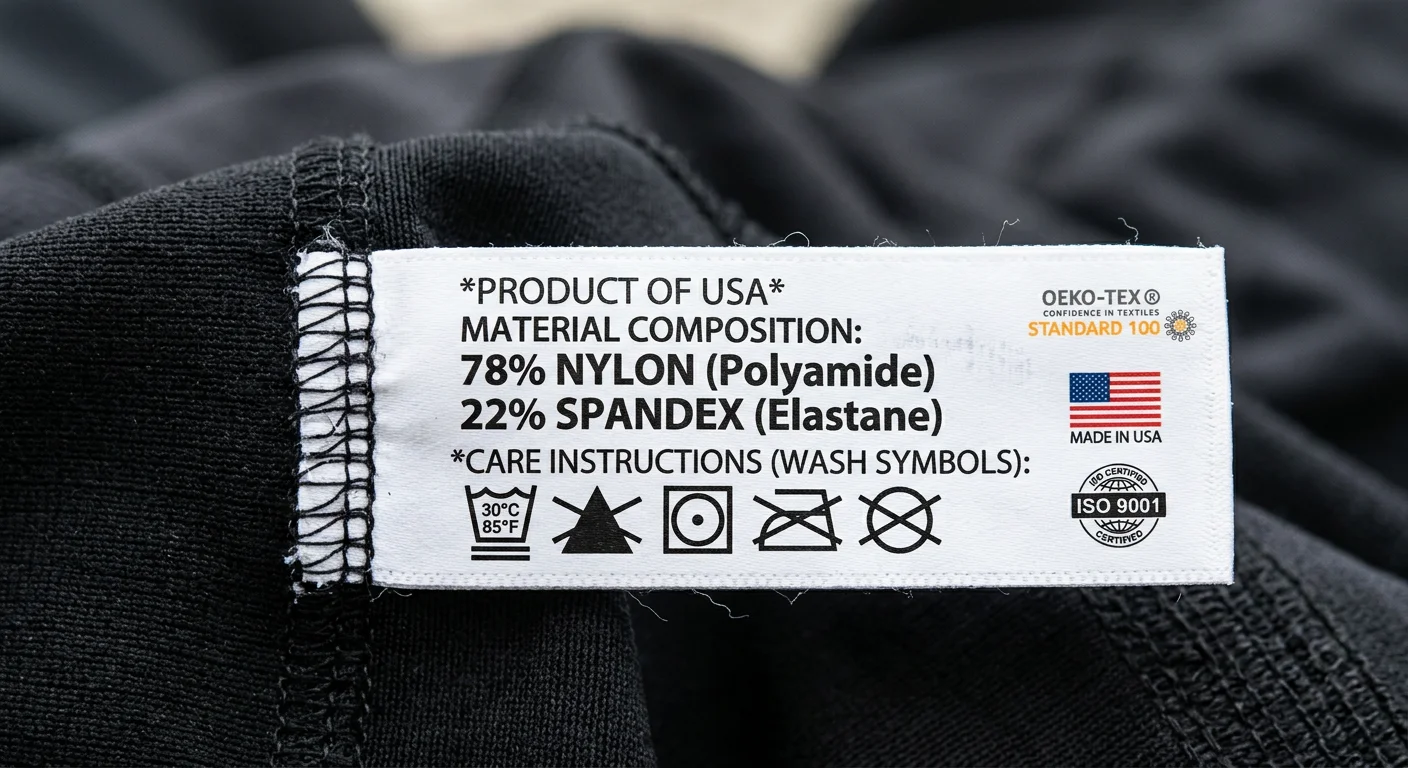
The label sewn into your compression gear is the one part of the garment that can't lie to you — as long as you know what you're looking at.
Most people glance at the fiber list and move on. That's a mistake. The composition line is where you tell a genuine athletic compression fabric apart from a stretchy legging with clever marketing copy stitched onto it.
The 10-Second Store Check
Run this sequence before anything else:
Find the composition line — the one listing specific percentages, not just names
Spot the elastane or spandex number — this shows you the compression potential right away
Check whether nylon or polyester dominates — this tells you about durability and how fast it dries
Read the wash and dry symbols — compression fabrics break down fast in high heat
Look for OEKO-TEX Standard 100 or GOTS if the seller is making any sustainability claim
That's it. Five steps. Done in under a minute.
What Each Label Element Tells You
Fiber percentages: Read the numbers, not the names. A label that says "nylon-spandex blend" without percentages gives you nothing useful. A label that says 78% nylon / 22% spandex puts the garment at a clear point on the compression spectrum. You know what you're buying.
Elastane/spandex share: Higher percentage means stronger compression hold and better shape recovery. Under 10%? That's comfort stretch, not true compression. The 18–22% range is where four-way stretch fabric starts earning its label.
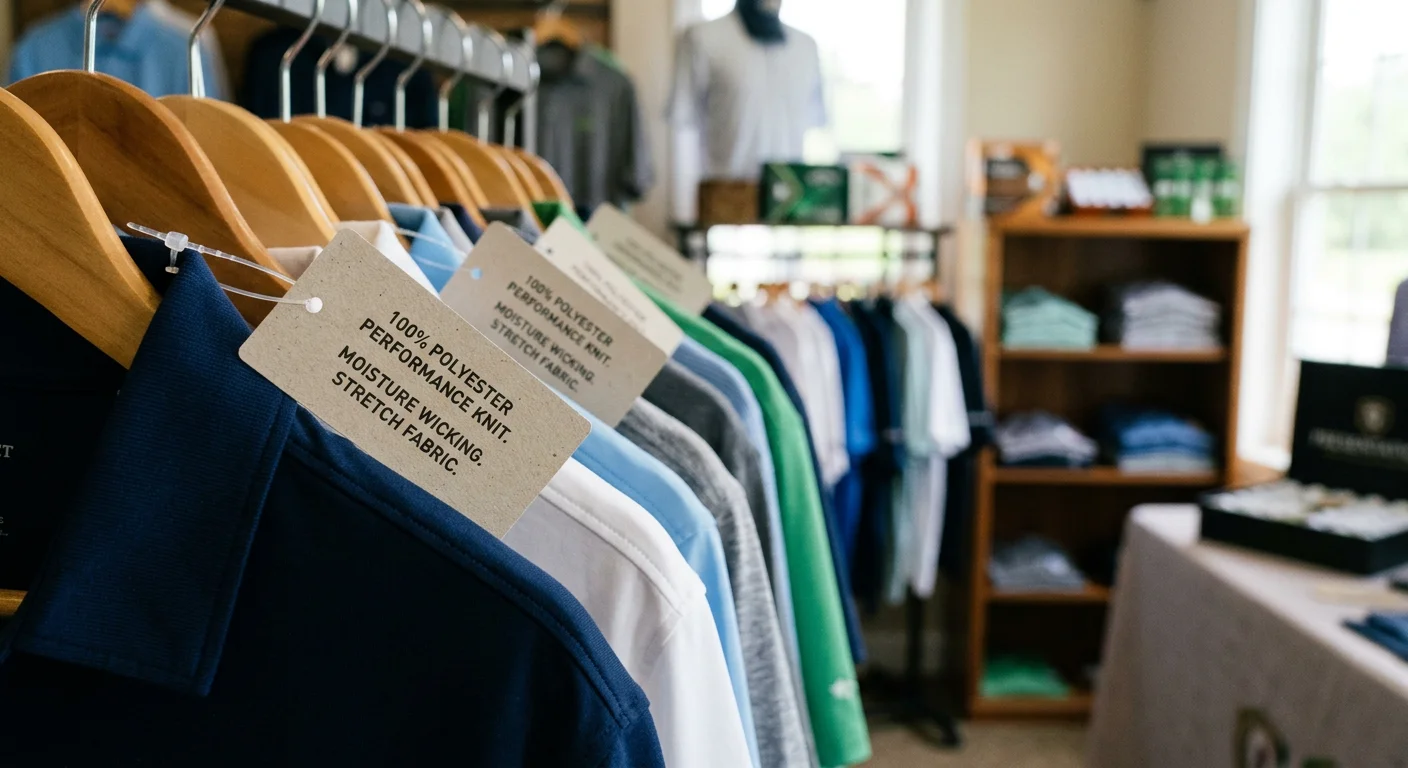
Polyester or nylon dominance: Both dry fast and hold up well. A polyester-dominant outer fiber gives you strong moisture-wicking performance and solid wash durability. Nylon-dominant fabrics feel softer against the skin and resist abrasion better.
Care symbols decoded:
- Washtub with one line underneath = gentle cycle
- Dots inside the washtub = temperature (1 dot cold, 2 warm, 3 hot)
- Square with a circle = tumble dry; an X means skip the dryer
- Iron with one dot = low heat only
For lycra compression wear and nylon elastane blends: cold wash, no tumble dry . That's the rule that keeps garments lasting longer.
Red Flags Worth Knowing
Skip any compression garment whose label shows:
Missing percentages — "blend" with no breakdown is incomplete disclosure
"Eco" or "sustainable" wording with no GOTS or OEKO-TEX certification to back it
Cotton above 60% in a product marketed as performance compression — the spandex ratio won't be high enough to deliver real graduated compression fabric behavior
Delicate care only on a garment you plan to wash twice a week — those fabrics won't hold up to your training schedule
The fiber content line is factual. The marketing copy above it isn't always. The two sometimes conflict. Trust the numbers.
FAQ: Common Questions About Compression Wear Fabric
Here are the answers to the questions that come up most often — direct, no fluff.
How tight should compression wear feel?
Snug and firm, not painful. You should feel a clear, noticeable squeeze — that's the point. What you shouldn't feel: numbness, tingling, or skin going pale or purple. Those are signals the pressure is too high for your size. A good-fitting garment lets you walk, sit, and breathe with ease. It still feels like something is working on your legs — that's normal.
How long before compression fabric stops working?
Three to six months of regular use, with proper care. The telltale sign it's done: the garment slides on easier than it used to. That ease isn't a feature — it's the elastic giving out. Check for two things: the fabric no longer hugs with firm pressure, or you see visible wrinkling in zones that used to be taut. Either one means it's time to replace it. Don't wait for the swelling to come back. The fabric is already telling you.
Can I sleep in my compression wear?
Standard daytime compression garments? No. Remove them before bed. Two exceptions exist:
- Nighttime-specific garments made for lying down
- Garments a clinician prescribed for 24-hour wear
Wearing regular compression socks to bed adds no recovery benefit. Your body doesn't need circulatory support while lying flat. It's just extra pressure with no upside.
What mmHg level is standard for athletic socks and sleeves?
20–30 mmHg is the go-to range for most performance and recovery use — calf sleeves, compression socks, arm sleeves. Products in the 15–20 mmHg range work well for travel, long workdays, or low-intensity use. Drop below 15 mmHg and you're in comfort stretch territory. That's not true compression.
What's the right way to wash compression fabric?
Wash after every use. Use cool water, a gentle cycle or hand wash, and mild detergent. Skip the fabric softener. It coats elastic fibers and breaks down compression performance over time — use after use, wash after wash. No tumble drying on heat. Air-dry flat or hang instead. That one habit — skipping the dryer — does more to extend garment life than any other care choice you can make.
What spandex percentage do I need?
For true athletic compression, 18–20% minimum . Below 10%, you get comfort stretch — fine for yoga, not useful for graduated compression. Medical and recovery garments push toward 20–30% spandex. They also use tighter knit structures to hit specific mmHg targets at a consistent level across all sizes.
Conclusion
Fabric isn't a footnote in compression wear — it's the whole story.
Chasing a marathon PR? Sourcing your next activewear line? Or just fed up with compression tights that go slack after six washes? The material underneath it all decides whether you get genuine support or just the illusion of it. The right spandex compression fabric ratio holds your muscles in check. The right moisture-wicking compression material keeps you moving when discomfort would pull you out.
Here's the short version:
Nylon-spandex leads for performance durability
Polyester-spandex wins on budget and sweat management
No single fabric does everything — context decides the winner
Building or buying compression wear that performs? Don't guess at the fabric spec sheet. Use this guide as your filter instead.
Ready to manufacture compression wear that checks every box? Start a conversation with Berun's team — the right fabric partnership starts here.