You've probably already spent hours scrolling through Alibaba listings, DMing factories that never reply, or getting quoted MOQs that make zero sense for your order size. We get it. We've walked 50+ brand founders through exactly this maze, from first-time sellers testing 300 pairs to established labels scaling into the thousands. The hard part is finding a manufacturer that won't ghost you after the deposit, fumble your tech pack, or hand back samples that look nothing like your mockup. That's where deals fall apart.
This guide gives you a day-by-day production timeline, the exact questions to fire at any activewear manufacturer before wiring a cent, and three distinct paths for orders of 50 pairs or 5,000. No history lessons. Just the checklist, the numbers, and the script for your next factory call.
The Complete Custom Yoga Pants Production Timeline (Day-by-Day Breakdown)
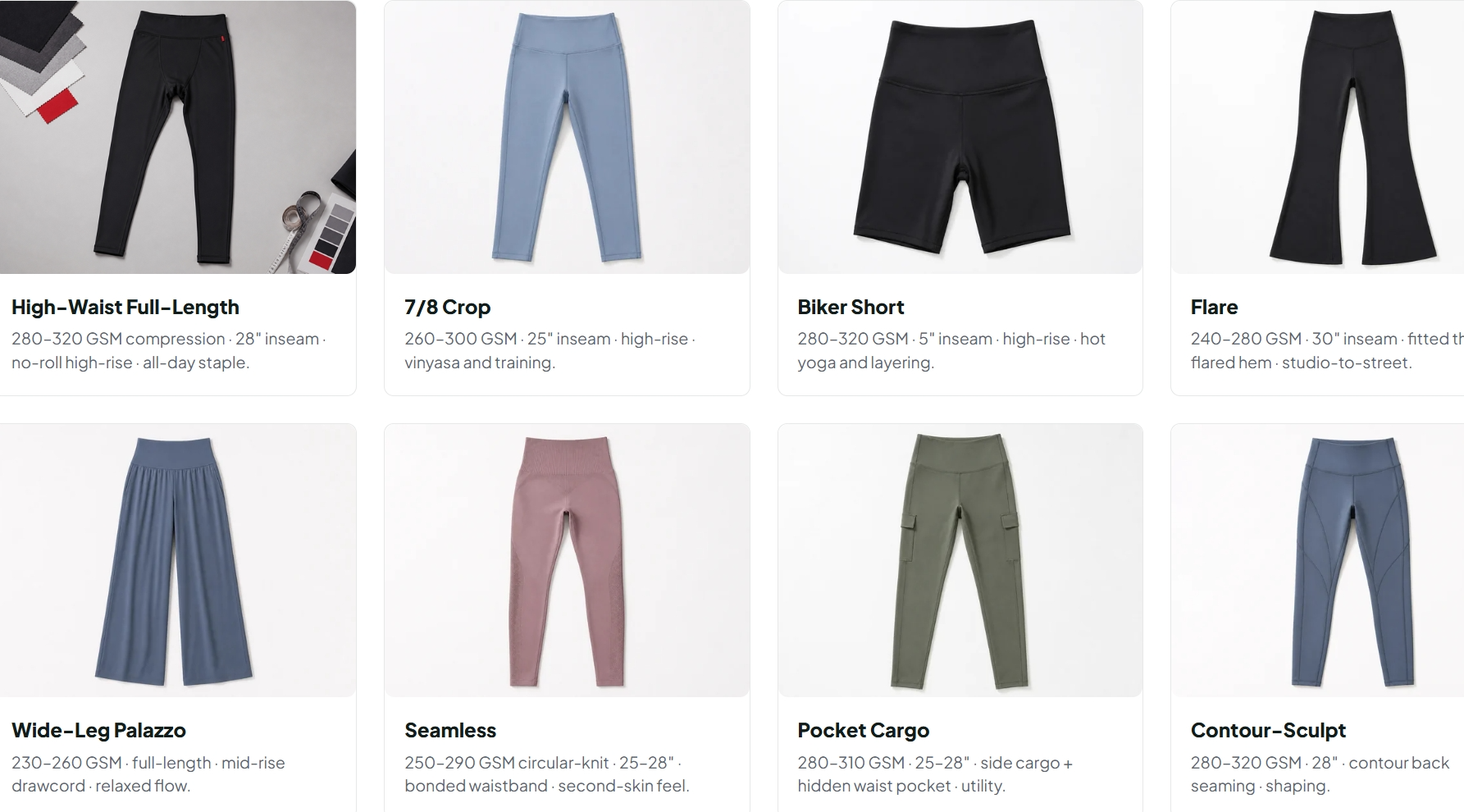
Thirty-five days is the fastest we've seen from first email to boxes on your doorstep, and it only happens when every stage runs clean. More often, you're looking at 45-60 days end-to-end. Here's how the calendar breaks down when you're working with an overseas activewear manufacturer.
Days 1-7: Brief, Tech Pack, Costing
You send reference styles, fabric specs (usually 250-280 gsm nylon-spandex, 20-25% spandex blend), and logo files. A responsive OEM yoga pants factory replies within 24 hours with MOQ terms, typically 100-300 pieces per color per style, plus indicative pricing. You also finalize the tech pack, including size grading, seam placement, waistband height, and stitching type. This whole phase runs 3-7 days.
Days 8-20: Sampling
Pattern making and cutting take 2-3 days, sewing the first prototype another 1-2. Your custom seamless leggings manufacturer ships that sample via express (3-5 days). You fit-test it in an actual yoga session, wash-test for shrinkage, then send revision notes. Expect a second sample and final approval somewhere between day 16 and 20. Faster shops compress this to 12-15 days flat.
Days 21-27: Fabric & Pre-Production Sample
Stock fabric orders take 2-4 days; custom Pantone-matched colors add another 4-8 days for lab dips. The pre-production sample, made on bulk fabric on the actual line, becomes your golden sample reference. This stage runs 3-7 days.
Days 28-40: Bulk Cutting, Sewing, Printing
Cutting is quick, usually a single day. Sewing takes the most time, 15-25 days for a typical run, though some yoga wear wholesale suppliers quote 15 days best-case. Logo printing or heat-transfer adds 5-8 days if you're not integrating it into the sewing window.
Days 43-47: QC and Packing
Formal AQL 2.5 inspection checks measurement tolerances (±1cm waist/hip), seam strength, color shading. Packing, including ironing, polybagging, cartons, and pallets, takes another 3-5 days.
Shipping : air freight adds 5-10 days door-to-door; sea freight adds 25-40 days but cuts cost significantly.
3 Popular Provider Paths for Different Order Sizes
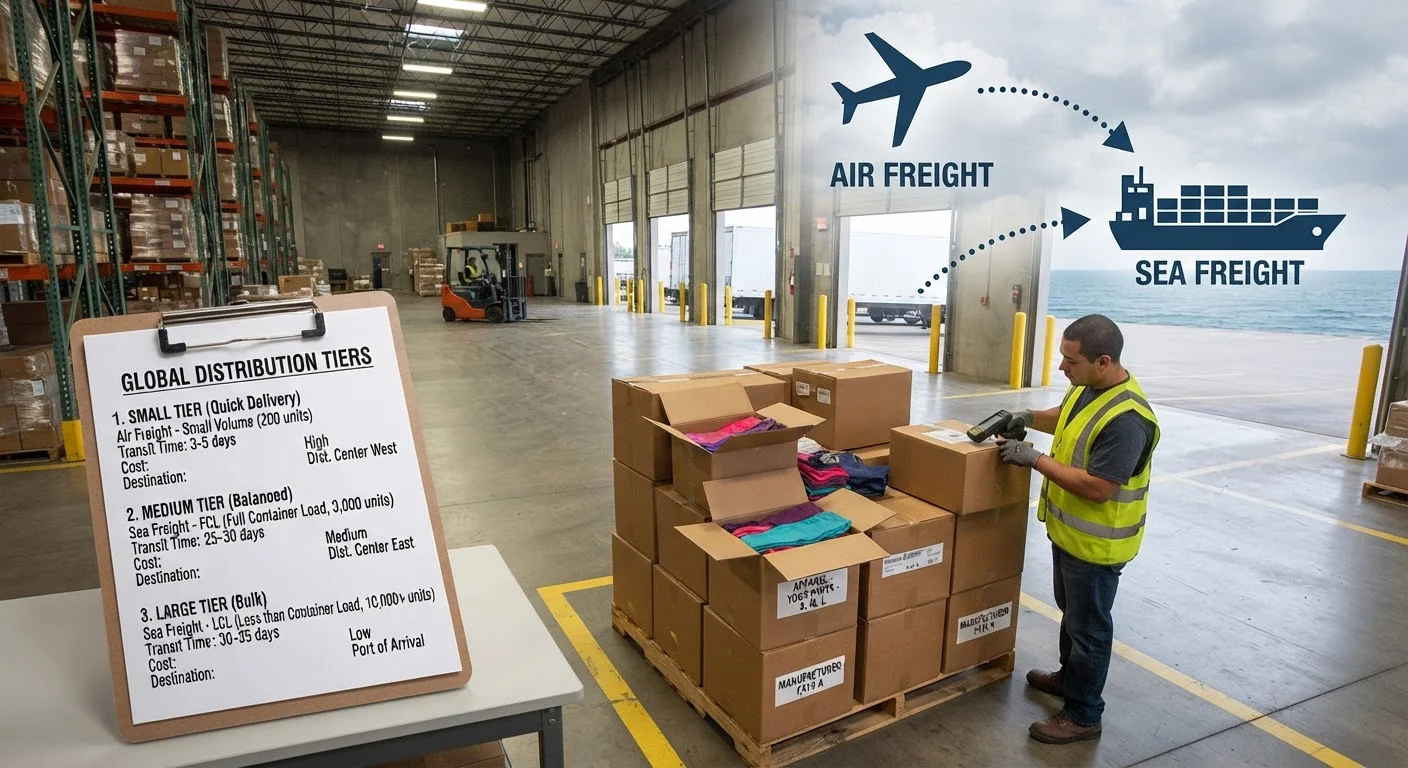
Three orders crossed our desk last quarter: 80 pieces for a solo founder testing a print, 1,200 for a mid-tier brand launching its first drop, and 8,000 for a retailer stocking six regions. Each one needed a different yoga apparel manufacturer relationship. Matching your volume to the right path saves weeks of back-and-forth and keeps your margins intact.
Path A: Under 500 Pieces — The Startup Lane
Target ODM yoga wear factories already running standard block patterns you can tweak, not full custom development. MOQ is 100-300 pieces per color per style. Expect $8-15 FOB per piece, plus a $30-80 sample fee. Skip factories demanding 1,000+ minimums; they're pricing you out before you've sold a single pair.
Path B: 500-2,000 Pieces — The Scaling Brand
This is where a genuine custom yoga leggings manufacturer relationship starts. You get real fabric customization, multiple colorways, and negotiating room on MOQ. Pricing drops to $6-10 per piece. Factories in this tier run 2-4 production lines and can quote realistic 25-day sewing windows instead of squeezing you behind bigger clients.
Path C: 2,000+ Pieces — The Enterprise Order
Now you're negotiating with a full-scale sportswear manufacturer based in China, often with 5-10+ production lines and dedicated QC staff. Price per piece falls to $4-7. You'll also gain leverage on payment terms (you can negotiate 30% deposit and 70% before shipment) and priority scheduling during peak seasons.
Path | Order Size | Price/Piece | MOQ Flexibility | Manufacturer Type |
|---|---|---|---|---|
A | ≤500 | $8-15 | Fixed, low negotiation | ODM factory |
B | 500-2,000 | $6-10 | Moderate | Custom leggings manufacturer |
C | 2,000+ | $4-7 | High, priority scheduling | Large sportswear manufacturer |
What Your Per-Pair Cost Breaks Down To
That FOB quote you're staring at breaks down into six separate costs. Materials (fabric, waistband elastic, thread, trims) eat 50-60% of your per-pair cost. On an $8 pair, that's $4.00-$4.80 in nylon-spandex alone. Direct labor runs $1.50-$3.00 depending on whether your seamless yoga leggings manufacturer is in Guangzhou or a cheaper inland facility. Factory overhead (utilities, machine depreciation, supervision) adds another $0.80-$1.50, and most shops calculate it as 50-100% of the labor line.
Then there's tooling. If your mold or die setup costs $2,000 and you're ordering 2,000 pieces, that's $1.00 per pair buried in your first invoice, gone by pair 2,001.
Don't skip defect allowance. Any custom fitness apparel factory builds in 2-4% for rejects, $0.10-$0.30 per pair.
Ask for the breakdown by line item. When a quote jumps from $8 to $9.50, you want to know if it's fabric, labor, or margin creeping up, because each one gets negotiated differently.
The 8-Question Mandatory Checklist (Ask Every Manufacturer Before Sending Money)

One brand founder we worked with lost a $12,000 deposit to a "manufacturer" who turned out to be a trading company subletting orders to three different factories. She never asked question one. Don't repeat her mistake. Fire these eight questions at any manufacturer, activewear manufacturer, or ODM yoga wear factory before a single dollar leaves your account.
1. Are you a real manufacturer, and can you prove it? Request the business license. Match the legal name character-for-character against their bank account. Anything under 2 years old or registered capital below ¥500,000 is a red flag for bulk orders.
2. Can I verify your factory physically or via live video? Ask for a walkthrough of the actual production floor, machines running, not a polished showroom reel. Cross-check the address on satellite maps.
3. What are your quality systems and defect rates? Get last year's defect percentage in writing. Insist on third-party pre-shipment inspection with a random 10% pull on mass orders.
4. What certifications do you hold for this exact product? CE, ISO 9001, or country-specific marks like SONCAP. Get scanned copies and check expiry dates yourself.
5. What's your MOQ, capacity, and real lead time for my quantity? Push for hard numbers. Vague reassurance like "flexible" means nothing without a unit figure.
6. What payment terms and bank protections apply? 30% deposit, 70% before shipment tied to inspection is the standard among reputable custom fitness apparel suppliers. Anyone demanding full payment upfront is a walk-away signal.
7. Can we start with paid samples and a small trial batch? Pay $50-$500 for real samples. Free ones rarely reflect mass-production quality.
8. Who are your existing clients, and how long have you operated? Ask for two trade references. Call them.
If any answer lacks a document or a number, don't wire the deposit.
How to Use the SPIN Questioning Method When Negotiating with Your Factory
You're in a negotiation room with a translator maybe and a factory manager who's fielded a hundred pitches before yours. The ones who win ask questions and let the custom yoga leggings manufacturer talk themselves into the deal. SPIN (Situation, Problem, Implication, Need-payoff) flips who's doing the convincing.
Structure a 30-45 minute call this way:
Situation (3-5 questions, 5-10% of time) : "What's your current monthly capacity for this line, and what utilization rate are you running?" Skip anything you could've found on their website.
Problem (3-5 questions) : "Do small, irregular orders make it hard to run long batches?" You're hunting for pain points tied to price, volume, terms.
Implication (5-10 questions, the real weight of the call) : "If line utilization rose from 65% to 85%, what happens to your margins?" This is where the OEM yoga pants factory does the math out loud, and the math usually favors you.
Need-payoff (2-3 questions) : "If we committed to a stable monthly volume with fewer SKU changes, how valuable would that be for your planning?" Let them say the number.
Aim for a 70/30 talk ratio: factory talking, you listening. Prep 5-7 Implication questions before the call. That single habit is what separates founders who land a 10-15% price break on their next seamless yoga leggings manufacturer order from the ones still emailing "any discount?" into the void.
Seamless vs. Cut-and-Sew: Which Manufacturing Process Fits Your Order?
Two garments, same brief, wildly different production lines. That's the split between seamless and cut-and-sew. Pick wrong, and you lose either fit quality or six weeks of your timeline.
Cut-and-sew starts with flat fabric rolls, cut into pattern pieces, then stitched together. You get real design freedom – paneling, color-blocking, embroidery, heat-transfer logos, all layered on easily. Fabric choice is wide too: combed cotton, ring-spun blends, recycled polyester (rPET).
Seamless knits the garment in one piece on circular machines, with very little stitching. For yoga pants specifically, that means a smoother "second-skin" feel and 25-35% more stretch in leggings-style builds. Production also runs 25-35% shorter in some workflows.
The tradeoff is cost and access. Seamless requires higher machinery investment and a smaller supplier pool , which raises MOQs and reduces your pricing leverage. One benchmark puts seamless garments 15-30% more expensive than equivalent cut-and-sew pieces, even though total time-to-complete is lower.
Quick rule : if you're chasing comfort and body-hugging performance, go seamless. If you need style variety, custom paneling, and easier decoration from a smaller pool of seamless yoga leggings manufacturers, cut-and-sew is the safer default.
How to Communicate Tech Pack Requirements to a Remote Factory
Picture a merchandiser in Dongguan opening your email at 8am, scrolling past three photos and a paragraph of vague notes, then moving on to the next brand's file, one that tells her what to do. That's the moment your order either gets prioritized or buried. A custom yoga leggings manufacturer builds only what you specify in writing.
Send one PDF. Include a table of contents, numbered sections, embedded fonts, high-res images. Name it Brand_StyleNumber_Version_Date so pattern, cutting, and QC teams file it without asking.
Your tech pack needs:
Cover sheet: style code, MOQ, sample timeline, special notes ("seam taped waistband")
Technical flats: front/back views, arrows labeling stitch type and seam placement
Bill of Materials: fabric GSM, spandex %, Pantone codes, zipper brand
POM sheet: numbered measurements with tolerances (waist: 68cm ±1cm)
Revision history: "v1.2 supersedes v1.1, updated rise height"
Reference page numbers in emails ("see BOM item 03"). Don't retype specs. Schedule a video review within 48 hours of sending, and don't let bulk production start until you've approved the PP sample against this exact document.
Conclusion
The best partnerships we've seen start the same way every time. Someone stops chasing the lowest price tag and starts asking better questions. That's really the whole game here. Whether you're placing 300 pairs or 3,000, the manufacturer who answers your fabric-testing question without hesitation is telling you something a glossy catalog never will.
Your checklist is your leverage now. Walk into that first conversation with a custom leggings manufacturer and lead with SPIN questions, not "what's your price." Watch how they respond to pressure about tech packs or MOQ flexibility. That reaction tells you more than any sample ever could.
Pick your path based on your numbers, not your nerves. Then send that inquiry today. The factories worth working with are used to being interviewed. Go interview one.