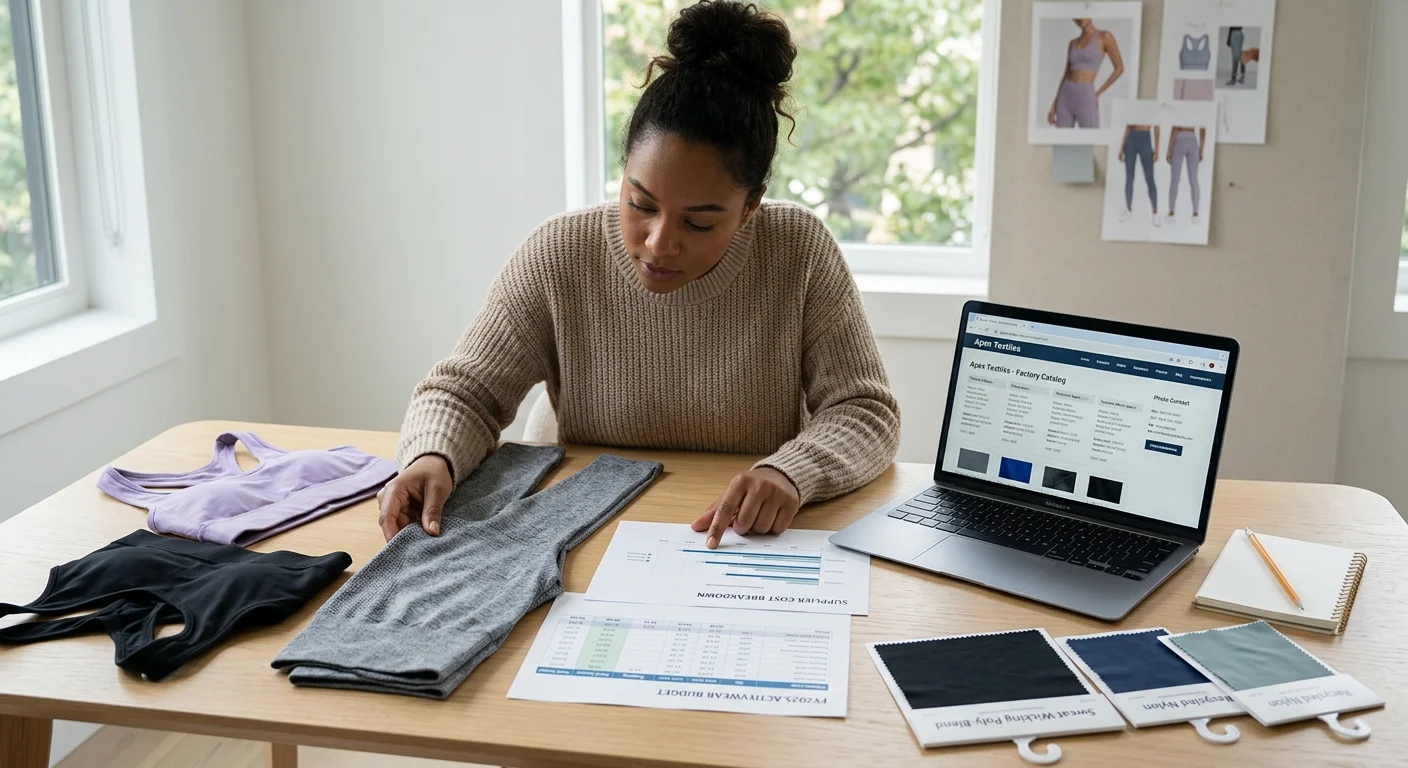
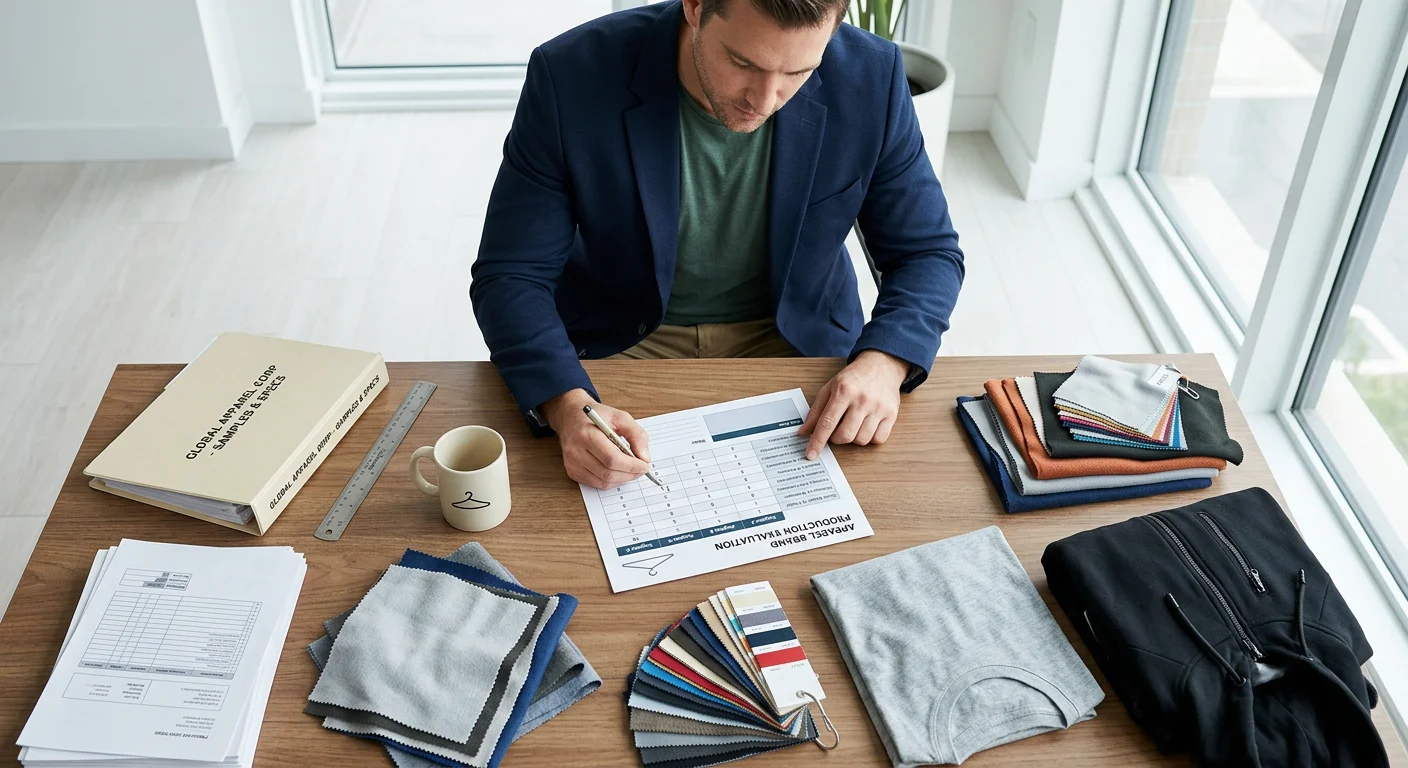
You’ve talked to three OEM yoga clothing factories, and each one handed you a catalog thick enough to make your head spin — leggings in forty colorways, sports bras in every cut imaginable. The question nobody’s answering is which of these should become your first collection. Because “I’ll offer a little of everything” is exactly how founders end up with a warehouse full of slow-moving inventory and a brand that feels like nothing in particular.
This isn’t about fabric trends or flatlock stitching. It’s a decision framework built from a real small yoga brand’s journey from zero to a working SKU matrix. It shows you how to assign roles — hero, volume, support, entry-price — across your first few series, sequence your launches around MOQ and cash flow, and know when custom logo yoga pants earn their spot versus when a themed capsule collection is the smarter bet. By the end, you’ll have a reference table to match against your own budget and supplier constraints, with no guesswork required.
The Three Collection Archetypes and Their Supply Chain Realities
Every yoga apparel wholesale decision is a supply chain decision first, a branding decision second. Factories don't organize their capacity around "aesthetic vibes." They organize it around three operating models, and each one comes with its own cost structure, MOQ reality, and speed-to-market tradeoff. Match your collection type to the wrong model, and you'll pay premium prices for basics or wait months for a "limited drop" that's no longer limited by the time it ships.
Archetype One: Core Collection (Simple & Efficient)
This is your basics tier. Think seamless yoga leggings, classic sports bras, the pieces that don't change season to season. Supply chains built for this run long production cycles, centralized inventory, and lower unit costs. You get the best per-piece pricing here, but only if you commit to volume and consistency. This is where your OEM yoga clothing partner earns their keep through stable fabric sourcing, predictable dye lots, and minimal variability. If your brand's foundation isn't solid here, everything built on top of it wobbles.
Archetype Two: Premium/Customized Collection (Managed Complexity)
This tier is where custom logo yoga pants, specialty seams, and sustainable yoga fabric blends live. You're asking your ODM activewear manufacturer to juggle more options: different trims, custom hardware, maybe recycled or performance fabrics with longer lead times. The tradeoff is higher reliability requirements and tighter partner coordination, but you still don't get fully bespoke production. In this managed complexity zone, you get customization without blowing up your entire production timeline. It's ideal for the collection that signals your brand identity without being a one-off gamble.
Archetype Three: Limited-Edition/Thematic Collection (Agile & Adaptive)
Seasonal capsules, collabs, drop culture – this is the archetype built for short lead times, flexible capacity, and fast pivots. Supply chains here prioritize speed over cost efficiency. You'll pay more per unit, and MOQs are often negotiated case-by-case rather than fixed. But this is exactly the model that lets you test market appetite on 300 units instead of 3,000, protect cash flow, and pull the plug fast if a print doesn't land.
Trying to launch archetype three before archetype one exists leaves you with a themed capsule collection that has no core foundation. That isn't a brand. It's a one-hit product drop with nothing to return to.
Defining Your Brand’s Core Categories: Hero, Volume, Support, and Entry-Price Items
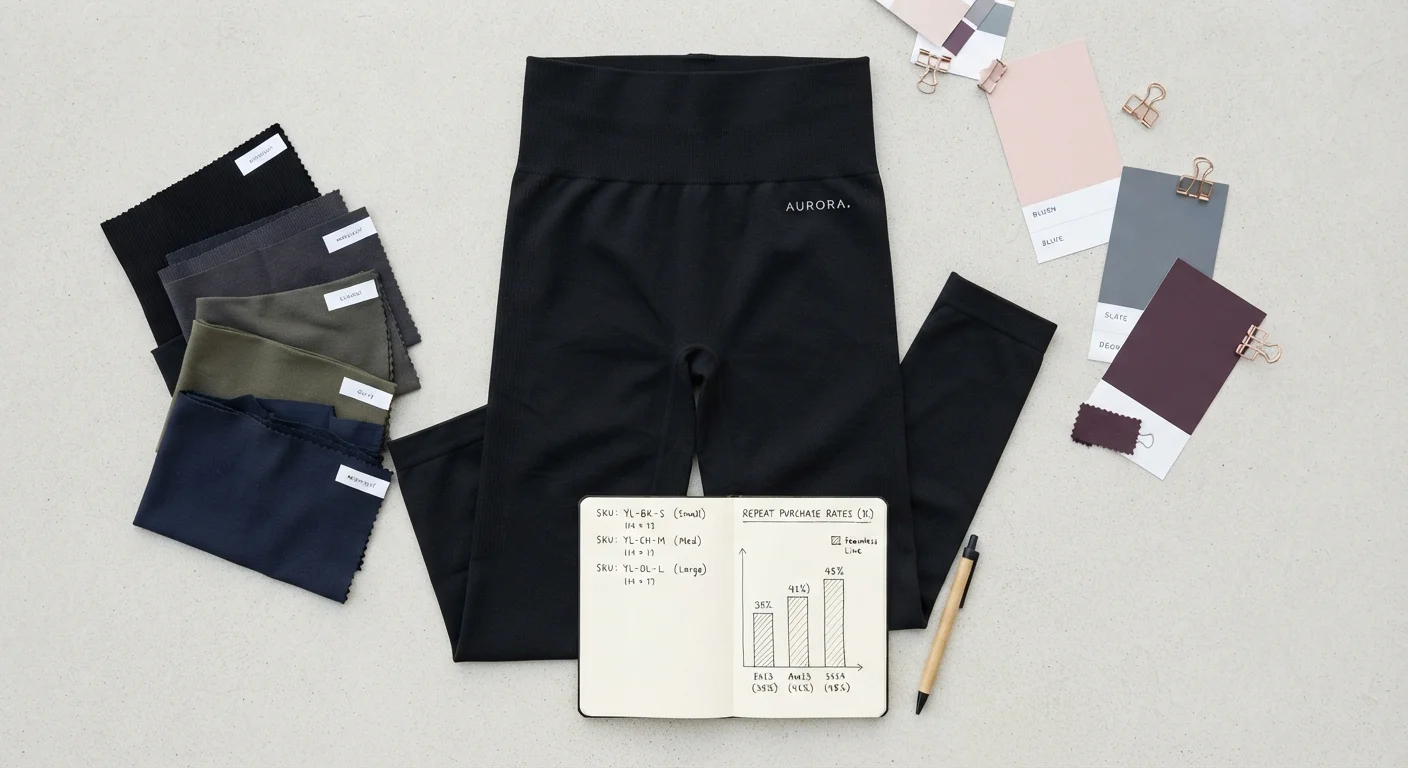
A small yoga brand we'll call Luma Flow started with twelve SKUs and no idea which ones mattered. Six months in, they pulled their order data and found something surprising: customers who bought one specific legging as their first purchase placed a second order within 90 days at 45% , while their catalog average sat closer to 22% . That one legging carried the whole brand. That's why you build a real SKU matrix instead of a scattered catalog.
Hero items are your 1–3 flagship pieces. For Luma Flow, that was one seamless yoga leggings style made through a dedicated seamless yoga leggings manufacturer. These earn outsized marketing spend because they turn first-time buyers into repeat customers and pull them into other categories. A hero candidate needs a return rate under 35% — anything higher and it's not brand-worthy, no matter how good it photographs.
Volume items are the workhorses. Sports bras, capris, layering tanks — evergreen basics that should account for 50–70% of units sold. They don't need to be exciting. They need reliable stock, which is why they belong with the archetype-one core production model from earlier. Stock-outs on volume items quietly kill momentum.
Support items raise average order value. Headbands, grip socks, or a mat towel bundled with the hero legging. Attach rates climb 5–15 percentage points once you merchandise support items as "complete the look" add-ons at checkout rather than standalone products.
Entry-price items are the acquisition engine — priced 20–40% below your hero item, but never so cheap they undercut your activewear brand positioning. Custom logo yoga pants at a reduced price point, using simpler trims than the hero SKU, play this role well. You eat the margin. You're converting first-time buyers who'll eventually trade up.
Luma Flow's mistake wasn't picking bad products — it was treating all twelve SKUs as equals. Once they mapped each item to one of these four roles, production planning with their ODM activewear manufacturer got simpler, because each category has different MOQ tolerances, fabric sourcing needs, and reorder cadences.
A Real-World Case: How a Small Brand Built Its SKU Matrix from Scratch
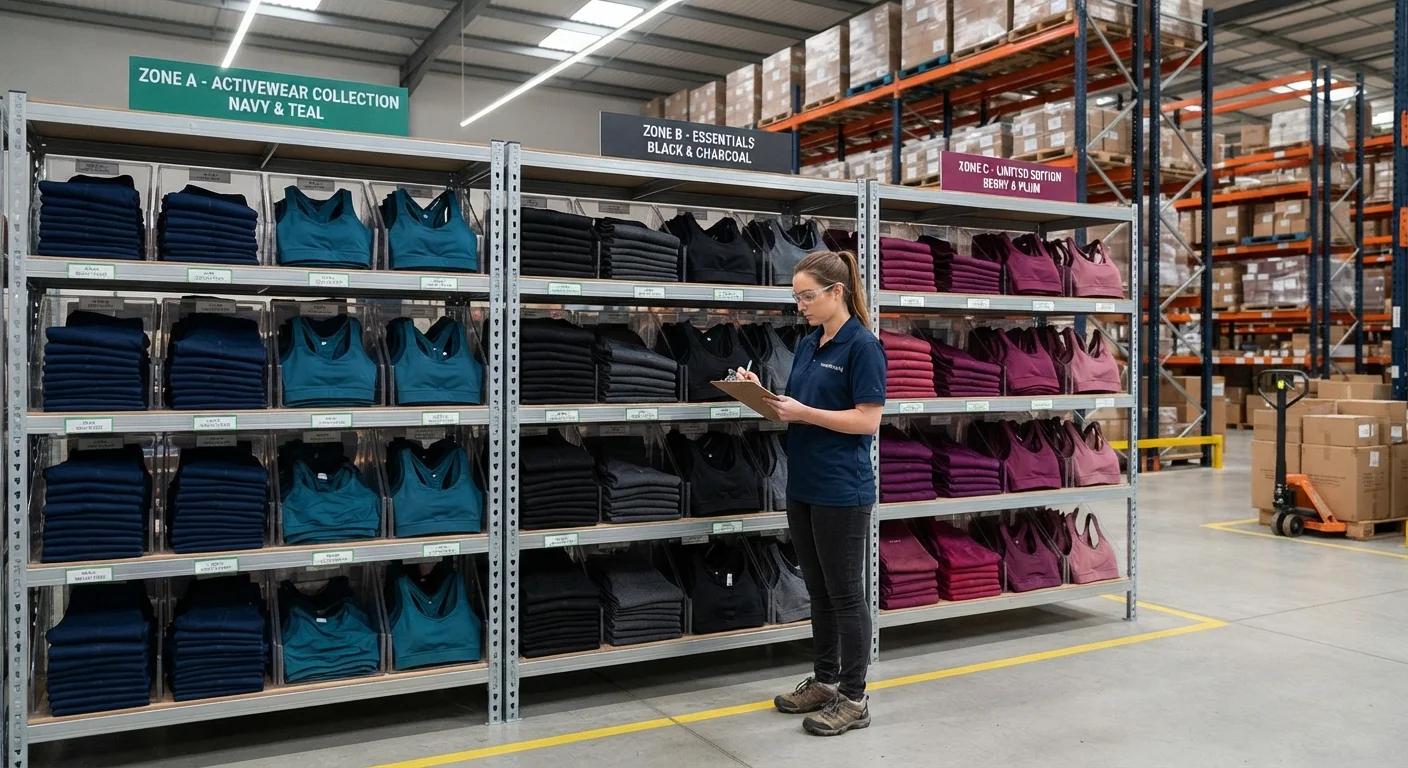
By month eight, Luma Flow's original twelve product lines had quietly multiplied into 882 SKUs once every colorway and size got counted separately. Nobody planned it that way. Someone added three extra sizes to a bestseller. Someone else greenlit a limited print run without checking if it matched the existing catalog structure. Inventory turnover crawled at 4.2x. Oversell rates hit 12–18% of orders. Stock variance hit 7–9% between what the system said and what was in the warehouse. Working capital locked in dead or slow-moving stock hit $63.2K. That money should have gone toward testing their next themed capsule or paying down the MOQ on a new seamless yoga legging run. Instead, it was sitting in the warehouse in size XL neon coral.
Building the Matrix: Style × Size × Color
Luma Flow adopted a three-dimensional SKU matrix: Style, Size, Color. They locked it in as policy. Every product got a formula: LUMA-LEG-S01-BLK-M . LEG marks the category, S01 the style, BLK the color, M the size. That ended the duplicate listings for the same legging under two different codes.
They spent the first four weeks purging obsolete variants and merging near-duplicates. That cut 882 SKUs down to 420 , a 52% reduction. Anything with weak margins and erratic demand got dropped. What survived earned a defined role: hero, volume, support, or entry-price.
What Changed in Twelve Months
The whole rebuild took 8–12 weeks and cost $18.5K–$34K . That covered software setup, data cleanup, and staff training. Within a year:
Inventory turnover climbed from 4.2x to 6.8x
Oversells dropped from 12–18% to 1.2% of orders
Stock variance fell from 7–9% to 1.8%
Revenue rose 15–22% on better availability alone
Year-one ROI landed around 340% . A clean SKU matrix lets a small yoga apparel wholesale brand scale custom sportswear design without losing its shape.
Collection Launch Sequence: Aligning MOQ, Fabric Costs, and Cash Flow
Fourteen thousand dollars sitting in a warehouse in the wrong size is a sequencing problem. Most founders nail their collection roles — hero, volume, support, entry-price — and still blow the launch. They order everything at once, at the wrong MOQ tier, without checking whether their cash flow can survive the wait between paying the factory and getting paid by customers.
The MOQ-to-Cost Math You Can't Skip
Most cut-and-sew factories set style MOQs at 200–500 units, fabric MOQs at 300–500 meters per color, and colorway MOQs around 100–200 units. The cost curve moves fast. At 100 units, you might pay $12 a unit for $1,200 total. Push to 500 units, and unit cost drops to $8 — a 33% savings. But your cash outlay jumps to $4,000, more than triple. Lower MOQ protects cash. Higher MOQ protects margin. Pick based on what you can survive, not what looks cheapest on paper.
For a small brand testing an 8-style capsule at 100 units per style with a domestic OEM yoga clothing partner, expect fabric spend around $16,000 (2 yards per unit at $10/yard), labor near $12,000, plus $1,500–$3,000 in trims and $500–$1,500 in shipping. Your first production run lands between $30,000 and $32,500.
Setting Your Inventory Envelope
Budget $15,000–$50,000 for initial inventory depending on collection complexity. Keep a 10–20% contingency for MOQ surprises or urgent reorders. Set aside another 20–30% of monthly sales for restocking your volume-tier items. Track cash weekly. Forecast twelve months out. Push suppliers for Net 30 or Net 60 terms. If you're selling wholesale, require 30–50% deposits to fund production upfront.
A Simple Test with $20,000 in the Bank
Say you have $20,000 available with a 15% contingency, leaving roughly $17,000 to spend. Four styles at 100 units each (400 units total) at $25 landed cost runs $10,000. You're inside budget, with room left for marketing. Push to 200 units per style (800 units) at $20/unit, and you're at $16,000. It still fits, but you've erased your buffer.
Start conservative with 50–100 units per style, even at a 15–40% cost premium, until your hero item's reorder rate proves itself.
Series Positioning – Target Audience – Production Difficulty: A Quick-Reference Table
Print this table out. Tape it above your desk. When a factory sends you a new catalog, or an Instagram trend tempts you into "just one more capsule," this is what stops you from overbuilding.
Every collection you launch should map to a role, an audience, and a difficulty score before a single yard of fabric gets cut. Here's how the four categories break down once you've built your SKU matrix and know your archetype-based production model.
Series Type | Positioning Goal | Primary Audience | Secondary Audience | Production Difficulty (1–5) | Typical MOQ / Budget Range | Key Cost Drivers | Release Cadence | Risk Level |
|---|---|---|---|---|---|---|---|---|
Core / Basics Collection | Establish reliability, build repeat-purchase habit | First-time buyers, everyday practitioners | Wholesale accounts, studio partners | 2/5 | 200–500 units/style; $8–$12/unit landed | Fabric consistency, dye-lot matching, OEM yoga clothing capacity | Continuous, no seasonality | Low |
Premium/Customized Collection | Signal brand identity, justify higher price point | Loyal repeat customers, brand-conscious buyers | Gift buyers, influencer seeding | 3/5 | 100–300 units/style; $18–$28/unit | Custom logo yoga pants trims, sustainable yoga fabric sourcing, ODM activewear manufacturer coordination | Quarterly | Medium |
Limited-Edition/Thematic Collection | Test demand, generate press and social buzz | Trend-driven early adopters, existing fans | New customer acquisition via social | 4/5 | 50–150 units/style; $22–$35/unit | Fast-turn fabric sourcing, negotiated MOQ, print/dye minimums | Seasonal or event-tied | Medium-high |
Entry-Price Collection | Lower barrier to first purchase | Price-sensitive newcomers | Retargeting pool, sale shoppers | 1–2/5 | 300+ units/style; $6–$10/unit | Simplified trims, standard seamless yoga leggings manufacturer runs | Ongoing, replenished | Low |
This is activewear brand positioning on paper — a spreadsheet you can defend to your accountant. Match your yoga clothing MOQ tolerance and cash position against this table before you commit to custom sportswear design work, and you'll know exactly which series earns your next dollar first.
Conclusion
For new brand founders, the SKU matrix is a cash flow decision. When you see your collection as Hero, Volume, Support, and Entry-Price roles, everything gets clearer. Start with 3-4 core basics that prove your fabric quality and let your OEM yoga clothing partner nail consistency at low yoga clothing MOQ tiers. Once that supply chain is humming, layer in the seasonal or collab pieces that build brand identity. Skipping straight to themed drops before your basics are dialed in is how inventory graveyards happen.
Pull up that positioning table from this article, map your own budget and MOQ ceiling against it, and pick your launch sequence this week.