That mid-flow moment when your leggings start sliding down during a downward dog, or your top rides up mid-inversion—yeah, we've all been there. Your yoga wardrobe isn't built for the practice you're doing. A gentle yin session and a sweat-drenched hot yoga class need very different fabrics, cuts, and support levels, and figuring that out through trial and error gets expensive fast.
We've broken down real picks by practice type—flow, hot yoga, restorative, Pilates fusion—with honest notes on how each piece performs after a sweaty session and a few trips through the wash. Brands developing custom yoga clothing can use these performance insights to build better collections.We also call out the three wardrobe mistakes almost every beginner makes (yes, including that one legging fabric that goes see-through in downward dog). By the end, you'll know exactly what to add to your cart and what to skip.
Lululemon
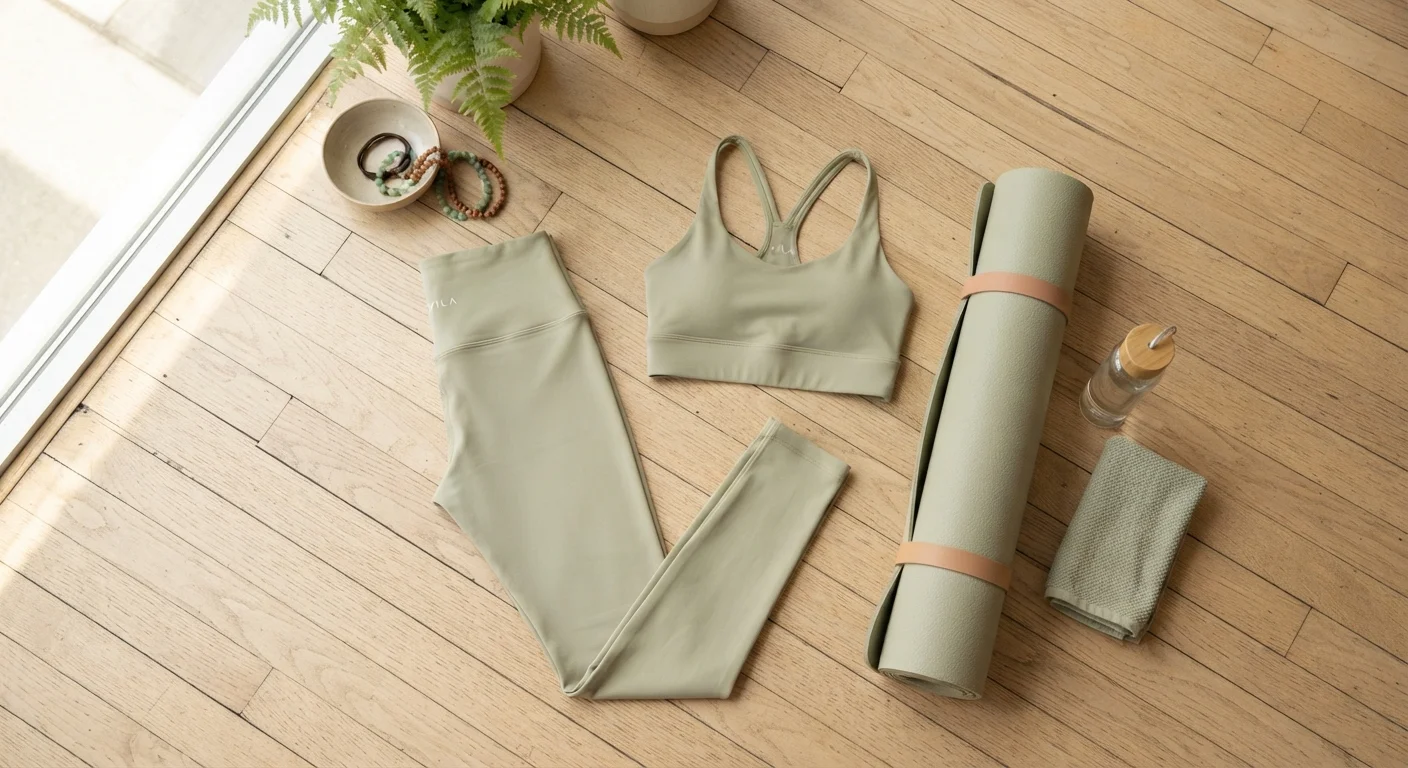
Vancouver-based Lululemon built its whole brand on clothes that move with your body, not against it. Since 1998, they’ve become almost synonymous with yoga apparel. Their fabric technology delivers.
The Align Legging gets all the talk, and it earns it. Made with their signature Nulu fabric, it feels buttery-soft against skin—like wearing almost nothing, with full 4-way stretch. The high-rise waistband stays put through vinyasa flows and inversions. No dreaded slip-down moment. Testers report little to no see-through issues even in deep forward folds, thanks to a gusseted crotch that also improves range of motion. One honest note: if you do high-repetition inner-thigh work, like Pilates fusion or lots of lunges, you might notice some pilling over time from friction. Not a dealbreaker, just something to know going in.
The Energy Sports Bra works well for hot yoga. It’s medium-support with a mesh back panel that actually ventilates during sweaty sessions—no swampy-back feeling by class end. It tends to fit C/D cups particularly well, though smaller chests might want more compression for jump-heavy Pilates work.
For breathable yoga tops, the Swiftly Tech shirt uses moisture-wicking fabric that handles sweat without clinging awkwardly. Solid for flow or hot yoga days.
Price-wise , expect $58–$128 depending on the piece. That’s not cheap, but the fabric quality (largely polyester-nylon blends with cotton mixed in) justifies it if you prioritize feel and longevity over budget. If soft handfeel and reliable stretch matter more than price tags, Lululemon delivers exactly that.
berunactivewear.com
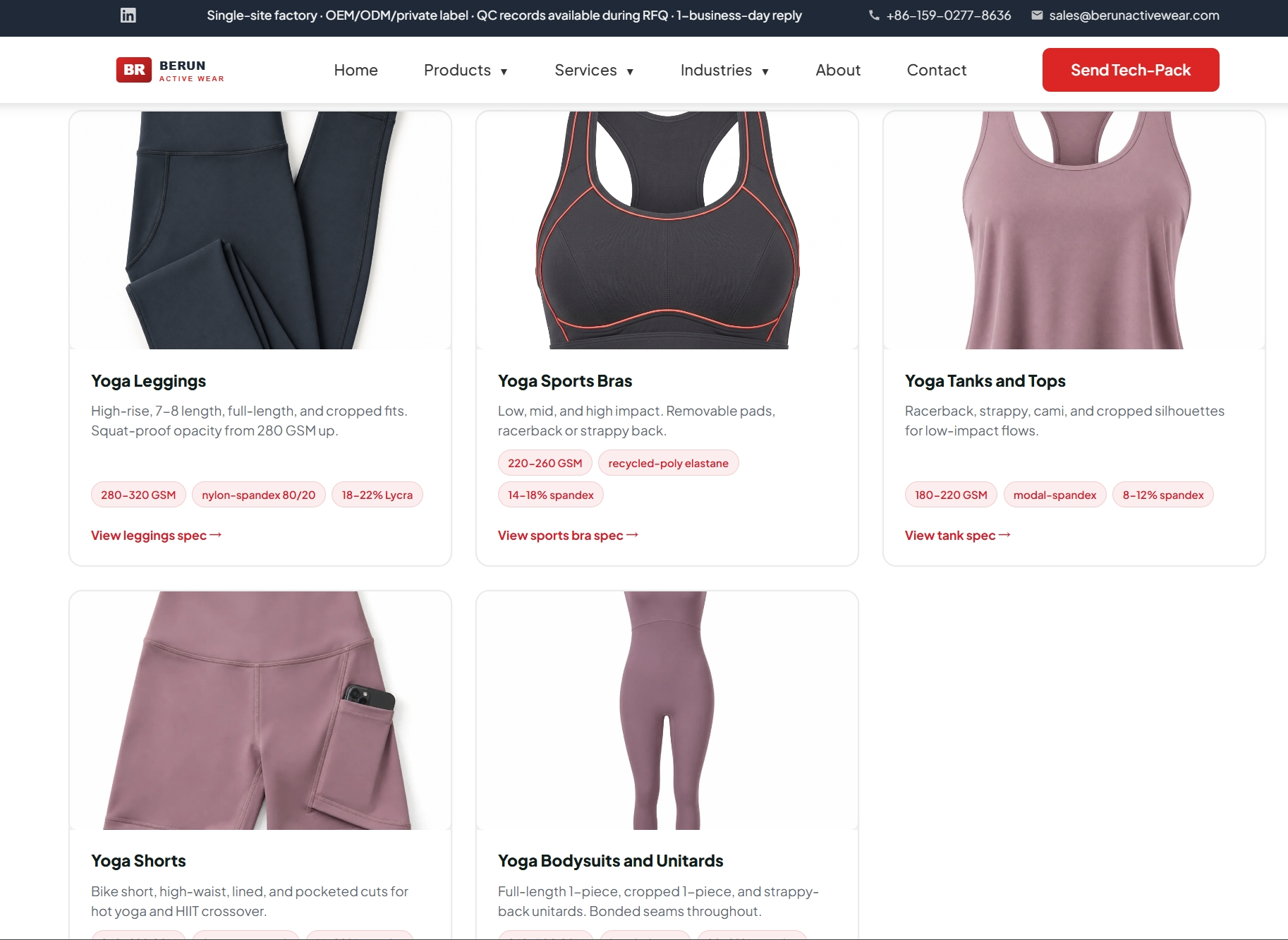
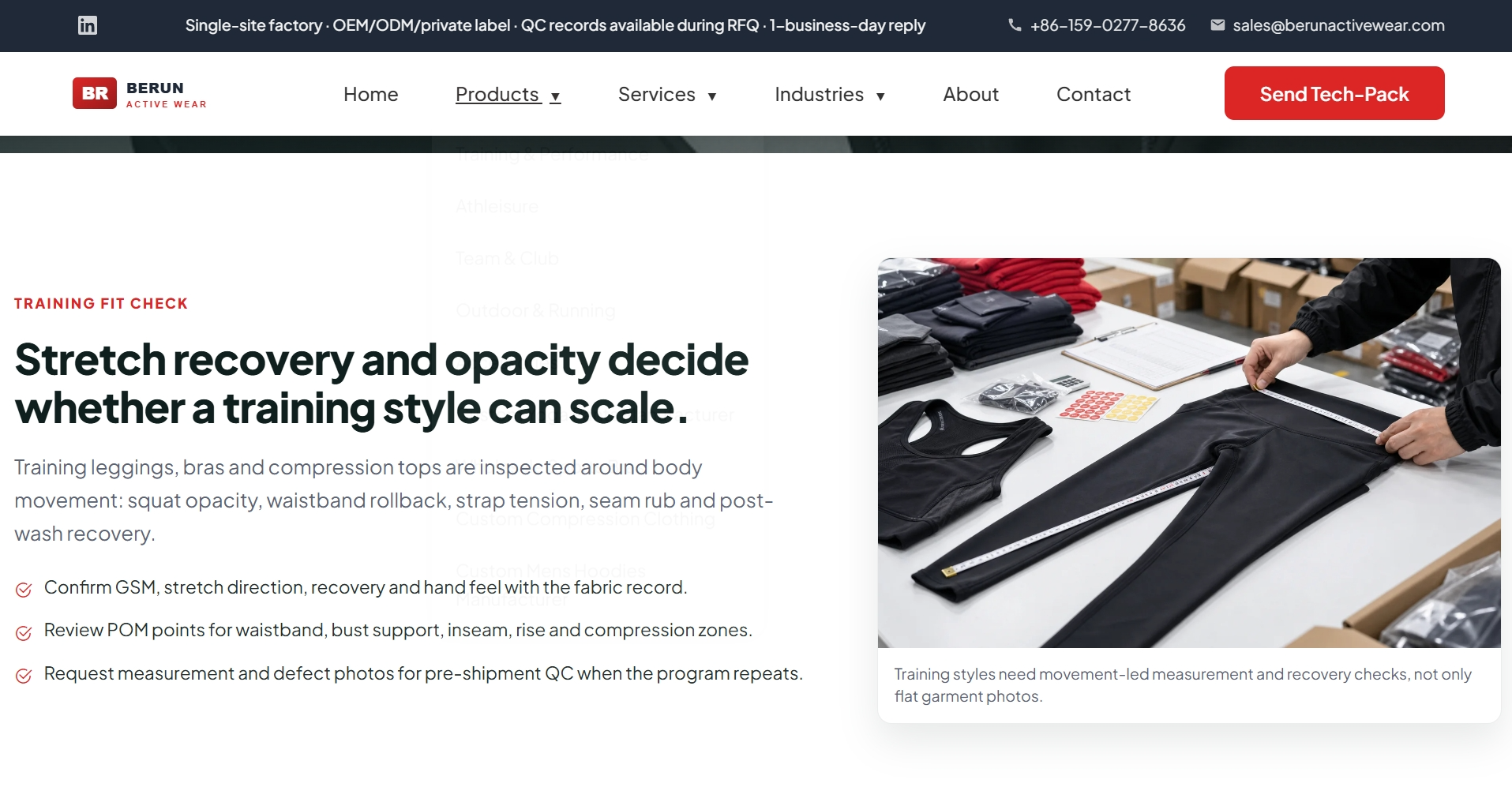
Studio owners, small activewear founders, and Amazon sellers need suppliers, not individual pieces. BeRunactivewear , a Guangdong-based activewear manufacturer running since 2017, fills that gap.
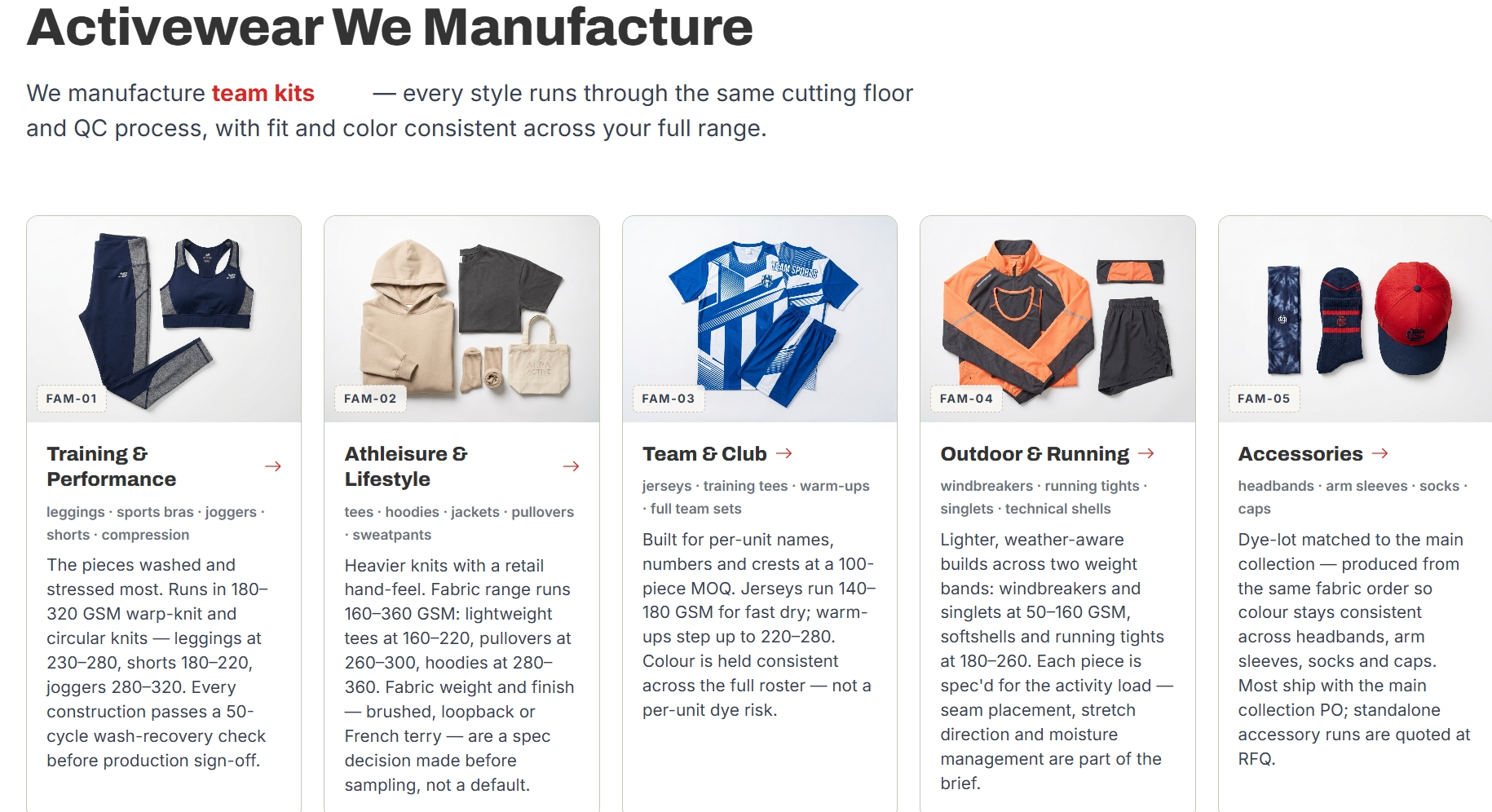
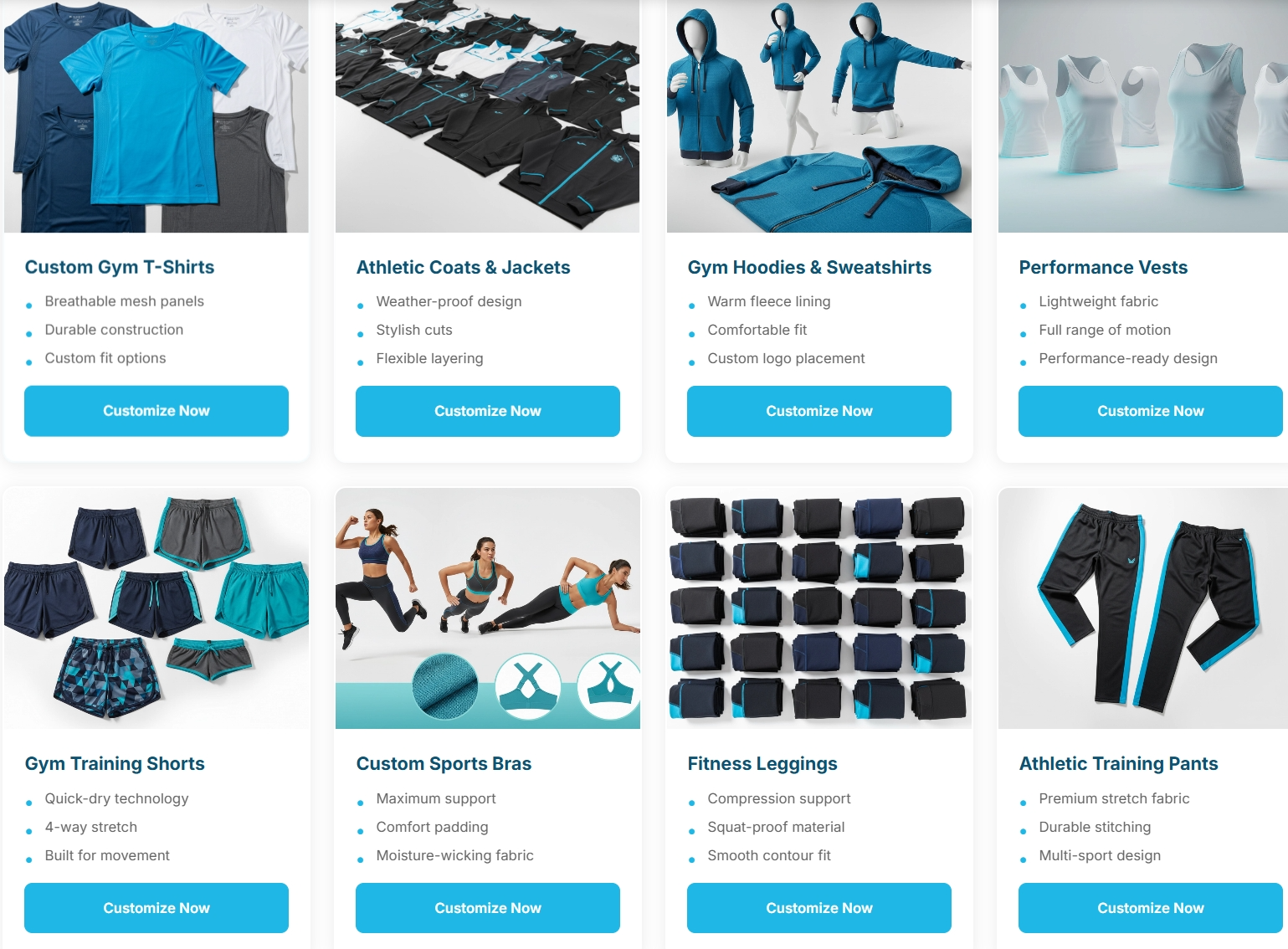
Berun is a full OEM/ODM activewear factory—8,500 square meters, 280 workers, 12 production lines—building custom yoga leggings , sports bras for yoga, seamless yoga tops, capris, and yoga shorts from scratch. If you're launching your own line of stretchy activewear, this is the kind of partner you'd be vetting.
The fabric specs matter here. Berun uses 180–320 GSM 4-way stretch nylon-spandex blends, the same category of moisture wicking fabric that keeps hot yoga sessions from turning into a wet mess. High-waisted leggings, V-waist cuts, scrunch styles, seamless construction—all on the menu. Flatlock seaming in high-friction zones (think inner thighs, underarms) helps prevent the chafing that ruins an otherwise good pair of yoga pants.
The MOQ is 100 per SKU, though some product lines drop to 50 pieces per style at roughly $15–30/set. That's workable for a boutique launch. A one-off personal order is too small. Their compression-wear page recommends checking for OEKO-TEX Standard 100 certification—worth asking about directly, since it's not blanket-advertised site-wide. Response time on quotes: 24 hours, per their own claim.
Decathlon
Founded in 1976 near Lille, France, Decathlon built its entire business model around one idea: sports gear shouldn't drain your wallet. That philosophy shows up everywhere in their yoga capris, sports bras for yoga, and stretchy activewear lines. Beginners gravitate toward this retailer when they're not ready to drop $80 on a single pair of leggings.
The numbers back up the scale. Decathlon runs 1,902 stores across 82 countries , sells 1.23 billion products a year, and posted €16.8 billion in net sales for 2025. That kind of volume is exactly why prices stay low.
What this means for your yoga wardrobe:
Expect a working price range of €5–€30 for yoga leggings, yoga pants, and breathable yoga tops, far below premium brands.
The fit works best for beginners still figuring out which style suits their practice, or anyone building a starter kit without committing to long-term compression retention.
Fabric quality lands in "good enough for now" territory, not buttery-soft or built to last for years.
Sustainability-minded shoppers get something extra here too. Decathlon reports 53.9% of 2025 sales came from ecodesigned products, and they ran 1,746 repair workshops last year alone. A stretched-out waistband doesn't automatically mean landfill.
If moisture wicking fabric and high-waisted leggings that survive a hundred washes matter more than price, look elsewhere. If you just need something functional for your first month of classes, Decathlon gets you there without buyer's remorse.
BORN Living Yoga
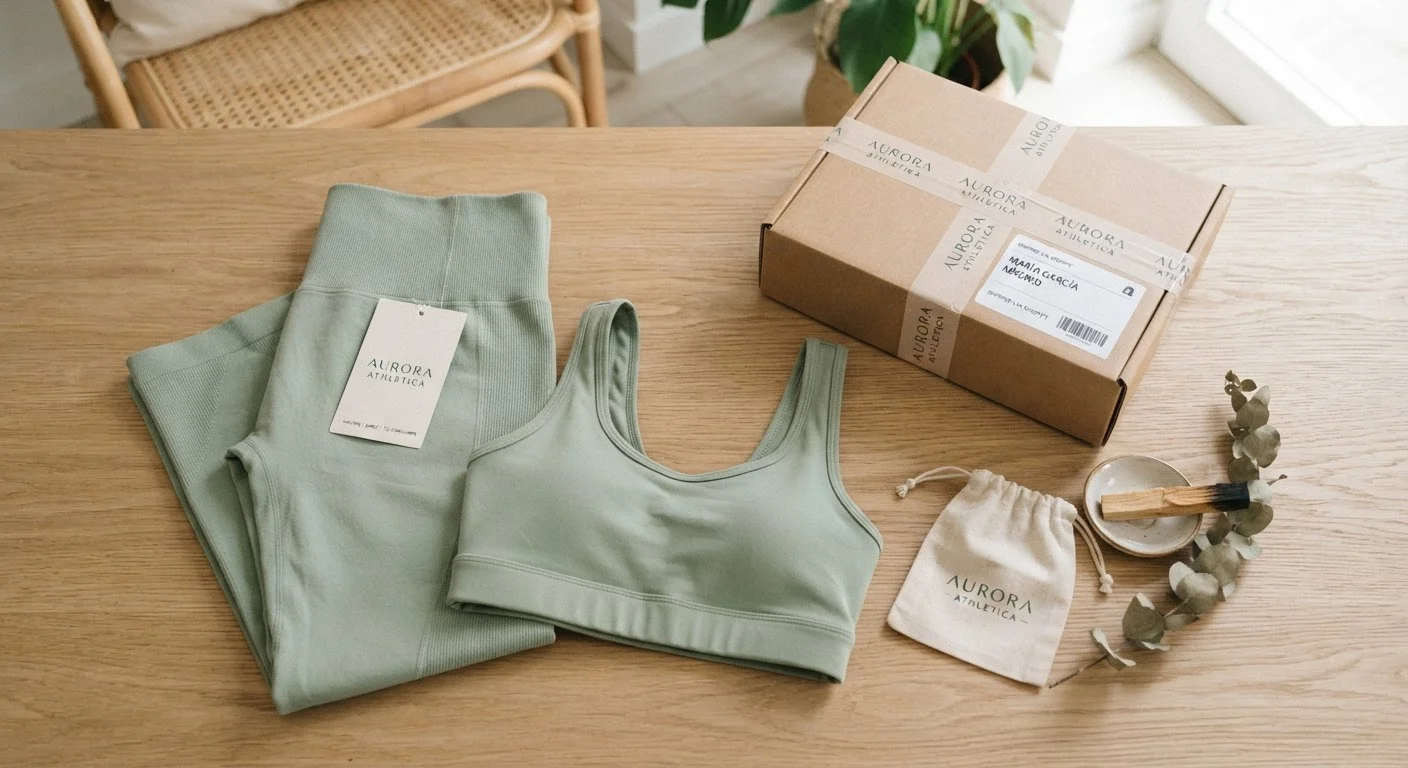
Madrid gave us this one. Born Living Yoga launched in 2017 as a direct-to-consumer apparel brand, selling through Shopify without a middleman markup eating into quality. That matters if you're comparing yoga leggings and wondering where the money goes.
The catalog runs deep—694 products listed on their storefront, averaging $51.80 per item. Yoga clothing Wholesale pricing spans $25 to $200, which puts this brand in mid-range territory. It's a small operation with 25 to 40 employees and roughly $7.3M in annual revenue, and it got an angel funding round in February 2025.
Where this brand fits your practice:
High-waisted leggings, sports bras for yoga, tops, shorts, and jumpsuits fill out the lineup
Positioning targets home practice and low-impact sessions, like Pilates, gentle yoga, restorative work, not hot yoga or aggressive flow
Materials are marketed as eco-friendly, though the brand doesn't lean heavily on moisture-wicking claims the way performance-first brands do
Trustpilot reviews mention fabric imperfections and inconsistent opacity depending on the item. Some pieces might run thinner or show more than others straight out of the box. If you're picking leggings for inversions or deep forward folds, double-check before checkout.
No published MOQ exists since this operates as a straight retail brand, and Oeko-Tex certification isn't confirmed anywhere in their materials—just general eco-friendly language.
Oysho
Inditex owns this one, same corporate family as Zara, and that lineage shows up in how Oysho blends fashion sensibility with actual workout function. Barcelona is the spiritual home base, though the legal paperwork points to Arteixo, A Coruña, depending on which filing you're reading. Founded in 2001, the brand has spent two decades figuring out how to make yoga leggings look like something you'd wear to brunch afterward, not just to class.
Oysho Training, their fitness-specific line, targets exactly the practice type this article keeps circling back to: yoga, barre, Pilates, and lighter-intensity sessions. Don't expect this brand to hold up during aggressive hot yoga flows or heavy compression needs. That's not the design brief here.
The high-waisted leggings have core-control panels that stay put through seated stretches and gentle inversions. Mesh paneling on select tops gives some breathability, though it's more style accent than heavy-duty ventilation. The compressive collections feel snug without the aggressive squeeze you'd get from performance-first brands.
Pricing lands around €25–€60, putting it between Decathlon's budget tier and Lululemon's premium shelf. Retail footprint stretches across more than 40 countries with over 457 stores, and their flagship site pulled in roughly $273 million in 2025 revenue, per one dataset. Other sources cite different figures depending on methodology, so treat those numbers as ballpark rather than gospel.
This is a straight retail brand built for shoppers who want their studio-to-street wardrobe to double as everyday fashion, with no published certifications or yoga clothing wholesale MOQ.
Nux Active
NUX Active labels its support levels clearly. Three tiers—LOW, MEDIUM, HIGH—across five sizes, and each tells you what to expect before you buy. LOW gives you that second-skin feel, true to size. MEDIUM tightens things up. Expect it to look one size smaller on the hanger than what you'd normally grab. HIGH delivers maximum muscle support and better oxygen delivery, but it hugs hard. Size up one to two sizes from your usual pick, or you'll feel like you're wearing a compression bandage through your Pilates fusion class.
That compression mapping matters for movement-heavy practices where gear needs to stay locked in through transitions, not just look good in a mirror pose.
What's in the fabric:
The 7/8 legging uses recycled nylon with a high-rise cut, good for eco-conscious shoppers who still want that snug, no-slip waistband.
One bra listing breaks down to 93% SENSIL Nylon, 7% Spandex, a blend built for stretch recovery after repeated squats or lunges.
The brand uses Italian BodyEngineered seamless knitting technology, which explains why reviewers rarely mention chafing at the seams.
Sizing runs by actual bust, waist, and hip measurements rather than vague S/M/L guessing. Bras span 30" to 40" bust, bottoms cover 22" to 33" waist. Prices land around $50–$90, mid-range territory. Free shipping kicks in over $100, so bundling a top with bottoms makes financial sense.
Skip this brand if you want loose, flowy yin yoga clothes. It's built for compression, not drape.
Reebok
Bolton, England, 1958. That’s where Joe and Jeff Foster started what eventually became a $3.8 billion acquisition target for Adidas, then flipped to Authentic Brands Group in 2021 for roughly $2.5 billion. Reebok isn’t a yoga specialist—it’s a fitness-first brand, and that shows in how its apparel performs on the mat.
The PureMove Bra is the standout piece. Launched August 2018, it uses Motion Sense Technology with Sheer Thickening Fluid (STF) woven into the fabric. Support adapts based on how hard you’re moving. Slow vinyasa flow? It stays soft. Jump into a Pilates-fusion burpee sequence? The fabric stiffens to lock things down. The material blend is 73% nylon and 27% spandex, with breathable perforations that help during sweatier sessions.
Where Reebok fits your practice:
- Best for: cross-training, Pilates, and mixed studio classes where you’re bouncing between strength work and yoga flow
- Skip it for: pure restorative or yin sessions—this isn’t a drapey, soft-cotton brand
- Price positioning: mid-market, more accessible than Lululemon, less budget-friendly than Decathlon
Reebok’s real strength is versatility over specialization. If your weekly schedule mixes a hot yoga class with strength training or Pilates, this brand’s supportive bras and durable leggings handle both without needing two separate wardrobes. It’s not the softest fabric on this list, but it’s built for people who don’t sit still.
3 Common Beginner Yoga Wardrobe Mistakes (And How to Avoid Them)
Every beginner buys the same three things and regrets them by week three. These are patterns showing up across gyms, studio locker rooms, and Amazon return requests.
Mistake #1: Grabbing Cotton Leggings for Hot Yoga
Cotton feels soft in the store. It feels miserable forty minutes into a sweat-drenched vinyasa class. Sweat soaks in and stays there. One comparison found cotton yoga clothing takes roughly 2.5 hours to dry , versus 40 minutes for quick-drying synthetic blends. That's the difference between a slightly damp shirt and a soggy, chafing mess by savasana.
Fix it: Stick to moisture-wicking fabric—nylon-spandex or polyester blends—for anything heated. Before buying, do a squat test under bright light . If you can read text or see skin through the fabric, put it back.
Mistake #2: Sports Bras With Underwire or Hooks
Hardware and hot yoga don't mix. Underwire digs in during backbends. Hooks catch during floor transitions and inversions. Anything with zippers or metal clasps has no business near a yoga mat.
Fix it: Choose a seamless, wire-free sports bra with medium-to-high support and a racerback or criss-cross strap design. Test it before checkout. Lift your arms overhead, twist side to side, fold forward. If it shifts, pinches, or needs constant readjusting, it's the wrong cut for your practice.
Mistake #3: Sizing Up "For Comfort"
Loose leggings sound comfortable in theory. In practice, they slide down during downward dog, bunch behind the knees, and ride up during every single inversion.
Fix it: Go with high-waisted leggings that fit close to the body. Skip low-rise cuts entirely—they're the number one culprit for mid-class wardrobe malfunctions. Run the fitting-room test: squat, then forward fold. If you're adjusting the waistband mid-test, size down or try a different rise.
Bonus check: Cheap fabric turns sheer when stretched. Shine a phone flashlight behind the material during that same squat test. If you can see through it, look for opaque, gusseted options instead.
Conclusion
Your mat doesn't care about brand logos, but your body notices the difference between fabric that moves with you and fabric that fights you. Match your yoga leggings to your actual practice. Buttery-soft high-waisted styles suit slow-flowing vinyasa; sweat-wicking, squat-proof pairs handle hot yoga. Skip the shiny, thin sports bra that seemed cute in the dressing room but slides mid-downdog.
Start small. Pick one solid pair of yoga pants , one supportive bra built for your chest size (not just your Instagram aesthetic), and one breathable top that survives twenty rounds of sun salutations without becoming see-through. A reliable yoga clothing wholesaler can help expand these essentials into a complete activewear range.Get those three right, and everything else from capris to shorts to layering pieces falls into place.
Stop guessing, stop overbuying, and build a closet that shows up for every class you walk into.