You've been grinding for two years, your shoulders finally cap out, your quads have that separation you used to only see on YouTube—and now you're standing at a fork in the road, wondering if you should chase a Physique trophy or a Bodybuilding one. Most articles will hand you a dictionary definition of the difference between Bodybuilding and Physique and call it a day. Your frame, your training age, and your relationship with rice will tell you whether you're built for a Classic Physique stage or a straight-up mass monster showdown. Below, you'll run through a three-part self-assessment—body proportions, years under the bar, and how your gut handles competition-level carb loading—that'll tell you, in about five minutes, exactly which division deserves your next twelve weeks.Many fitness brands use custom training clothing manufacturer solutions to create stage-ready apparel lines for athletes.
Complete the self-assessment within 5 minutes: Three-dimensional self-test form for body type, training duration,dietary tolerance

Grab a tape measure, a scrap of paper, and three minutes. This table does the diagnostic work that takes a coach an hour of Q&A.A professional training clothing supplier helps gyms and teams source consistent performance wear.
Dimension 1: Body Type Data
Calculate your BMI (weight in kg ÷ height in m²), then measure wrist, waist (above hip bone), and upper arm with a soft tape, snug not tight.
Score | Frame Type | Signal |
|---|---|---|
Small wrist + higher body fat | Easy-gain-fat type | Lean toward Physique's aesthetic ceiling |
Large wrist + naturally muscular | Power type | Bodybuilding's mass-building rewards your genetics |
Even taper, moderate fat | Balanced type | Either division works—training age decides |
Dimension 2: Training Age (Score 0–3 per category)
Months of continuous regular training: 0 months= 0 , <6mo= 1 , 6–24mo= 2 , >24mo= 3
Weekly training frequency: 0x= 0 , 1–2x= 1 , 3–4x= 2 , ≥5x= 3
Bodyweight squat (10 reps, no pain)= 2 ; push-up (10 reps standard)= 2
Total T: ≤2 = Beginner. 3–5 = Returning trainee. ≥6 = Regular trainee (Bodybuilding's higher weekly volume assumes T≥6).
Dimension 3: Diet Tolerance (Score 0–2 per category)
Daily veg/fruit servings, water intake, high-calorie food days, satiety stability, binge frequency, digestive comfort with fat/sugar, psychological stress under restriction.
Total D: ≤6 = Low tolerance (lean Physique's shorter, gentler carb cycles). 7–10 = Moderate. ≥11 = High tolerance. You can handle Bodybuilding's aggressive carb-cycling swings without cracking.
Comparison of training volume over 12 weeks

Numbers settle arguments that opinions can't. A 2025 quantification study tracked competitive physique athletes over 12 weeks and found something concrete: Men's Physique competitors run fewer weekly sets than Bodybuilding Classic competitors. Private fitness labels often develop private label training clothing with tailored fits for different athlete groups.And the gap isn't spread evenly across the body. It concentrates in two specific muscle groups: pectorals and deltoids.
Where the Numbers Land
The research didn't publish an exact "X sets fewer" figure. But cross-referencing it against standard hypertrophy training ranges (10–20 sets per muscle group weekly, with advanced lifters clustering at 16–20) gives you a workable estimate.
Muscle Group | Phase | Bodybuilding Split (Sets/Week) | Physique Training Program (Sets/Week) | Gap |
|---|---|---|---|---|
Pectoral | Off-season | 18–22 | 12–16 | ~4–8 fewer |
Pectoral | Pre-contest | 16–20 | 10–14 | ~4–6 fewer |
Deltoids | Off-season | 18–22 | 12–16 | ~4–8 fewer |
Deltoids | Pre-contest | 16–20 | 10–14 | ~4–6 fewer |
Why This Matters for Your Split
Notice the pattern holds year-round. It's not just a contest-prep thing. Bodybuilding competitors keep chest and shoulder volume high both off-season and heading into a show. Physique competitors dial back in both phases, and the pre-contest cut goes even deeper as they shift toward conditioning work over pure volume accumulation.
Practically: if your training age scored ≥6 on the earlier self-assessment and you thrive on higher weekly frequency, the Bodybuilding split's extra 4-8 sets per week on pecs and delts is sustainable. If that volume already leaves you beat up, Physique's more conservative approach protects your joints while still building the aesthetic your division rewards.
Seasonal macronutrient difference range in diet
Carbs are where the two divisions really part ways. Physique athletes run a steady middle line all season. Bodybuilding competitors ride a rollercoaster that gets extreme in the final weeks.
Physique's Carb Maintenance Range
Physique competitor diet research points to 3–7 g/kg/day as the operating zone, with most competitors settling into 4–6 g/kg/day most weeks. It's periodized by training day, not by proximity to the show:
Low/recovery days: 3–5 g/kg/day
Normal training days: 4–6 g/kg/day
High-intensity days: 6–8 g/kg/day, still within a maintenance or mild deficit calorie target
Protein stays high and steady at 1.6–2.4 g/kg/day, while fat sits at 10–25% of total calories. Whatever's left after protein and fat gets allocated to carbs, which explains why the range stays fairly narrow and predictable.
Bodybuilding's Carb Swing in the Sprint Phase
Bodybuilding competitor diet protocols look nothing like this in the final 2–4 weeks. Research tracking traditional bodybuilders through contest prep found carb intake dropping as low as 0.16–1 g/kg/day. For a 70kg competitor, that's sometimes under 70 grams a day. Fat intake climbs to compensate, landing in the 15.3–40.7% range (0.38–1.09 g/kg/day), noticeably higher than what Physique competitors run late-stage.
Then comes peak week. A 3–5 day carb depletion phase drains glycogen down near that 0.5–1 g/kg/day floor.Working with a reliable custom training clothing supplier allows brands to test new competition-focused collections. What follows is a carb-loading phase pushing intake up to 8–10 g/kg/day, sometimes approaching 10–12 g/kg/day for an 80kg competitor. That's 640–960 grams of carbs in a single day, purely to maximize glycogen storage before stepping on stage.
The Practical Difference
If your gut handled steady carb cycling fine on the earlier tolerance self-assessment but panics under extreme restriction, Physique's flatter curve protects you. If you scored high on diet tolerance and have the discipline for near-zero-carb stretches followed by a massive rebound, Bodybuilding's boom-bust pattern is manageable, but it's not forgiving if your body fat percentage isn't dialed in beforehand.
The difference between competition attire and stage performance
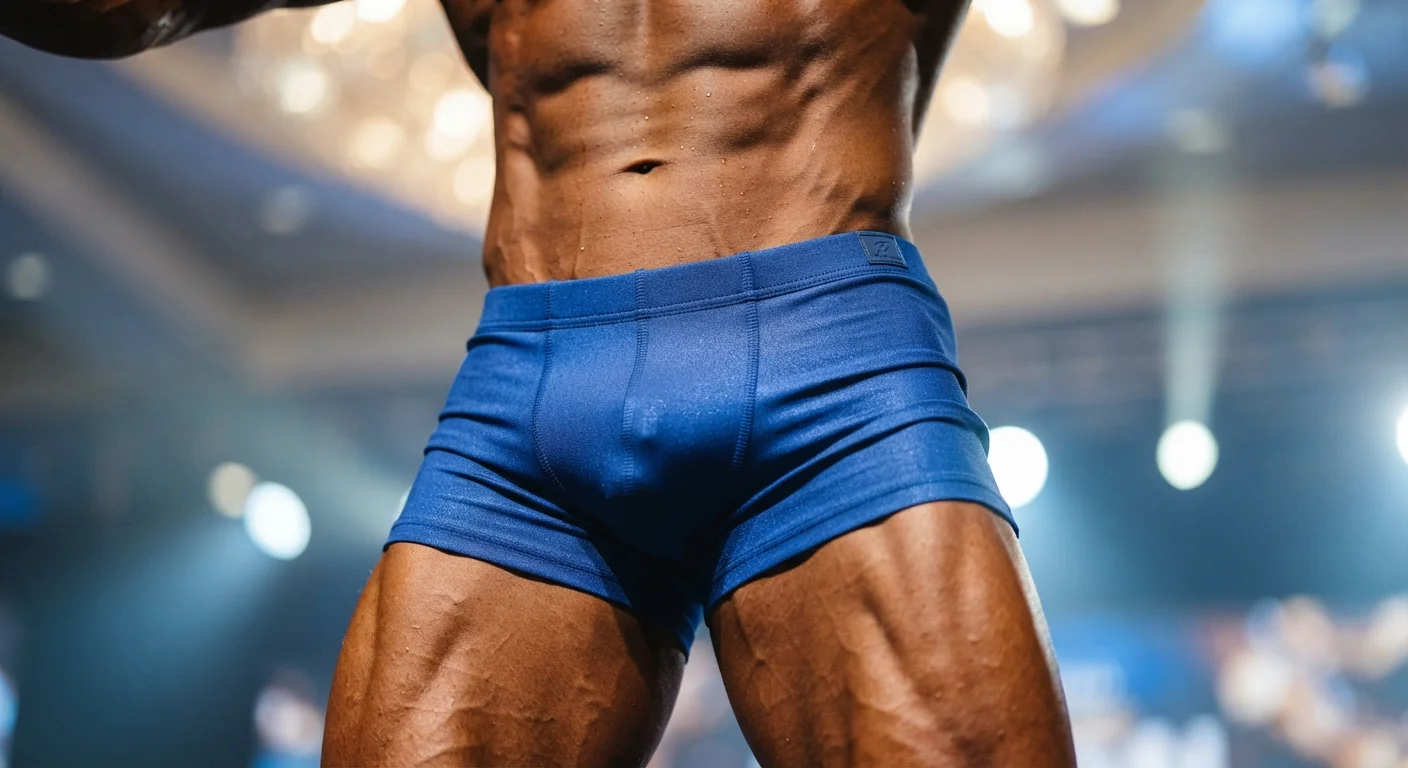
Step into any Physique lineup and you'll spot quarter-length board shorts—loose, hanging past mid-thigh, hiding a good chunk of the leg. Walk over to the Bodybuilding lineup and you'll see skimpy posing trunks that leave every inch of quad and hamstring on full display. That's a direct reflection of what each division's judging criteria rewards.
Why the Shorts Matter More Than You Think
Physique division judging criteria zeroes in on shoulder-to-waist taper, overall symmetry, and a "walked off a magazine cover" presentation. Legs matter less here, so the shorts intentionally cover them. Bodybuilding judging criteria demands the opposite. Judges need to see quad sweep, hamstring detail, glute-ham tie-ins, vascularity. Nothing can hide. That's why the trunks shrink down to almost nothing. Full exposure is functional for scoring.
Mens Physique Posing vs Bodybuilding Posing Routine
The posing style splits just as hard. Mens physique posing looks like a runway walk with a relaxed stance, quarter turns, a confident half-smile, and minimal flexing intensity. A bodybuilding posing routine is a different animal entirely. It includes front lat spread, side chest, most-muscular. Each mandatory pose demands maximum contraction, and competitors often grimace or let out an audible exhale to squeeze every fiber. Peak contraction under stage lighting separates a top-5 placing from a top-15.
If you're someone who freezes up performing for a crowd, Physique's presentation style is far more forgiving than Bodybuilding's raw, intense stage demands.
Core comparison of assessment criteria: How to score muscle mass, drought severity, and line smoothness
Judges don't score on vibes alone. Behind every callout is a structured mental checklist that breaks your physique into three measurable buckets: muscle mass, "dryness"—how lean and vascular you look under the lights—and line flow, which is how smoothly your physique reads from head to toe. Knowing how these get weighted tells you what your body needs to hit before you book a show date.
Muscle Mass: The Foundation Score
Bodybuilder muscle mass requirements track loosely against FFMI, or fat-free mass index. Men at FFMI 22-25 read as "excellent" onstage—dense, mature muscle bellies that fill out a lat spread and make judges' eyes widen. Physique competitors don't chase that ceiling. FFMI 20-22 reads clean and athletic without tipping into mass-monster territory, which costs points under physique division judging criteria, where taper matters more than raw tonnage.
Dryness: Where Body Fat Percentage Talks
Physique competitor body fat percentage separates hard from bodybuilding's numbers. Stepping onstage at 8-12% for men puts you in "competition dry" territory—vascularity visible, striations showing through quad sweep. Physique competitors typically sit at the higher end, 10-12%, since the division rewards a fuller look over paper-thin conditioning. Bodybuilding competitors push toward that 8% floor because bodybuilding judging criteria scores hard cuts, not just leanness.
Line Flow: Subjective Score, Objective Anchors
Line flow judges how smoothly muscle groups transition—delt into arm, quad sweep into knee. Judges anchor this partly to proportion: calves in the 34-38cm range read balanced, while undersized calves cap your line score no matter how dry you are up top.
12-week training timeline
Contest prep is a project with a start date, four checkpoints, and a stage date you can’t move. Before you lock in "12 weeks," do the math backward.
Step 1: Calculate Your Real Timeline
You want to lose 0.5–1% of bodyweight per week. A 70kg competitor drops 0.35–0.7kg per week. If you need to lose 7kg (about 10% of bodyweight), that math gives you 10–20 weeks, not 12. Cram it into 12 and you’re pushing the upper limit every week. That’s where muscle starts going with the fat, and Bodybuilding competitors losing mass pay a bigger price than Physique competitors chasing a tighter waist.
The Four Phases
Weeks 1–4 (Foundation): Mild calorie deficit, 4–6 lifting days, weekly weigh-ins and waist measurements. Aim to hit 85% of your training and diet sessions each week.
Weeks 5–8 (Intensify): Carbs drop gradually. Keep training intensity high to protect muscle. This is where Bodybuilding’s heavier split pays off.
Weeks 9–10 (Prep): Cut carbs further but don’t wreck training quality. Try on your posing trunks or board shorts now, not the week before the show.
Weeks 11–12 (Taper + Peak Week): Drop total volume, keep muscle under tension. On contest morning, eat a protein-and-fat breakfast, then have chocolate or honey 1–2 hours out. Sip glucose water with creatine during warmup. Do slow stretching, not explosive lifts.
Track front-load metrics (sessions completed, diet-compliant days) each week. If you go two weeks below 70–75%, adjust the plan before the plan adjusts you.
Decision Tree: Based on your body data, simply click to determine
A decision tree doesn't care about your feelings on stage lighting. It runs on numbers, and yours are already on that scrap of paper from the self-assessment above. Plug them in, follow the branches, and you'll land on an answer in under a minute.
Start Here: Training Age Score (T)
T ≤ 2 → Stop. Neither division yet. Spend 6 months building base volume before revisiting this tree.
T ≥ 3 → Proceed to Frame Type.
Branch 2: Frame Type
Easy-gain-fat type → Go to Diet Tolerance (D).
Power type → Go to FFMI check.
Balanced type → Go to Diet Tolerance (D).
Branch 3A: Diet Tolerance (Easy-gain-fat / Balanced types)
D ≤ 6 → Physique. Your frame and gut both favor the steady 4–6 g/kg carb range over Bodybuilding's boom-bust swings.
D ≥ 7 → Check body fat percentage. Sitting at 10–12% or lower already → Physique still wins on taper. Sitting above 15% with T≥6 → Bodybuilding , since you've got room to grow mass before a cut matters.
Branch 3B: FFMI Check (Power types)
FFMI 20–22 → Physique. You'll read athletic without extra cutting work.
FFMI 22–25 → Bodybuilding. Your body already has the muscle mass that division is built for.
Run your three numbers through this once.
berunactivewear.com
Every board short and posing trunk on that stage started as a fabric spec sheet somewhere. Berunactivewear is an 8,500 m² OEM/ODM activewear factory in China with 12 production lines and 280 workers. They build exactly that kind of competition-grade gear for sportswear brands and gym chains across North America, Europe, and ANZ.
Their performance fabric must stretch at least 150% in both warp and weft and recover at least 90% after two cycles. That’s the difference between trunks that hold their shape through a most-muscular pose and ones that sag by the third callout. For leggings and fitted competition wear, a common blend is 85% rPET and 15% elastane. Tech packs go to [email protected]; WhatsApp +86-159-0277-8636 gives faster answers on fabric and fit questions before you commit to bulk.
Conclusion
Match your genetics, training age, and diet tolerance to a system that works for you. If you've got the frame and you're still building your foundation, a physique training program with moderate volume and manageable carbs will get you to the stage without burning you out. For those who've spent years accumulating mass and can handle a bodybuilding split with brutal caloric deficits, that route rewards the work already put in.
Run through the self-assessment table one more time before you commit. Then map out your actual 12-week calendar, pick your division, and start training with intention instead of guessing.Understanding training clothing custom wholesale price helps fitness businesses plan larger seasonal orders.