Every year in stockrooms across Melbourne, Sydney, and Perth, a retailer downloads a "2024 Fashion Trends" report, orders based on it, and watches half that inventory sit untouched because the report was written for a Northern Hemisphere calendar where December means coats, not board shorts.
This guide helps you avoid that mistake. Instead of generic style predictions, you get a season-by-season breakdown of actual Australian consumer fashion behavior: what sells, when it sells, and how many weeks before the shift you need to place your orders. We'll map out seasonal buying patterns and retail data alongside a practical action calendar, so whether you're running a boutique in Byron Bay or buying for a multi-store chain, you'll finish with a checklist ready for your next purchase order.
Summer (December–February): Pre-Season Buying Timeline & Key Stocking Strategy
Australian summer buying starts in winter. If you're browsing linesheets in August, you're exactly on time.
The Back-Timed Ordering Calendar
Work backwards from your target shelf date. Aim for full summer stock ready by mid-December.
Aug-Sep : Linesheets drop, order windows open
Sep-Oct : Peak wholesale ordering activewear - this is when serious buyers commit
Oct-Nov : Order cutoff, production begins
Late Nov : Stock ships to store
For independent stores placing smaller DTC-style orders, Cottmark Empire's formula works well. Subtract 3-4 weeks production, 1-2 weeks delivery, and 1 week for photos/content from your launch date. A December 1st launch means your final order deadline sits in early to mid-October. Miss that, and you're selling summer stock in January instead of December.
A good rule of thumb: place core buys 6-8 weeks before your first summer selling week, and list stock 2-4 weeks before peak demand around mid-to-late November.
What to Stock and How Much
Split your seasonal budget like this:
40-50% on fit-sensitive essentials like swimwear, shorts, and sandals. Buy early while sizes are full.
30-40% on summer basics: tees, tanks, linen dresses.
10-20% on trend pieces and colour stories.
Cap any single category, say swimwear, at 20-30% of total seasonal inventory cost. One miscalculated bet should not sink your cash flow.
The Clearance Arbitrage Move
This is where smart Australian retailers quietly win. Source from Northern Hemisphere clearance in February-March, when overseas stores dump resort and summer stock at 50-70% off to make room for their spring. Focus on non-dated, classic styles you can hold for 6-9 months. Reserve 10-20% of your summer budget for these opportunistic buys.
Autumn (March–May): Trans‑Seasonal Bridge & Transitional Layer Planning
Nobody buys a winter coat in 30-degree heat. That's the trap most Australian retailers fall into every March, stocking heavy knits while customers are still in linen. Autumn here isn't winter-lite. It's a bridge, and it needs its own buying logic.
The Temperature Swing You're Buying For
March highs sit around 22-30°C. By May, that drops to 13-20°C. You're dressing for an 8-10°C daily range that shifts week by week. That's why trans-seasonal fashion forecasting in Australia centers on layering systems, not single garments.
What to Stock
Split unit volume like this:
40-50% tops — mix of base layers (150-190 gsm cotton/modal) and mid layers (180-240 gsm merino or cotton knit)
20-25% outerwear — unlined trenches, shackets in 220-280 gsm twill, unstructured blazers
20-25% bottoms — 9-11 oz denim, wool-blend trousers
10-15% accessories — scarves, light beanies
Cap heavy-coated pieces at 30% of your outerwear buy. Keep the rest light-to-mid weight, wearable from 15-22°C.
Ordering Timeline
Wholesale buying activewear for Autumn-Winter typically happens October-December the prior year, 6-9 months out. Retail launch runs February-March. Build in 8-10 weeks before March for photoshoots and store windows.
Reduce Markdown Risk
Plan 30-40% of Autumn styles, especially knitwear and outerwear, to carry into Winter. Stick to neutrals — black, navy, camel, charcoal — over Autumn-specific prints. Target under 20% of trans-seasonal SKUs hitting clearance before June.
Winter (June–August): Cold-Weather Assortment by Climate Zone
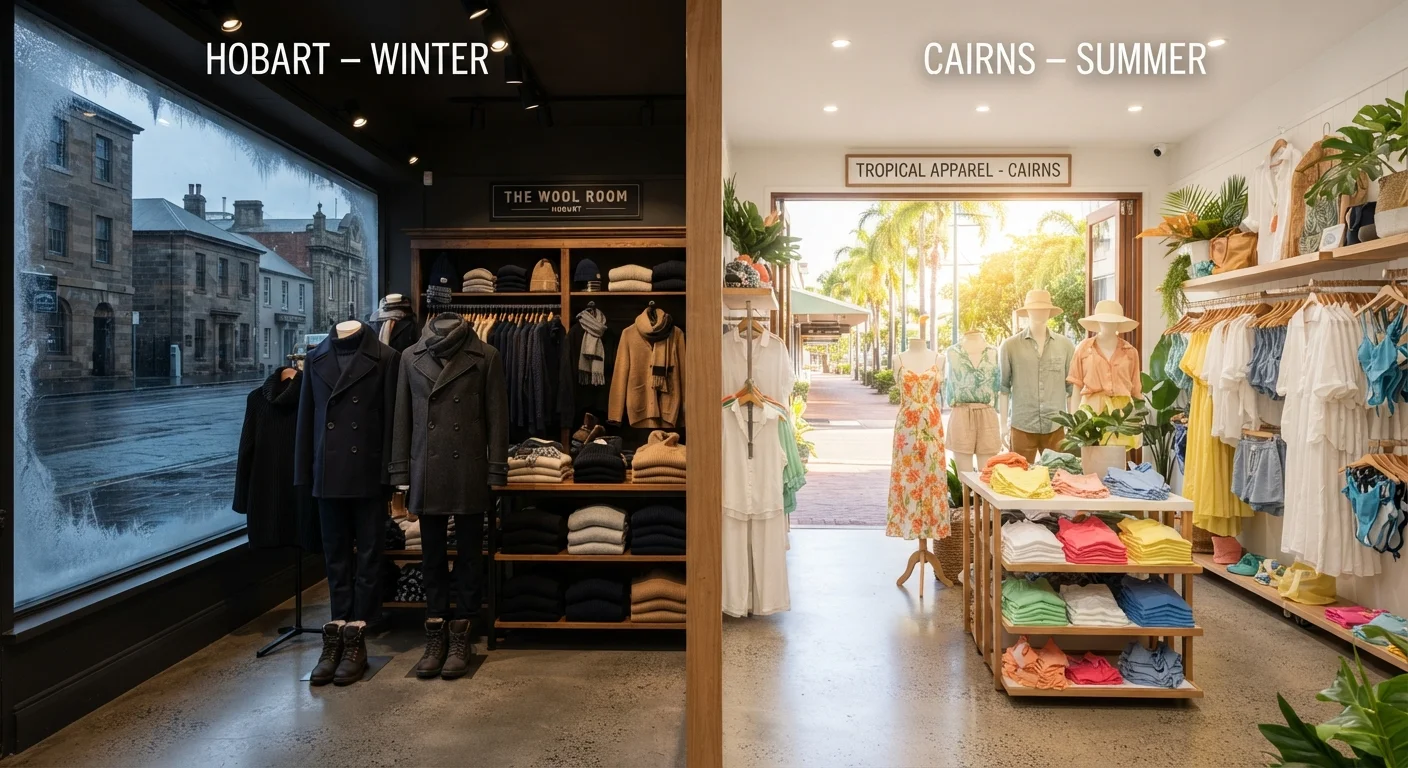
A ten-degree drop in Hobart means something different from a ten-degree drop in Cairns. Yet most Australian retailers buy winter stock as if the whole country shares one climate.
Cluster Stores by Climate
Skip building a unique plan for every store. Group locations by shared climate traits using the USDA Cold Hardiness scale (Zone 1 at -50°F through Zone 11 above 40°F) as your anchor:
Zone 1-3 stores : deepest winter assortment, heavy insulation, cold-extreme basics.
Zone 4-6 stores : core cold-weather essentials, balanced heavy/midweight layers.
Zone 7-9 stores : lighter winter carry, transitional pieces.
Zone 10-11 stores : minimal cold-snap coverage, fashion-led layering.
This stops you shipping the same puffer jacket depth to a Melbourne CBD store and a Brisbane suburban one.
The Weather Sensitivity Numbers
Temperature drags footfall by -0.0104 per degree. Warmer days lower coat sales probability and lift dresses. Rain cuts street-store footfall by 7.4% but lifts mall footfall 5.2%. So street locations need stronger in-store conversion tactics on wet, mild days than enclosed centres do.
What Fills the Rail
Outerwear: coats, parkas, puffers.
Thermals and fleece sets.
Knitwear, hoodies, gloves, hats, scarves, socks.
Performance pieces: windproof shells, weather-resistant footwear.
Small-run bundles for slower-moving cold accessories.
Push winter essentials onto endcaps and freestanding displays with clear price signage. Replenishment-sensitive categories need visibility, not just stock.
Lock Orders Early, Sell Beyond the Cold
Use the same backward-count formula as other seasons. Production plus delivery plus content time equals your deadline, at least 4-6 weeks before launch. Then keep winter demand alive off-peak by targeting indoor sports arenas and building newsletter lists for early-buy customers before the next cold snap.
Spring (September–November): Pre‑Summer Restock & Lightweight Transition
September catches most Australian retailers with the wrong stock on the rail. They've cleared winter coats, but the tees and light jackets that should replace them are still sitting in a activewear supplier's warehouse. Spring buying needs to start in winter, not spring.
The Order Window That Actually Works
Australian activewear wholesale buyers who plan properly place Spring orders 2-3 months out, so your June-August window is when core buys need to happen. Count backwards from a September 15th launch: 3-4 weeks production, 1-2 weeks delivery, and a week for content. That puts your order deadline in early-to-mid August. Miss it, and you're launching lightweight stock into November instead of September.
Buy Deeper, Not Wider
Resist the urge to stock ten different jacket styles. Pick 3-4 proven categories — tees, chinos, light jackets, sandals — and go deep with full size runs and 3-5 colourways. Customers want choice within something you've already validated, not a museum of one-off pieces that never move past size 10.
Three Micro-Peaks, Not One Season
Spring doesn't sell evenly. Split it into distinct demand windows:
Early September: lightweight basics and first transitional layers
October: cardigans and light jackets for cooler mornings
November: carryover basics that stretch into early summer, while heavier transitional stock clears out
Set Your Reorder Points Higher
Spring stockouts hurt more than winter ones because buying momentum builds fast. Raise reorder points 10-30% above winter levels. If a SKU sells 20 units weekly with a 3-week lead time and you want 10 units safety stock, your reorder trigger sits around 70 units.
Track Sell-Through Weekly
Aim for 60-70% full-price sell-through by week 6-8. If a line isn't hitting that, start markdowns at 15-20% before it ages further. Escalate to 30-40% by late November on anything that won't survive into pre-summer.
Pre‑Season Buying Calendar: A Month‑by‑Month Action Checklist for Australian Retailers

Forget the fashion calendar for a second. Retail sales in Australia run on a second calendar entirely — one built around clearance windows, mega sale events, and tax dates. Overlay this onto your seasonal buying plan and you stop guessing when to order.
January — Boxing Day tail still moving stock at 40-70% off. Buy next summer's basics here: swimwear, tees, beach accessories. Lock Australia Day (26th) promo stock for BBQ and outdoor categories. Pull sell-through reports now and cut underperforming lines before February.
February — Traffic is quiet, so use it to renegotiate Australian activewear supplier terms and lock autumn replenishment. Valentine's Day buys (fragrance, jewellery, gift sets) need placing 4-6 weeks out.
March — End-of-summer clearance hits 30-60% off. This is your window to buy next summer's basics at current-season prices. Lock Easter stock 4-5 weeks ahead.
April — Place final winter fashion and footwear orders. Anzac Day (25th) drives outdoor and DIY promos.
May — Click Frenzy Mayhem (mid-May) suits mid-market fashion. Start EOFY assortment planning: appliances, tools, office furniture.
June — EOFY (late May to 30 June) delivers the year's deepest genuine discounts: 15-40% on electronics and appliances. Front-load this category buy.
July — Prime Day and "Christmas in July" test gift price points early.
August — Winter apparel clears at 30-60% off. Buy next-winter basics now. Lock Father's Day stock.
September — Post-Father's Day mid-season sales clear residual winter stock and open cheap spring/summer teaser buys.
October — Halloween buys go in 6-8 weeks out. Click Frenzy Main Event needs online-exclusive fashion and electronics locked with timed price drops.
November — Black Friday alone drove $2.2 billion in online spend in 2024. Front-load Q4 electronics and fashion here.
December — Boxing Day clearance runs 40-70% off previous-season fashion. Plan your buy positions now.
Visual Merchandising & Digital Storefront Alignment for Each Season
Seventy percent of purchase decisions happen inside the store, not before it. That statistic should reshape how Australian retailers think about seasonal merchandising strategy — stock isn't enough. The display has to sell it.
Build the Calendar Before the Season Arrives
Map your seasonal display calendar 6-12 months out. Finalise creative direction 6-8 weeks before launch, then start production 3-4 weeks prior. Refresh windows, entrances, and hero fixtures at least four times a year, aligned to the summer, autumn, winter, and spring shifts already covered in your buying plan.
Prioritise the Zones That Move Product
Not every square metre deserves equal attention. Focus budget and labour on:
Window displays (noticed 70% of the time, influencing entry decisions in nearly 1 in 4 shoppers)
Store entrance and primary product wall
Endcaps and central display tables
A well-executed seasonal reset can lift sales by up to 540% compared to a poorly executed one. Sixteen percent of unplanned purchases trace directly back to display and signage quality.
Go Low-Cost First
Change colour and lighting before buying new fixtures. Swap props, surface finishes, and lighting direction. Modular graphics and slide-in frames let multi-store operators refresh fast without rebuilding.
Sync Digital With Physical
Match digital signage to live promotions. Add scan-to-shop QR codes on physical displays. Keep badges like New and Low Stock consistent across both channels.
berunactivewear.com — Custom Activewear & Private‑Label Manufacturing Partner for Australian Apparel Retailers
Independent stores testing activewear for the first time rarely have the cash flow to commit to 500-unit minimums. That's the gap berunactivewear fills. Based in Wuhan, Berun is a "No MOQ" custom sportswear manufacturer that works directly with Shopify and Amazon sellers, plus smaller Australian retailers who need test batches before scaling.
How the Process Runs
Send your idea: a photo, a competitor product link, or a rough sketch works. A designer is assigned from start to finish.
Lock the details: fabric, cut, printing method, then pricing is negotiated once specs are confirmed.
Approve a fitting sample before bulk production starts.
One Sourcing Rule Worth Following
Order both a stock sample (baseline quality check) and a custom development sample of activewear built to your spec. Measure 5-7 key points across three sizes on each. That single habit catches sizing inconsistencies before you're holding 300 units of leggings that run small.
Contact: [email protected] or WhatsApp +86-159-0277-8636 for quotes with quantity range and deadline attached.
Conclusion
Your buying calendar isn’t broken because trends shifted overnight — it’s broken because you’re still forecasting on a Northern Hemisphere clock. The seasonal buying patterns that work in London or LA will leave your racks full when Sydney is sweating through a 35-degree February.
Lock in your six-week pre