You're probably losing 30-40% of your revenue to returns before a customer even decides if they like your brand. Between sizing headaches, brutal seasonal demand swings, and the fact that shoppers won't buy a bikini without seeing it on someone who looks like them, this niche breaks most generic ecommerce playbooks.
I've dug into what's working for swimwear brands heading into 2026 — specific, swimwear-tested tactics with real numbers behind them. From a fit quiz that slashed one brand's return rate, to weather-triggered campaigns that turn a heatwave into a sales spike, these five strategies are built for the exact problems keeping your conversion rate stuck.For brands scaling online, working with a custom swimwear supplier helps create better-fit products while keeping inventory flexible.
Andie Swim's Fit Quiz: Reduce Returns and Boost Conversions
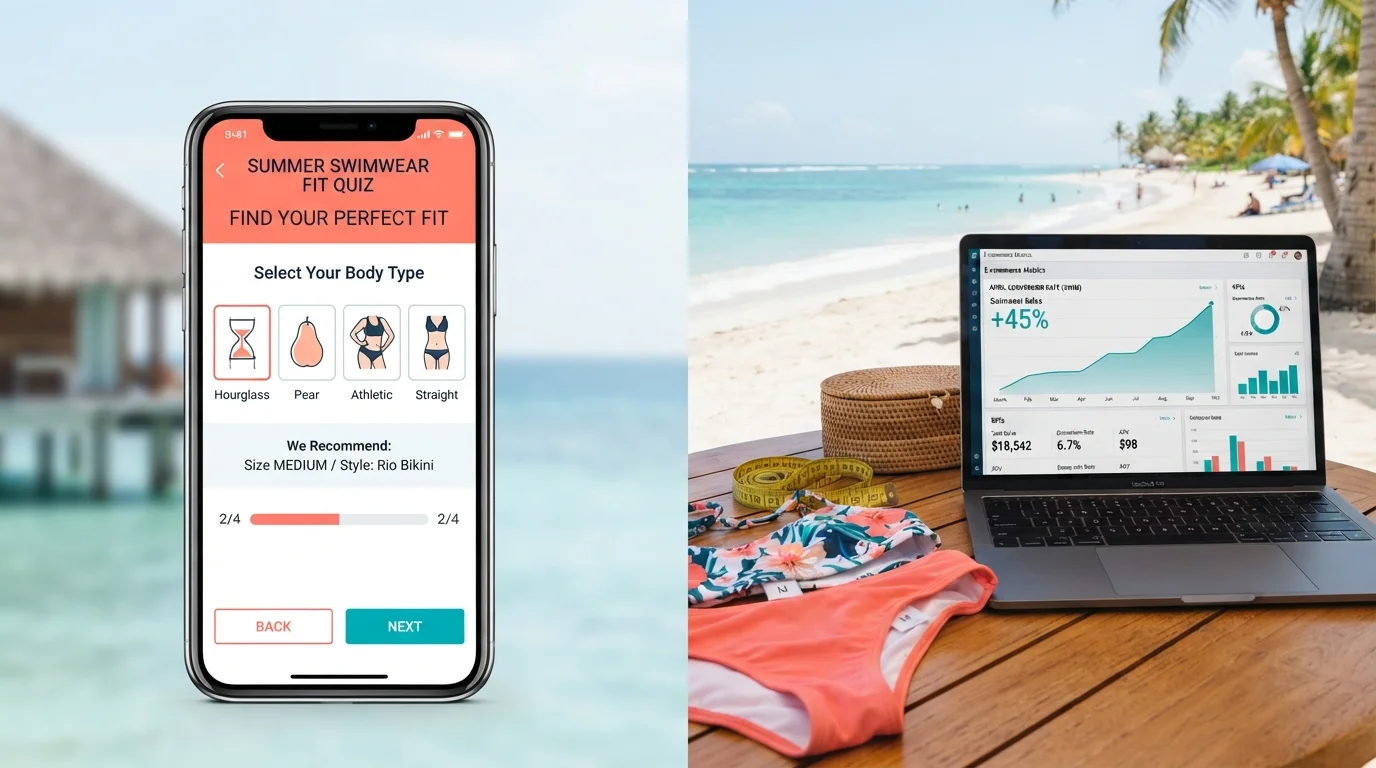
Swimwear brands using style/fit quizzes see a 141% average lift in conversion rates, and quiz-takers convert 5x more often than shoppers who skip it. Andie Swim blew past that benchmark.
The Problem
Bikini shoppers won't buy blind. They need to know how a suit fits their body before they click add to cart. Get it wrong, and you're eating a return. Get it right, and you've earned a customer for life. Andie built their entire funnel around solving this one problem.
The Solution
Andie's Fit Quiz is the primary entry point into their catalog. Twelve core questions dig into body shape, coverage preferences, support needs, and past fit frustrations. The output is personalized size and style recommendations.
They didn't stop there. Reviews on product pages are filterable by body type, so shoppers can see real fit examples from people who look like them. If someone adds multiple sizes of the same item to their cart, a Fit Consultation tooltip pops up before checkout to catch the issue early. Free returns and exchanges mean customers can order a few sizes without hesitation, and try-on behavior is embraced.
The Case (and the Numbers)
The quiz drove a 296% increase in conversions, a 21% increase in AOV on quiz-driven sessions, and a 96x ROI. Automated email revenue grew 55% after quiz data fed into Klaviyo flows, and the quiz results email flow alone has generated over $70K in revenue since June 2022.
Andie also added shoppable UGC video on product pages, which drove a 5% revenue increase, a 4% conversion rate increase, and 4% more transactions, with no drop in AOV. The video reinforces quiz recommendations with real customer proof.
Execution Checklist
Build a fit quiz with 8-12 questions covering body shape, support, coverage, and fit frustrations. Route quiz data into your email platform (Klaviyo works) and trigger a dedicated results flow. Add body-type filters to your review section. Set up a cart-level fit consultation trigger for multi-size orders. Pair quiz outputs with UGC video or interactive galleries on product pages.
Common Mistake
Treating the quiz as a standalone tool instead of connecting it to email segmentation and PDP content. The compounding effect of quiz, email, and UGC drives Andie's numbers.
berunactivewear.com
Berunactivewear ’s Micro-Batch Model: How to Cut Seasonal Inventory Risk
Ordering swimwear inventory is a bet. Guess too low on bikini styles before summer, and you’re out of stock during your only real selling window. Guess too high, and you’re sitting on markdown-bound inventory come September. That’s the single biggest structural problem in swimwear inventory management. Most independent brands try to solve it by guessing harder next season instead of fixing the process.
The Problem
Swimwear brands commit to full production runs 4-6 months before peak season. They lock in quantities based on last year’s sell-through data, which may not reflect this year’s trends, TikTok virality, or shifting sizing feedback. Get the mix wrong, and you’re either restocking too late or discounting too early.
The Solution
Berun Active Wear uses a validate-then-scale model. The OEM/ODM Swimwear manufacturer runs an 8,500 m² facility with 280 workers across 12 production lines since 2017, and the model is built for exactly this risk. Brands start with a stock sample to check baseline quality, then move to a custom development swimwear sample built from their own tech pack. From there, a 10-30 person wear test scores fit and comfort, including waistband slip, sheerness, and friction. Only styles hitting 80/100 or higher move to bulk. Measurement tolerance stays tight, within ±0.5-1cm across 5-7 key points across 3 sizes tested. This directly reduces the fit-based returns that crush swimwear margins.
For volume ramping, Berun recommends starting with micro-batch runs of 1-50 units to validate a pattern. Then commit to 200-500 pieces per colorway once sell-through proves itself. On the pricing side, brand activewear-style sets run MOQ 50-100 pieces per style/color of wholesale activewear at an estimated FOB price of $15-30 per set. That’s a fraction of typical US-based production costs of $10-18+ per piece.
Execution Checklist
Request a stock sample before committing to any custom development of swimwear. Build a formal wear-test scorecard with a target of 80/100 minimum before scaling. Start new styles at 1-50 unit micro-batches, not full seasonal runs. Lock measurement tolerance specs of ±0.5-1cm into every tech pack.
Common Mistake
Skipping the wear-test stage to hit a launch date is a common mistake. Brands that fast-track straight to bulk production without scored fit testing are the ones eating the highest return rates come August.
Frankies Bikinis' Welcome Email Sequence: A 4-Step Blueprint
New subscribers convert at their highest rate in the first 10 days, then interest drops off a cliff. Miss that window with a generic "thanks for signing up" email, and you've burned your best shot at a first purchase. Frankies Bikinis built a 4-email welcome flow to capture that window, and it's one of the tightest swimwear email marketing sequences I've broken down.
The Problem
Most swimwear brands send one welcome email with a discount code and call it done. That's leaving money on the table. A single email can't handle brand education, fit confidence, and urgency all at once, and fit confidence is what swimwear shoppers need before they'll buy.
The Solution
Frankies runs a 4-step sequence, each email with a distinct job:
Delivery & Welcome (0-5 minutes after signup) – Confirms the opt-in and delivers a 10-15% off code with a 5-7 day expiry. Subject line pattern: "Your 15% off code is inside (plus what to shop first)." Includes a hero editorial shot and links to New Arrivals and Bestsellers.
Brand Story & Social Proof (24-72 hours later) – Founder story, body-positive brand positioning, review snippets ("4.8/5 across thousands of reviews"), and a UGC prompt tagging the brand's Instagram.
Education / Style Guide (Day 5-7) – Triangle vs. underwire, cheeky vs. moderate coverage, plus a link to a fit quiz or size chart. This email does the heavy lifting on swimwear conversion rate optimization by killing size hesitation before it becomes a return.
Soft Pitch / Offer Push (Day 7-10) – Reminds subscribers the code is expiring, handles objections (free shipping, 30-day returns), and spotlights 3-4 top sellers.
The Case (and the Numbers)
This structure isn't guesswork. Benchmarks for this exact sequence type show Email 1 hitting 50%+ open rates and 10%+ click rates. By Email 4, opens settle to 25-30% with 4-7% clicks and roughly 2% direct order conversion. Aggregated across all four emails, well-run fashion welcome flows see 35-45% average open rates, 6-10% click rates, and a 3-8% first-order conversion rate from new subscribers – a swimwear customer retention lever most brands never activate.
Execution Checklist
Build the flow in Klaviyo with fixed delays: 0 minutes, 24-72 hours, Day 5-7, Day 7-10. Lock the discount at 10-15%, expiring in 5-7 days. Put fit/sizing education in email 3, not email 1. Reintroduce the code with urgency language in email 4.
Common Mistake
Sending all four emails with the same "shop now" energy. Email 2 should build trust. Brands that hard-sell too early see engagement drop before the offer email lands.
Neolo's Weather-Triggered Campaigns: Capitalize on Seasonal Demand
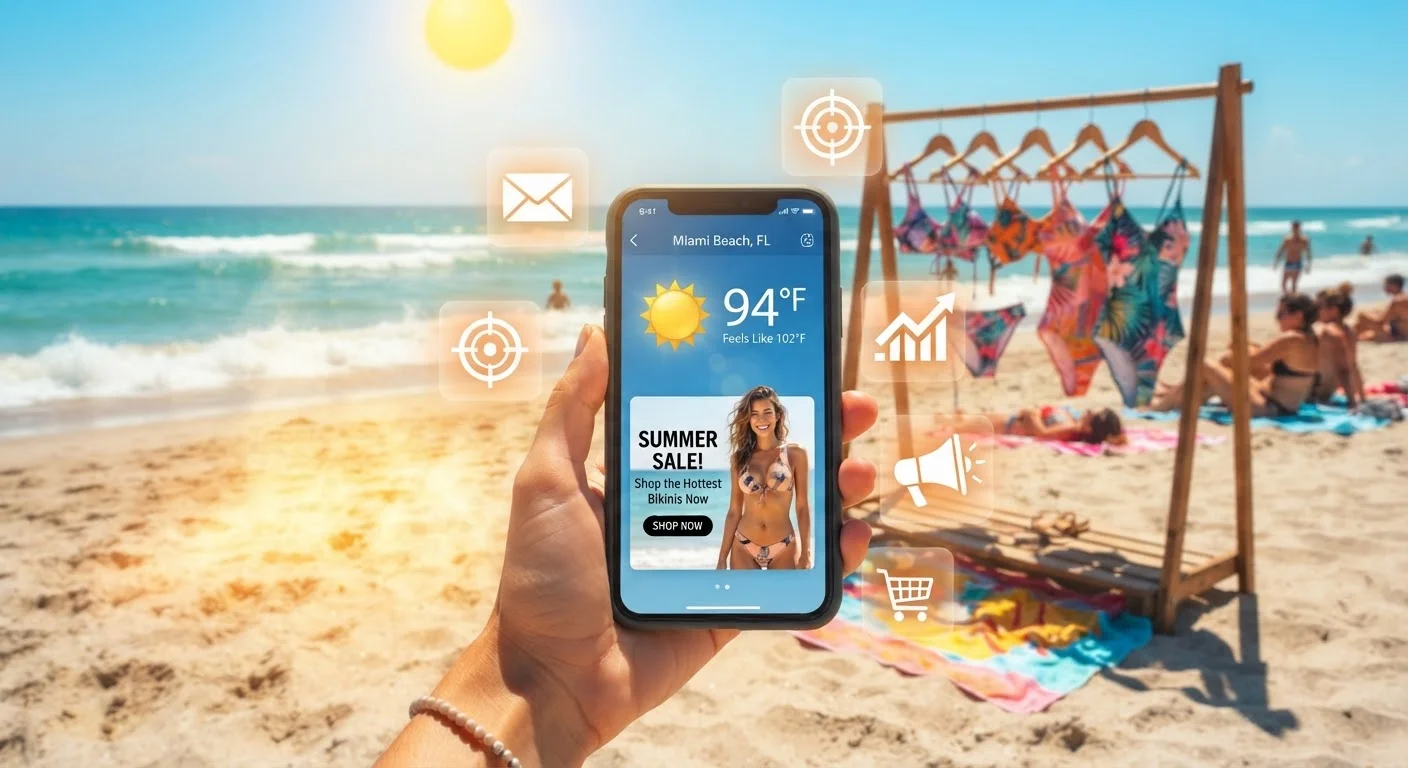
A single heatwave can do more for your bikini sales than a month of scheduled promotions. Neolo's approach ties ad spend to real-time weather data instead of a static calendar, and the performance gap between the two is massive.
The Problem
Most swimwear brands run seasonal promotions on a fixed schedule: launch in March, push through July, discount in August. But demand doesn't follow a calendar. It follows temperature. A brand running "summer sale" ads in a cold, rainy week is burning budget on shoppers who aren't thinking about bikinis at all.
The Solution
Neolo's model connects live weather APIs (Visual Crossing and similar) to ad platforms like Google Ads and Meta, triggering campaigns based on actual conditions rather than dates. For swimwear, the most effective triggers are:
Temperature above 28-30°C (82-86°F) : enable swimwear campaigns, increase bids 20-40% on high-margin styles
Clear skies + UV index above 7 : activate outdoor/beach-lifestyle creative and boost bids on cover-ups, sun-protective fabrics
Weekend afternoons correlated with outdoor activity : stack bid increases during peak leisure windows
The setup starts with 12-24 months of transaction data cross-referenced against historical weather to find your brand's actual demand surge conditions, not generic seasonal assumptions.
The Case (and the Numbers)
WeatherAds case studies show up to 67% lower CPC and 89% higher engagement when campaigns align with real-time conditions compared to fixed schedules. Initial pilots run 2-4 weeks , testing a weather-triggered campaign against a calendar-based control to quantify the lift before scaling spend.
Execution Checklist
Pull 6-12 months of conversion data by geography and weather condition. Tag your catalog by weather sensitivity (bikinis = high, cover-ups = medium). Set a rule like: "Temp > 28°C, clear sky in [city] → enable campaign, +25% bids, swap creative to 'Perfect Beach Day.'" Connect via API for hourly evaluation. Run a 2-4 week pilot in 1-3 geographies before rolling out nationally.
Common Mistake
Setting triggers too broad. A single national rule ignores regional climate differences. A Miami heatwave and a Seattle heatwave don't mean the same thing for swimwear demand. Segment by geography first.
YongTing's Abandoned Cart Recovery: Recover Lost Revenue
Seventy percent. That's how many swimwear shoppers add a bikini to their cart and then just disappear. Baymard and Contentsquare put the global average cart abandonment rate at 70.19-70.22% across dozens of studies, and mobile swimwear shoppers (the ones scrolling Instagram and impulse-clicking a bathing suit) abandon at 76-80%+. Globally, that's up to $4.6 trillion in merchandise sitting in abandoned carts. Most independent swimwear brands treat this as a lost cause. YongTing's system is built to recover that revenue, targeting abandoned carts as the single biggest swimwear conversion rate optimization opportunity most brands never touch.
The Problem
Stores with no recovery system in place recover only 0-2% of that lost revenue organically. Zero effort, near-zero return. Meanwhile, the top reason shoppers bail (cited by 48-55%) is unexpected costs at checkout, including shipping, taxes, and fees. Add forced account creation and clunky checkout flows, and you've got a leaky funnel that no amount of ad spend can fix.
The Solution
YongTing's approach layers automated email, SMS, and behavioral segmentation instead of relying on a single generic email. A multi-step sequence that sends the first touch within 4 hours captures the highest-value recovery window. 45% of all recoveries happen in the first 2 hours after abandonment. Miss that window, and recovery odds drop fast.
The messaging itself targets the actual abandonment reason. Shipping-cost objections get a discount code, size uncertainty gets a link back to a fit guide, low-stock items trigger urgency copy. Segmenting by device matters too. Mobile abandonment sits near 80% versus 66% on desktop, so mobile-specific SMS flows close a gap email alone can't.
The Case (and the Numbers)
Basic single-email setups recover 5-10% of lost revenue. Optimized 3-email sequences push that to 10-15%. Advanced automation, combining email, SMS, and value-based sorting, reaches 15-25%+, the band YongTing's system is built for. On a $100K/month abandoned-cart value, that's the difference between $10K and $25K reclaimed monthly. Abandoned cart emails alone average a 40-50.5% open rate, more than double standard marketing emails, and generate $3.65-$18.90 per email sent. Recovered carts often carry higher AOV too. WooCommerce data across 6,000+ stores shows recovered carts averaging $174, beating both placed ($117) and abandoned ($141) cart values.
Execution Checklist
Trigger email 1 within 4 hours. Build a 3-email sequence over 48-72 hours. Layer SMS for mobile abandoners. Segment messaging by abandonment reason: cost, sizing, stock. Track recovery rate monthly against the 10-25% benchmark.
Common Mistake
Sending one email and stopping. Only 16% of retailers send a third recovery touch. That's exactly why most leave 10+ percentage points of recoverable revenue on the table.
Conclusion
You need the right five marketing tactics for 2026, executed well.
Fix your fit quiz and you'll cut returns before they happen. Trigger campaigns off weather data and you'll catch demand spikes competitors miss by days. Rebuild your welcome sequence and abandoned cart flow, and you'll turn browsers into buyers without spending another dollar on ads. That's the pattern across every strategy here — swimwear customer retention and conversion rate optimization come from solving the specific problems this category creates: sizing anxiety, seasonal urgency, and razor-thin attention spans.
Pick one strategy. Implement it this week, track the numbers for 30 days, then layer in the next.
The brands winning in 2026 will be the ones who fixed the leaks first.Reliable swimwear custom wholesale price planning also helps brands protect margins while expanding seasonal collections.